Getting the transcript
Reading the captions from YouTube. A video nobody has opened here before takes 10 to 30 seconds; this page fills in on its own.
Getting the transcript
Reading the captions from YouTube. A video nobody has opened here before takes 10 to 30 seconds; this page fills in on its own.
Arda HK · @hoke20
Words
14,937
Runtime
1:18:47
Speaking pace
190wpm
Reading time
62min
190 words per minute, between the 181 median and the 201 75th percentile of 349 measured videos. That distribution comes from the 349-video hook study.
Opening (first 30 seconds)
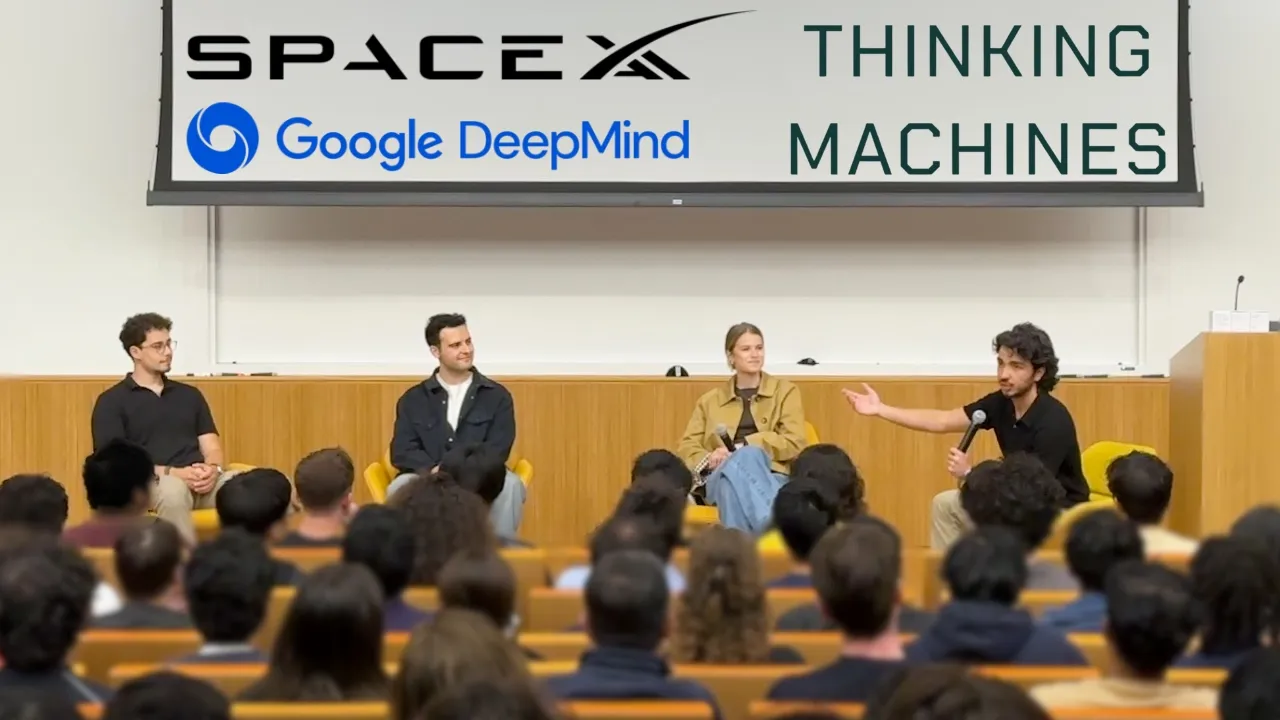
Hi everyone. Thank you for coming to our event on a Friday night and obviously uh thank you to our panelists for coming to our event on a Friday night. Let's get another round of applause for our panelists please. [applause] We have Adam who's a research engineer at Google Deepline. He's going to be talking and all of our alumni. All of our panelists are Berkeley alumni. Uh Adam is a research engineer at Google Deepmind Oliver who worked at um Curser and now SpaceX AI um and Riley who's working at Thinking Machines
95 words, the words spoken in the first 30 seconds at 190 words per minute.
Free, no signup. See how the first 30 seconds hold attention, with rewrites.
Sentence shape
| Measure | This transcript |
|---|---|
| Sentences | 752 |
| Average words per sentence | 19.9 |
| Longest sentence | 225 words |
| Questions asked | 65 |
| Sentences containing a number | 24 |
Most used terms
Filler phrases
1,276 in total: like 519 · um 403 · uh 142 · you know 88 · kind of 42 · actually 32 · sort of 23 · right? 10 · I mean 9 · basically 7 · literally 1.
A literal whole-word count of the same phrase list the Prepublish browser extension uses, so a phrase inside another word is not counted and a phrase used in its ordinary sense still is. It is a count and not a judgement.
Run the check on the words above: where attention is likely to drop, with a rewrite for each weak line. The free check shows the scores and the one issue costing the most.
What this transcript is
Every word below is the caption track YouTube publishes for this video, pulled from the video itself and reproduced unchanged. It is not Prepublish's writing, not a summary, and not a re-transcription: it is the video's own published captions. English captions, generated automatically by YouTube, in the video’s original language. Source: the video on YouTube. A channel that would rather this page did not exist can ask for its removal through the contact page, and it is removed.
No Script X-ray for this video: YouTube shows a Most replayed graph only once a video has enough views.
Hi everyone. Thank you for coming to our event on a Friday night and obviously uh thank you to our panelists for coming to our event on a Friday night. Let's get another round of applause for our panelists please. [applause] We have Adam who's a research engineer at Google Deepline. He's going to be talking and all of our alumni. All of our panelists are Berkeley alumni. Uh Adam is a research engineer at Google Deepmind Oliver who worked at um Curser and now SpaceX AI um and Riley who's working at Thinking Machines as a um engineer a software engineer.
Before um we start with our questions, how this is going to be structured is the first half an hour I have my questions to get warmed up. The second half an hour or so it's going to be audience Q&A. So while you're listening to our panelists, please uh think about the questions that you can ask. And one disclaimer is that this panel is focused on career internships, their journey um and how uh they got to places and vices etc. not focused on um what specifically they're doing or like the secrets or what's the next big thing etc.
Please keep that in mind. Um, with that, Riley, can you please uh walk us through your journey at Berkeley, what you've done, um, uh, what you did after graduation, and what you're doing now? >> Yeah. Um, hi guys, I'm Riley. Um, so my journey from Berkeley to now, um, I came to Berkeley in 2016. Um, I came in from the, I guess, arts and sciences program. Um, and I knew when I got here that I wanted to study computer science.
I had done some coding in high school. Um, I really loved it. I think I partially liked it because of the technology, but also because of all of the uh free food at companies that I had visited when I was in high school from Google and different programs that I had done. Um, and I guess when I was on campus, I was involved with a few different clubs. Um, one of which actually I know Arta through, which is Excel Scholars. um and some of the people here too.
Um and I quickly um I guess learned from a few internships that what I thought I really wanted wasn't actually what I I did want. I did a few internships at larger tech companies. Um and what I realized through those uh opportunities was that I actually wanted to work at um a few companies that were a little bit smaller. Um I wanted to work in environments um where there there was just like a lot more work to done work to do um because just by the nature of how small the teams were.
Um and so when I was a a junior at Berkeley I actually um took a semester off to work at a um ML radiology startup in PaloAlto. Um the team was like I think at the time eight people um and we were building FDA approved uh CT MRI models um to use in different healthcare institutions. Um I loved it and so then I went there postgrad. Um turned out to be quite a lemon. Um the company went to zero after I was there for like a year and a half.
Um but I learned so many amazing lessons and think it was absolutely the best decision for my career at the time. um worked at a few other startups here and there. Um mostly consider myself to be a full stack product engineer. I really love building products and seeing customers actually use them and see that moment of delight. Um and was working at a company called Hex working on their um AI data products and uh just was really interested in getting a little bit closer to research.
So left that company after almost four years and joined Thinking Machines Lab in January. Um, and what I do now, I I work mostly on internal tooling. So I work sort of in like a embedded fashion with our compute team, our pre-training and post- training teams and build all the internal tools that they need to uh do their job better. Um, so [clears throat] yeah, I don't know if if you wanted that long of an answer, but you got it. >> That was amazing.
We want to we want to hear details about exactly your journey. Now Oliver, um, your journey is also very exciting. uh you started warsel joined curser and now that whole thing firstly obviously one of the rocket ships can you tell us about what you did at Berkeley and now you were also involved in Khax um and all your path your journey to where you're at now >> yeah of course also this is such a beautiful building I wish we had this when we were undergrads like going around here we were saying like Autumn was like this looks like an Apple Park kind of building so this is beautiful I'd say like make full use of it Um, but yeah, I can start with a quick intro.
So, my name is Oliver. Uh, I originally grew up in Europe, so my parents are from Spain. I came to Berkeley back in 2021. I studied computer science in the college of letters and science. Uh, when I got to Berkeley, I didn't know exactly what I wanted to do back when I was in high school. Um, a big thing I did was hackathons. I love going to hackathons. I love that kind of atmosphere. people are always building, super ambitious, curious and uh you can do things that you didn't think you were pos like you were capable of doing and so I really like that environment and so naturally when I got to Berkeley I got involved in Cal Hacks Berkeley's hackathon uh I organized it for a few semesters and met incredible people through it and uh still are very close to the organizers to this day um we do a lot of like alumni events and it was a great time and so uh yeah on the side of like hackathons Cal hacks I did a few internships when I was at Berkeley.
Uh my sophomore and junior year. So my sophomore year I worked at Amazon. I was a software engineering intern. Uh then at Apple I did a very similar role as a software engineering intern. I kind of had the same experience as Riley working at big tech companies. You learn a lot about like how companies work at scale, like best engineering practices, but your scope is slightly smaller than it would be like at a startup. um it's not as fast-paced.
Uh you're not kind of like pushed as hard. So for me, I knew I wanted to try something different. So as Arda alluded to, uh no spoilers. [laughter] Uh I started working at Verscell. You might have heard of Versell. Um does a lot of hosting. We have like they had Vzero, which is their AI for websites. Um now a lot of like um new frameworks are coming out for building with agents that Verscell is working on. Uh awesome stuff.
So like I met a few of the engineering um leaders on that team before I started there full-time uh when I was in undergrad. I was really drawn to the vision and so I worked there for about a year and a half. I started off in a security team doing software engineering. I really enjoy the problem set that they had just like millions of websites uh that have billions of visitors every single day and just like the scale of problems that they have which is fascinating.
Uh but I stayed in that team for a few months. I then transitioned to the Verscell agent team. They build this Verscell agent that's kind of like an omni agent. It does a lot of things from like code review to um debugging why your Nex.js deployments are failing uh to like customer support. This Verscell agent does kind of everything. And so that was like a year and a half at Verscell. And then six months ago uh I joined Cursor working as a software engineer mostly on back-end systems.
And as you can imagine, it's been quite the ride. We joined SpaceX. It was official uh just a few weeks ago. Um and so, and so now we're part of like a much larger organization with XAI, SpaceX, what previously was Twitter, and of course, Cursor. And so, yeah, that's a bit about me. I know I probably rambled for a little too long, so uh I'll pass it on to Adam. >> Don't worry. For the first first question, you can go along.
We want to get the context. Now, um, you also are really good at picking some really cool rocket ship companies to work on. Can you walk us through the setup you've done at Berkeley where how it made you um, how it made you ready for what comes after Berkeley? Like, can you walk us through your journey, your journey as well? >> Of course. Of course. Well, firstly, uh, I think Oliver was a little generous with his interpretation of what I said here.
I I was saying how jealous I was about this building. Uh you guys, yeah, it's a special place to be. We were saying we had nothing like this when we were at Berkeley. Um yeah, well, thank you for the introduction. Um and it's gonna be hard to follow those two, but um I guess I I'll do the the Oliver route. So I I I was born actually in the US. I lived in Egypt for 10 years. Uh and then I moved here sort of middle school, elementary school time.
Um and moved to the Bay Area for college to come to Berkeley. And I guess my first year at Berkeley was a co year. Um and so it's kind of a unique kind of a good kind of a bad spot to time to join and and start college. Um the positive part of that which was sort of the kernel of my experience um was the kind of like freedom and creativity and expression and and optionality that it gave me. So it gave me a ton of time to explore a bunch of different things.
So uh freshman year for about a year and a half I sort of interned with this print uh company called Formlabs which is called which is like basically resin 3D printing. Um, so I interned with them for about a year and a half uh for like freshman year up until halfway through sophomore year. Um, which was easier to do during COVID because of all the time. Um, and then I started uh an internship at Scale AI about like end of sophomore year and then I worked there for about a year and a half.
Um, and that was that was an experience. I had like good and bad learnings from that. But um I think that was my first real taste of sort of a extremely volatile startup environment with all the advantages of speed but all the disadvantages of trying to figure out what exactly are we building and and you know how quickly the market moves. Um and then I left scale uh sort of beginning of my senior year of college to join a startup called Harvey.
And at the time, Harvey was like this very small startup um and had all the advantages that scale had of speed, but all the disadvantages of confusion and and and and you know, trying to build something from scratch is very hard. Um and so I stayed at scale at Harvey, which is kind of a AI for law startup. Um for about almost two years um and around that time, that was sort of like my first year postgrad is kind of when those two years ended.
Um, and then I I went to DeepMind. Um, and and sort of, you know, similar takeh takeaways as as uh Oliver and Riley where you know these bigger companies they have a lot of basically every decision that you guys have ahead of you has a lot of like good and bad in it and it's sort of up to you to decide what you want from it. And so you know with bigger corporations you get this like broad understanding of like okay this is how things work like things that function and create money and are like have you know incredible people allocated towards them.
This is how they function and the disadvantages are often bureaucracy friction scope. Um and then on the other hand you know the early startups you have all this ownership all this upside. You know the startup can do really well or can do really poorly. Um you learn a lot regardless but um it's sort of up to you where on that spectrum you want to lie. Um, and I guess we'll probably get to sort of what our, you know, pointed views on what you guys what we think you guys should be doing uh later, but I guess the the early part of that from from my experience is um you can't really go wrong with a place that you pick and a path that you take.
Um, as long as you know what you're getting in into what you want to get out of it. Um, and that sort of was consistent across, you know, bigger company, smaller company, successful startup, slightly less successful startup, uh, and so on and so forth. But yeah, yeah, I guess >> before I get to my next question for you, Adam, um feel free to make this conversational if you hear any other panelists like touch on a point.
I have my question, but please uh hop on back at it. Um but my next question is uh going back again when you were looking for an internship or a new grad role. Um what's one thing that you think that made you stand out that uh made you that was your differentiator? um and that made other companies want to hire you. I know that you have a really cool project that you've done in your first year. Um can you tell tell us more about that? >> Yeah, of course.
It's actually a funny funny thing like I think my answer for that question is like it's a single sentence and it's basically um over COVID I got I was really bored had a lot of time on my hands. My parents were very strict about, you know, leaving house, leaving the house uh for, you know, medical risk reasons and such. And so I had all this time on my hands. So I I started getting into building my own like robotic quadriped.
And I spent like maybe a few months like 3D printing parts for it and like buying servos. And basically at the end of a couple months had a little robot dog that walked around. And this was like a cool project. It was fun. I learned a lot. I built it myself. At the end of the day, it wasn't like fundamentally unique. Like there were other projects like it online. there are more popular versions of it. Um, but I think it was a really clear demonstration that you know, one I have like true passion for building the technology.
Two, I translated that passion into something real, something physical, something that, you know, involved me staying up late or putting time and effort towards it. And the reason I say it's funny is because, you know, I can trace every single interview I've ever had. And like that was probably the selling point in the interview, to be honest. Um, I remember the internship I got for Form Labs freshman year was I mean like 3D printer company, 3D printer dog, like pretty straightforward.
Um, scale I remember it was it was like a PhD internship like I weasled my way and I didn't even know it was a PhD internship and the only way I didn't get kicked out of it was because they latched onto that project. Like the person interview me who interviewed me did like high school robotics and thought it was cool and interesting. Um, my interview for Harvey also same thing like the guy was like oh this is pretty cool.
Um, and so like fundamentally like a month's worth of my time has translated pretty much to my entire career arc. And so I guess to answer your question, I would say each and every one of you has something that like stimulates you, that makes you feel excited, that makes you feel passionate. Um, you should just like kindle that and like maybe spend like a few weeks, especially with like codeex and whatever leverage you have with you nowadays.
Um, translate it into something real. And that's like a very falsifiable falsifiable demonstration that I promise you most people aren't doing. Um, and also probably helps to help you figure out what excites you in the first place, right? Um, so yeah, that that would be my that would be my answer. >> I want to double click on this. I also realized that I haven't introduced myself, but my name is Arda and I'm one of the lead mentors at Hello World mentorship program.
And one question that we get a lot is like what makes you stand out and I tell the exact uh same thing Adam is saying which is side projects although maybe conceptually um building a walking robot was like let's say I know it it requires a lot of work but it's not like you're not innovating something new you're like doing something but that shows the um employers that you you go the extra mile you care about something you're actually really passionate about it in hardware specifically This was making a robot dog, but is software making a different website, different product.
Um, and actually like making it work and showing it. I know Adam, you have like videos on YouTube where like you actually show it, not just like work on it for a day and then putting to aside and then we're talking about it. Those are some of the things that really differentiates you. Another example is I just talked with a Boeing engineer um who was starting at Boeing as a new grad and he was like I'm pretty sure my only selling point was I had a flight simulator at home that I hand built.
Um this is like another example of that. But Oliver, how about how about you? What do you think that um made you stand out when you looking for um internships or your new grad position? >> Yeah, if you're gonna double click, I'll triple click on this. [laughter] And uh I don't want to make this all about like promoting hackathons, but I love hackathons. So I'm gonna go back to that point constantly, but yeah, when I was in Cal Hacks, I went to a lot of other hackathons as well, like you know, tree hacks at Stanford, um hackathons like all over the country.
And when I went to these hackathons, I found myself using the same technologies. I would use Nex.js, I would deploy on Verscell. And so by the time I graduated, I had so much experience working with Versell products that when I had the interview with Verscell, they were like, "Oh, can you build us an XJS app?" I was like, "Yeah, of course I can." Like I've done this so many times at hackathons. And so doing a lot of side projects, even though like I never did anything as cool as a like robotics.
Um doing side projects and going to hackathons in a way is kind of like a forcing function as well. Being in that timeressured environment, working with such ambitious people, um trying out new ideas. I would highly highly recommend that and yeah just trying a lot of different products because uh then when I joined Verscell um a product came out called cursor I started using it I was a top 10 user of cursor at Verscell at my previous company and so um yeah that gave me a lot of experience using cursor's product uh sharing feedback just like understanding how it works so by the time like I had my cursor interview I was like yeah so I have these thoughts here um this this and this and so I'd say just like try a lot of different things uh you never know like where you're going to end up.
Like looking back, it sounds obvious, but you never know what's going to come out of it. So just try a lot of things. Go to hackathons. We're actually sponsoring uh SpaceX AAI sponsoring Cal Hacks this fall. So please make sure to go. Um we'll be there. I'll be on the sponsor booth. So um if you're there, please uh come say hi. But uh I'll pass it on to Riley. >> Before that, where do you think people can find out about more hackathons that are outside?
By the way, call hacks applications are open and earlier you apply the better it is. Um, and where do you think they can find more hackathons? Last the big ones like call hacks or uh tree hacks. >> Yeah, exactly. And I don't want to promote hackathons too much. I know this is not all about hackathons, but yeah, MLH, um, if you've heard about it, has a website with tons of hackathons. You can go go there and see all the major ones happening.
I spend a lot of time on Twitter, so I'd say Twitter is a great way to learn what's happening, not just like hackathons, but also like all kinds of tech events. We're very close to San Francisco. I think that's a great thing about Berkeley. I would say like definitely uh go over the bridge, see what's happening on that side of the bay. There's always tons of events in uh San Francisco as well. So, I'd say Twitter and then MLH uh would be the best places to find it.
Two more resources, devpost.com that will they will also have like hackathons and another one is uh luma the app that you use to RSVP for this event. Sometimes they will also like make uh all hackathons available to everyone and now that part three there is no excuse to not go to SF and join to these hackathons. There's one every single day and lots of companies hire like there's a reason why you're going to be like car hacks with your company, right? because >> oh yeah, we just released a new grad role.
So if there's any seniors in the crowd, uh please apply. We can share the link afterwards as well. Sorry for all the promotion. [laughter] Um but yeah, please apply. We'll share the link afterwards. Um and yeah, very lucky to have free BART. I wish we had that when we were undergrads. So you have no excuse. If it's free to go over to uh San Francisco, then you should make full use of it. >> New building, free bars. They really waited for you all to make these things.
But how about you Riley? I'm still bitter that I spent all my time in Soda Hall. Um, all right. I guess I guess first of all, I would totally plus one the hackathon. I actually hosted a hackathon last night with three other co-workers. Um, it was a fine-tuning hackathon using Tinker, which is our fine-tuning platform at Thinking Machines. So, that was fully a recruitment event as well. We definitely look at how people are using um, Tinker as a product as well.
Um, how I like honestly kind of forget the question, but I think it was like how did you >> stand up? Okay, I have two answers here. They're a little different, so I'm not going to quadruple click here. Um, so they made it sound really easy. It was not and it wasn't easy for them. They clearly put in a ton of work, but I have a little bit of a different um side quest that I had. I was relentless as a I as a freshman here, I was like, I want an internship after freshman year.
Like, I'm going to get an internship. I grew up in South Bay and I would when I would drive home to see my family on weekends or during holidays, I would literally write down every [clears throat] single billboard of for any software company on the freeway home. If you drive like through the city, there's so many billboards of different companies. I created an Excel spreadsheet and applied to every single company that I could think of.
I didn't even know what a lot of these companies did, but I just was like, I'm gonna I'm just gonna spread wide and figure out like which which companies are interested in Berkeley interns. I do think there is a like point here around quantity versus quality. But out of probably applying to like hundreds of companies, I did get a hit and I ended up working at the New York Times my freshman year. I was the youngest intern that they had ever had.
And I do think that there is something to be said about just like what there's like there's some metaphor here about like an ice cube melting when you don't know the point at which the ice cube will start melting. But I would say that in general like it is very important to stand out but it is also very important to just like keep pushing keep trying. Um it is like challenging to get an internship to get a job but um you you just never know when the ice cube will end up melting.
Um the second I think thing that made me stand out specifically with Google um my hackathon or my project was actually um I started a program when I was in high school for um providing computer science uh curriculum and education to underresourced and low-income communities in the East Palto um like school network. Um and one of the ways that I was I was able to finance this program was through Google. Um it was totally cold outreach.
I found some people at Google that were willing to take my project on and they completely funded. They gave me um I think 80 laptops for us to use for around 100 students and I spent my summers in high school um teaching computer science to um middle and high school students and then we we'd go to Google and uh do a tour. They'd get to play around with some robots. Um and it was kind of um an introduction for students who didn't actually have computer science education in their schools.
Um, that was kind of my segue into getting a job at Google. Um, because I already had a relationship with people. Um, and I I guess it was a little different, but I think under the same umbrella of just like find something that you're passionate about, stick to it. It will eventually um you'll eventually reap the benefits of it. >> One lesson I want to highlight there is not um self-rejecting yourself when it comes to um doing things that you want to do.
Like Riley was like, I really want to get an internship, but she didn't think like, oh, because I'm a freshman, no one's gonna accept me, so I shouldn't try. Or because [clears throat] there a lot of because things that you can tell to yourself to self-reject out, but no one is going to come to you with these opportunities if you're not pursuing. I think that's a really good lesson for everyone to take here. Whether you have lots of experience or not much experience, whether you're freshman or a different grade, whether like X or Y, if you want something, you should go for it and not self-reject yourself because if you don't do it, you won't get it.
Um Oliver for my next question. Um can you walk us through the mindset if we in the audience we have quite mixed but mostly upper classmen and people are thinking about the next step after college. Um there a lot of thoughts about hey do I want to go to the industry do I want to do big company because it's safer although like not that that might not be the case anymore. um or hey do I want to go to small company take risk because there's a lot of things happening or do I want to do grad school but by the time I graduate from grad school is this still going to be relevant what I'm working on there a lot of questions in student minds when it was a different it wasn't too much of a different era but it was still like a different time when you were graduating can you walk us through your um uh Oliver's brain when you were graduating and maybe like one factor that um helped you most decide what you want to do next after college, whether that's designed in big company, small company, grad school, industry. >> Yeah.
And I feel like my job is so different from even like a year and a half ago when I graduated. Um, I feel like times have changed so quickly. So, um, yeah, I'm sure it's a very different time now than even when I graduated. Um, I'll touch first on like grad school. I didn't really consider grad school just because I'm a very like I love creating projects. I'm a very like hackathon person. Um, I love just like the feedback loops of when you work on something, seeing the impact really quickly and being part of like a very ambitious team.
So, I think grad school is absolutely the right choice for a lot of people if you, you know, know your research area that you want to specialize in. Um, I kind of knew like from my internships, from my side projects that I didn't want to go like further into academia. So, yeah, that was just my my thinking there. um on ter in terms of like smaller team sorry smaller company bigger company um my internships uh during my college experience um taught me that I didn't want to go back to like big tech companies I think internships should be a good like two-way evaluation like I know a lot of people are worried about like return offer um is a company going to like give me a full-time job um I'd say like use your internships as a very exploratory phase uh to understand like not not just do they want me back, but do you want to work in that environment?
Are you motivated by the people around you? Are you being pushed enough? Is your manager invested in your growth? I would say use internships as you learning about them as much as they're learning about you. And so, um, yeah, through my internships, I realized I didn't want to work at a big tech company. I feel like, um, even though I loved the teams I was in, I was very kind of like closed off to those teams. And so I wanted a much larger impact and feeling more connected to the center of gravity of the company.
And so that just pushed me to do more startups. Uh Versell was around 500 to 600 people. So I'm not sure if you would call that a startup, but of course much smaller than like the Amazons and Apples of the world. And so yeah, that's pretty much what motivated me. I wanted somewhere where I could have a big impact. Uh the feedback loops were very quick. um even six months into my Verscell experience uh we had a conference and one of the things I worked on was actually presented uh by our CTO and so I found that like super exciting and energizing and push me to work even harder and so you know those feedback loops like the impact of your work just seeing that for me is like super energizing and so that's kind of how I knew I wanted to go into industry and also work at smaller companies where I can have that kind of impact.
I guess it's like a poison like once you feel that impact that you can make in a small company the visibility that you can get it it like really excit if it's something for you really excites you and really pushes you to uh to see small companies but for Adam in our panel here I think you were the the I would say it's my most likely one to be PhD because you were you did an internship for PhD students and then you currently you're a research engineer at Google deep mind where it's not tradition itional to be there as like uh with your undergrad degree.
Um can you like tell us about your decisions, why you chose um what you did, what did you consider and also how does one get a um research engineer role at a Google deep mind with undergrad degree? >> Yeah. Um I mean actually my my response is very akin to what Riley said earlier. Um, you know, I remember when I was applying to internships all throughout college, I had this like running spreadsheet and I I remember like, you know, spreadsheets a very powerful primitive, but like I had maybe 300 rows freshman year and I had this column of like the status of that application and it was like read all the way down except for like two or three places.
And so I think the highle point there is you know the world is from my vantage point a very inefficient place and put differently unfair or inefficient like depends how you frame it and so if you say you know I only want this thing I only want thing A and you select out of B C and D you're really reducing the surface area of things that could work out and things that could click and so the answer to you know how did I get a PhD level role at this place or that place it wasn't that I was like Oh, I really want to, you know, have this scope or this position, you know, honestly, um, it was that I applied to a lot of places.
And out of the 300 places that I applied, you know, even before this AI craze, of the five places that I was able to get an interview at or whatever the number was, um, I had five options and I went with the option that I was most excited about. Um and you know I I I was I always thought of you know wanting to do a PhD and you know that route wasn't as open for me and I tried as maybe going into industry and so I think again like to to to like really distill the point is you know it's already such an inefficient world you should just maximize the surface area of things that could go well for you.
Um and usually you'll have a few options and they'll look very different or similar and you just pick the one that you're most attracted to. And I guess you know it doesn't really make sense to say I only want this thing and and sort of handicap yourself by not exploring all the other things mainly because you know the world is so complicated it's very hard to know what you want ahead of time. So a good a good way to like like a good manifestation of this in the real world is like if you look at startups for example you know most startups the idea that they land on the the whatever the thing that ends up making them money is like five ideas into where they started and these are people who are esteemed prolific researchers prolific engineers have worked at everywhere for however long have all the credentials you can imagine and still they could not think about the thing that they wanted to build immediately until after iterating and making contact with the real problem.
So, you know, I would say that should humble us and that should make us want to engage with reality more and and and update quickly. Yeah. >> Thank you. How about how about for you right away you um what's like one factor that really um pushed you to make the decision that you made and like what helped you decide what to do um after college? >> Um okay. Um I think for me I was deciding between a few um postgrad offers and I think that I was just so enamored and excited by the mission of building for healthcare um that it it was it was a it almost felt like an obvious decision to me in hindsight because I I was so excited to work directly with radiologists to work with healthcare institutions and build technology for them that they would be using on a daily day-to-day basis.
Um, so I I in terms of PhD, grad school, MBA, things like that, they were they were just not on my mind. I was I was so I was like itching to be in a company and to build something um and see how it would be used. Um, and I think I just wanted to be in an environment where I felt like a a loadbearing person, where I had the opportunity to um, like [clears throat] fail safely, like fail in a way where I could rebound and try something different.
Um, and that where I could try uh, a little bit of research and then also uh, build the actual product as well. Um, yeah, >> you wanted to be at a place where you can build where you can make an impact, I guess. While you at the mic, our next question, this is a question, uh, last question before going to a Q&A section. By the way, please think about your questions. But my last question, um, is, can you tell us about a time when things didn't go the way that you expected?
Um, where you went through challenging times and how did you navigate that? I know uh I know like the first company you joined after school didn't do well. Now, it is easy to talk about it, but I'm sure it wasn't really easy when going through, especially towards the end. Can you tell us more about that challenge? >> Yeah, absolutely. Um, I guess first of all, I was so emotionally attached to this company succeeding.
So, it was really difficult to see it not. Um, and I think that it was such a great experience for me to like see a company not succeed because it really changed my aversion to risk. Um, I think I was very fearful in undergrad or graduating of making mistakes, of things not working out. And I think in the back of your head, you're always like, "What's the worst thing that can happen?" And the literal worst thing that could happen actually happened to this company.
Um, and so I think that what was unexpected for the company was building really uh great models, getting those models FDA approved, building a a a very elegant, fancy um application that radiologists could read CT and MRI scans. Um, but learning that you can't just build something cool. You have to meet your users where they are. you have to um like focus on execution, focus on deployment. And I think that we were a group of uh pretty nerdy people that were excited about building models but weren't really excited to go sit with radiologists in uh different healthcare systems and like really deeply understanding the way in which they worked.
So I left that experience um kind of with a a new mindset that um it takes more than uh I guess the the cool like sexy technology. It really takes a group of people who um are humble, are ready to uh roll up their sleeves um and do kind of the the unsexy work as well. >> How about you? >> Yeah, it'll be hard to follow that. Um [laughter] [gasps] uh yeah when I was at Verscell um and I wanted to switch teams to you know move away from the security team I was in to do more uh the Verscell agent.
I feel like that was a difficult change to make because a lot of things you work on that you see succeeding people are using um there's like daily active users people love it. It's kind of like your baby. like it's hard to leave behind because you spend so many hours just like thinking about those problems and investing time and not to say you don't trust the people that come afterwards but like you made a lot of intent in intentional decisions you put a lot of focus into it and you really want to see it succeed um and so for me it was quite difficult to make that change especially because like I only had six months of real uh work experience and so making that transition over and like leaving a lot of your like old teammates behind your manager behind and and having to like you know talk to new people on this new team.
You have to meet the manager. You have to like make warm introductions. Um all that process that I really had no experience doing before. Like there was not some like laid out um formula or book for me to like know how to do it. Um that was like for me a big change and like I had no idea like if it would work like would I just damage relationships between like my previous co-workers and so it was kind of like an unknown uncharted territory and so ended up working out really well.
Um, and so kind of convinced me to like when you want something just like try to go for it and try to like do your best when you know something is wrong, when you know you're not growing like you used to or you're ready for a change um just like pursuing it. And so for me that was kind of the thing that I came in like very excited about this team wanting to work on like security problems and then like a big shift happened and you know just do your best try to find those opportunities and always like be optimistic when you when you approach them.
Thank you. >> Yeah. I um you know both what Oliver and Riley said deeply resonated. Um when I was at scale the so the year and a half I spent at scale we were basically working on this product and without getting into the details of the product um I was like very deeply invested in the way that Oliver described in this thing. And at the time I think I had a very like simplistic view of like you know technology plus effort in equals money and success out and and um I think you know Riley's absolutely right that that is not the equation and the equation has a lot more texture to it and um you know you can see this in industry like a lot of people have similar ideas um and there's so many like I AI agent companies or what whatever it be and it's clear that it's not just technology and people.
It's there's something else. There's there's, you know, I don't you can call it a billion different things, but it's really are you meeting your users where they are? Are you able are you meeting the technology at the right point in time? Do people understand it enough to want to use it? And a whole bunch of other things. And so, I guess that was a deeply humbling experience where I poured my all into something and it didn't work out.
And it was my first real project honestly outside of college where I didn't know what the personal implications of that were. I mean, the thing I worked on for a year and a half and basically became my identity failed. And does that does that mean that, you know, I'm not going to be successful? Does that mean that, you know, do I still stay at the company, right? Do I still have a job here? Um and and um yeah, that deeply humbling but also um deeply like important takeaway because actually the day goes on, there's a next product, there's a next company, and it's so hard to make these things work anyways.
So, you're just, you know, most people were going to fail anyways, right? you're going to most odds are you were going to fail and try again and try again. Yeah. >> I love how everyone here talked about like what they learned after their failure and I just want to point out that maybe um while you were going through it, it felt like the world was like going down or like it felt everything that could go wrong was going wrong but like where you're at now or for all of you kind of that like things over time happen to work well. um even there are some bumps along the way and after some time that they just become stories that we talk about and learnings that we learn about.
Now it's time for questions from the crowd. So please raise your hand and I'll have Hea uh play with my people. Hi, all of you today talked about some things that you should do for an internship, but I was also wondering what are some things that you maybe thought were overpromoted or that honestly didn't matter as much as you thought they would going into it? >> I can give a very brief answer. I mean I think I think like the grind set like the 996 mentality is a little overrated.
I think it's a you know deeply nuance nuanced space. You know you need clarity and you need to think hard about problems about where you want to work what you want to do um and also apply yourself but like the real answer is somewhere in between. Yeah. >> Yeah. To add on to that, um I think um a lot of people think of joining like the hottest companies and I know like we're at three very exciting companies. So it might sound ironic that I'm saying it, but like simply applying to companies because like everyone else is or because they have a lot of prestige or brand, but not because like you enjoy that role.
Um I think like joining a company in the wrong role can be quite quite bad and like you're going to be unmotivated. You're going to want to switch. And so I think just like not pursuing brand names only, but then an area that you're very passionate about as well. >> Yeah, huge plus one to both of those points. Um, kind of a little bit similar to like pursuing brand or pursuing things that sound cool. Um, I think I was really focused on like finding a really good like mentor and coach that was like in leadership or was a manager or some some position above me.
Um, and I think that my approach there was a little bit transactional. Um, and I think what I wasn't thinking about at the time was actually how critical like my peers were to me in these internships or jobs that I had. And like you all should like look around the room because you're probably looking at people who will be leading tomorrow's companies. And I think what I've learned now is um the importance of creating relationships with the people that I directly work with and not just focusing on creating relationships with who is at that snapshot in time technically in charge. >> Let's [clears throat] see hands. >> Hi, I'm originally from China and now studying here at Berkeley.
So I have been exposed to both the Chinese and USI ecosystem and I have two question just wrote it down so I just for my screen. Yeah I have been really curious but the first question is I have been really curious about to [cough] hear your perspective on Chinese AI industry whether there are companies technologies or areas where you think Chinese team are doing particularly strong uh work or have real competitive advantages.
Uh and the second question is that uh looking forward as foundation model companies keep expanding into more capabilities and products uh where do you think the most meaningful opportunities for startups will still remain and what can startups build that the model companies are less likely? >> We want to I don't know if you guys want to answer but we want to keep this panel more about career and not specifically about China versus US or the different model.
We don't want to put our analysts into any spot that they're not comfortable with. But maybe uh we can rework the question to um if I'm building something uh how would I how should I think about uh a big uh model lab maybe building a similar product and taking over the whole company. Back in the day this was hey like a classic VC question of why shouldn't Google build something that will take over. But now it's more like hey what like this big lab can make a product that will take over.
If you guys like think about this at all, I >> Yeah. Um, really good question and welcome to Berkeley also. Those are two great questions. I will not answer either of those two questions, but I will answer this one. Um, I like to and I'm I guess in terms of like thinking about what problems are still like solvable or I guess maybe um not problems that larger labs are thinking about um I think overall if I were to think about like what I would want to start a company on or like different problems I think I would just uh two things I think first of all I try and approach things like just not from a zero- sum mentality.
And what I mean by that is like um are there different industries or markets where it's not like one one there's one winner or there's one group of people that can win like if you look at a lot of different industries the second the second move or the second player or third player like there there is a lot of opportunity with different markets. Um, so I think I would find problems that I'm like genuinely motivated by and find problems that um, there are niche markets within that.
Um, I guess I had one other thought and now I can't remember what I was going to say. Um, h I might have to come back to my other thought. Okay. >> Uh, plus one to the first point. Not sure about the second point just yet if it comes back. [laughter] Um but yeah uh I also have two points. One is like all of us have probably used like cursor cloud codecs these platforms but larger America the larger world like probably 1% or less of the world has used all these tools.
So it might sound like oh they're replacing everything but if you go to like the middle of America you'll find like a lot of people are like oh chatbt is owned by a company like there's a company that runs this like you'll go there and find out like the world is very different. And so I think just like stepping out of this bubble um and just like realizing that a lot of the world doesn't see things or they're not as aware as as we are out of like the AI labs I think um gives a lot of opportunity to help these you know mom and pop shops these like more legacy companies integrate AI.
I think like distribution this whole idea of being like forward deployed I think there's a lot of opportunity there to like help everyone else like catch up and like help specialize in like specific industries like Riley was saying. Um, I think there's a lot there. And then my other point was going to be [laughter] Yeah. Um, I think my other point was about like this whole forward deployed motion. I think like betting on things that will benefit from increasingly powerful models like I know this whole idea of like model rappers like oh as soon as the next model comes out then my whole startup is kind of like there's no purpose for it anymore.
I think just like betting on that and trying to see like a year into the future. I know that's hard to do like given how fast things are changing but like think about cyber security like if the model gets 10 times better like what kind of security issues is the world going to have and so kind of like extrapolating out even a year I know that's really hard to do but just try to see a little further into the future like don't base your whole startup idea on what the world is like today because it's going to be dramatically different tomorrow.
Do you remember your second point or no? In case I don't want you to lose it again. [laughter] >> Okay. >> Okay. Um yeah, I mean I think um you know I think there is two two forces at play here, right? There's like the globalization of the thing, diffusing the technology that we know exists already into the rest of the world, the rest of the US, the rest of of the world. And then the other force at play is like creating net new things like something new of value, something different, something that wouldn't have existed otherwise.
And I think you know over the like in the fullness of time this is kind of a story that we've seen repeat over and over again. A new technology comes, people worry that it's going to displace people and uh you know actually doesn't. It ends up creating more things. Um, and you know, at the point of the technology, it's hard to see that because you're like, well, like, come on, dude. Like, you need one, you know, ox and one till to, you know, do a farm that would have taken like a hundred of us.
So, like, so how is this going to make new jobs? And it's always hard to think about it, right? If you went back 200 years and you said, "Hey, by the way, someone's job is going to be to stream themselves playing video games." They'd be like, "What what are video games?" Right? And so, I think it's actually a position of hubris to think that um we've solved the world and it's over. And you know, I think I think actually when you have technology that's leveraged on human productive capacity, which should expand our ambitions for things to solve and and sort of like Oliver said, you know, what are problems you think that will exist a year from now or 5 years from now because there will be undoubtedly.
Um, and maybe those problems are larger and bigger than things that previous generations have solved. And that should kind of motivate like a sense of of uh the world is so much grander and more complicated than any of us could individually solve or any single technology could resolve. And if you have that mentality of like abundance of positive sum um I think you'll find there's a lot of problems to solve even past the diffusion of the existing technology.
Um yeah >> thanks. There you go. >> Hi Adam Olivery. Thank you so much. uh I find your uh just uh journeys very relatable and inspiring. So I'm sort of of a similar age group as you. I'm a grad student over here. I'm studying the MH program. But the background I have is very different. Uh I studied chemical engineering in India and now I'm here studying systems engineering. I don't have a software background but I'm in a world where everything is software.
I go to a career fair, they want a software engineer. they don't even want to hear what I have uh built or whatever. The one thing that I think um [clears throat] I lack um as compared to your experiences is the four years of internships that you guys did, they were at I would say bigger names and more of a already in a software field, right? Mine were more traditional engineering. Um so I think what I want to know from you guys is as somebody who is going to graduate in nine months with a master's degree uh and wants to get into product management roles or what forward deployed engineering I think we discussed that a little bit right now uh what advice would you have for me um yeah it's and I think everybody's going to reach this point uh within the next two years so it would be great to hear. >> Yeah.
Yeah. >> Um well actually when you describe sort of the background and experience you have I think um the thing I was struck most by was that you're very lucky and I think for two reasons. I think the first reason is if you look at you know the set of innovations that have happened over the last like 100 or 200 years most of them come from bridging insights from like two or three desperate topics like where the insight was there but someone just had to stitch them all together.
And so I think you have a very unique viewpoint on I think it was chemistry systems mechanical engineering. I mean this that's that's a that's a rich space where there's absolutely a set of very interesting problems at the crux of those things. Um but then like more pragmatically right I think right now you you mentioned that you think one of the things that you think you could you want to invest in more is like software engineering skills and like you know lucky for you these models are great at that you can you use them directly and so actually I think the thing that the industry has a lot of lack of is is that people like willing to exercise their agency and actually I bet you know if you go to codeex or I don't I don't I probably or Gemini um [laughter] Sorry.
Sorry. Gemini or Codeex, that that order. Um [laughter] I bet you will find that you know if you can express the problems that you're interested in, right? Software engineering is not the bottleneck for you. >> Um and then the the last quick point is you know you mentioned something about you know these jobs are always hiring for software engineers. And I think you're right. I think a lot of companies are not actually very forward-looking unfortunately and they sort of do what others do.
So there's there's kind of a chicken or egg problem here where I think you need to find a way to frame your experiences in a way that are palatable to them. But once you get that kind of aligned um you know and unlocked you should be the more important thing is like what are you actually excited to work on and and undoubtedly you will find a job and then the next question will be like what do I want to work on and and that second part is the thing that's much more scarce and that's why I think you're lucky but yeah hopefully that's helpful.
Yeah. >> Yeah. Yeah, I want to say like the role of a product manager is becoming very important because now with tools like Gemini with codeex and cloud code, [laughter] sorry >> and Grock [laughter] as well as well. Sorry, you got me there. Um, I'd say it's a lot easier to translate um engineering tasks into code. We have a lot of product managers who are shipping code every single day. you in Slack can at cursor please fix this and so for a lot of just like very easy tasks cursor all these agents can already do it and so I think the whole idea of this like idea person this person that's very proactive they're always like watching what's happening in the company they know like they talk to different teams I think that's super valuable not to say that software engineering is going away like by no means um but like yeah being super on top of things understanding how the organization works being kind of that that like piecing together all parts of the organization and taking like unknown territories and like um managing them I think will be incredibly powerful.
So yeah, I'd say the role of a product manager is incred incredibly important and I agree with Adam. I think just like having these agents be like your personal tutor 247. You can ask them millions of questions. They can teach you everything. They never get tired of you. You don't pay them per hour like you pay them per token. um [laughter] like that's super helpful and I wish I had that when I was um you know learning new areas.
So I'd say like use them as much as you can to your advantage. >> Great answers. Um yeah, can we switch spots? Like you have so many different degrees and like industries to offer. Um I would definitely plus one leveraging just the creativity um from the intersection of those different opportunities. We've also been agreeing way too much up here. So, I'm going to offer a point of disagreement um on the product management piece.
Um my hot take here is um start like start your career at a company as an IC, an individual contributor rather than trying to um like start personally as like a product manager. This is my personal opinion. Um the reason why I say this is because um there is so much to learn when you join a company. the culture, the tech stack, um how different teams communicate together, what the product direction is. And I think that there um is a lot of value in starting with a specific like area of the team um contributing contributing like a specific value and then incrementally building yourself up to be like being a product manager.
I think that um if I look at the most successful product managers that I work with today, they um started maybe as a software engineer or maybe uh they started in ops or they started in a specific category. They really deeply um like understood that part of the business and then um grew into a product management role. I think it's personally I think it's like quite different to uh like maybe start as a new grad unless it's like maybe an APM program at GDM or something like that. um take this with a grain of salt.
That's just my opinion. >> Can I add something? >> I've also considered um newrad product manager versus software engineering. And like the way I learned about it was by talking to a bunch of new grass software engineers and new product managers and people who switch from software engineering to product managers. And I agree with the take that Riley is saying on learning the fundamentals and being part of the team as an engineer first before trying to manage um engineers as a product manager.
Um there are some like good APM programs that like sets you up for success like Google has APM or like different companies have programs like that and within that environment if you stay in that environment that could help you out. Um what I initially I was like uh going back and forth at least for now I am following what Riley's advice is which is starting as an individual contributor learning the being on the ground learning how things work and then if I still I if I'm still like very excited about managing the product if I'm still very excited about overall the product I'm working at maybe that's the uh decision that I make later.
Um those are my two cents. Next question. raise, keep your hands up and then we'll come to you with the next question. >> Hello, my name is David. Um, I'm a junior business major. Um, so a lot of my questions, a lot of times I hear technical people should be able to explain their complex ideas to business people, non-technical people. Um but what are some best practices, ideas that business people, finance, nontechnical people should implement when collaborating with software engineers, technical people so that you know we can support them and then together build great tech that has product market fit and like doesn't blow the bank. >> Great question.
Um, my perspective here is focus less on your degree or like your specific role at a company and focus so much more on like what drives you, what you're passionate about. Um, I would say that like uh I think like getting getting creative, getting into the weeds, um, understanding what engineering teams are building and I think vice versa is very important as well for engineers. Um, but I would say that like kind of similar to how important the role of a product manager is becoming today, that's like because you're able to wear all these hats which is so amazing because of what AI has brought today.
Um and so I think similarly I think you're in a really amazing position to um like communicate with engineers um and understand their language um and yeah like pu like push back on different ideas that they have um yeah I think that's kind of it. I don't know if you guys have >> Yeah, not much to add. Um no. Okay, >> next question. >> Sorry. Hi guys. Uh, thank you so much for your insightful question and answer. I have a question I wanted to point it over specifically because like your answer like connect to me personally a little bit.
So I have a question about cuz you told that like you told us that like you want like you are a person want to build a product want a person to deliver your like effect to impact the world. So I have a question like what are the reason and what are you looking for when you decide that you will join SPEX? >> So it was a question like what qualities I look for in a company before I join. >> Yeah. What are the reason like why you change from the path that you want to do something you want to be a star that you change to the path that you want to work for Spex and what are the thing that you're looking for when you work at SP.
Yeah. And the whole like SpaceX was like through an acquisition. So joining Curser, but Curser was like already growing really fast. Um I joined it was about 500 people back in April. Now it's like over a thousand. So it's grown like uh immensely over the last couple months. Yeah. What do I look for? Um I think quite a few things. For one, just like working alongside like super talented people. I think just like the talent density and just excitement of like everyone else around you is like as passionate as you are for me is extremely um like energizing and it makes me do my work like so much better.
Being around like people who are as invested into the mission of the company as you are. So yeah, something that's really important to me just like super invested into the company's mission. I think like if you don't align with like how the founder how the company operates then you're not going to do your best work. And so for me that's super important. Um also the role you know like are you given a lot of breath um working at these like faster moving smaller companies things are changing a lot constantly I think that's the only constant is change and so um when you're working you might say like oh who owns this and like at a big tech company chances are someone owns it there's a team for it but working at a startup most times no one has thought about it and so like you can just do things you can just go in there you can just start a new system um you know joining early you kind of define how the company operates going forward and so I think that's something that I look for as well like how much impact can I have how can I define the systems early on um is is super important to me so yeah when I was like looking at cursor I I just saw like the whole industry all of software engineering changing um you know one of the very important leaders of cursor who was also at Verscell was Lee Rob Lee Robinson if you follow him on Twitter he has a lot of YouTube videos um he just like the way that you know software engineering changed from like Nex.js JS to Cursor.
Um, that was just like a huge revolution. And so like I was kind of mind-blown. I was just like super invested from the start. Like I mentioned earlier, I was one of the biggest users of Cursor back when I was at Burcell. And so um yeah, super invested in the company, what they were doing, but also in the people just like that talent density was um really drew me to join. >> Next question. Keep your hands up. >> Sorry.
Quick question. How often do you guys hand write code if you >> can you just wave so we can see where you are? >> Also stand up please when you're [snorts] holding the mic and also you can introduce yourself your name major that will help us our panelists answer the question >> and by hand write code you mean like on a keyboard like one character after another [laughter] just to clarify. Yeah, I'd say zero percent for me. >> Yeah, like zero.
Yeah, five zero to 5%. Yeah, >> I still I would say 5 to 10. I I I think there's some things that are just quicker to type in type in your ID than to ask an agent to change. Um, so I I've actually, this sounds also a little just contrarian to be contrarian for no reason, but there there have been times where I've like instituted an afternoon where it's like a not a full afternoon, but like an hour of like, okay, Riley, you cannot use AI.
Um, now figure out what what is what how AI is actually accelerating you and making you faster and in what ways am I being like lazy or not using AI to make my job easier. And so I do think that there's like little things now that I've been like, "Oh, okay. I find joy out of this and it it might be faster for me to just like edit a few lines or edit a few comments than like typing in my typing in my chatbot like oh can you change this line?
So >> are you suggesting that I shouldn't ask to change the data for me? >> Yes. >> Hey everyone, sorry. My name is Richard. I'm a senior at Berkeley studying economics and analytics. Um, thank you all, all three of you for being here. Uh, my question is, um, it seems based on all of your stories that you've all been through a lot of ups and downs. I mean, I know Adam and Riley, you guys shared how you guys spent years working on companies that ultimately did not get to where you wanted it to go.
Um, so throughout your journeys, throughout those processes, how did you guys stay mentally afloat? How do you guys make sure that you didn't really burn out? Uh especially after really bad things happen. Um and what sort of motivates you to keep going? >> That's a really good question. Um [snorts] I guess to be fully candid there I I don't think that I prevented myself from burning out. I think what's important in times of burning out is to like recognize it. recognize on the flip side what the source of burnout is and take like the time that you need maybe between jobs.
Um I think that what has like kept me afloat is um probably uh the people and team that I work with. Um so as an example uh the healthcare startup that I worked at that uh did not work out. I met um or worked with somebody named Olivia. Um, Olivia then recruited me to the next company that I really like to work at, which was Hex. I worked there for almost four years. At Hex, I met someone another engineer named Claire.
And Claire had gone to Thinking Machines before I did. And then she uh reached out to me and told me that I should come join Thinking Machines. So, I think that like maybe not to answer your question fully, but like what has kept me going is um not only like the products that I'm working on, how much money the company's making or not making, but um the people that I work with on a daily basis. Um yeah. >> Yeah. Nothing to add on my part, but I just want a major plus one.
Just people around you and especially at Berkeley like going through midterms. I know like not every midterm goes the way you planned. just like having that core like group of people around you that can support you um as you're going through hard times. >> Yeah, I I agree with plus plus two, I guess. Um uh I the only thing I would add is I think I think the Bay Area in specific has this like flavor of uh like work is the major identity that someone has.
And I think it's actually useful to like zoom out before like accepting that and seeing like what what other things in your life constitute you. So like you know for a lot of people like a job is a job right and and like there's other parts that make up their lives. You know it's it's good and enriching and stimulating to have a job be a bigger part of your life but I think it's worth worth questioning you know if the company feels it's all right like I'm still human.
I still like to play tennis and cook and none of those things have to change necessarily. Um, and yeah, you can just take it in stride and learn from the failures. But like like uh like Riley said, it's easier said than done. >> I'll close off uh with my last question, but don't worry if you haven't had a chance to ask your question because uh the next part of our event is going to be open networking. Um but my last question to you all is if you were to imagine yourself today in the audience as a student that goes to Berkeley, what um advice would you give to yourself in a few sentences?
What would you want to tell yourself who is sitting here based on things that you know now? >> Yeah, I can start. I think for one like obviously this is a great community. I think Berkeley having such a concentrated dense area of like all your friends, all your classmates in one area you can meet like I don't know after this event uh go for dinner like that experience sadly you're probably never going to have again having all your friends like s in such a close proximity that I'd say like make full use of that.
I like Riley's point earlier about like people in this room, people you meet in classes will be running tomorrow's companies and so just make use of those relationships, really invest in them. And that kind of leads to my second point about like not optimizing every single decision. I think um a lot of times with like classes, with internships, with um like um all kinds of opportunities, you think like if you do X, you'll get Y.
Like you look at every opportunity as kind of having a payoff. And a lot of things like you have to invest in without knowing where they're going to go. Like a lot of like side projects, a lot of like hackathon projects you do, but like you don't know where it's going to end up. Like will this hackathon project become a company? Who knows? Just try it. And so I think not doing things that feel right or like oh this will have an obvious payoff, but just like investing in a lot of things and especially relationships that you have at the moment.
Man, I feel like I saturated my advice earlier. Um, I think I would say, um, I guess a few things here. Um, I think have fun while you're here. Um, being here is like such a precious place. So many people want to be here. Um, I cannot believe that this building is so beautiful. Um and I guess um the second thing I would say sort of similar to what has been said before um growth is quite nonlinear. Um I think that I similar to the equations mentioned earlier of like oh if I put in X plus Y then I get zed.
But like that is rarely the case. Um, and so I would say like um be okay with um like be okay with failure and recognizing that failure um is like part of part of the journey to like um like figuring out uh what what you what you really enjoy and what will bring you success however uh you define that. And I think secondly, um, focus less on, um, like your title, honestly. Like, uh, I I feel like most of the most of the people that I work with are who are like the absolute rock stars.
Um, like don't care like what their title is, what team they came in on, um, like what their quote unquote statuses. And um I feel like the the most uh I guess like the foundational people to different teams that I worked on are um just the people who either really care about the mission or uh the end product. Um and so if I was sitting on in shoes, I would I would basically tell myself like, oh, okay, I don't have to get to like L5 by next year.
Like it's okay if I don't do that. And a lot of the people who I know today who are like quite successful were not worried about those things or did not get to the L5 the the following year. Um, yeah. >> So, if you're in the right rocket ship, doesn't matter where seat you see you seat sit on. How about you? >> Yeah. I mean, I I think it's always hard to follow. It's like like truffle hunting. Um I I you know I I think I would say you know reflecting on the past few years that what's in very rare supply is sort of a sense of humility towards sort of the outcomes that you see happen and that you strive towards.
Um, I think, you know, we can all acknowledge how amazing and fast-paced the environment is. And I think sort of the best outcomes come from a place of security, come from a place of humility, come from a place of abundance and and positive some mentality. And you know, to the earlier points like, oh, okay, like you're in an amazing environment and you're probably surely someone here is going to start an incredible company, right?
Um, and your mentality towards that should not be let me let me meet everyone here so I can wait out who that person is. your mentality should be um wow what a privilege it is to have exposure to that um and let me like earnestly engage with everyone. So I would say that's my first point and that's what I would also tell my my younger self. And then I think the second point would be oh man I'm losing it. It is contagious.
Um uh oh man that was a good one too. Um it's okay we have time. >> I'll give myself like two seconds. One sec. Um >> yeah no I don't got it if not >> if it comes to you during your networking session um you can share with them but with that such a strong finish from our panelists please give us a big round of applause for our [applause] >> um wait I did remember it. Can I say that? >> Yes. [laughter] Yes. >> I had to dig deep.
Um, so, so the other thing I was going to say is like aside from like the ooey gooey like you know be humble and and try your best part which I do earnestly believe uh you know if you do actually empirically look at the greats in history in any field in you know starting companies great scientists um they had this like unwavering belief in themselves and there's a lot of ways to curate that. There's like maybe it's like self-confidence, maybe it's like their parents really reaffirmed it when they were a kid or something.
Um, but like a good example of this is like Claude Shannon. I'm sure a lot of like the CS people here would know who that is. Um, also you know why Anthropic named their model Claude. Um, and and you know this guy was an incredible scientist. You know I don't have to explain his career but like one of the best like the one of the forefathers of our industry effectively and you know he spent multiple years of his life after great acclaim and great success working on unicycles.
So, you know, there there is something to be said about like really believe in whatever your interest draws you to. And I assure you, you guys have already qualified yourselves to be capable enough and just like really earnestly, candidly tug on that thread as hard as you can. And more often than not, that's a much better path to follow than sort of like comparing yourself to others or being like, "What's the next cursor?
What's the next SpaceX or what's the next Stinky?" Um, you'll find yourself a much quicker shortcut if you do that. I I I truly believe that. Yeah. Another big round of applause for [applause] now we want to share a few um other events that we're organizing. The first one is a career fair organized by our dear friend Hea. Um it the companies such as OpenAI, Google, Tesla, LinkedIn. These are the companies who didn't come to this career fair but they're coming for HEA.
Um you can scan the QR code, sign up. Uh, it's coming up real soon, next week. Everyone got it? >> We'll give everyone in this room guaranteed access. >> Also, if you like look at some links on Heb's PC, you might get guaranteed admission to call hacks. There's a little little tip for you all. Another event, if you're interested in entrepreneurship and innovation, I he invented a polymer chemical material that is used in high techch applications. um he is a great person.
He's going to be talking about how to become creative, how to innovate something, how to go from zero to one. This is on September 24th. It's going to be on CDSS social kitchen. Everyone's first. Last event by SpaceX. Uh Oliver mentioned that SpaceX just released their new grad application. Guess a great way um like what's a great way to get a job? Potentially going to uh their event, meeting with the engineers, recruiters there.
Um shaking your hand, showing your face, tell them who you are, tell them what you're building, tell them what you're passionate about the company potentially. You could also work in physics. Everyone got the current code? >> All right. With that, there is one more thing and I will give this to Riley. >> Thank you. Um yeah, so this was a little last minute, but um we are really excited about um what uh we were able to hack last night at the uh the Thinking Machines um hackathon with Tinker.
And um we'll be sending out a um a I guess a a link or survey after this. Um and if you fill it out, we'll um Thinking Machines will give you credits to actually use our fine-tuning platform. um it will be enough credits to um fine-tune um different open source models or open weights models. Um and the other the other thing the other reason why I mention this is um it's great to start getting familiar with tools like Tinker or other like um like fine-tuning or training platforms.
Um a lot of the people that we end up hiring are like quite involved in the Tinker community. Um, so it's just like a a great way as well. Just like going to Oh, it's not up there anymore, but just like going to a hackathon or um going to uh like SpaceX Space X AI. Wow, that is such a mouthful now. Jeez. Um yeah, just like going to that career event as well. >> All right, another round of applause for Riley for giving [applause] everyone in this room. you will receive an email um after this event with a link to a feedback form.
And once you fill out that feedback form, you're going to get the link to fill out Riley's form to get the free credits. Um as well as like uh putting your name out there for Thinking Machines Lab. Um now I want to invite Marcia to stage. Um, we want to thank our panelists and also we want to thank Marcia for um all of her contributions. Now I just want to give a small gift to everyones hat. >> Sweet. Thank you. [applause] [applause] >> Thank you. >> Merch is the one true content.
And also we want to thank you Marcia for all of her help uh running this program. So, we want to give you a small gift here, Marcia. [applause] >> Okay, thank you. >> All right, now it is time for the networking section. Um, we'll have maybe one panelist here, two panelists outside. Um, who would like to sit? Okay, I'll rather you stay here and then I'll take Adam and Oliver outside. Um, feel free to uh talk with them.
A finishing round of applause and thank you all for coming to our event. [applause] Hey, hey, hey. >> [music]
The words are the caption track's own and nothing is reworded or re-transcribed. Paragraph breaks are placed between sentences so the text reads as prose.
Free tools for your own script: paste a draft and see where it stands before you record it.
Paste your draft and see where viewers are likely to drop off, with a rewrite for each weak line.
Paste the first 30 seconds of your own draft for a hook score and rewrites.
Check your draft against YouTube's advertiser-friendly guidelines before you record it.
Read this channel's public videos and transcripts, and download a writing brief for it.