Getting the transcript
Reading the captions from YouTube. A video nobody has opened here before takes 10 to 30 seconds; this page fills in on its own.
Getting the transcript
Reading the captions from YouTube. A video nobody has opened here before takes 10 to 30 seconds; this page fills in on its own.
Extra History · @extrahistory
Where viewers went back to watch this video again, from YouTube's public Most replayed graph, lined up with what was said at that moment.
Most replayed moment #1
5:253.0x the video's typical replay level
raiding Muslim trade routes on the Red Sea, striking close to Mecca and Medina. But it was his plundering of a pilgrim caravan headed to Mecca in 1186 that made Raynald one of the most hated men in the Muslim Middle East. In retaliation, Saladin sprung his trap. He
Said at 5:18
Most replayed moment #2
3:562.2x the video's typical replay level
powers of Islam against the Crusader states via force when necessary. By 1186, he'd been named the Sultan of both Egypt and Syria, skirmished with the secretive assassins, and had become famous for largely fighting other Muslims. He mounted a propaganda campaign arguing that his conquest was
Said at 3:48
Most replayed moment #3
1:072.2x the video's typical replay level
Middle East and battle the Crusader states was born in Tikrit in 1137. His personal name was Yusuf with the honorific Salah ad-Din, meaning the righteous of the faith, a name Westerners would contract to Saladin, which we'll be using for this series for simplicity. But whatever you call him,
Said at 1:00
The graph counts replays. It does not show where viewers stopped watching.
Words
1,616
Runtime
9:21
Speaking pace
173wpm
Reading time
7min
173 words per minute, between the 160 25th percentile and the 181 median of 349 measured videos. That distribution comes from the 349-video hook study.
Opening (first 30 seconds)
Sephoria, July 2nd, 1187. The armies of the Crusader states march to war. Leading them are three nobles of the Christian kingdoms of the Middle East founded during the First Crusade. Guy de Lusignan, King of Jerusalem, Raymond III, Count of Tripoli, and the Grand Master of the Knights Templar. Before them, they carry the True Cross, a piece of wood from the crucifix Christ died on, secured in an ornate silver box. And they're on a rescue mission to relieve the besieged city of Tiberias. But,
87 words, the words spoken in the first 30 seconds at 173 words per minute.
Free, no signup. See how the first 30 seconds hold attention, with rewrites.
Sentence shape
| Measure | This transcript |
|---|---|
| Sentences | 91 |
| Average words per sentence | 17.8 |
| Longest sentence | 47 words |
| Questions asked | 2 |
| Sentences containing a number | 8 |
Most used terms
Filler phrases
2 in total: actually 1 · like 1.
A literal whole-word count of the same phrase list the Prepublish browser extension uses, so a phrase inside another word is not counted and a phrase used in its ordinary sense still is. It is a count and not a judgement.
Run the check on the words above: where attention is likely to drop, with a rewrite for each weak line. The free check shows the scores and the one issue costing the most.
What this transcript is
Every word below is the caption track YouTube publishes for this video, pulled from the video itself and reproduced unchanged. It is not Prepublish's writing, not a summary, and not a re-transcription: it is the video's own published captions. English captions, generated automatically by YouTube, in the video’s original language. Source: the video on YouTube. A channel that would rather this page did not exist can ask for its removal through the contact page, and it is removed.
Sephoria, July 2nd, 1187. The armies of the Crusader states march to war. Leading them are three nobles of the Christian kingdoms of the Middle East founded during the First Crusade. Guy de Lusignan, King of Jerusalem, Raymond III, Count of Tripoli, and the Grand Master of the Knights Templar. Before them, they carry the True Cross, a piece of wood from the crucifix Christ died on, secured in an ornate silver box. And they're on a rescue mission to relieve the besieged city of Tiberias.
But, they are not allies. In fact, until a few days ago, these men were divided over a bitter succession crisis. However, now they've put that aside to face a threat so great no one kingdom can face it. The man who united the Muslim Middle East against them, Saladin. And they don't know it yet, but they're marching right into a trap. A trap at the Horns of Hattin. The man who would unite the Islamic Middle East and battle the Crusader states was born in Tikrit in 1137.
His personal name was Yusuf with the honorific Salah ad-Din, meaning the righteous of the faith, a name Westerners would contract to Saladin, which we'll be using for this series for simplicity. But whatever you call him, young Saladin was born into a world politically defined by the Crusades. Now, if you've watched our series on the First Crusade, you might wonder how that uncoordinated trash fire managed to be so successful.
The answer is weakness. By happenstance, the First Crusade managed to strike the Islamic Middle East at a time of fragmentation and infighting. When the Turkish Seljuk Empire was losing control over satellite states and breaking into competing provinces that were unable to coordinate a response. After all, why let a united Muslim front get in the way of a good crusade? Sorry, sorry, had to do it once. In that vacuum, the invading Franks were able to carve out a series of Crusader states, which became new wildcard players in Middle Eastern politics.
By the time Saladin became a young adult, there were three main kingdoms: the County of Tripoli, the Principality of Antioch, and the Kingdom of Jerusalem. A fourth had fallen to the Turks, sparking a second crusade that failed to capture Damascus. Saladin's family were Sunni Muslims of Kurdish origin and served as soldiers and politicians under a family allied to the Seljuk Turks. Growing up with a classical Islamic religious education and frequent games of polo to train him as a cavalryman, he would actually receive most of his useful tutelage under his uncle, who trained him as a soldier and commander.
Now, we could probably do a whole series on Saladin's early life and battles, but for the sake of brevity, let's just say this. The first four decades of Saladin's life found him fighting other Muslims far more than the Crusader states. And this is because Saladin and his uncle served under Nur ad-Din, the ruler of the Seljuk Empire's Syrian province. And while Nur ad-Din's leadership was a critical factor in defeating the Second Crusade, he devoted much of his life to consolidating Muslim power in the Middle East, trying to unite the disparate Muslim provinces behind a jihad or holy war, declaring a crusade against the Crusaders.
Of course, political, religious, and ethnic divisions stood in the way of unity, but Nur ad-Din believed the only way to defeat the Crusader states and reclaim their territory, especially the holy city of Jerusalem, was to create an allied force among the Muslim states. As part of that effort, Saladin and his uncle took control of Egypt, which had been a Shia kingdom prior. Then, when his uncle died, the young Saladin took over as vizier of Egypt, where the charismatic soldier showed great talent for leadership, particularly in attracting talent through generosity, until he was declared sultan by his patron, the Abbasid caliph in Baghdad.
Saladin also began putting his brothers and sons in high-ranking positions, building his family into what would be the Ayyubid dynasty. And when Nur ad-Din died, Saladin took on his mission to unite the powers of Islam against the Crusader states via force when necessary. By 1186, he'd been named the Sultan of both Egypt and Syria, skirmished with the secretive assassins, and had become famous for largely fighting other Muslims.
He mounted a propaganda campaign arguing that his conquest was necessary to defeat the infidels, but critics pointed out that when he did battle the Crusaders, he didn't always win. Eventually though, he finally had sufficient force to confront the Crusader states, and it just so happened to be a good time to attack because the most powerful of the Crusader states, the Kingdom of Jerusalem, was in a succession crisis.
King Baldwin the Sixth, a teenager with leprosy, had come to the throne in 1174. Unable to have children and expected to die at any time, Baldwin was surrounded by plots throughout his 11-year reign with Raymond the Third, Guy de Lusignan, his sister Sibylla, and a freebooting noble named Raynald of Châtillon among the chief plotters. When Baldwin died, followed by Sibylla's son that he'd named as his heir, who also had leprosy by the way, the nobles nearly came to blows.
So, to keep the crown away from Guy, Sibylla became the compromise candidate. But then, upon her coronation, she shocked the court by marrying Guy, thus putting him on the throne. An event so divisive, Raymond temporarily allied himself with Saladin against the Kingdom of Jerusalem, which just goes to show that politics often played as much a role as religion during these conflicts. Meanwhile, Raynald of Châtillon, a man who acted more like a pirate than an idealized image of a knight, was provoking Saladin.
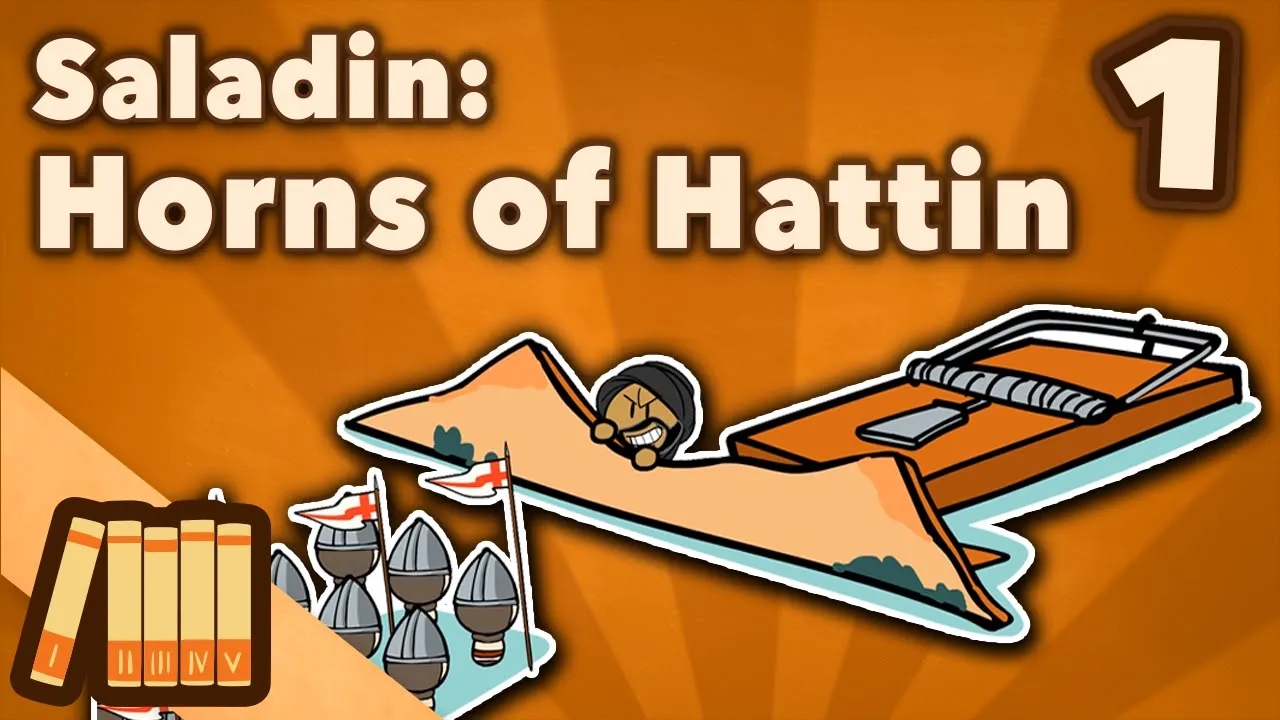
He began raiding Muslim trade routes on the Red Sea, striking close to Mecca and Medina. But it was his plundering of a pilgrim caravan headed to Mecca in 1186 that made Raynald one of the most hated men in the Muslim Middle East. In retaliation, Saladin sprung his trap. He besieged the fortress of Tiberias, knowing that the Crusaders would be forced to attempt a rescue, and they did. The rivals put their squabbles aside and formed an alliance to crush Saladin.
Though really, even then they argued. Raymond insisted it was a trap that Tiberias, which was his fort commanded by his wife, should be sacrificed. But, the others called him a coward, so they marched. July 3rd, 1187. It is so hot. The Crusader forces, weighed down by armor, trudged toward Tiberias. Saladin they find has filled the wells along their route, and mounted archers keep ambushing them with volleys of arrows before slipping away.
The plan had been to march to Tiberias in a day, but wounded men are slowing them down. So, they decide to stop at a spring for the night. But, Saladin got there first. Instead of attacking, however, the exhausted Crusader army stakes camp. Then, Saladin's troops surround the Crusaders, beating drums through the night to keep them awake, yelling that God is great, and lighting grass fires to blanket the encampment in smoke.
Meanwhile, Saladin has a supply chain of camels bringing his forces fresh water. And in an extra twist of the knife, they take skins up to the Crusader lines and dump it out in front of the exhausted parched men. The next morning, exhausted and choked by smoke, the Crusaders make a desperate drive toward the springs at the village of Hattin. Again and again, the demoralized Crusaders smash against Saladin's infantry, pierced by an unending rain of arrows.
At this point, Raymond, who had not wanted this plan in the first place, gives up and manages to break his forces through and flee to Lake Tiberias where he can withdraw. Saladin lets him go. He wants King Guy. He wants Jerusalem. And with Raymond's forces gone, this fight is unwinnable for the Crusaders. The sun beats down. Knights stumble into the Muslim lines, unarmed, begging to be killed. But, Guy makes one last gamble.
He withdraws his forces to a ruined Iron Age hillfort on a high plain. Two low hills, the horns of Hattin, guard the approach. And when Saladin's army begins to press him, he calls on God and the true cross for aid and orders a charge. If he can kill Saladin, he reasons, the Muslims will break. The assault takes Saladin off guard. Directing his troops, his son by his side, he suddenly sees the Christians surging toward him in a downhill charge.
The desperate attack buckles his infantry line, driving his front ranks back so the combat swirls mere feet from him. But Saladin advances, yelling encouragement to his troops. They throw the Christians back, only for the rally once more and crash the front line again, the combat nearly reaching Saladin, who by this point realized that he was the objective. But his lines hold and the Crusaders are sent scrambling back up hill.
His son says it's over, but Saladin says it will not be over until the king's opulent tent falls. But as he says this, he sees the canvas topple in the distance. The sultan dismounts and prostrates himself in prayer. God has given victory. Saladin has just annihilated the military power of the Crusader states, captured the king of Jerusalem, taken their most holy relic, and now the city of Jerusalem lies nearly undefended.
Did you all know that Ahmet Ziya Turk, Alicia Bramble, Casey Muscha, Dominic Valenciana, Gunnar Globus, Kyle Mergatroid, and Orioles 1 were all legendary patrons? Thanks, everyone.
The words are the caption track's own and nothing is reworded or re-transcribed. Paragraph breaks are placed between sentences so the text reads as prose.
Free tools for your own script: paste a draft and see where it stands before you record it.
Paste your draft and see where viewers are likely to drop off, with a rewrite for each weak line.
Paste the first 30 seconds of your own draft for a hook score and rewrites.
Check your draft against YouTube's advertiser-friendly guidelines before you record it.
Read this channel's public videos and transcripts, and download a writing brief for it.