Getting the transcript
Reading the captions from YouTube. A video nobody has opened here before takes 10 to 30 seconds; this page fills in on its own.
Getting the transcript
Reading the captions from YouTube. A video nobody has opened here before takes 10 to 30 seconds; this page fills in on its own.
Jasmine Homden · @jasminehomden
Where viewers went back to watch this video again, from YouTube's public Most replayed graph, lined up with what was said at that moment.
Most replayed moment #1
12:577.9x the video's typical replay level
input, there is not much room left for genuine introspect. By reducing that mental load, it creates the conditions for clarity. And to really summarize that point, create more, consume less. Number two, notice what you are drawn to without an audience. Self-determination
Said at 12:49
Most replayed moment #2
0:454.8x the video's typical replay level
psychologist called Erik Erikson, he mapped out stages of identity development. And his big idea was that identity doesn't just appear. It is something that we actively build. And this is through a process of exploration and commitment, [clears throat] where you're basically trying things and
Said at 0:38
Most replayed moment #3
7:594.7x the video's typical replay level
Research by neuroscientist Kent Berridge shows that the brain's wanting system is actually separated from the liking system. So, wanting and liking are actually two separate mechanisms altogether, just running on different neurochemistry. And I think that's pretty cool. So, wanting is driven by
Said at 7:52
The graph counts replays. It does not show where viewers stopped watching.
Words
2,717
Runtime
15:04
Speaking pace
180wpm
Reading time
11min
180 words per minute, just under the 181 median of 349 measured videos. That distribution comes from the 349-video hook study.
Opening (first 30 seconds)
When somebody asks, "What do you want?" from a career, from a relationship, just from life in general, do you actually know? Very clearly actually know what you want? Because I don't think most of us do. And I think what makes this so weird, and especially interesting, is the fact that we live in a world with so much choice. We have more options, more paths than ever before in human history, and yet a lot of us, including myself, feel more lost than free. But I think that
90 words, the words spoken in the first 30 seconds at 180 words per minute.
Free, no signup. See how the first 30 seconds hold attention, with rewrites.
Sentence shape
| Measure | This transcript |
|---|---|
| Sentences | 167 |
| Average words per sentence | 16.3 |
| Longest sentence | 54 words |
| Questions asked | 12 |
| Sentences containing a number | 13 |
Most used terms
Filler phrases
40 in total: actually 19 · like 8 · kind of 7 · basically 3 · I mean 1 · literally 1 · sort of 1.
A literal whole-word count of the same phrase list the Prepublish browser extension uses, so a phrase inside another word is not counted and a phrase used in its ordinary sense still is. It is a count and not a judgement.
Run the check on the words above: where attention is likely to drop, with a rewrite for each weak line. The free check shows the scores and the one issue costing the most.
What this transcript is
Every word below is the caption track YouTube publishes for this video, pulled from the video itself and reproduced unchanged. It is not Prepublish's writing, not a summary, and not a re-transcription: it is the video's own published captions. English captions, generated automatically by YouTube, in the video’s original language. Source: the video on YouTube. A channel that would rather this page did not exist can ask for its removal through the contact page, and it is removed.
When somebody asks, "What do you want?" from a career, from a relationship, just from life in general, do you actually know? Very clearly actually know what you want? Because I don't think most of us do. And I think what makes this so weird, and especially interesting, is the fact that we live in a world with so much choice. We have more options, more paths than ever before in human history, and yet a lot of us, including myself, feel more lost than free.
But I think that tension is the first clue that it isn't just indecision. There's something so much bigger going on behind that. So, what's actually going on? Well, a psychologist called Erik Erikson, he mapped out stages of identity development. And his big idea was that identity doesn't just appear. It is something that we actively build. And this is through a process of exploration and commitment, [clears throat] where you're basically trying things and seeing if it works for you, or doesn't work, and ultimately you're able to gradually commit to these things that do, and have a more clearer sense of self.
That Erikson's student, James Marcia, took that framework and made it more specific. So, in 1966, Marcia identified four distinct ways that people move through this process. One, some people completely skip exploration, and basically just adopt whatever identity is handed to them, whether that be through their parents, through their culture, just any kind of script that was written beforehand, >> [clears throat] >> that was given to them, they just adapt to and basically live through that narrative.
And Marcia called this stage foreclosure. So, it looks like certainty, but it is absolutely borrowed. Number two, others avoid the question altogether, not exploring, not committing, just kind of drifting along, hoping that clarity will just appear. And Marcia called this identity diffusion, kind of like the psychological version of just pressing snooze forever and not really doing anything at all. Number three, then there is identity achievement.
People who have actually done the exploration work and come out the other end. These people tend to feel settled and are assured in their sense of self. And number four, in between all of those, where I think most of us probably sit right now, the identity moratorium. And this is a period of active exploration, where you're trying things, you're testing them out, asking all those uncomfortable questions, exploring concepts and videos about certain things.
But the keyword in this is active. It's kind of engaged confusion. You're not hitting the snooze button. You are literally trying to actively find the answers to the questions that you have. And that is a distinction that matters. But the fourth stage requires something very specific to work. It needs psychological space, which is room to explore, to try, to be wrong, to be new at something, and be okay with being bad at it.
And just to have preferences that aren't immediately visible to everybody else to witness. And I believe that that is exactly what modern life keeps taking away from us. Because that inner experimentation is now happening publicly. Every version of you is visible, or at least some sort of footprint of that version of you is visible. And sometimes it's not this massive huge performance that we think it is. I mean, I've been on the internet since I was about 15 years old.
And there are pictures of me looking looking very different because I was 15 years old. And I'm still on the internet 15 years later. Obviously, my style, my taste, there is not one aspect of my life that is the same. And that is genuinely a good thing. But when exploration becomes like performance, you're doing something because it feels trendy or because you are able to compare yourself to many other people on the internet, it starts to develop into something else.
You're no longer just figuring out who you want to be, you're also figuring out who everybody else wants you to be. And this brings us onto something that sits right underneath the surface of all of this. Self-concept clarity. Developed by Jennifer by and colleagues in 1996. It describes how clearly, confidently, and consistently you understand who you are. And research shows that people with low self-concept clarity don't just feel confused about identity in abstract.
They also experience measurably more anxiety, lower well-being, and more difficulty making decisions that actually fit them. And that doesn't mean that that's because something is wrong with them, but because the conditions for building self-concept clarity are harder for them to develop. So, when you're drawing a blank when somebody asks, "What do you want?" it might not be because you don't necessarily have preferences, it might just be that you haven't had enough time or room to feel stable enough to generate them clearly.
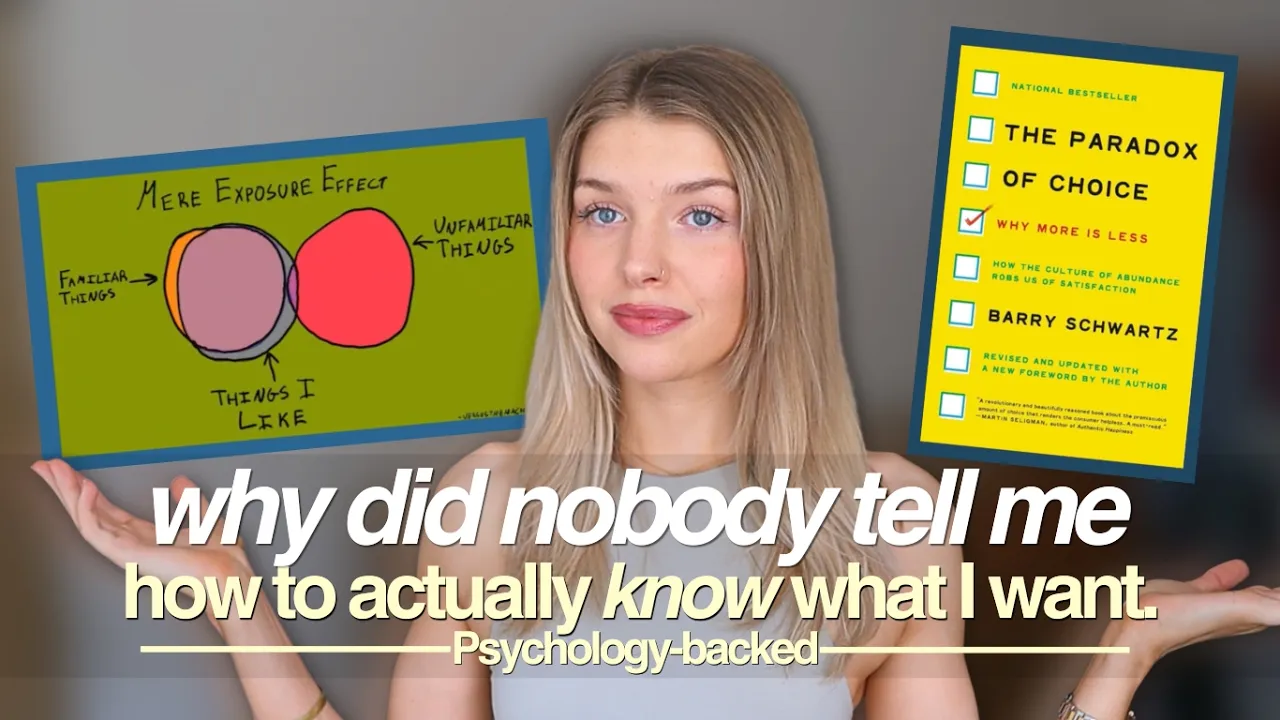
So, there is a small issue when it comes to having 70,000 options. Psychologist Barry Schwartz, who on work by economist Herbert Simon, identified what is called the paradox of choice. The idea that having more options actually makes us feel less likely to make a choice. Simon had originally distinguished between two types of decision makers. One, maximizers. Those are the kind of people that need the best options and will keep searching until they find the perfect one.
And two, satisficers. These are people that are just looking for something that is good enough. But research does show consistently that maximizers, the people that are trying to keep their options open and optimize, report less satisfaction and more regret. That pursuit for the perfect answer actually prevents them from having any answer at all. And Schwartz was actually able to test this with psychologist Sheena Iyengar and Mark Lepper in what is now a fairly famous study.
And in the study, people were either presented with six or 24 jam options. So, even though the larger display of 24 jams initially had more interest, people who chose from just the six options were 10 times more likely to make a decision, which leads to the conclusion that more options creates more friction, not more satisfaction. Now, if we apply this concept to life, when you're not choosing a particular career or a relationship, you're also debating every kind of alternative version of you.
You're keeping the question open even when you've technically answered it. When there is one path, you'll walk on that one path, but when there's a hundreds, it's really difficult to decide which one is the best one to walk on. So, you kind of just stand there and wait and hope that a decision will come to you eventually. And here's what it does to desire specifically. When everything is possible, nothing feels obvious, which leads us onto the next segment.
Just think about how much external input you have every day. How many ads you see, how many recommendations, how many opinions, other people's lives and other people's choices. And this doesn't necessarily have to just be online, this can also be applied in person. With all this aspirational content, what a productive good morning looks like, or what a healthy good relationship should be, what a good version of you looks like.
And I think you should be really specific about this, because it is easy to not long and miss how deep this truly goes, because your 6:00 a.m. morning routine has been optimized before you've even decided if it actually feels good for you. And how you dress is an aesthetic that you've been fed without ever really deciding if you like it. And you're also told what a relationship should look like, how it should progress, what you're supposed to feel in a 60-second clip online since you were a teenager.
And none of that is natural. But what it is doing is actively shaping what you think you want. And there is a very specific psychological mechanism at work here, identified by Robert Zajonc in 1968. And he called this the mere exposure effect. The more frequently you're exposed to something, the more positively you tend to evaluate it. That familiarity will start to feel like preference. It's not necessarily something that you're choosing, but it is something that you're exposed to enough that you start to think that it's yours, which is actually incredibly unsettling, especially when you think about how many preferences were just things that were shown to you enough times that you actually started to adopt them.
But, what is [clears throat] even more unsettling is it goes further than that. Research by neuroscientist Kent Berridge shows that the brain's wanting system is actually separated from the liking system. So, wanting and liking are actually two separate mechanisms altogether, just running on different neurochemistry. And I think that's pretty cool. So, wanting is driven by dopamine and liking something is driven by something else entirely.
Okay, but what does that mean in practice? I'm so glad you asked. You can intensely want something, and once you obtain it, you won't actually enjoy it. But, that also means that you can enjoy something that you never thought you would pursue. So, when you're chasing a goal that feels urgent and all consuming, that drive isn't necessarily evidence that achieving it will feel good. It could just be a very loud want, which actually has very little to do with who you are.
For example, let's just say you want to be an astronaut because it looks great on paper, everybody would respect you, it's a really cool job, and you love the reaction that people give you when you say, "I'm going to be an astronaut one day." And now, let's say that you put in the work and you do all the things to actually get there. And then suddenly, one day, you're an astronaut. Congratulations, that's a pretty cool job.
However, that internal intrinsic feeling that you have doesn't actually feel very good because what you've actually done is pursue something for extrinsic value. And psychologists who study motivation draw on two very similar distinctions. Intrinsic motivation, which is wanting something because it genuinely aligns with who you are, and extrinsic motivation, wanting something because it is positioned as desirable, mostly because it's signaling something validating.
And research from determination theory suggests that when we act from extrinsic motivation, we experience less satisfaction and paradoxically, a less stable sense of self. And then, there's also comparison theory. My goodness, I am parched. Developed by Leon Festinger in 1954. His idea was that humans constantly evaluate themselves compared to their peers. And yes, this has always been true throughout history. Human beings have actively compared themselves.
And as I've said in so many of my previous videos, the scale of which we are doing that now is absolutely astronomical. We are measuring ourselves against perfectly curated algorithms and highlight reels of inspirational content, all showing us how we should be acting or how we should be living. But this effect has proven time and time again that it isn't inspirational at all. It has proven to be anxiety-inducing, reducing self-clarity, and it is making it harder for us to hear that internal standard when the external one is just so loud.
So, when you are asking yourself, "What do I want?" and you're drawing a blank, it might not be because you don't know. It could just be that you are saturated with so many people's wants, other people's preferences, that your own signal, your own voice, has just gotten lost or at least really, really quiet. Now, I think it is really important that we remain balanced when it comes to psychological concepts, and especially when we're applying them to real life, because that this can tip into something very unhelpful.
I also don't want to leave you in a very heavy space, and not really give it a more rounded ending. Feeling uncertain about not knowing what you want isn't necessarily a problem to solve. Sometimes it's just the end of the stage in your life. Sometimes it's a sign that you're going through a transition, and sometimes it is just being 22. There is a version of this conversation that can become its own trap, where the awareness of all the noise, all the external influence, becomes another thing to be anxious about.
And importantly, the goal is not to achieve perfect clarity, but it is to create slightly better conditions for your own signal and voice to come through. And Marcia's research is pretty clear on what not to do. Premature closure, locking in an identity before you've had any chance to really explore it, tends to backfire. And that's speaking from experience. And that premature closure sometimes leads to you living somebody else's life.
You end up living somebody else's answer to a question that you've never really sat with yourself. And that genuinely can look very successful for a while. That gap between performance and the actual self usually catches up eventually. And the people that develop the clearest, most stable sense of self are definitely not the people that decided the earliest. I think they're the ones that stay curious the longest. Okay, so what does psychology actually suggest here?
I've got a few things. Number one, reduce input before you increase clarity. If that signal in your brain is being drowned out by all that external noise, adding more reflection on top of that noise is not going to help. But, cutting back on the input, even if it's temporary, is much more effective than just reflecting harder. And this is backed by cognitive load research. Decision making and self-reflection draw on limited mental resources in the brain.
And when those resources are constantly saturated with external input, there is not much room left for genuine introspect. By reducing that mental load, it creates the conditions for clarity. And to really summarize that point, create more, consume less. Number two, notice what you are drawn to without an audience. Self-determination theory distinguishes between autonomous motivation, which is just wanting something genuinely because it comes from inside, and motivation driven by external approval.
So, a useful question would be, what would you spend your time on if nobody was going to see it? What have you done recently that you didn't take a photograph of or even mention to somebody else? How did that feel? Because that unwitnessed experience tends to be where our preferences truly lie. Number three, pay attention to your energy, not the interest. Interest can be manufactured by an algorithm, but energy is much harder to fake.
So, what makes you feel more yourself after you do it? That is usually a more honest signal than I think I want this. And remember Berage's distinction. A lot of what we're interpreting as desire is just a wanting signal, not a liking signal. And the way to tell the difference is to notice how you feel once you have obtained the goal. If you get there and feel nothing or move the goalposts, that is really important and it is worth noting because it might just be a signal to say this wasn't really your preference to begin with.
Or you could well be a perfectionist, but that's a topic for another video. And you're allowed to want something, it doesn't always mean that it's bad, but it's also important to recognize whether it's coming from internal or awesome signals or if it's coming from external input. And number four, give yourself permission not to know yet. For me, this is personally one of the hardest ones, but it is backed by Marcia's identity development research.
The not knowing is productive when it's exploratory, but not when it's anxious, which means accepting uncertainty rather than fighting it. Tends to make that exploration experience shorter and a little bit more digestible. I will hold my hands up here and say I have yet to test this out because I genuinely live my life on the edge. The willingness not to know, paradoxically, what makes eventually knowing possible.
The words are the caption track's own and nothing is reworded or re-transcribed. Paragraph breaks are placed between sentences so the text reads as prose.
Free tools for your own script: paste a draft and see where it stands before you record it.
Paste your draft and see where viewers are likely to drop off, with a rewrite for each weak line.
Paste the first 30 seconds of your own draft for a hook score and rewrites.
Check your draft against YouTube's advertiser-friendly guidelines before you record it.
Read this channel's public videos and transcripts, and download a writing brief for it.