Getting the transcript
Reading the captions from YouTube. A video nobody has opened here before takes 10 to 30 seconds; this page fills in on its own.
Getting the transcript
Reading the captions from YouTube. A video nobody has opened here before takes 10 to 30 seconds; this page fills in on its own.
Jon Walland · @jonwallandcoach
Words
6,168
Runtime
23:48
Speaking pace
259wpm
Reading time
26min
259 words per minute, above the 201 75th percentile of 349 measured videos. That distribution comes from the 349-video hook study.
Opening (first 30 seconds)
Okay, so this video is going to be about exercise life cycles. This is basically the lifespan of an exercise. And what I want to do in this specific video is show you how to structure your training using this principle to avoid plateaus and achieve indefinite muscle growth. This is a component of the IP method. Um really just focusing in on the life cycle component of this and um it's going to be a really interesting video. I've got a lot of stuff to share. We're going to really deep dive into this. Now plateaus are a normal part of trading. This is going to be true for pretty much everyone unless you're a complete beginner or you're taking steroids. When you're a beginner, all that you really
130 words, the words spoken in the first 30 seconds at 259 words per minute.
Free, no signup. See how the first 30 seconds hold attention, with rewrites.
Sentence shape
| Measure | This transcript |
|---|---|
| Sentences | 334 |
| Average words per sentence | 18.5 |
| Longest sentence | 176 words |
| Questions asked | 23 |
| Sentences containing a number | 10 |
Most used terms
Filler phrases
200 in total: um 62 · uh 37 · basically 33 · right? 22 · like 15 · you know 14 · actually 7 · kind of 7 · I mean 1 · literally 1 · sort of 1.
A literal whole-word count of the same phrase list the Prepublish browser extension uses, so a phrase inside another word is not counted and a phrase used in its ordinary sense still is. It is a count and not a judgement.
Run the check on the words above: where attention is likely to drop, with a rewrite for each weak line. The free check shows the scores and the one issue costing the most.
What this transcript is
Every word below is the caption track YouTube publishes for this video, pulled from the video itself and reproduced unchanged. It is not Prepublish's writing, not a summary, and not a re-transcription: it is the video's own published captions. English captions, generated automatically by YouTube, in the video’s original language. Source: the video on YouTube. A channel that would rather this page did not exist can ask for its removal through the contact page, and it is removed.
No Script X-ray for this video: YouTube shows a Most replayed graph only once a video has enough views.
Okay, so this video is going to be about exercise life cycles. This is basically the lifespan of an exercise. And what I want to do in this specific video is show you how to structure your training using this principle to avoid plateaus and achieve indefinite muscle growth. This is a component of the IP method. Um really just focusing in on the life cycle component of this and um it's going to be a really interesting video.
I've got a lot of stuff to share. We're going to really deep dive into this. Now plateaus are a normal part of trading. This is going to be true for pretty much everyone unless you're a complete beginner or you're taking steroids. When you're a beginner, all that you really need to do is just eat enough protein, train hard, do so consistently, and you basically never run into a plateau. It's only really once you exit that phase where plateaus start to become a lot more normal.
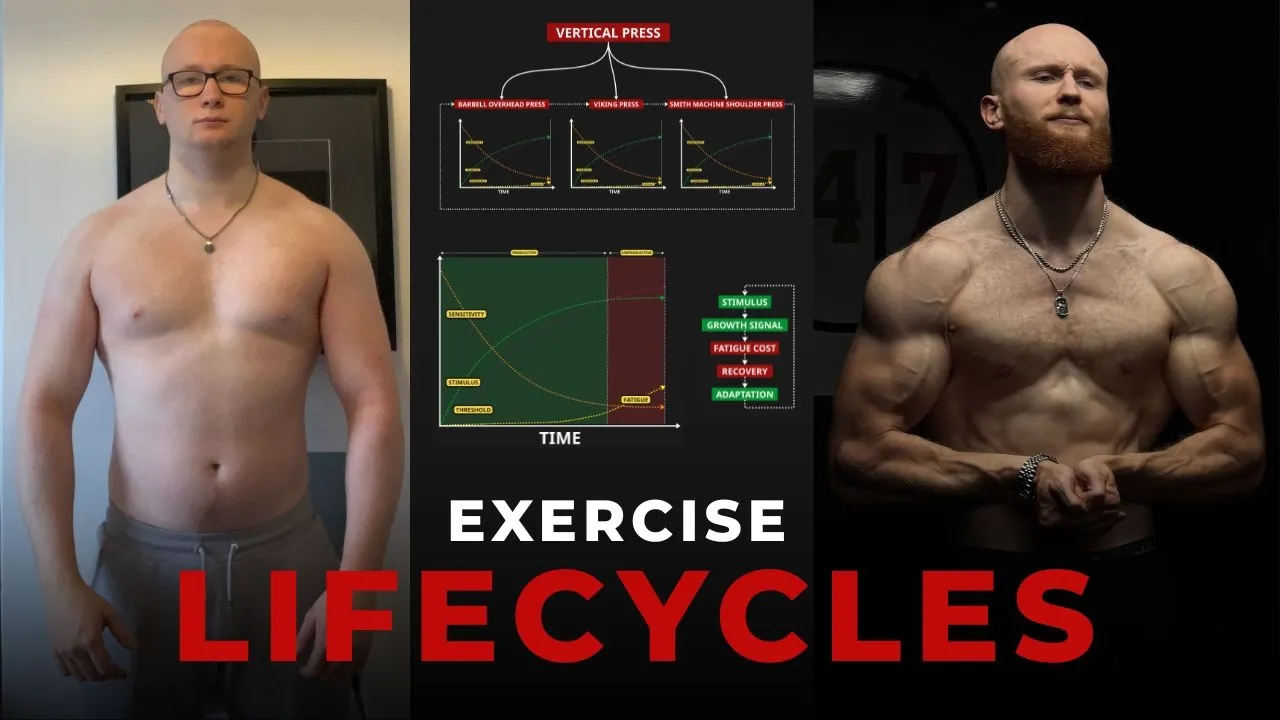
The picture of me on the left was right in the midst of one of the biggest plateaus of my life. And I was at this point in time, I was eating exactly what I needed to. You can tell I was putting on a little bit too much weight, but my perspective at the time was that I just needed to eat more food to get over this plateau. Um, in reality, of course, that isn't the case. I just needed to understand what exercise life cycles were.
And even though plateaus are completely normal and they will happen over time, they are also completely preventable. And the strategies that I'm going to lay out in this video are going to show you how to circumvent them completely so that you can enable muscle growth to occur basically indefinitely. This is all contingent on setting the conditions for progressive overload first. All right? If you've never had a plateau before, you've probably benefited from being able to simply progressively overload and gain muscle as a result of that.
After the beginner stage, you really now have to start setting the conditions for that to take place in order to grow muscle. It's sort of reversed. And if that's confusing, don't worry. I'm going to be able to elaborate on this uh very very shortly. So, we're going to be talking quite a lot about stimulus in this video. This is basically the main driver of adaptation. And just to very quickly define a few things so that the whole of the video makes sense.
Stimulus is basically the specific training stress that you apply to muscles that forces an adaptation to occur. An adaptation could be in terms of strength. It could be in terms of muscle growth. Ideally, what we want is a bit of both. But what I want you to do is think about stimulus as the dose of stress that's applied to the muscle. Um, I'll use an example of a bicep curl. The bicep curl itself would be the exercise, but the stress applied to the bicep that causes it to grow, that would be the stimulus.
And we want stimulus to be increasing over time in order to get that adaptation, to give the muscle a reason to adapt. Um, and when we talk about exercises, these are very simply just tools that we can use, vehicles of delivery if you like, to deliver that stimulus. Now, anytime you train the body, there is always going to be a fatigue cost. This is basically the cost of applying stimulus over time. There's a couple of different forms of fatigue, and I'm not going to get into the weeds about this, but it's just an important component that we have to consider when we're looking at plateaus and why they exist.
Um, there's a couple of different ways of measuring fatigue. The first of which would be local fatigue. This would be any kind of fatigue that's associated with a specific joint or part of the body. A good example of that might be joint pain or joint inflammation. Um, this can happen over many many weeks or many months uh of repeated stress applied to a muscle. You might find that in the tendon or the joint. Um, and that is one form of fatigue, right?
We can we want to minimize this as much as possible. Another form of fatigue would be systemic fatigue which accumulates over time. That would just be that feeling of lethargy. Um you know where you kind of don't really have the same motivation or the same energy to take into your trading. Your performance really starts to decline at this point. And this actually affects your whole body as a as an organism. Right? Fatigue is something that rises very slowly.
Um but it also takes a long time for it to fall down as well. If you've ever de loeded before, this is a way to resolve high levels of fatigue. Um but ultimately what you need to know at this point is that we have to keep fatigue low in order to keep training performance high and recovery optimized. And then lastly, recovery cost. This is basically just the total recovery demand that is created through training. So again, I'll use the example of a bicep curl.
If you were to do a set of bicep curls, um it might take 48 hours to 72 hours for most people to recover from that uh stimulus. Um you know, this is basic stuff, but it's just important to lay this out. And essentially the process that this follows is that you would apply that stimulus to the muscle. That's the very first thing that you would do. That would come in the form of your training session. There would be a growth signal as a result of that which would signal to the muscles to grow.
There will always be some degree of fatigue associated with that and a recovery time and then after that an adaptation will occur leading to you being able to then go ahead and stimulate the muscles again. And ideally we want to stay in this process continually like we literally just want to go around in circles but we also want to minimize the cost uh associated with the fatigue and we also want to minimize the recovery time as much as possible and then time that next session at just the right moment where recovery has been able to run its course. the adaptation has already occurred and then you can go ahead and apply a greater stimulus to force another adaptation on top of the adaptation that was already made.
Um, and this is a process that you want to just be able to cycle through continuously. Ultimately, the goal is to apply greater stimulus over time to generate continuous muscle growth or adaptation while keeping your fatigue low enough to recover effectively and therefore be able to grow muscle indefinitely. Right? And this is a really common form of progression. Um, this is basically just what double progression looks like.
You can you can look at any progression model and it's basically the same thing. The ultimate goal of any progression model uh is for the amount of stimulus that you're applying to the muscle. It will increase over time which will force the muscles that you're applying that stimulus to to continually adapt over time and get stronger and get bigger. And this is basically the ideal scenario um to kind of break this down very quickly before we get into the rest of the video.
Um this would basically involve increasing the load on the bar or the exercise, keeping it steady uh while you increase the reps at the same time. So this is a very easy way, very um common way as well to make progress. A lot of beginners will use this progression model uh where you keep the keep the weight on the bar the same uh you increase the reps as this week progresses or maybe this is a couple of weeks really depends and then as you increase the load on the exercise the reps drop down in order to accommodate for that you increase the reps again as you keep the weight the same and obviously over time you're basically just adding weight to the exercise very very steadily and the stimulus is increasing.
All right, this is what progression should look like. If this continued forever we would all be 250 lb freaks, right? We would all be carrying around a lot of muscle. we'd all have 500 lb deadlifts, uh, 500 lb bench presses. You know, this this is the ideal scenario, but obviously this doesn't really work out in reality. Um, and what what in reality progression ends up looking like is essentially where you increase the weight, increase the reps as you've kept the weight the same.
Uh, you've done a load jump, increase the weight again, but this time it's taken a little bit longer to be able to increase the reps on this one. Maybe that takes another week, for example, to bring the reps up to the upper end of the rep range to then be able to increase the load again. But in this third load jump, well, we've tried to increase the reps and it's got up to this point here, which wasn't quite where it needs to be in order to be able to qualify for that load jump.
And well, it's not really increasing anymore, right? So, you haven't really been able to increase the the weight on the bar again. And actually over here, we can see that the reps have actually fallen below what they were here. So, actually on paper, we can imply that well, the strength has actually gone down. Um, and this is basically following a a diminishing returns line on the stimulus chart here. So if you were to have a look at this, the stimulus is going up up up as the weight on the exercise is going up as well.
And then this starts to taper off here. And what's just important to note, I know this probably seems quite basic, but what's really important just to remember here is that from this point to this point, there is no more stimulus being applied to the muscle. It is the exact same amount of stimulus here as it is here. And therefore, no muscle growth is happening. There is nothing for the muscle to adapt to. And therefore, this would be considered a plateau.
Right? We simply cannot force adaptation forever with the same stimulus. Meaning that from here to here, you know, if we were to continue with this exercise and the stimulus was kept exactly the same, we've already adapted to it. We cannot force adaptation with the same stimulus because the muscles have become adapted to that stimulus over time. And what we really need to do is find a way to keep muscles in a constant state of growth and therefore find a way to deliver increased stimulus indefinitely.
Like what we're trying to do is this forever. Um, and like I say, on the next uh on in the next kind of section of the video, I'm going to be able to go through what that looks like. So to really understand how to avoid plateaus, we got to just break down what plateaus are. Um, and what I've done here is just basically mapped out in a very similar way to this, you'll see the stimulus line here. Um, I've included the exact same thing on this graph, but just with a few other vectors that we can look at.
And this will break down why we couldn't increase the stimulus. It will break down why we couldn't increase the weight on the bar. Um, and I've split this into four phases. So there's four different lines here. Let me break down each one individually. Um, the first one that you'll see is obviously the stimulus. We've been through this. uh this will just involve uh you applying a greater stimulus to the muscle in the form of maybe more reps or more weight on the bar uh or more mechanical tension you know however you want to progressively overload.
There is then a threshold line. Now this is basically just mapping out the required amount of stimulus to force adaptation to occur. And the reason why the threshold line is below the stimulus line is because in the beginning well there's a lot of adaptation going on because clearly the threshold for growth is down here but the stimulus that's being applied is up here. So this meets the criteria for adaptations to occur.
And you'll see over time this gap starts to close. We won't go into that in more detail, but this is basically think of the threshold as the criteria that needs to be met in order for muscle to grow. As soon as the threshold overlaps and as soon as the threshold is above the amount of stimulus that's being applied, then muscle growth cannot occur because the criteria isn't being met. The next line is sensitivity. So this would basically be how sensitive you are to the stimulus that's being applied and the amount of adaptation that is happening as a result of that stimulus. uh whenever you start a new exercise, you very you're highly sensitive to that new exercise.
You'll find even if you've been training for many many years very consistently, you might try a new exercise that's very similar, but it might be, you know, the muscles might feel a lot more sore than they would normally. And that the reason for that is because it's very novel, it's very new, it's stimulating the muscles in a new way, and your muscles are very sensitive to that new stimulus, which does fade over time.
Um, and we just need to accommodate for that. Um, another component of this sensitivity line would be your skill acquisition. you know, um if you if you try a new movement, there is going to be a skill component of learning that exercise and building a uh building a feel for it and becoming more efficient with it, developing those neural pathways. Again, most of those adaptations that happen uh occur in the beginning portion of any new exercise.
And then the final line here is just fatigue. The adaptations that you're making at the beginning of a new exercise, a lot of that is going to simply come down to you building skill with performing the exercise. As we move into the second phase, a lot of this sensitivity has dropped down. this will drop down very quickly because you're now much more uh skilled with the exercise. Um you know, your coordination has improved and progressive overload is still possible.
Absolutely still possible. You're still adding weights to the exercise each week. You're still, you know, increasing the reps, doing whatever you can to progressively overload, but there is definitely more effort that is required. Now, bear in mind, the amount of weight you're lifting over here is now far higher than it was at the beginning. So, naturally, that is going to cause more stress on the body, more stress on the muscle, uh more stress on the joints, and as a result of that fatigue is now starting to creep up.
Right? This is a result of the stress that's being exerted on the body. But the gap between the stimulus applied and the threshold for growth is now shrinking. The conditions are still set for growth, but the gap between the stimulus line and the threshold line is now really starting to shrink. The gap is getting smaller. Um, but progressive overload is still possible because clearly the criteria is still optimal. In the third phase, the user has mostly acquired all of the necessary skills to perform that exercise as efficiently as possible.
Right? there is no more adaptations to make in terms of just skill acquisition or developing coordination with the exercise. Um the stimulus is still rising. You're still able to progressively overload. There is still some form of of adaptation um that is occurring. Um but it's at a much slower rate. You can compare uh the differences. The line has significantly flattened. Um progressive overload is still possible, but it's much more difficult to perform reliably.
And this would be the phase where you start to go to the gym and you're finding now that you know if you were to have a a bad night's sleep, it's almost certainly going to affect your performance in the session. like the margin for error becomes a lot smaller, becomes a lot narrower. Um, and you might start finding at this point that you're going to get a lot of grinder reps. Um, the sets that you're performing are going to get really difficult and you really have to dial in a lot of these external variables like your sleep, your recovery, your diet.
Um, otherwise it's going to be very difficult to to reliably produce that progressive overload that's required for muscle growth. Um, the threshold for growth is about to overlap. It's not quite done that just yet, but it's about to overlap, and we'll go through why that would be in a moment. And the fatigue is now rising much more quickly. It's now starting to impact your recovery a little bit. Um, you'll notice this line coming up here.
Again, the reason for this is because the amount of stress being exerted on the body here is way higher now than it was at the beginning. Um, and the limiting factor is no longer skill. It is simply the muscle's ability to contract, right? It's it's purely on the muscle that is limiting your ability to progress at this point. But of course, it's still possible. When we move into the stage four, well, because the threshold for growth is now above the applied stimulus, well, growth isn't really possible anymore.
There might still be some very minor adaptations occurring. Um, but it's almost imperceptible. On paper, at this point here, the reps are not going up. The weight on the exercise is not going up. There is basically a plateau in uh in full swing at this point because progressive overload just simply isn't possible. And you can keep going along this point, but it's not very sustainable. Um, it's really important to be able to recognize exactly when this point occurs so that you can prevent it and you can you can kind of take action to avoid spending too much time in this phase.
And one of the reasons why you don't want to spend a lot of time in this phase is because now fatigue is really starting to ramp up. And this this here is probably one of the most important things that you need to look at because the longer you spend in this phase and the longer your fatigue levels are starting to rise. Well, now your recovery is now being impacted. Your ability to now perform during the training sessions is now being hindered and it's going to make you feel very low energy.
Um your sleep quality might start to decline. Your appetite levels might start to decline. This is where maybe your joints don't feel as good as they were at the beginning. And one thing that you can do, and I've seen this before, this was one of the traps that I fell into many, many years ago, is that if you're no longer able to increase the weight on the exercise and you're no longer able to do any more reps, the logical uh next step to that in order to progressively overload is just simply adding more sex to the exercise.
That is one form of progressive overload and it is viable. However, what that's going to do is it's going to drive up those fatigue levels even more because you're now doing even more volume. You're creating even more stress for the body. And what that does is it just it spirals the fatigue levels out of control. And that's the point where you start to need D losses. You need to start taking time off training to reset these fatigue levels enough to be able to actually adapt to the training that you're doing.
Now, the way that I set up my own training, and this is also a component of the IP method, is where de loing is just simply not necessary because this phase here where fatigue levels are now starting to creep up to levels where it's now genuinely impacting your trading. We can basically circumvent this. And what I want to do in the next uh section of this video is is go through how that works. Um, I did write some some uh some notes down here just to just to go through um because otherwise I would forget.
The duration of this process is totally dependent on the person. If you're a complete beginner, you are still going through this exact same process. You may have just never got to this point here. This is really important, right? If you're a complete beginner, um you are still going through this process of applying more stimulus. There is still going to be a threshold for growth. There is still going to be a a component of sensitivity to these new exercises that you're doing.
And you are still going to be generating fatigue. may just be that because you're getting stronger every single week and you're very rapidly adapting and because you're very sensitive to muscle growth in general, well, you may have been training for 9 months at this point, but you're still only here on the graph. Whereas someone who spent 10 years training is potentially far less sensitive to growth in general. Maybe the amount of weight that they need to lift is much higher.
And so, as a result, their fatigue levels are naturally going to be higher and the the cost of their training is just generally going to be higher. So, they have to manage their fatigue a lot better. And the duration of this process is naturally going to be much shorter. It might be closer to 8 weeks or 10 weeks, for example. So, it's really important to note this. If you've never got to this point, lucky you. Um, it's still worth watching this video so that you can see how to avoid getting to this point entirely and what to do once you get there.
But, yeah, this is very much nuanced. It also depends on the exercise, right? This basically maps out what happens over the course of an exercise life cycle. But, it really depends on the exercise, right? If we were to apply this to a bicep curl, well, there isn't really going to be much fatigue associated with a bicep curl. Maybe you might have a little bit of uh sensitive joints, but it's not going to wreck you, right?
Compare that to a deadlift. If you did deadlifts for for 10 weeks in a row and you were really pushing and you were really trying to progressively overload, increasing the stimulus week to week. Well, then the fatigue levels are naturally going to be higher anyway. So, there is going to be some nuance between exercises. There's going to be some nuance between people as well. Um it's not going to look as pretty as this in reality.
Uh fatigue levels again, they are affected by other components. This is purely just an illustration. And so what we can do is we can structure this process into what I refer to as a life cycle where you start a new exercise that would mark the beginning of the life cycle. Again, sensitivity is nice and high. You're increasing the stimulus very rapidly. Uh the threshold for growth is below the stimulus that you're applying and the fatigue levels are nice and low.
This would be the beginning of a life cycle. And following it all the way till the end of the life cycle where you're no longer able to progressively overload, you're no longer able to make any meaningful adaptations to the muscle or to your strength. that would mark the end of the life cycle because that marks the end of the productive duration at which you're able to practice with this new exercise. This is why at the beginning of the video I said there is no best exercise because even if you find an exercise where this duration from the beginning to the end of the life cycle is really nice and long and you're able to make a ton of progress, grow a ton of muscle, well, it is going to die at some point.
It just depends on the person and it depends on the context of how long that duration is. This is why it's so important to look at life cycles as a nuanced principle that is different for different people because what works for me isn't necessarily going to work for you and what works for you isn't necessarily going to work for me. So if you are just searching for a perfect exercise, this hopefully explains why it doesn't exist and it's very much case dependent.
So to give you an analogy, imagine that pasta is your favorite food. You enjoy pasta so much. Anytime someone offers you pasta, you just cannot get enough of it. It's always on your mind. Well, imagine eating pasta three times a day for an entire month. It's not going to be your favorite food after the end of the first month, right? However, what is important to note is that the duration it takes for you to become fed up with pasta is going to depend on the person, right?
I think pasta is all right, but maybe it might take me three days to get fed up of eating pasta every day. For you, it might take a week. For someone else, it might take three weeks, right? It really depends on the person. And it also depends on the food, right? I think broccoli tastes pretty good, but I don't think I could eat it for four days in a row and still enjoy eating it. But it's not going to be the same duration as as pasta, for example.
It's totally dependent, which is why training in these arbitrary training blocks where it's like a six week block or an 8week block doesn't really make sense because it doesn't account for the productive life cycle of the exercise. And if we can just figure out where the exercise becomes unproductive and we can simply make a decision at that point so that we can keep muscle growth happening, if we can make sure that the muscles we're trying to grow are continually being stimulated, then we solve this problem and we can enter into a phase where infinite muscle growth is very much possible.
We can avoid plateaus entirely. And what I'm going to do in these next few minutes is show you kind of how this works. In order for me to do this, I do need to go through the six fundamental movement patterns. And this is basically just a way of organizing all of the exercises that exist uh into categories, right? Um I don't want to spend too long here uh because this is very basic stuff. So a movement pattern is essentially a category of fundamental movement that is defined by similar joint action and muscle groups.
Okay? And there are six fundamental movement patterns that sit as an umbrella on top of basically an infinite number of variations. There are an infinite number of ways to practice the squat movement pattern. For example, you could do back squat, front squat, goblet squat, pendulum squat. I mean, there are so many different ways that you can perform that one fundamental movement pattern. And each one is a different way to stimulate the muscle.
And if you can simply get stronger with each of these six fundamental movement patterns, you are going to be able to build the physique of your dreams, right? Because you now have an infinite number of tools that you can use to then strengthen each one of these movement patterns. And I've I've listed a few examples for each just to just to illustrate what exercise variations are. Right? Now, if we come over here, what I'm going to do, I'm going to show you as an example um the vertical press movement pattern.
And this is basically just a very quick overview of variation cycling. I wanted to keep this video very focused on life cycles and just explain the concept. Uh in future videos, I am going to go through what variation cycling is. Um the kind of decision-making process that should be used between each life cycle, but this is basically how to structure your training so that you avoid that unproductive part of the life cycle and you can essentially just stimulate muscles continually and avoid plateaus forever.
Right? So what I've basically done is I've taken the graph that we were just looking at. I've cut off the unproductive section of this life cycle just before the threshold for growth overlaps the amount of stimulus being applied and I've taken the vertical press movement pattern as a simple example with a few different variations from the vertical press movement pattern that you can basically cycle through in order to continue this cycle of progression, continue this cycle of adaptation.
And basically the process that this follows is let's say you've been doing barbell overhead press. Again, this graph for barbell overhead press might look a little bit different. It's quite a fatiguing exercise. Maybe the fatigue levels might be a little bit higher. Maybe the duration of this life cycle might be a bit shorter. Again, it really depends on the person. It really depends on the nuance of the individual that's practicing with the exercise.
But you might spend 8 weeks, for example, practicing with the barbell overhead press. You might have been gaining uh, you know, one kilo a week on your overhead press, slowly chipping away, getting stronger and stronger. And at the end of this life cycle where your ability to progress has now basically subsided and you're no longer able to keep progressively overloading, the logical thing to do at this point is not to continue practicing with that exercise and then continue driving up your fatigue or adding more sets in order to force progressive overload at the cost of your fatigue levels.
The logical thing to do is just to carry over all of the strength adaptations that you've just made to something that is similar enough to allow you to carry over those strength adaptations to it, but still different enough to be able to stimulate the muscles in a new way. And all of these variations that I've got here, um, they are just examples. You know, there's nothing special about the Viking press. There's nothing special about the Smith machine shoulder press.
They are just illustrations of the vertical press movement pattern. Again, you could select an infinite number of different variations and maybe there are different exercises that would be better suited to you and better suited to your specific requirements and your specific objectives. But the goal here, the objective here is basically at the point of the life cycle ending over here, you are then going to be able to carry those strength adaptations over to the next variation within the same movement pattern.
And you're going to be able to restimulate the muscles because the sensitivity is now way higher. There is now going to be a skill acquisition component. Meaning that you the limiting factor to this exercise at the beginning of the life cycle is not necessarily going to be the muscles. You might have to now learn how to do the exercise. Even though you've been vertical pressing for maybe months and months, there is still going to be a skill acquisition phase.
Meaning that your fatigue levels are naturally going to drop down because the amount of weight that you're using and the amount of stress that's being applied to the body is naturally going to be a lot lower. And you're going to now be able to stimulate the muscle growth again. you're going to be able to apply stimulus over time very gradually above the threshold required for growth required for adaptation and you can basically just continue this cycle going for as long as you want and once you get to the end of this process let's say you've gone through three different variations well because you've now spent you know 12 weeks away 16 weeks away again all very nuanced all very much depends on the person you can simply just cycle your way back to the barbell overhead press and because you've spent enough time away from it and the muscles are no longer used to that specific constraint profile of the exercise that you were originally training with, you're now going to be able to apply all of the strength adaptations you've built from the Viking press, all of the strength adaptations you built from the Smith machine shoulder press, and then apply them to the barbell overhead press, and you're going to be able to continue the cycle of progression basically indefinitely.
You're never going to plateau again. And you can basically apply this principle to any of these um these movement patterns. I would recommend if you've never done this before, just to start with one movement pattern to begin with. If your vertical pull is considerably weaker than all of your others, I'd recommend just starting with that first. Um, there are definitely still some uh nuances to this that are worth explaining in a completely separate video like when to rotate exercises, you know, when to actually change exercises, what you should change to because it very much depends on the weak points that you have and the limitations that you have in place for the movement pattern.
It may well be that your I'll take the vertical pull movement pattern as an example. It could just be that your lockout portion of the lift is the weakest portion and that's the only thing that you need to strengthen. So, it might make sense that when you rotate exercises that you rotate to an exercise that's going to strengthen that portion of the movement. Um, there's so many different uh nuances to this and I don't think it's worth going through in this specific video.
Uh, but essentially to illustrate how this works long term, you might have a few different variations that you're cycling through. And what you're able to do is gain strength. You go through the skill acquisition phase. You're able to progressively overload, gain gain strength on this one variation, carry over to the next variation, carry over to the variation after that, and then once you return back to the original variation that you started with, well, now you're much stronger.
You've gone through a phase of training different constraint profiles. You've now strengthened the weak points. Ideally, if these variations have served that goal and you're now going to come back to it even stronger, um you're going to be able to reimulate muscle growth and basically just continue this process forever. Um like I say, this is just one component of the IP method. Um it's not the full method, but what I would say is if you do want to if you're interested in this and if you want me to set this up into your own training, um reach out to me on Instagram or you can book a call with me in the description below.
Uh and we can figure out if you have plateaued, we can figure out why that might be. Uh I can give you some direction in what to do next and um yeah, we'll speak on the other side. Like I said, I'm very active on Instagram, so you can message me on there as well. And um if you found this useful, please do uh like and comment and um subscribe ideally.
The words are the caption track's own and nothing is reworded or re-transcribed. Paragraph breaks are placed between sentences so the text reads as prose.
Free tools for your own script: paste a draft and see where it stands before you record it.
Paste your draft and see where viewers are likely to drop off, with a rewrite for each weak line.
Paste the first 30 seconds of your own draft for a hook score and rewrites.
Check your draft against YouTube's advertiser-friendly guidelines before you record it.
Read this channel's public videos and transcripts, and download a writing brief for it.