Getting the transcript
Reading the captions from YouTube. A video nobody has opened here before takes 10 to 30 seconds; this page fills in on its own.
Getting the transcript
Reading the captions from YouTube. A video nobody has opened here before takes 10 to 30 seconds; this page fills in on its own.
Forgotten Fleet · @ForgottenFleet1
This video has no Most replayed graph yet: YouTube shows one only once a video has enough views. These are the moments viewers replayed most in Forgotten Fleet's most watched videos.
Most replayed moment at 6:06
12.1x that video's typical replay level
never left. 98 of California's crew died that morning, and Scott was one of four men aboard her awarded the Medal of Honor. She eventually settled to the harbor floor anyway, raised, rebuilt, and fitted with the same advanced radar as the West Virginia. California was back
Said at 5:58
Most replayed moment at 3:44
5.3x that video's typical replay level
Today, the Nagato lies upside down on the lagoon floor in just 110 ft of water. Yamamoto's flagship, the ship that launched the attack on Pearl Harbor, is lying on its back in a Pacific lagoon. Nobody's allowed to
Said at 3:38
Most replayed moment at 11:42
11.5x that video's typical replay level
In a shipyard in Newport News, the partially completed hull of an Iowa-class battleship sat untouched. The USS Kentucky, one of the two ships ordered but never finished, had been suspended in construction since the war ended. She was never completed, never
Said at 11:36
The graph counts replays. It does not show where viewers stopped watching.
Words
3,667
Runtime
21:48
Speaking pace
168wpm
Reading time
15min
168 words per minute, between the 160 25th percentile and the 181 median of 349 measured videos. That distribution comes from the 349-video hook study.
Opening (first 30 seconds)
Right now, at the bottom of Pearl Harbor, there is a battleship. It's been there since December 7th, 1941. It will still be there long after everyone watching this is gone. And the strangest thing about that is not why it sank. It's what happens every single time anyone seriously looks at the question of what it would take to raise it. Something stops them every time. The Arizona is not a mystery. It is not forgotten. It is not waiting to be solved.
84 words, the words spoken in the first 30 seconds at 168 words per minute.
Free, no signup. See how the first 30 seconds hold attention, with rewrites.
Sentence shape
| Measure | This transcript |
|---|---|
| Sentences | 296 |
| Average words per sentence | 12.4 |
| Longest sentence | 51 words |
| Questions asked | 2 |
| Sentences containing a number | 59 |
Most used terms
Filler phrases
2 in total: actually 1 · like 1.
A literal whole-word count of the same phrase list the Prepublish browser extension uses, so a phrase inside another word is not counted and a phrase used in its ordinary sense still is. It is a count and not a judgement.
What this transcript is
Every word below is the caption track YouTube publishes for this video, pulled from the video itself and reproduced unchanged. It is not Prepublish's writing, not a summary, and not a re-transcription: it is the video's own published captions. English captions, generated automatically by YouTube, in the video’s original language. Source: the video on YouTube. A channel that would rather this page did not exist can ask for its removal through the contact page, and it is removed.
Right now, at the bottom of Pearl Harbor, there is a battleship. It's been there since December 7th, 1941. It will still be there long after everyone watching this is gone. And the strangest thing about that is not why it sank. It's what happens every single time anyone seriously looks at the question of what it would take to raise it. Something stops them every time. The Arizona is not a mystery. It is not forgotten.
It is not waiting to be solved. It is something stranger than that. And the closer you look at it, the stranger it gets. Before we go any further, drop a comment below and let us know where in the world you're watching from. Have you ever visited the Arizona Memorial? And if you or your family have any connection to the Arizona, to Pearl Harbor, or to anyone who was there that morning, I want to hear about it. Those stories matter, every single one of them.
The Arizona was not always a famous ship. For most of her career, she was just one of many. Commissioned in 1916, named after the 48th state admitted to the Union, she had fought in no great battles, made no history anyone wrote down. She spent most of the 1920s and 1930s doing what battleships did in peacetime, training exercises, fleet maneuvers, long stretches at anchor. By 1941, the Arizona was 25 years old, which made her aging by the standards of the fleet.
She had been modernized, heavier armor, new deck plating, upgraded fire control. Her crew numbered around 1,500 men. Most of them were young. A lot of them had joined in the previous year or two as the Navy expanded ahead of what most people already sensed was coming. On the evening of December 6th, 1941, the Arizona's ships band was at Block Recreation Center in Pearl Harbor. They were competing in something called the Battle of Music, a competition between the bands of the Pacific Fleet ships. 21 musicians from the Arizona playing in front of a crowd of sailors.
They came second. They went back to the ship that night. The next morning, most of them were dead. December 7th, 1941, the attack on Pearl Harbor began at 7:48 in the morning. The Arizona's crew were at Sunday quarters, many of them still eating breakfast. The first wave of Japanese aircraft came in fast and low over the harbor. The Arizona was moored on Battleship Row, directly behind the USS Vestal, a repair ship. Torpedoes couldn't reach the Arizona through the Vestal's hull.
The Japanese pilots knew that, so they sent in the bombers. At 8:06 in the morning, an armor-piercing bomb weighing nearly 1,800 lb punched through the Arizona's teak deck. It tore through two decks before it detonated. The bomb hit in or near the forward powder magazine. What was stored there was around a million pounds of gunpowder. The explosion that followed was not a bomb blast. It was a catastrophe. The entire front third of the ship exploded outward.
The bow lifted out of the water. A fireball 500 ft tall rose over the harbor. The shockwave knocked men off their feet on ships 3 mi away. Sailors on the USS Nevada, moored nearby, were hurled off the deck by the concussive force. The explosion was so violent it registered on seismographs. The Arizona sank in 8 minutes and 30 seconds. [music] 1,177 men died of a crew of around 1,500 in less than 9 minutes. On the bridge when the bomb hit was Rear Admiral Isaac Kidd.
He was the commander of Battleship Division One, the most senior officer in that part of the harbor. He was the highest-ranking American officer killed at Pearl Harbor that morning. His body was never found. Years later, divers found his Naval Academy class ring fused to the metal of what remained of the superstructure. That was all that was left him. The Arizona's captain, Franklin Van Valkenburgh, died at the same moment.
Both men were awarded the Medal of Honor posthumously. Below decks, the story was different depending on where you were. Men near the explosion had no warning at all. Men further back had seconds. A sailor named Donald Stratton was in a gun director above the deck when the bomb hit. The fireball rolled over his position. He suffered burns over 65% of his body. He survived because another sailor on the nearby USS Vestal managed to throw a rope across the water.
Stratton crawled across it hand over hand 50 ft above the burning water. He made it to the Vestal. After months of treatment, after doctors told him he would never fully recover, Stratton re-enlisted. He went back to war on a different ship. He lived to be 97 years old, dying in 2020. He was one of the last men alive who had survived the Arizona. There were roughly 335 survivors in total. That means nearly four out of every five crew members aboard the Arizona that morning died.
In the immediate hours after the attack, rescue teams worked to reach anyone still alive inside the ship. Divers went down into the wreck. The conditions were almost incomprehensible. Burning oil on the surface, zero visibility underwater, the ship still settling. Some men were pulled out alive from trapped compartments in the aft section. Tapping sounds were heard from inside the hull for 2 days. Divers and rescue crews worked until the sounds stopped.
They never reached everyone. In the weeks that followed, Navy divers recovered what personal effects and documents they could reach. They recovered bodies from the accessible sections. The men they could reach were brought out. More than 900 sailors and Marines remained inside. In December 1941, with the war just beginning, there There no realistic option to do anything else. The ship was destroyed. The harbor was under military lockdown.
There was a water fight, and so the Arizona was left. The Navy did not walk away entirely. Over the next 3 years, a careful salvage operation removed everything of military value that could be safely extracted. The aft gun turrets, turrets 3 and 4, which the explosion had not reached, were cut away and lifted out. Their guns were mounted in shore batteries on the hills above Oahu, defending the island for the rest of the war. >> [music] >> The superstructure was systematically dismantled and removed for scrap.
Every piece of steel that could contribute to the war effort was taken. What was left below the waterline was left where it was. The forward section of the ship, the section the explosion had destroyed, was never touched. [music] There was nothing salvageable in it. And the men inside both sections stayed where they were. By the end of the war, what remained of the Arizona above the waterline was almost nothing. A rusted outline at the surface of the harbor.
Gun turret barbettes still sticking up. A place where the water looks slightly different. For several years after the war ended, there was no formal memorial. Veterans came back to Pearl Harbor and stood on the dock and looked out at the water above the wreck. There was nothing else to do. A simple wooden platform was built over the hole at some point in the late 1940s. It was never officially sanctioned. Sailors who served at Pearl Harbor used it to hold ceremonies.
Every year on December 7th, they came back. In 1958, President Eisenhower authorized a permanent memorial. The Navy ran a design competition. The commission went to an architect named Alfred Preis. Preis was born in Vienna. He had come to Hawaii in the 1930s. After the Pearl Harbor attack, the US government classified him as an enemy alien and interned him briefly because of his Austrian birth. The man who designed the USS Arizona Memorial was someone the US government had locked up in the days after Pearl Harbor.
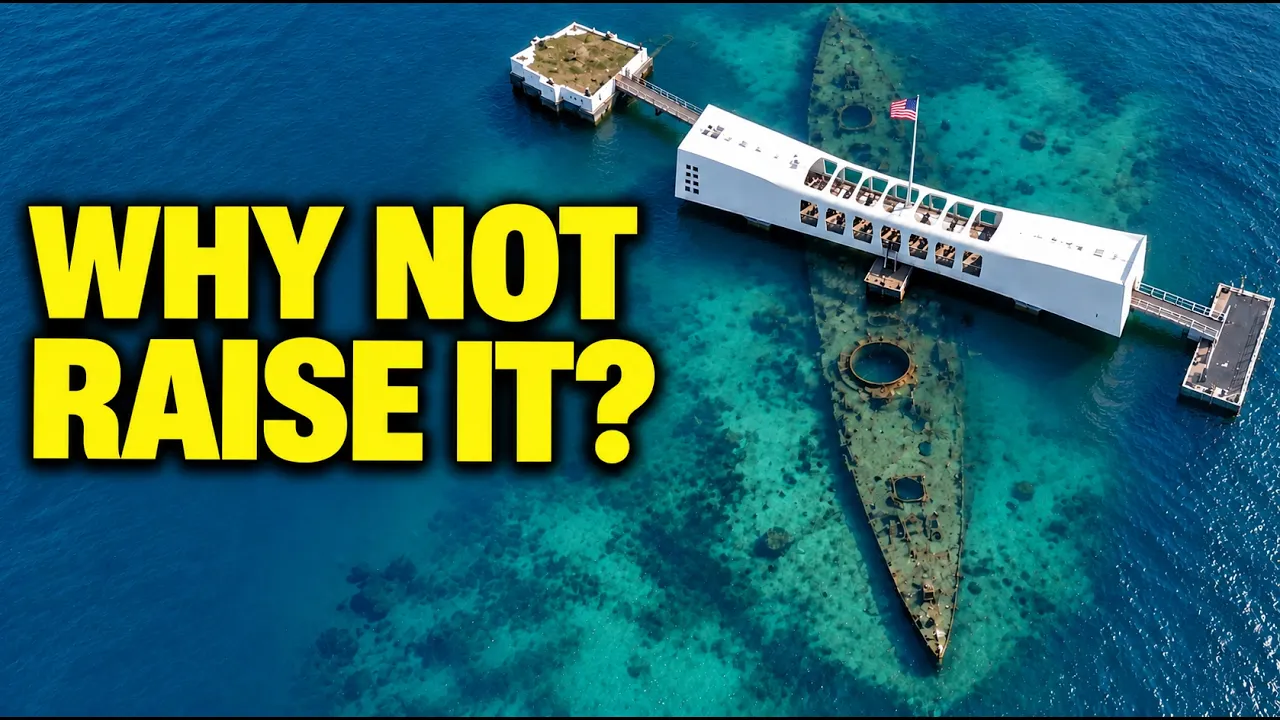
His design was not what people expected. The memorial is a white concrete structure 184 ft long that spans the sunken hole without touching it. Visitors walk into it from a small boat. They stand above the wreck itself. The middle section of the structure sags slightly. Priest said the sagging center and the rising ends represented initial defeat, eternal remembrance, and ultimate victory. Some veterans hated the design.
They wanted something more traditional. The debates went on for years. The memorial opened on May 30th, 1962. The oil was already leaking then. It is still leaking now. The Arizona sits in about 40 ft of water. That sounds shallow. In practice, it means that parts of the wreck sit just a few feet beneath the surface of the harbor. You can see the dark outline from the memorial above on a clear day. What you're seeing is the after section of the ship, the part that was after the explosion.
What you cannot see, because it no longer has a recognizable shape, is the forward section. The front third of the Arizona is gone as a structure. It was destroyed by the explosion in 1941 and has been corroding ever since. Steel frames bent into shapes they were never designed to hold. Deck plates collapsed inward. The harbor floor and the wreck have merged in many places. The after section is more intact, but intact is a word that needs qualifying.
The hole has been sitting in salt water for more than 80 years. National Park Service researchers who monitor the wreck have documented ongoing and progressive corrosion throughout the structure. In places, what was once whole plating has become part of the harbor floor. The Arizona is not a sunken ship the way most people picture a sunken ship. It is the remains of an explosion sitting on a harbor floor dissolving slowly into it.
The oil is the part that surprises people most. When the Arizona went down in 1941, she was fully fueled. Close to a million gallons of heavy fuel oil in her bunkers. Most of it burned in the fires that morning. The fires on the Arizona burned for two days, but not all of the oil burned. Estimates today put the amount still inside the wreck at around 500,000 gallons. Still there. Still liquid after more than 80 years.
Still sealed barely by tanks that have been corroding since the day the ship sank. A quart of oil seeps out of the wreck every single day. You can see it from the memorial. Small rainbow slicks drifting across the surface of the harbor. People call them the tears of the Arizona. It sounds poetic. It is also a scientific problem nobody has solved. The oil seep is being monitored constantly. Scientists from the National Oceanic and Atmospheric Administration and the National Park Service track it, measure it, study how the rate is changing.
The concern is not just environmental. It is what the oil tells you about the condition of the tanks. As long as the oil is seeping out slowly, the tanks are holding. The moment those tanks fail completely, 500,000 gallons of heavy fuel oil could pour into Pearl Harbor. Pearl Harbor is an active United States naval base. The harbor, the surrounding reef, the entire ecosystem. Every time anyone has seriously looked at the question of moving the wreck, this is one of the first things that comes up. >> [music] >> Any significant disturbance to the hole risks rupturing those tanks.
And there is no engineering plan anyone has produced that makes that risk [music] acceptable. Here's where the numbers become something other than numbers. 1,177 men died on the Arizona on December the 7th, 1941. More than 900 of them remained inside the wreck. Over the decades, diving surveys have occasionally recovered small amounts of human remains, bone fragments, teeth. The Defense POW/MIA Accounting Agency [music] has conducted careful forensic work using DNA recovered from these fragments.
A small number of men have been identified this way. A small number. >> [music] >> Because here is the reality of the forward section of the ship, the section where most of the men died. The explosion that sank the Arizona happened inside the ship. The forward magazine going up didn't just sink the whole, >> [music] >> it obliterated the interior. The men who were in that part of the ship on December 7th, 1941 were killed >> [music] >> instantly by an explosion of almost incomprehensible force.
What remains of them is mixed with 80-plus years of sediment, corroded steel, and harbor silt. Those who have studied the question most closely have consistently [music] concluded the same thing. The remains cannot be individually recovered or identified. And then there is a layer to this that most people are not aware of. Veterans who served on the Arizona can request upon their death to have their ashes interred inside the wreck, not scattered in the harbor, placed inside, lowered into a gun turret, sealed in, to rest with the crew they served alongside.
More than 30 men have done this since the memorial opened. The last living survivor of the Arizona was a man named Lou Conter. He survived the attack as a young seaman. He spent the rest of the war in the Pacific, survived, came home, lived his life. He talked about the Arizona for the rest of his life. He came back to the memorial every year he could. He died in April at the age of 102. When he was gone, there was no one left who had stood on that deck.
The Arizona is not just a wreck with men inside. It is a graveyard that people are still choosing to join. Any conversation about raising it has to start there. Congress designated the Arizona a national memorial in 1962. The wreck sits within a web of overlapping legal protections, memorial designation, military burial authority, and National Park Service preservation mandate. No single law you can point to on one page, but a barrier that no government agency with jurisdiction has ever shown any interest in unpicking.
And what you would be doing is excavating a federal way war grave. A war grave containing the co-mingled remains of close to a thousand American servicemen, some of whom cannot be individually identified, some of whom were specifically requested to be left there by their surviving families, some of whom chose in death to be placed inside. No legal framework exists to do that. American law has procedures for military burials, for the recovery of remains from overseas battlefields, for the identification of the missing.
It has no procedure for excavating a national memorial containing the remains of men who were deliberately and officially interred there. Nobody has tried to write one because every time the question comes up seriously, whoever is asking it reaches the same place. What do you do with 900 men? And nobody has an answer. But even if you set all of that aside, even if you resolve the law, resolve the ethical questions, found an answer for the remains, here's what you would actually be trying to raise.
The forward section of the ship, roughly the first 200 ft, is not salvageable as structure. It was destroyed by the explosion in 1941. You would not be lifting it. You would be excavating it piece by piece from a harbor floor in conditions of near zero visibility in a working naval base above a 500,000 gallon oil tank. The after section is more intact, but it has been embedded in the harbor sediment for more than 80 years.
The weight of the hull has pressed it down. Any attempt to raise what remains would be an engineering undertaking without modern precedent. To understand how difficult that is, look at what the Navy did with the USS Oklahoma. Oklahoma was also sunk at Pearl Harbor on December 7th, 1941. Unlike the Arizona, Oklahoma capsized rather than sank. And unlike the Arizona, the Navy decided to raise her. The Oklahoma had been on the bottom for less than two years when salvage began.
Her steel was still structurally sound. Her interior, while flooded, was not destroyed. >> [music] >> The salvage took nearly two years. Engineers drove rows of winches into the harbor floor and slowly, inch by inch over months, dragged the hull upright using steel cables. It remains one of the largest ship salvage operations ever attempted. The Oklahoma came up. And she was so damaged after two years on the bottom that the Navy immediately decommissioned her.
She was stripped and sold for scrap. >> [music] >> In May 1947, two tugboats began towing what was left of the Oklahoma toward a breaker's yard in California. Halfway there, a storm hit. The Oklahoma began listing. The tow cables had to be cut to save the tugs. The Oklahoma sank in the open Pacific. Her exact resting place has never been found. The Arizona has been on the harbor floor 40 times longer than the Oklahoma was when that salvage began.
What the Oklahoma required was nearly two years of work in good conditions with a structurally intact hull. What the Arizona would require is something without a historical precedent. And the outcome, even if it succeeded, would [music] be a corroded oil-soaked, partially destroyed hole with no military or historical use. You would not end up with a ship. You would end up with a problem. Over the decades, people have proposed raising the Arizona periodically.
Politicians have brought it up. Veterans groups have discussed it. Every serious examination has reached the same conclusions in roughly the same order. The overlapping legal protections make it extraordinarily complex. The remains cannot be ethically disturbed. The oil is a serious environmental risk. The engineering is somewhere between extraordinarily difficult and practically impossible. And the outcome would be the destruction of the existing memorial.
The memorial that 2 million people visit every year. The memorial that is, for many Americans, one of the most meaningful places in the country. You would be destroying it to recover wreckage. No proposal has ever passed the first serious review. None has come close. Here's the part nobody really talks about. The people responsible for the Arizona aren't trying to [music] raise it, but they're also watching it disappear.
The National Park Service conducts regular surveys of the wreck. Dive teams go down, measure the whole thickness, and document the structural changes. The surveys in recent years have shown the deterioration is accelerating. Sections that were measurably thicker a decade ago are thinner now. Parts of the outer hole that were intact in the surveys of the 1990s are now perforated. The bow structure, what little remains of it, is settling further into the harbor floor every year.
Marine biologists have found that the rate of corrosion increases as the whole thins. Thinner steel corrodes faster, which means the ship is disappearing faster than it was. The official position of the National Park Service, quietly but clearly stated, is this: The Arizona will be allowed to rest where it is until nature takes it, not raised, not excavated, not disturbed, allowed to go. The memorial will stay. The site will stay.
The gun turret barbettes that you [music] can see today sticking up above the surface will eventually drop below it. The oil will keep seeping out until the tanks finally fail completely and whatever is left drains away. Eventually, there will be nothing visible at all. Just water and the white memorial above it and the harbor floor beneath >> [music] >> where the Arizona has been pressing itself for more than 80 years.
The question of why the Arizona was never raised usually gets asked as though the answer is about money or technology that hasn't been invented yet or politics that nobody has resolved. All of those things are true, but the real answer is about the men inside. Raising the Arizona means doing something [music] to 900 people. Deciding what to do with remains that in many cases cannot be individually [music] identified, disturbing men whose families specifically requested they stay there, removing men who chose in their own deaths to be placed inside.
The Arizona is not a shipwreck that nobody got around to dealing with. >> [music] >> It is a grave that people decided to leave as one, not by accident, not by neglect, [music] by a series of deliberate choices made over more than 80 years by the Navy, by Congress, by the National Park Service, and by the families of the men inside. The bell of the USS Arizona was recovered in 1950. It sits today at the University of Arizona in Tucson.
Every December 7th, it rings in remembrance of all 1,177 men [music] who died aboard the Arizona. It takes a while. The ship it came from is still where it sank. The hull is thinning. The oil is leaking. The men are still inside. >> [music] >> In a few decades, maybe less, there may be nothing visible on the surface at all, just the memorial and the water, and 80-plus years of history pressed into the harbor floor beneath it.
The Arizona has been at the bottom of Pearl Harbor for more than 80 years. Every single person with the authority to change that has decided it should stay exactly where it is. That is not a failure to act. That is the answer, and it always will be. If you want to see the video about what is still happening to the Arizona's hull today, and what the National Park Service found on their most recent dive survey, that one is right here.
And if you're new to this channel, we cover stories like this one every week. There are a lot more of them.
The words are the caption track's own and nothing is reworded or re-transcribed. Paragraph breaks are placed between sentences so the text reads as prose.
Free tools for your own script. No signup, no login.
Paste your draft and see where viewers are likely to drop off, with a rewrite for each weak line.
Paste the first 30 seconds of your own draft for a hook score and rewrites.
Check your draft against YouTube's advertiser-friendly guidelines before you record it.
Read this channel's public videos and transcripts, and download a writing brief for it.