Getting the transcript
Reading the captions from YouTube. A video nobody has opened here before takes 10 to 30 seconds; this page fills in on its own.
Getting the transcript
Reading the captions from YouTube. A video nobody has opened here before takes 10 to 30 seconds; this page fills in on its own.
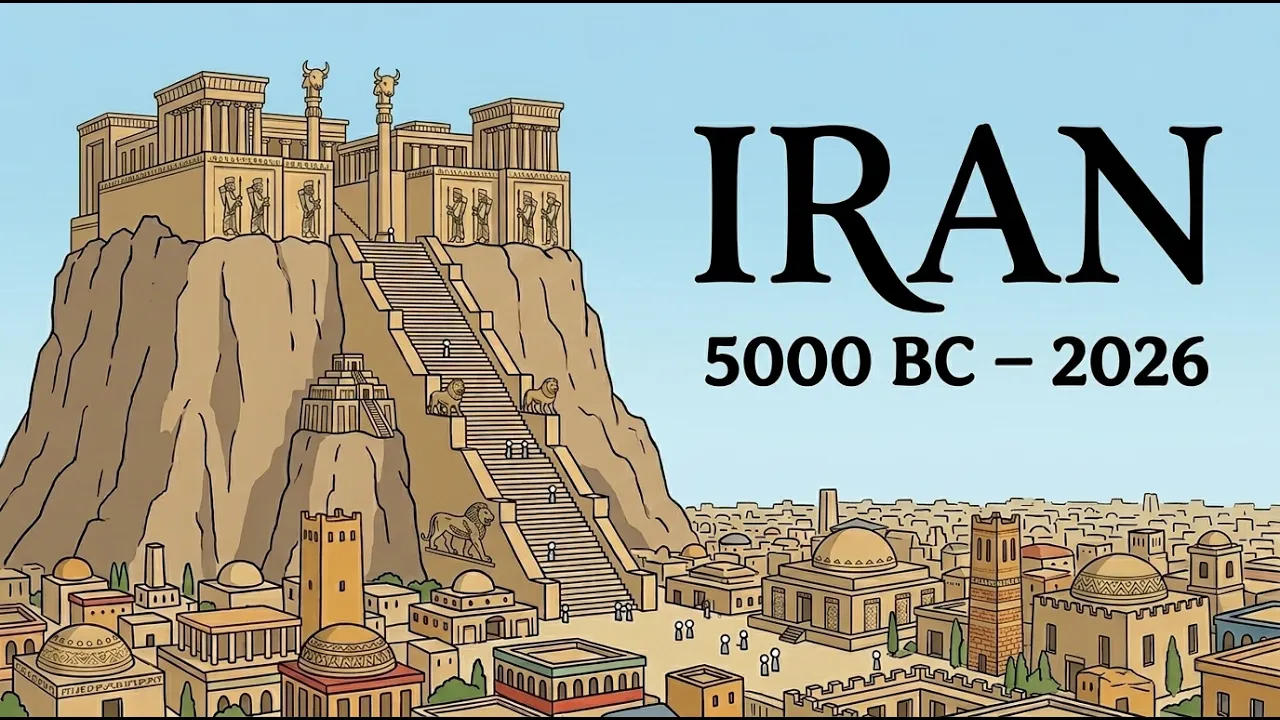
Genius History · @genius_history01
Where viewers went back to watch this video again, from YouTube's public Most replayed graph, lined up with what was said at that moment.
Most replayed moment #1
6:152.9x the video's typical replay level
was the law. They were a superpower that fought Rome and Byzantium for 400 years, but those 400 years of war left Iran exhausted and bleeding. In the 7th century, a new force came out of the deserts of Arabia, the Arab Caliphate. The Persian capital fell, and all of
Said at 6:08
Most replayed moment #2
3:312.5x the video's typical replay level
world had a beginning and it will have an end. There will be a final battle, a purification by fire, and a final judgment. When the Persians later conquered Babylon, they freed the Jewish people who were being held captive there. During those years, Jewish thinkers
Said at 3:25
Most replayed moment #3
2:252.4x the video's typical replay level
diplomacy, it stood at its very beginning. The people we call Iranians today arrived later. Sometime between 2,000 and 1,500 BC, nomadic tribes began moving onto this mountainous plateau from the north. They belonged to the same family of people who would eventually settle Europe. In fact, their
Said at 2:17
The graph counts replays. It does not show where viewers stopped watching.
Words
1,902
Runtime
10:57
Speaking pace
174wpm
Reading time
8min
174 words per minute, between the 160 25th percentile and the 181 median of 349 measured videos. That distribution comes from the 349-video hook study.
Opening (first 30 seconds)
For thousands of years, the world's greatest empires made the exact same fatal mistake. They marched onto the Iranian plateau with their swords drawn, absolutely certain they could wipe this civilization off the face of the earth forever. The legendary armies of Alexander the Great invaded here. The ruthless Roman legions marched here. Arab armies swept in under the banners of a new religion, and the terrifying Mongol hordes of Genghis Khan tore through, leaving behind nothing but towers of skulls. In any other part of the
87 words, the words spoken in the first 30 seconds at 174 words per minute.
Free, no signup. See how the first 30 seconds hold attention, with rewrites.
Sentence shape
| Measure | This transcript |
|---|---|
| Sentences | 148 |
| Average words per sentence | 12.9 |
| Longest sentence | 36 words |
| Questions asked | 4 |
| Sentences containing a number | 24 |
Most used terms
Filler phrases
10 in total: like 9 · literally 1.
A literal whole-word count of the same phrase list the Prepublish browser extension uses, so a phrase inside another word is not counted and a phrase used in its ordinary sense still is. It is a count and not a judgement.
Run the check on the words above: where attention is likely to drop, with a rewrite for each weak line. The free check shows the scores and the one issue costing the most.
What this transcript is
Every word below is the caption track YouTube publishes for this video, pulled from the video itself and reproduced unchanged. It is not Prepublish's writing, not a summary, and not a re-transcription: it is the video's own published captions. English captions, generated automatically by YouTube, in the video’s original language. Source: the video on YouTube. A channel that would rather this page did not exist can ask for its removal through the contact page, and it is removed.
For thousands of years, the world's greatest empires made the exact same fatal mistake. They marched onto the Iranian plateau with their swords drawn, absolutely certain they could wipe this civilization off the face of the earth forever. The legendary armies of Alexander the Great invaded here. The ruthless Roman legions marched here. Arab armies swept in under the banners of a new religion, and the terrifying Mongol hordes of Genghis Khan tore through, leaving behind nothing but towers of skulls.
In any other part of the world, a nation would have vanished forever after suffering that many blows. They would have dissolved into history, just like the Babylonians, the Hittites, or the Assyrians. But with Iran, something impossible happened. Time and time again, despite losing on the battlefield, despite losing their capital cities, and despite being occupied by foreigners, the Iranians did something no one else could do.
They absorbed their conquerors. Just a few decades would pass, and the brutal invaders would start speaking the Persian language. They would start building Persian-style buildings, using Persian laws, and even wearing Persian clothes. Again and again, Iran essentially digested its enemies. How has Iran managed, from the ancient world right up to today, to force every major power to deal with it? How did they keep their identity alive for 5,000 years?
And why did this legendary country suddenly abandon its famous name, Persia, and force the world to call it Iran? This is the story of how one nation invented the way we think about time, turned politics into a holy war between light and darkness, and learned how to lose battles in order to win eternity. To understand how deep this culture goes, we have to go back to the very beginning. Most people think of ancient Egypt or Mesopotamia as the start of civilization.
In those history books, Iran is often left out, but that is a massive mistake. Archaeologists have found cities in Iran that are 7,000 years old. These people were standing shoulder to shoulder with the great powers of the ancient world. The first big player here was a state called Elam. They were so powerful that they were giving orders to the famous Sumerians. But the most mind-blowing thing happened in the 23rd century BC.
After a war, the Elamites and their neighbors signed a written treaty. This is the first documented international treaty in human history. Iran didn't just join global diplomacy, it stood at its very beginning. The people we call Iranians today arrived later. Sometime between 2,000 and 1,500 BC, nomadic tribes began moving onto this mountainous plateau from the north. They belonged to the same family of people who would eventually settle Europe.
In fact, their ancient language was a direct relative of Latin, Greek, and even English. They called themselves Aryans, which meant noble, and they named their new home the land of the Aryans. Over time, that name changed into the word we know today, Iran. But it wasn't just land they claimed, it was a new way of thinking. In these harsh mountains, a religion was born that changed human consciousness forever, Zoroastrianism.
Before this, most people thought life was just a circle, seasons changing, things repeating forever. But for an ancient Iranian, the universe was a battlefield between a god of light and truth and a spirit of absolute evil and darkness. To be Iranian meant you were a warrior of light. This religion did something massive. It was the first in history to say that time does move in a straight line. The world had a beginning and it will have an end.
There will be a final battle, a purification by fire, and a final judgment. When the Persians later conquered Babylon, they freed the Jewish people who were being held captive there. During those years, Jewish thinkers learned these ideas about the end of times and judgment day from the Iranians. Later, these ideas flowed into Christianity and Islam. We literally live in the linear time that ancient Iranians invented.
The first truly great superpower of the Aryans was built by a man named Cyrus the Great in 550 BC. Cyrus was different from the cruel kings of the past. When he conquered a city, he didn't destroy their temples or turn them into slaves. He built an empire on respect. His successor, Darius the First, expanded those borders even further. Nearly 50 million people, half the population of the entire world at that time, lived under Persian rule.
Darius was a genius at organizing. He divided the country into districts, created a single tax system, minted gold coins, and built a massive network of roads. Along these roads, he created the fastest postal service the world had ever seen. But history is brutal. Cyrus the Great eventually died in a terrifying battle in Central Asia. Legend says the enemy queen cut off his head and dipped it in a bag of blood saying, "You wanted blood?
Now drink your fill." We are often told that the Greeks destroyed the Persians in the famous wars involving the 300 Spartans, but that is mostly a Western myth. While the Greeks defended their home, for the giant Persian empire, losing a few small cities was like a mosquito bite. The Persians just changed their plan. They started using their massive wealth to pay the Greeks to fight each other. They made Athens and Sparta go to war.
And eventually, the exhausted Greeks were forced to sign a treaty on the Persian king's terms. Persia became the master of Greece without firing a single shot. The real disaster happened later. A young ambitious king from Macedonia named Alexander the Great invaded in 330 BC. He crushed the Persian army and burned down their most beautiful palace. It looked like the 1,000-year history of Iran was finished. But this is where the Iranian survival mechanism kicked in.
Eastern culture began to eat its Western conquerors. Alexander the Great himself started wearing Persian clothes and following Persian customs. The Greek invaders were being turned into Persians. Eventually, the Greeks were kicked out by the Parthians and the Sassanids. For 700 years, these Iranian empires were the only force on Earth that could stop the Roman Empire. They dealt crushing defeats to the Roman legions over and over again.
Then, in the year 224, a new golden age arrived. The Sassanids created a powerful centralized state where Zoroastrianism was the law. They were a superpower that fought Rome and Byzantium for 400 years, but those 400 years of war left Iran exhausted and bleeding. In the 7th century, a new force came out of the deserts of Arabia, the Arab Caliphate. The Persian capital fell, and all of Iran was brought under Arab rule.
The Arabs brought a new religion, Islam, and a new language. For any other culture, this would have been the end. In Egypt or Syria, the local languages and identities vanished and became Arab. But the Persians did it again. They lost the military battle, but they won the cultural war. The Arab rulers realized they couldn't run their giant empire without Persian bureaucrats, scholars, and poets. The Persian language, Farsi, did not die.
It survived and became the language of science and beautiful poetry. The Arabs might have conquered the land, but the Persians reprogrammed the empire. After the Arabs, a true apocalypse hit Iran. In the year 1220, the Mongols under Genghis Khan arrived. The Mongols didn't just conquer, they destroyed everything. They wiped out irrigation systems and slaughtered entire cities. It looked like Iran would just become a field for nomads to graze their horses.
But when Genghis Khan's grandson founded a state here, something incredible happened. The fierce Mongol conquerors suddenly converted to Islam. They made Persian the official language of their state. They started building giant Persian mosques with beautiful blue domes and supporting Persian poets. At the end of the 1300s, it happened again. A conqueror named Tamerlane invaded. He was famous for building pyramids out of human heads, but even he was amazed by Persian culture.
He took Iranian artists back to his capital, and his children started a Persian Renaissance. For almost 300 years, the people sitting on the throne were Mongols or Turks, but within a few generations, they all became Persian. The Iranian cultural code was like a virus that infected and changed every invader. In 1501, a man named Shah Ismail reunited the country. He made Shia Islam the official religion, which forever Iran from the rest of the Islamic world and the Ottoman Empire.
Iran had once again forged a unique identity. But by the 1800s, the country entered a massive crisis. Powerful empires like Russia and Britain began playing a great game in Iran. They carved the country into spheres of influence. The British were taking the oil while the Russians occupied the north. The country was suffocating under colonial powers, but Iran found a way out. In 1925, a leader named Reza Shah took power.
He wanted to modernize the country as fast as possible. In 1935, he made a move that shook world diplomacy. For centuries, the Western world had called the country Persia. To Europeans, that name sounded like fairy tales, old carpets, and a culture that was stuck in the past. Reza Shah declared, "Enough." He sent a message to every embassy in the world. From now on, you must call us by our true ancient name, Iran, the land of the Aryans.
This wasn't just a small change. It was a statement. He was telling the world, "We are not an exotic colony. We are a modern, powerful nation with ancient roots, and you will respect us." The history of Iran is always a history of radical turns. In the 20th century, the country became a pawn in the games of the world superpowers. Decades of foreign interference and political pressure eventually led to the Islamic Revolution of 1979.
The monarchy was overthrown, Iran became a theocratic republic, and its relationship with the West was broken. Today, we see a strange paradox. In the minds of most people, two different Irans exist at the same time. When people hear the name Iran, they think of news reports, sanctions, and political tension. But at the same time, the word Persia hasn't disappeared. It has become a romantic, mythical name associated with ancient grandeur, flying carpets, and legendary empires.
Two names, one land, and a constant struggle over how the world will remember them. Over 5,000 years of history, this culture developed the ultimate survival skill. Whether it was the Greeks, the Arabs, or the Mongols, they didn't disappear. They changed their conquerors to be more like them. They stood at the very beginning of civilization and invented the way we think about time. But their greatest battle is happening right now.
Hidden behind the simple name of a country is a quiet, invisible war. It's a war between who they were in the past, who they are today, and how the world wants to see them. Iran doesn't just survive history, it outlasts it. Thank you for watching this 5,000-year journey. If you found this helpful, make sure to like and subscribe for more deep dives into the stories that shaped our world. See you in the next one.
The words are the caption track's own and nothing is reworded or re-transcribed. Paragraph breaks are placed between sentences so the text reads as prose.
Free tools for your own script: paste a draft and see where it stands before you record it.
Paste your draft and see where viewers are likely to drop off, with a rewrite for each weak line.
Paste the first 30 seconds of your own draft for a hook score and rewrites.
Check your draft against YouTube's advertiser-friendly guidelines before you record it.
Read this channel's public videos and transcripts, and download a writing brief for it.