Getting the transcript
Reading the captions from YouTube. A video nobody has opened here before takes 10 to 30 seconds; this page fills in on its own.
Getting the transcript
Reading the captions from YouTube. A video nobody has opened here before takes 10 to 30 seconds; this page fills in on its own.
Dark Skies · @DarkDocsSkies
Where viewers went back to watch this video again, from YouTube's public Most replayed graph, lined up with what was said at that moment.
Most replayed moment #1
6:448.7x the video's typical replay level
the aircraft had been tracked at speeds as high as Mach 3.2. The Americans had no idea how the Soviets had managed to create an aircraft this powerful. And it seemed they would never have a chance to catch one to find out for themselves.
Said at 6:37
Most replayed moment #2
12:047.6x the video's typical replay level
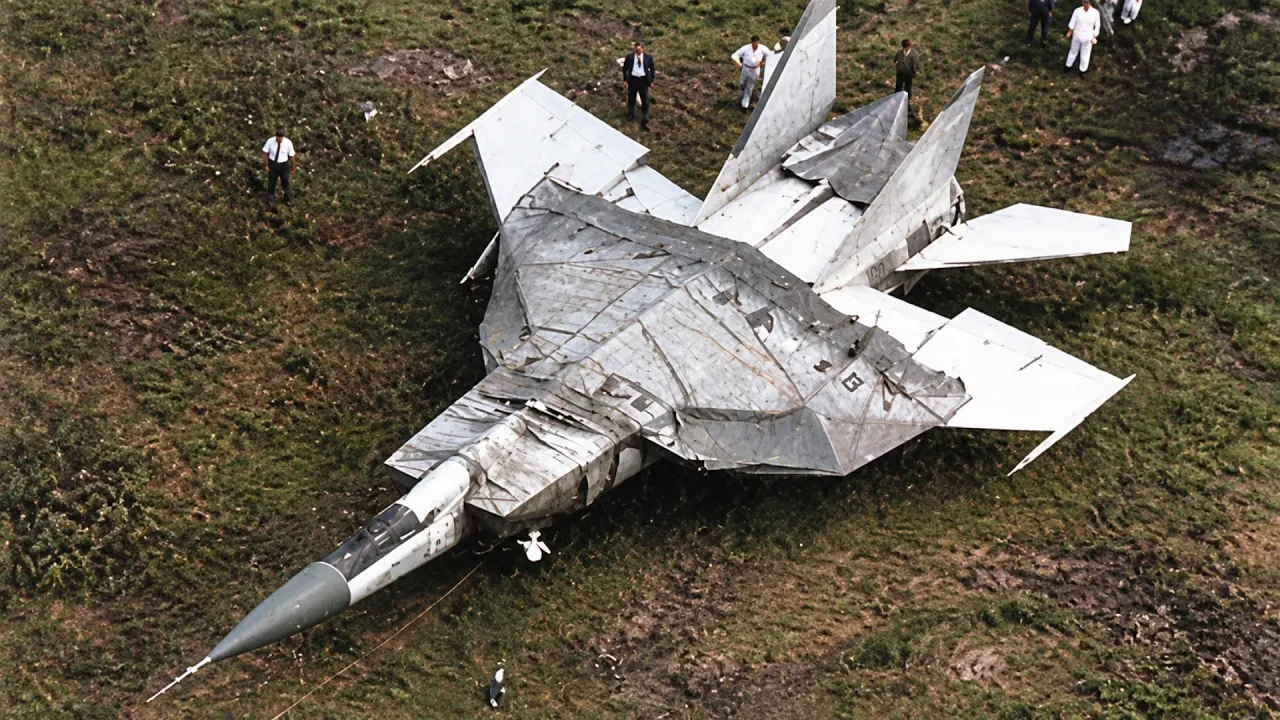
The jet kept going even after the asphalt ended, rolling about 800 feet across the grass ahead before the Soviet pilot managed to bring his aircraft to a full stop.
Said at 11:59
Most replayed moment #3
18:347.3x the video's typical replay level
those times, the pilot and the rest of the crew at the air base would gladly finish it themselves. Reportedly, the so-called MiG alcohol became so popular that soon enough Soviet crews began
Said at 18:31
The graph counts replays. It does not show where viewers stopped watching.
Words
3,440
Runtime
23:12
Speaking pace
148wpm
Reading time
14min
148 words per minute, below the 160 25th percentile of 349 measured videos. That distribution comes from the 349-video hook study.
Opening (first 30 seconds)
A Soviet pilot defected to the West in a MiG-25, landing at a civilian airport in Japan, with one of the Cold War’s most closely guarded secrets. For years, the West had watched this aircraft from a distance, flying higher and faster than anything they could intercept. Fighters couldn’t reach it. Missiles struggled to lock onto it. Then, in 1976, the United States finally got its hands on the MiG-25. And when they opened
74 words, the words spoken in the first 30 seconds at 148 words per minute.
Free, no signup. See how the first 30 seconds hold attention, with rewrites.
Sentence shape
| Measure | This transcript |
|---|---|
| Sentences | 162 |
| Average words per sentence | 21.2 |
| Longest sentence | 62 words |
| Questions asked | 1 |
| Sentences containing a number | 60 |
Most used terms
Filler phrases
9 in total: like 6 · sort of 2 · actually 1.
A literal whole-word count of the same phrase list the Prepublish browser extension uses, so a phrase inside another word is not counted and a phrase used in its ordinary sense still is. It is a count and not a judgement.
Run the check on the words above: where attention is likely to drop, with a rewrite for each weak line. The free check shows the scores and the one issue costing the most.
What this transcript is
Every word below is the caption track YouTube publishes for this video, pulled from the video itself and reproduced unchanged. It is not Prepublish's writing, not a summary, and not a re-transcription: it is the video's own published captions. English captions, published by the channel, in the video’s original language. Source: the video on YouTube. A channel that would rather this page did not exist can ask for its removal through the contact page, and it is removed.
A Soviet pilot defected to the West in a MiG-25, landing at a civilian airport in Japan, with one of the Cold War’s most closely guarded secrets. For years, the West had watched this aircraft from a distance, flying higher and faster than anything they could intercept. Fighters couldn’t reach it. Missiles struggled to lock onto it. Then, in 1976, the United States finally got its hands on the MiG-25. And when they opened it up, it was not the machine they thought it was.
The eyes of American officials remained glued to the TV screens as they witnessed a pack of Soviet jets taking off. Halfway across the world, the USSR was holding an air show at Domodedovo Airport in Moscow, and the event was being broadcast to foreign audiences, translated into English. Whatever was about to take off from the runway, the Soviets really wanted everyone to see: a trio of Soviet aircraft that no one could immediately recognize cut across the clouds.
Their long, sharp nose design, swept-back wings suited to high-speed flight, and a set of vertical tails suggested this was the latest evolution of the MiG clan. Its name was the MiG-25, although many would soon refer to it as “Foxbat.” It was unlike any of the models that had come before it. To start, the fuselage was flanked by two colossal air intakes located just behind the cockpit. Even compared to aircraft like the American one of the fastest aircraft in the U.S. at the time, few units featured intakes this large and imposing.
Whatever was powering this new Soviet creation called for a dramatic airflow. The Americans couldn’t know exactly what sort of powerhouse the Foxbat was working with, yet a single look at the back of the mysterious new fighter hinted that the U.S. should be worried. Pushing the aircraft forward were two monstrous engines, large enough to comfortably fit at least two people inside them. It was impossible to know how fast they could go just by watching them go on TV, but if size alone was any indication, there was a good chance they could considerably surpass the already impressive Mach 2 speed of the MiG-21.
The jets darting over Moscow also sported a particularly long wingspan, somewhere around 45 feet. The MiG-25 could very well have been designed specifically to serve as the ultimate Soviet defender. Suddenly, America’s entire aerial strategy was at risk. At the time, the U.S.’s main aerial deterrent relied on units like the B-58 Hustler, a bomber capable of flying twice the speed of sound and dropping both conventional and nuclear payloads over Soviet targets before defenses could intercept them.
With these new aircraft taking over, however, America could soon face a fleet of supersonic interceptors, making any attempt to infiltrate Soviet airspace nearly impossible. Without knowing exactly what they were up against, America could do little to counter the menace taking shape over the skies of the Soviet Union. Officials didn’t know how, but one way or another, they needed to get their hands on the MiG-25. The Foxbat would officially be introduced into service in 1970, but it wasn’t until the following year that the world could catch another glimpse of the enigmatic aircraft.
In October, Israeli officials reported that a pack of foreign jets was banking hard over the Mediterranean and approaching the northern coast of their nation. Recently, Israel had been conducting reconnaissance flights over Egyptian airspace to track potential threats before tensions between the two countries detonated. For the Soviet Union, this constituted a provocation, and so now it was their time to conduct an operation near Israeli territory on behalf of the Egyptians.
Guiding the mission were a set of MiG-25s equipped with camera systems powerful enough to capture images from over 70,000 feet above the ground. Not even the American MIM-23 Hawk surface-to-air missiles the Israelis were armed with could go up that high. If the Israelis were to catch the intruders, their best shot would be to go after them on board their F-4 Phantom IIs. However, no matter how close the U.S.-made jets got to the Soviet aircraft, these always seemed to be one step ahead.
While the Phantom’s maximum service ceiling was capped somewhere around 60,000 feet, the Foxbats flew somewhere between 75 and 78 thousand feet above the ground. The best chance the Phantoms could get to strike down the Soviets was to accelerate enough to get into a very specific position before releasing their AIM-7E Sparrow missiles. But not even experienced pilots could get this quite right, because even if they managed to get their aircraft into the right spot, the window to release their strike was so short that, in just a matter of seconds, the MiG-25 could easily get out of the way.
Not a single Israeli Phantom managed to land an effective strike. Years later, an Egyptian pilot tasked with following the Foxbat flights through radar revealed: (QUOTE) “We saw Phantoms being scrambled… They were climbing at maximum speed, but never came even near. Sometimes they would manage to cross the flight paths of MiG-25s, but in reality were much lower than the MiGs. Israeli [missiles] were equally helpless.” To make matters worse, not even while operating so close to the MiG-25 could Israel, or the rest of its Western allies, get any more information on the Soviet jet.
When not up in the sky, the aircraft was kept in underground shelters protected by Soviet soldiers. Test runs were carried out in deserted regions, in radio silence, far from prying eyes that could gather valuable information on their full capabilities and potential weaknesses. Still, despite the secrecy, there was one mystery the MiG-25 local radar stations could solve. According to reports, during some missions over the skies of the Middle East, the aircraft had been tracked at speeds as high as Mach 3.2.
The Americans had no idea how the Soviets had managed to create an aircraft this powerful. And it seemed they would never have a chance to catch one to find out for themselves. Now, all they could do was hope for a miracle. A miracle named Viktor Belenko. No one could have suspected that Belenko wasn’t quite like the rest of the Soviet Air Defense Forces pilots. At 29 years old, he held the rank of Lieutenant among the 513th Fighter Regiment, flying some of the USSR’s most advanced aircraft as he patrolled the far eastern region of the country he was tasked with keeping safe.
His life at home seemed just as perfect to outside observers, greeted by a wife and young son every time he returned from a mission. But behind closed doors, a quiet frustration was setting in inside Belenko. With each passing year, the pilot kept questioning whether he was working for the right side. By the mid-70s, the Soviet Union was slowly showing signs of stagnation; yet censorship and citizen surveillance remained as powerful as ever.
Years later, Belenko would admit: (QUOTE) “Soviet propaganda at that time portrayed [America] as a spoiled rotten society which has fallen apart. But I had questions in my mind.” At some point, Belenko began to wonder: what would happen if the next time he got on board his aircraft, he just kept flying ahead instead of heading back to his Soviet base? In the USSR, just having that thought could be dangerous. Still, the pilot did not abandon his idea.
Perhaps he had heard the stories of Soviet allies who had escaped to the West. In the 50s, a duo of Polish pilots had taken off and headed toward Denmark aboard two MiG-15 fighters. Over in North Korea, shortly after the Korean War reached a military truce, aviator No Kum-sok fled from a base near Pyongyang aboard another MiG-15 and flew toward South Korea. These men could have lost their lives for what they did, yet upon successfully delivering such valuable aircraft to the West, they were awarded with state decorations, got to shake hands with American presidents, received rewards equivalent to over a million dollars when adjusted for inflation, and had the chance to make a new life for themselves upon being granted American citizenship.
If these men had been so lauded for handing a MiG-15 to the West, then Belenko could only imagine how good he would have it if he managed to deliver one of the most feared and secretive jet models of the USSR to the Americans. There were no guarantees he’d make it alive, and even if he did, he’d probably never be able to return to the USSR, nor see his family again. Still, his mind was made up. He was stealing a MiG-25 for the enemy.
The perfect opportunity for Belenko to escape came on September 6th, 1976. The pilot was scheduled to conduct a training mission, taking off from the Chuguyevka air base near the eastern shore of the country, and just a few hundred miles from Japan’s coast. The day of the mission, Belenko made sure to pack his military ID and a notebook with flight data. The aircraft could travel over 1,000 miles under the right conditions, enough to reach Japan.
However, at high speeds, fuel would burn rapidly, and upon checking his fuel levels, the pilot couldn’t be sure the aircraft would have enough range to reach his destination. Still, as the pack took off and assumed position over the Sea of Japan, Belenko decided he wasn’t going back. According to reports, he grabbed his radio and reported to his fellow pilots that his aircraft was experiencing engine trouble. Once out of sight of the rest of the MiG-25s, Belenko turned in the opposite direction and set course toward Japan.
To avoid both Soviet and Japanese radar, he flew his aircraft as close to the waterline as possible, down to somewhere around 100 feet. His goal was to reach Chitose Air Base, located in the southwest of Hokkaido Island. However, all the pilot had to guide himself was a map of Japan he had memorized before departure. Before he knew it, he was lost, flying over Japanese territory yet unable to find a single military base where he could land.
Fuel was running out; if he didn’t get the MiG-25 down soon, the jet would give up. It’s said he only had minutes’ worth of fuel left when he finally spotted a runway below. It belonged to the civilian airport in Hakodate. The landing strip was too short, and Belenko was coming in too fast. As the jet came down, it touched down on the runway with enough force to make the whole fuselage quake. Belenko pulled the brakes as fast and hard as he could, the wheels beneath the aircraft burning as they approached the end of the landing strip.
The jet kept going even after the asphalt ended, rolling about 800 feet across the grass ahead before the Soviet pilot managed to bring his aircraft to a full stop. Belenko unstrapped himself and stepped out of the cockpit just as onlookers and airport vehicles began to gather around his aircraft. He didn’t speak English or Japanese. Still, he needed to make sure no one messed with him, not before he had a chance to speak with officials.
And so, without thinking about it, Belenko pulled out a pistol and fired a couple of warning shots. The local authorities proceeded to take him into custody. The USSR demanded that Japan return its aircraft and pilot at once, while America asked Japan to let engineers inspect the aircraft before it was sent back. Japan certainly didn’t want to be on bad terms with a nation armed with nuclear missiles positioned well within striking distance of its shores.
On the other hand, if Japan agreed to help the Americans, they might unlock valuable military knowledge that could help keep the country safe against potential escalations with the Soviets. And so, at first, the U.S. was allowed only to observe the aircraft up close and run a couple of tests on a few systems. However, by the time the aircraft was finally sent back to the USSR two months after Belenko’s defection, the Soviets immediately realized the Americans had done far more with their precious jet.
The MiG-25 had been cracked open, sent back to the nation in pieces inside 30 crates shipped to the Soviets by cargo ship. They could tell the engines, radar, and avionics had been tested. Moreover, it was reported that at least 20 parts of the jet were missing, presumably kept by the Americans for further analysis or perhaps for reverse engineering. The delivery of the deconstructed MiG-25 also came with a bill from the Japanese government.
For the damage to Hakodate Airport caused by Belenko’s emergency landing, as well as for the time and effort invested in packing and sending the crates, authorities demanded that the USSR pay $40,000. In return, the Soviets told the Japanese they ought to pay a fine for the MiG-25 pieces that were lost under their watch. They put the price tag at 10 million dollars. According to reports, as of this day, there is no evidence that either country ever paid the other.
As for Belenko, the Soviets told their people stories about him losing his life in a car crash or returning to the USSR after his defection, only to be executed. In reality, he was allowed to stay in the United States, where, after being granted citizenship, he started a new life as an aerospace engineer, helping America understand the many secrets of Soviet aircraft, starting with the MiG-25. And, as it turned out, the aircraft was nothing like what the U.S. had once believed it to be.
As the Americans dismantled the MiG-25, they quickly realized that it was by no means the ultimate interceptor they had feared for years. According to aerospace analyst Stephen Trimble: (QUOTE) “[The Americans] seemed to [have overestimated the jet’s] abilities based on its appearance, from the size of the wing and the huge size of its air intakes. They knew it would be very fast, and also thought it would be very maneuverable.
They were right about the first one, but not so right about the second one.” As it turned out, the moment the Soviets learned that the Americans were working on high-speed, high-altitude nuclear bombers by the late 50s, the USSR became convinced that the only way to ensure the nation’s survival was to get a supersonic interceptor off the ground in record time. And they would achieve it no matter how many compromises had to be made.
In particular, the USSR was nervous about the prospect of facing the North American XB-70 Valkyrie, an aircraft said to be capable of taking off from American bases, covering over 4,000 miles of terrain, deploying some of the most devastating payloads in the U.S. arsenal, and getting away from the blast to avoid any damage thanks to its ability to go over 2,000 miles per hour. Ultimately, the Valkyrie would never enter operational service, but the Soviets were moving forward with their supersonic concept.
The first major challenge was how to give the jet enough thrust to go faster than any aircraft the Americans might deploy against it. The answer came in the form of the Tumansky R-15 powerhouse, an almost 5,500-pound giant that had originally been planned to serve as an engine for single-use cruise missiles. While undoubtedly powerful, when Americans tested it, they realized that as it reached full power, the temperature became so high that it began burning itself apart.
Whenever the aircraft was seen flying past Mach 3 near Israel, it was probably only attempting to intimidate its rivals. When it got back to base, it likely needed considerable repairs or to have entire engines removed. At extreme speeds, the thermal stress became so high that the entire aircraft was pushed to its limits. To deal with this, the Soviets opted to use a nickel-steel alloy to build almost the entire jet.
While considerably heavier than titanium, this material was far more heat-resistant and easier to work with. Additionally, to protect all internal electronic compartments during flight, engineers surrounded them with a cold liquid mixture of water and pure grain alcohol. It’s said that during some missions, the aircraft could burn as much as 130 gallons of this concoction. However, it’s also reported that during some flights, the MiG-25 didn’t burn through its entire supply.
And during those times, the pilot and the rest of the crew at the air base would gladly finish it themselves. Reportedly, the so-called MiG alcohol became so popular that soon enough Soviet crews began referring to the aircraft as “Letayushchiy Gastronom,” or “the flying restaurant.” Ultimately, the colossal engines, heavy steel frame, and gallons of cooling liquid onboard the MiG-25 gave the jet a gross weight of nearly 81,000 pounds.
For comparison, the American Phantom II carried only about half that load. This meant that even with its large wings, the jet was not as maneuverable as initially thought. In fact, some have claimed that pilots struggled to control it during missions. If flight and speed were not sustainable, it was reasonable to believe perhaps the Soviets had opted to invest more in radar. However, when Americans removed the aircraft’s sharp nose to inspect the TL-25 Smerch-A system inside, they realized this wasn’t necessarily the case either.
It’s not that the radar lacked potential. In fact, it could detect objects over 60 miles ahead and was more resistant to jamming than many expected, allowing pilots to maintain contact with targets even in the face of electronic warfare. The problem was that, for all its strengths, the radar lacked the ability to detect targets flying below it. This might not have mattered much if the United States had fully committed to high-altitude bombers as its primary aerial strike force.
However, i+n the years that followed, U.S. strategy shifted toward stealth and low-altitude penetration. Aircraft like the B-52, and later the B-1 Lancer and B-2 Spirit, were designed to avoid detection by flying lower or remaining unseen, rather than operating at the extreme altitudes the MiG-25 had been built to counter. And so, by the time the American analysis of the Soviet jet was over, the secret was out. The MiG-25 was fast, but beyond that, it was only a highly specialized interceptor built for a threat that was already beginning to change.
Despite the MiG-25’s bad reputation, it would still become a popular aircraft worldwide, serving in 11 countries and having nearly 1,200 units built. It is also considered, to this day, one of the fastest jets ever built and holds records no other aircraft has been able to beat, including the highest altitude flight by an air-breathing jet at 125,000 feet. Its development also led to the creation of one of America’s most legendary fighter models, which, in its quest to outdo the Soviet Union before the MiG-25’s full capabilities were revealed, rushed to assemble the F-15 Eagle.
While not able to exceed Mach 3 like the MiG-25, the Eagle still delivered respectable speeds, reaching Mach 2.5. More importantly, the American jet had the sort of maneuverability that the Soviets hadn’t quite mastered with their unit, able to perform sharp turns during close-quarter combat, and either drop or climb thousands of feet in the blink of an eye to go after targets located by its near-all-seeing radar systems.
The USSR would try to counter its American rival by addressing the MiG-25’s shortcomings through new variants. In the end, however, the nation had to admit that the aircraft would never quite live up to the role it had intended for it. And so, despite its great potential, the MiG-25 was eventually replaced by the more capable MiG-31, or “Foxhound,” in the 80s. While borrowing some of the MiG-25’s design principles and sporting a similar silhouette, the Foxhound had learned from its older sibling’s mistakes.
Its radar could actually locate threats flying both above and below it. But even more impressively, it could also go after multiple enemies simultaneously, attacking at least four moving targets at once. The MiG-31’s wings and airframe were also strengthened, allowing it to reach supersonic speeds at low altitude, a feat which the MiG-25 was never particularly good at. The new Soviet jet was so powerful that, to this day, it remains in use by the Russian Aerospace Forces, making it one of the longest-serving models in the nation’s arsenal, one that would have never come if the MiG-25 hadn’t taken flight first.
The words are the caption track's own and nothing is reworded or re-transcribed. Paragraph breaks are placed between sentences so the text reads as prose.
Free tools for your own script: paste a draft and see where it stands before you record it.
Paste your draft and see where viewers are likely to drop off, with a rewrite for each weak line.
Paste the first 30 seconds of your own draft for a hook score and rewrites.
Check your draft against YouTube's advertiser-friendly guidelines before you record it.
Read this channel's public videos and transcripts, and download a writing brief for it.