Getting the transcript
Reading the captions from YouTube. A video nobody has opened here before takes 10 to 30 seconds; this page fills in on its own.
Getting the transcript
Reading the captions from YouTube. A video nobody has opened here before takes 10 to 30 seconds; this page fills in on its own.
Gurubusters · @gurubusters
Words
4,454
Runtime
27:17
Speaking pace
163wpm
Reading time
19min
163 words per minute, between the 160 25th percentile and the 181 median of 349 measured videos. That distribution comes from the 349-video hook study.
Opening (first 30 seconds)
This is an academic finance textbook. It was written by Patrick Boyle - former Hedge Fund Manager, University Professor, and YouTube's smartest finance guru along with his partner. University students pay thousands of pounds in tuition to be taught from this exact book. But there is a massive problem. I built a custom software tool to search historical Wikipedia revisions, and what it uncovered was passage after passage of exceptionally close textual correspondence. Because Patrick Boyle actively markets himself as a professor
82 words, the words spoken in the first 30 seconds at 163 words per minute.
Free, no signup. See how the first 30 seconds hold attention, with rewrites.
Sentence shape
| Measure | This transcript |
|---|---|
| Sentences | 377 |
| Average words per sentence | 11.8 |
| Longest sentence | 45 words |
| Questions asked | 12 |
| Sentences containing a number | 38 |
Most used terms
Filler phrases
37 in total: actually 13 · like 7 · you know 6 · kind of 5 · I mean 3 · literally 2 · uh 1.
A literal whole-word count of the same phrase list the Prepublish browser extension uses, so a phrase inside another word is not counted and a phrase used in its ordinary sense still is. It is a count and not a judgement.
Run the check on the words above: where attention is likely to drop, with a rewrite for each weak line. The free check shows the scores and the one issue costing the most.
What this transcript is
Every word below is the caption track YouTube publishes for this video, pulled from the video itself and reproduced unchanged. It is not Prepublish's writing, not a summary, and not a re-transcription: it is the video's own published captions. English captions, published by the channel, in the video’s original language. Source: the video on YouTube. A channel that would rather this page did not exist can ask for its removal through the contact page, and it is removed.
No Script X-ray for this video: YouTube shows a Most replayed graph only once a video has enough views.
This is an academic finance textbook. It was written by Patrick Boyle - former Hedge Fund Manager, University Professor, and YouTube's smartest finance guru along with his partner. University students pay thousands of pounds in tuition to be taught from this exact book. But there is a massive problem. I built a custom software tool to search historical Wikipedia revisions, and what it uncovered was passage after passage of exceptionally close textual correspondence.
Because Patrick Boyle actively markets himself as a professor at King's College London and Queen Mary University - and this is the book used to teach their students - I sent my evidence dossier straight to their Academic Integrity Boards. And look at what happened: Just four days after King's received it, Patrick Boyle's staff profile was scrubbed from their website - and the Dean of King's Business School responded directly, pointing out that he isn't even employed there anymore.
But before we get to the textbook, you first have to understand the credibility machine surrounding Patrick Boyle - because once I started checking what was underneath it, the pattern became very difficult to ignore. We all know what a fake trading guru looks like. They scream, they flex expensive cars, they sell worthless trading courses. But Patrick Boyle is supposed to be the antidote. The calm delivery. The dry humor.
The hedge-fund credentials. The university-professor image. Today, we're going to strip away that carefully cultivated image. I'm going to show you what Patrick Boyle's hedge-fund career actually looked like once you get past the title, how he systematically took the intellectual work of journalists and academics, erased where it really came from and repackaged it as Patrick Boyle's own brilliance. And finally, the evidence that could trigger a massive academic scandal.
If you watch Patrick Boyle, you've heard the credential a thousand times. Hedge Fund Manager. It is the foundation of his authority. In fact, if you go to his YouTube "About" page right now, it literally says: "Patrick Boyle is a hedge fund manager." Present tense. When the average viewer reads that, they picture billions of dollars under management. A skyscraper in London or Manhattan. A floor full of quant developers running complex algorithms.
But when I started digging into Palomar, the reality looked a little different. I checked the UK corporate filings first. The registered address turned out to be a generic service-provider address. So I tracked down where Patrick and his partner were actually operating from. And... here it is. It was a two-person operation. Just Patrick and his partner, sitting in a tiny, shared office space... directly above a deli.
Zero employees. Zero grand trading floors. There's nothing illegal about running a boutique shop lean - plenty of CTAs do it. But it's a world away from the high-rolling Wall Street titan image the internet assumes he has. Now, to understand what they were actually running, there's an important distinction. There were two main entities. The investors' money sat in Palomar Fund, an offshore fund registered in the Cayman Islands.
And the investment manager - the company actually managing and trading that money - was Palomar Capital Management LLP in the UK, controlled by Boyle and his partner. And once I had untangled that structure, I wanted to know the only thing that really mattered: How big was this fund, and how did it actually perform? And this is where things get really interesting. Because Patrick Boyle actually told prospective investors what kind of performance they were supposed to be impressed by.
In 2014, 2 years into running this fund, Patrick went on a web-based reality series called "Hedge Fund Lions' Den" to pitch for capital. In his pitch, Patrick told the judges, "We have a track record going back to 2007 with returns of over 9% a year annualized." And later, one of the Lions refers to the track record Boyle presented: "With a realized Sharpe Ratio of 2.9, why would you bother having investors at all?" But this was his pitch.
This was the expectation he was selling to investors: 9% returns and an astronomical 2.9 Sharpe ratio. If you're trying to raise money for a hedge fund, that's exactly the kind of number you want potential investors staring at. So naturally, I wanted to know: What did Palomar actually deliver? And that turned out to be surprisingly difficult. Palomar's corporate filings tell you plenty about the companies surrounding the fund, but almost nothing about the thing that actually matters to an investor: assets and performance.
But guys...I got the numbers! I reached out to the independent hedge fund database NilssonHedge. And I have to say, they were incredibly helpful. They went out of their way, and provided me with Palomar's reconstructed data and analytics for free! And importantly, this wasn't some sponsorship or quid pro quo - they didn't even know I was making a video that might mention them. And now we can finally compare Boyle's pitch with what happened.
According to NilssonHedge, over the period in their database Palomar produced a geometric return of just 2.4% a year, with a Sharpe ratio of 0.69. That simply wasn't the kind of performance that was going to attract serious new capital. And hedge funds have another problem that YouTubers don't: They are expensive businesses to operate. Palomar wasn't simply Patrick sitting upstairs with a laptop. This was a directly FCA-regulated investment manager running an offshore fund.
That means regulation. Compliance. Fund administration. Audit. Legal work. Accounting. Market data. Trading infrastructure. Insurance. Professional services. All of that costs money before the founders make a pound. And conveniently, we don't have to guess what kind of scale an emerging hedge-fund manager generally needed. In 2017 - during Palomar's existence - the Alternative Investment Management Association surveyed 135 small and emerging hedge-fund managers.
Their average break-even point? About $86 million under management. Now, that doesn't mean every fund needs exactly $86 million. Some firms operate much leaner. But this is how the hedge-fund business works. You can start small. But if you're running an externally funded hedge-fund business, eventually the economics demand scale. You need assets. And one of the most important ways you grow is by producing a track record investors want to allocate to.
Now look at Palomar. Around the beginning of 2014, Palomar had roughly $82 million under management. Then: $40 million. $27 million. $24 million. $22 million. And then it just sits there. Around twenty-something million dollars. Year after year. I can't tell you why every investor left - but the performance clearly wasn't compelling enough to rebuild the fund. And there's another detail I can't get out of my head. Boyle has talked about how much he was working.
Especially when I was running a fund. I mean, I was, you know, 12 to 15 hours a day in an office at a computer, uh you know, analyzing and studying things and trying to find an edge. Twelve to fifteen hours a day. Running a directly regulated hedge-fund manager, with all the infrastructure and overhead that comes with it... for a fund stuck around $20-something million. At some point, the economics become difficult to ignore.
You can be passionate about trading. You can work fifteen-hour days. But a hedge-fund management company is still a business. And if the fund isn't attracting capital, while the asset base is stuck at a fraction of the industry's typical break-even scale, eventually you have to ask: What's the endgame? In June 2018, Boyle answered that question. He sold! And from that same podcast, I found this. Would you describe your hedge fun as successful?
Yeah. Yeah. I mean it, you know, we were in business. When did we launch? In around 2012 and I sold the business in I think around 2018. Yeah... yeah... I mean it ... you know... That is the sound of a guy who knows the math doesn't add up. And after seeing the numbers, I wasn't prepared to take 'I sold the business' at face value. So I wanted to know exactly how that exit went down. Tracking down offshore regulatory filings is notoriously difficult, but after some serious digging, I managed to pull the Cayman Islands Monetary Authority - or CIMA - records for Palomar.
And what I found makes the ending of the Palomar story much clearer. In June 2018, when Patrick exited, Palomar was still on CIMA's registered mutual-fund list. But in the next quarterly report, in September 2018, it had completely disappeared. And that matters, because the outside-investor Palomar Fund did not continue in that form. Now, that doesn't necessarily mean the Cayman company itself vanished. The fund could have been in the process of winding down, deregistering, or being converted into a private vehicle.
And then look at what Palomar subsequently became. A 'private family office that does not accept outside money.' Now, Patrick likes to mention that after he "sold" the fund, he stayed on as a director for a little while. To an everyday YouTube viewer, that sounds impressive - like the new owners valued his Wall Street genius so much they kept him on the board. But anyone who understands offshore fund administration knows what that actually means.
When a Cayman fund surrenders its regulatory license and stops taking outside capital, the directors don't magically vanish overnight. You have to stay on paper to sign the legal resolutions, file the deregistration paperwork with CIMA, and hand over the corporate keys to the new owners. Staying on as a director of a shell that just deregistered as a mutual fund isn't managing money - it's corporate housekeeping. So here's my interpretation: Boyle didn't sell a successful hedge fund.
The hedge-fund business was effectively finished. What appears to have been worth transferring was the structure that remained. 'Patrick Boyle is a hedge fund manager.' Present tense. The filings tell a different story. Palomar didn't scale; it shrank. Its returns never matched the pitch. And it wasn't acquired as some financial powerhouse; it became a private family office that did not accept outside money. In my opinion, based on everything I've just shown you: Patrick Boyle is not a hedge fund manager.
He's a former, failed hedge fund manager. You can look at the same numbers and come to a different conclusion. But when you hear "hedge fund manager" used today as a credential of authority, that's the record I think you should have in mind. And once you realize how Patrick uses the present tense to polish his resume, you start noticing the exact same pattern everywhere. Look at his academic credentials. On his website, OnFinance.org, he writes: Patrick is a visiting professor of finance at King's College London and Queen Mary University of London.
Look at his LinkedIn profile right now: Professor - King's College London. Present tense. He wants millions of YouTube viewers to believe he is an active, tenured presence at one of the world's most prestigious business schools. But when I sent my complaint to King's College London, the first response I received was from the Dean of King's Business School. And look at how the Dean describes Patrick's supposed nine-year professorship: "...these individuals are not faculty at King's Business School and are not employed by us – we are not their employer - they have undertaken teaching for us at some stage in the past." Read that again.
"We are not their employer. They have undertaken teaching for us at some stage in the past." The Dean couldn't disown him fast enough. Just like his hedge fund, the prestigious title Patrick uses on YouTube to sell intellectual superiority is an outdated marketing badge. Now, there is nothing wrong with being someone who taught a guest class in the past. But there is something remarkably useful about pretending you are currently a professor at King's College when you're building a media empire based on authority.
Exaggerating your resume is one thing. But Patrick's brand depends heavily on the impression that you're getting Patrick Boyle's own research and analysis. When you watch his deep dives, you're supposed to think, "Wow, Patrick has done incredible research." Actually... no. When you trace the script backwards, somebody else did the research - and Patrick's words start looking extremely familiar. Let's look at the pre-2024 era of his channel.
Back then, the copying was much more direct - and the more videos I checked, the harder it became to dismiss as coincidence. Here's one example: his 2020 video about the US banning Chinese companies. Watch how he opens the video. Okay, so the US Senate overwhelmingly approved new legislation on Wednesday which could lead to Chinese companies like Alibaba Group and Baidu possibly being delisted from US stock exchanges amid increasingly tense relations between the world's two largest economies.
The bill was approved by unanimous consent in the US Senate and would require companies to certify that they are not under the control of a foreign government. If a company can't show that it's not under government control or if the public company accounting oversight board isn't able to audit the company for three consecutive years, the company's securities would be removed from US exchanges. He makes tiny cosmetic changes - swaps a word, drops a phrase, smooths the grammar - but the sentence still tracks Bloomberg almost line for line, with zero attribution!
Not in the video, not in the description box, nowhere. But wait, it gets much worse. Reciting the news without credit is bad enough, but taking somebody else's financial analysis and presenting it as your own is far more serious. Six minutes into that exact same video, Patrick drops a highly technical analysis about Alibaba's corporate governance. Watch what happens when we put his video next to a blog post written six years earlier by legendary NYU finance professor Aswath Damodaran.
When a shareholder invests in Alibaba, they don't actually get an ownership stake in the company at all, which is what you might think you're getting when you invest in shares. Instead, they get an ownership stake in Alibaba, a Cayman Islands shell company that has a contractual arrangement to operate its Chinese counterpart. Now, the Chinese government has granted legal standing to that agreement, but it does reserve the right to change its mind.
And if that happens, Alibaba shareholders are left owning nothing. Alibaba does not even allow its shareholders to vote for the board of directors. The board of directors is chosen by a group of partners which is made up of the founder Jack Mah and his handpicked partners. He didn't just borrow a statistic. He took a world-renowned professor's analytical framework, followed the same structure, and in many places used the same words - leaving the audience with the impression that this was Patrick Boyle's genius analysis.
His script is a massive patchwork of other people's work, sometimes word-for-word, sometimes lightly paraphrased, while Patrick sits in front of the camera soaking up the praise for his brilliant brainpower. And I am not just cherry-picking one video. I have a hard drive full of receipts spanning dozens of videos from this era. Once you know what to look for, the same pattern keeps showing up again and again. The uncredited copying was blatant, undeniable, and right out in the open.
But then, in December 2023, the illusion cracked. A user on the Hbomberguy subreddit publicly called Patrick out for plagiarizing. What happened next is interesting: the pattern in his videos changed. In the post-2023 videos, the verbatim copying becomes harder to find. Patrick starts flashing articles on screen. He names journalists. He gives the appearance of much more careful sourcing. But by this point, his channel was already enormous.
He had a large established audience, a recognizable persona, and an algorithm that already knew exactly who to push his videos to. That matters, because once a channel reaches that kind of scale, the machine starts feeding itself. The audience clicks because they know Patrick Boyle, the algorithm sees that people click, and it pushes Patrick Boyle to even more people. At that point, citing the journalist no longer really threatens the product - because Patrick himself has become the product.
And that's where the newer videos become more interesting. The wording changes. The attribution becomes more visible. But the source of the insight often doesn't. The journalists find the story. They do the interviews. They dig through the data. They identify the contradiction and come up with the sharp observation. Patrick comes along afterwards, changes the wording, adds some dry jokes, and delivers it as Patrick Boyle analysis.
You hear Patrick Boyle's voice. You see Patrick Boyle's face. But the thing you're actually impressed by - the reporting, the angle, the intellectual structure - very often appears to have been supplied by somebody else. And that's why this matters. You're not clicking because you want somebody to summarize Bloomberg. You're clicking because Patrick Boyle is presented as the product. Hedge fund manager. University professor.
Decades of finance experience. You're not just consuming information. You're being sold expertise. You're being sold authorship. The journalists did the digging. Patrick did the branding. But apparently, repackaging other people's reporting still isn't enough. Occasionally, the channel stops just summarizing the news. Occasionally, the videos try to elevate him into a profound, modern-day philosopher. And that's when the mask slips.
Look at his video from November 2025: "Elon Musk's Anti Woke Encyclopedia." After thirty minutes, Patrick shifts gears to deliver his grand, intellectual conclusion about academia and Silicon Valley. We live in a time when algorithmic aggregation is increasingly seen as being more trustworthy than human effort - when the outputs of opaque systems are treated as objective simply because they are machine-generated. The Silicon Valley mindset embraces the idea that making mistakes is fine, while the academic world builds trust slowly, through scholarship and scrutiny, over long periods in which the illusion of certainty is deliberately dismantled.
Wow. What a genius. What a modern-day Socrates! Except... a week earlier, The Guardian published an article quoting historian David Larsson Heidenblad. And the historian makes the exact same argument, in the exact same conceptual order. Algorithmic aggregation... to Silicon Valley mindset... to accepting mistakes... to academia. The vocabulary is altered just enough that a basic plagiarism checker might miss it, but the entire intellectual architecture has been lifted directly from the historian.
And here is the smoking gun: Earlier in that exact same video, Patrick explicitly quotes that Guardian article. He names the source for a direct quotation. But when he finds a brilliant philosophical conclusion? Suddenly, the citations disappear, and the profound insight is delivered seamlessly as Patrick Boyle's own thought. He doesn't forget how citations work. He just seems to forget them at the exact moment someone else's idea starts making him look clever.
And here is the ultimate irony. His whole aesthetic is the suited-up King's College Professor. But if one of his own students handed in an essay where they simply parroted the analytical structure of a Guardian article, masking exactly whose ideas were whose, so the professor would think it was their own original thought? In academia, that student would be brought up on academic integrity charges and face serious penalties.
Yet, when the professor does it to millions of people on YouTube... he gets a sponsor check. Speaking of academic integrity... Let's talk about his textbook. Trading and Pricing Financial Derivatives. The textbook used to teach students at King's College London and Queen Mary. When I saw how he was harvesting the work of journalists for YouTube, I thought... surely, a university professor wouldn't pull this exact same trick in a published academic textbook.
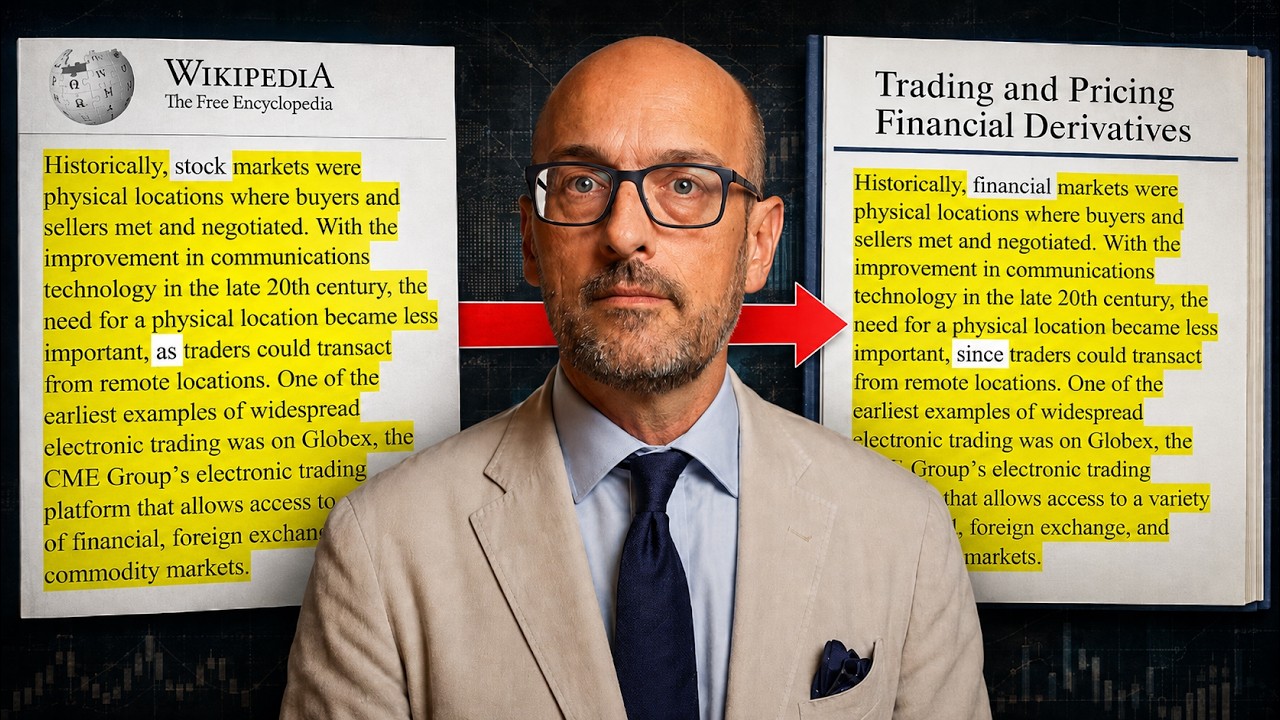
So, I started digging. At first, I just typed sentences from his book into Google and came up empty. But then, I noticed a few passages sounded strangely like Wikipedia. So I had an idea. I shouldn't be checking current Wikipedia. I needed to check the historical revisions from before his book was published. And my jaw hit the floor. Entire sections, definitions, and explanations were virtually identical. I was hooked, but manually digging through thousands of old Wikipedia revisions was taking too long.
So, I built a custom Wikipedia Revision Finder. I fed it the text from the book, and let it scrape the historical archives to find the best matches. Now, to be absolutely fair here: There are two names on this cover: Patrick Boyle and Jesse McDougall. I don't know which one of them hit Ctrl-C and Ctrl-V for each passage. But both put their names on the book, and both used it academically. Authorship comes with responsibility, not just a name on the cover.
I used that custom tool to generate a massive 31-page evidence dossier documenting 40 separate textual correspondences, with historical Wikipedia revision IDs, timestamps, and side-by-side comparisons. And I'm linking the full report in the description, so you don't have to take my word for any of this - you can inspect every example, revision ID and timestamp yourself. Let's look at the dates. The first edition was published in 2011.
Look at the timestamps on these Wikipedia edits. 2007. 2010. The text was sitting on Wikipedia before the first edition existed - in some cases years before. Look at this passage. Identical wording. Whatever process produced this book, the end result is extraordinary: passage after passage tracks Wikipedia wording that was already online before the first edition, and the book gives the reader no attribution telling them where that language came from.
But the Wikipedia matches were mostly prose - definitions, explanations, historical material. This textbook also contains something else: complex teaching sequences, financial examples, and end-of-chapter exercises. And after what I'd already found, I started wondering whether those had been borrowed too. So I started running the text against standard academic literature. And what I found wasn't just a stray overlap here or there but a systemic footprint across multiple established textbooks.
We are talking about shared pedagogical sequences, identical numerical structures, and borrowed problem sets spanning the entire book. To show you how the sausage was made, let's look at a few clear highlights. Take a look at this textbook by Robert Kolb and James Overdahl. In it, they outline a highly specific four-step process for pricing American call options. In Boyle and McDougall's book? The same four-step sequence.
Watch Steps 2, 3 and 4. That's exceptionally close. And it wasn't just the prose. The homework wasn't safe either. Same three call options. Same strike prices: $40, $30 and $35. Same $90 stock price. Same core exercise. That's not some generic overlap you'd expect between two derivatives textbooks. But this next one might be my favorite. Because sometimes a mistake tells you more than a similarity ever could. Imagine you are a university student taking Patrick's course.
You get to Chapter 6, Question 6. The book asks you to calculate the value of a European call option using a binomial tree. The book gives you the parameters: two 3-month periods. Stock movements of +6% and -5%. A 5% risk-free rate. A $51 strike price. Okay, great. Grab your calculator. Let's do the math. Wait a minute. Where is the starting stock price? You literally cannot solve a binomial tree without knowing the current price of the stock.
The problem is under-specified. Did the brilliant hedge fund manager just publish an unsolvable math problem in his own academic textbook? To find the missing stock price, you have to look... in a completely different textbook. There it is. And it's not just any book. It is John Hull's Options, Futures, and Other Derivatives. If you have any university background in finance, you know exactly what this means. John Hull's book is the absolute bible of financial derivatives.
When Boyle and McDougall were copy-pasting John Hull's exercise into their own book, they accidentally deleted the opening sentence! They copied the parameters, but forgot the starting variable - leaving their own students staring at a broken, unsolvable equation. And make no mistake: Hull wasn't just the source for this single broken exercise... Across chapter after chapter, I found close prose parallels, distinctive conceptual sequences, and numerous exercises where the underlying problem structure closely tracks Hull while wording or numbers are changed.
They systematically mined the bible of their own industry... and in this case, they couldn't even copy the homework correctly. Now, just to be completely clear: none of these textbook-to-textbook correspondences were included in the 31-page Wikipedia report I submitted to the universities. I only started comparing their book systematically against other textbooks after that report had already been sent. And if anyone wants to argue that these are just a few isolated coincidences, trust me: I have enough material for several more videos.
But at some point, it stops being my job to audit every page of their book. The universities have the Wikipedia dossier. They can do the full academic review. Because the pattern here is starting to look remarkably familiar. Just like his YouTube videos, this textbook appears to be a patchwork of other people's work - Wikipedia, established textbooks, borrowed examples, adapted exercises - assembled into something published under Patrick Boyle and Jesse McDougall's names.
And before anyone starts hunting for a footnote that makes this all okay: don't bother. I checked. Hull isn't credited. Kolb and Overdahl aren't credited. Wikipedia isn't credited. I could find no attribution for any of this material in the book. Academia and high finance gave Patrick Boyle enormous credibility. That's exactly why this evidence matters. The higher the pedestal, the harder the fall when you start checking the footnotes.
What I've found raises a much more uncomfortable question about where some of Patrick Boyle's apparent intellectual output actually came from. I don't hand down formal academic penalties - that responsibility sits with the institutions and the publisher. That's why I submitted the full 31-page Wikipedia dossier to King's College London and Queen Mary. King's response was telling: his profile was quietly removed from their website, they made it clear he is no longer employed there, and pointed me straight toward the publisher.
To be fair to King's, since he no longer teaches there, he is effectively yesterday's problem for them. But the dossier is still sitting with Queen Mary. I also reached out to Patrick Boyle directly, sending him detailed questions and giving him ample time to provide an explanation. As of this recording, he has not replied. If he responds after publication, I'll make his response available in full and pin the details at the top of the comments.
Stay sharp. Until next time!
The words are the caption track's own and nothing is reworded or re-transcribed. Paragraph breaks are placed between sentences so the text reads as prose.
Free tools for your own script: paste a draft and see where it stands before you record it.
Paste your draft and see where viewers are likely to drop off, with a rewrite for each weak line.
Paste the first 30 seconds of your own draft for a hook score and rewrites.
Check your draft against YouTube's advertiser-friendly guidelines before you record it.
Read this channel's public videos and transcripts, and download a writing brief for it.