Getting the transcript
Reading the captions from YouTube. A video nobody has opened here before takes 10 to 30 seconds; this page fills in on its own.
Getting the transcript
Reading the captions from YouTube. A video nobody has opened here before takes 10 to 30 seconds; this page fills in on its own.
Doctor Mike · @DoctorMike
Where viewers went back to watch this video again, from YouTube's public Most replayed graph, lined up with what was said at that moment.
Most replayed moment #1
14:094.3x the video's typical replay level
bruise isn't as bad. Oh my god, the the line ref. I would bet that heat exhaustion based on the sun. >> Canada goalkeeper Maxime Crépeau was lauded for reacting quickest and rushing to help an assistant referee who
Said at 14:02
Most replayed moment #2
7:513.0x the video's typical replay level
healing time cuz it's not just one clean slit that heals up nicely. There's usually pieces that have to be put together, multiple pieces of hardware, etc. >> [cheering] >> Tom Lockyer was playing the 50th match of his first season in the Premier
Said at 7:44
Most replayed moment #3
3:322.7x the video's typical replay level
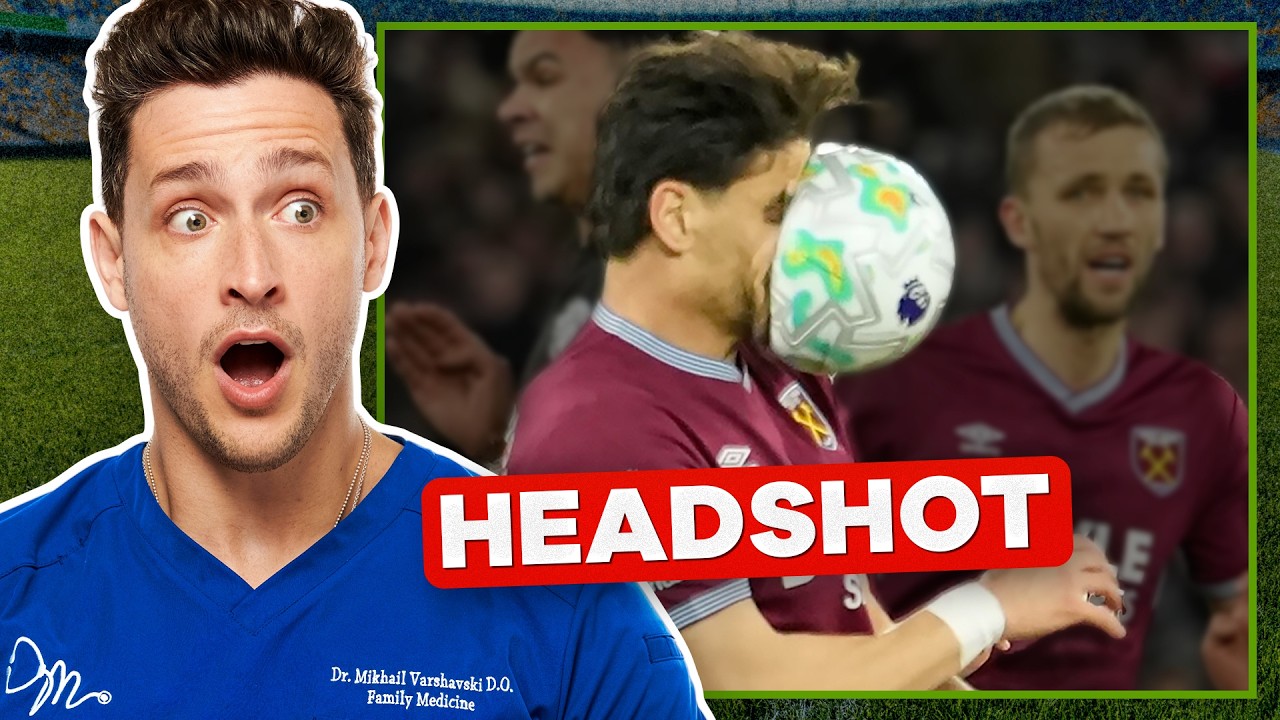
are doing this whole stem cell route. To me, it's unproven because I don't have really great research for it. OH, DID HE JUST GET CLIPPED in the face?
Said at 3:26
The graph counts replays. It does not show where viewers stopped watching.
Words
2,852
Runtime
15:22
Speaking pace
186wpm
Reading time
12min
186 words per minute, between the 181 median and the 201 75th percentile of 349 measured videos. That distribution comes from the 349-video hook study.
Opening (first 30 seconds)
The World Cup is in full swing, so we decided to take another look at some soccer, or football, injuries. Let's get started. >> Onside hit. >> Wow, it's a full-on breakaway. >> Singo. Singo trying to >> Oh my god, did he just kick the goalie straight in the face? >> From Wilfried Singo, he just pushed it a bit too close to the Italian >> Oh my god, it's going to hurt. It's going to hurt. OH, WITH THE BOOT. I MEAN, HIS EYES, there are so many sensitive neuromuscular structures.
93 words, the words spoken in the first 30 seconds at 186 words per minute.
Free, no signup. See how the first 30 seconds hold attention, with rewrites.
Sentence shape
| Measure | This transcript |
|---|---|
| Sentences | 224 |
| Average words per sentence | 12.7 |
| Longest sentence | 56 words |
| Questions asked | 21 |
| Sentences containing a number | 13 |
Most used terms
Filler phrases
60 in total: like 31 · I mean 8 · uh 6 · actually 4 · basically 3 · you know 3 · kind of 2 · um 2 · sort of 1.
A literal whole-word count of the same phrase list the Prepublish browser extension uses, so a phrase inside another word is not counted and a phrase used in its ordinary sense still is. It is a count and not a judgement.
Run the check on the words above: where attention is likely to drop, with a rewrite for each weak line. The free check shows the scores and the one issue costing the most.
What this transcript is
Every word below is the caption track YouTube publishes for this video, pulled from the video itself and reproduced unchanged. It is not Prepublish's writing, not a summary, and not a re-transcription: it is the video's own published captions. English captions, generated automatically by YouTube, in the video’s original language. Source: the video on YouTube. A channel that would rather this page did not exist can ask for its removal through the contact page, and it is removed.
The World Cup is in full swing, so we decided to take another look at some soccer, or football, injuries. Let's get started. >> Onside hit. >> Wow, it's a full-on breakaway. >> Singo. Singo trying to >> Oh my god, did he just kick the goalie straight in the face? >> From Wilfried Singo, he just pushed it a bit too close to the Italian >> Oh my god, it's going to hurt. It's going to hurt. OH, WITH THE BOOT. I MEAN, HIS EYES, there are so many sensitive neuromuscular structures.
God, I get stressed out by that. Like, obviously there's bone to protect there, but still. And the whiplash impact of all of that leading to a concussion. And people don't think about soccer when they think about concussions, and they should. Especially when it comes to women's soccer, higher rates of concussion there. He should be red carded and thrown out of the game going studs up like that. Wow, I can't believe he got up.
I mean, in a situation like that, you have to be sent out of the game, even if you say you feel fine, because you're just at a such a high risk for having a concussion. And sometimes symptoms don't show up immediately. You don't have to lose consciousness to have a concussion. He received on-pitch staple closures and was substituted later, requiring 10 stitches. To me, all of that, bone, skin, that heals. The brain, that could be lasting damage.
So, I'm glad he's okay from a neurologic standpoint. >> Messi. Oh god. >> Messi's taken a sore one there from Busquets. Ooh, she is here. >> Oh, see, it's that fall on the outstretched arm. People underestimate how much damage can come from that. Oh, the hyperextension of the elbow could easily tear the ulnar collateral ligament there. There's a lot of stuff that can go wrong there. It's almost like a baseball pitching injury. >> Barcelona announced that he suffered a fracture of the radial bone in his right arm.
Wow, he avoided surgery and finished the season with 51 goals in all competitions. What a beast. >> Ball's wide. Can he cut it back? Was that ball already out? Decision on the >> Oh, no. The trapped ankle. Oh, the ankle. Oh my god. He just destroyed his ankle. He fully rolled his ankle. He avoided a fracture or season-ending injury. He missed some time while recovering, but he returned to play later in 2024. The swelling was so dramatic that people feared a torn Achilles.
I would not fear a torn Achilles, but I would suspect a major ankle ligamentous injury like a anterior talofibular ligament tear. But, it was just a severe sprain. Wow, super impressive. I guess he had really good range of motion. Oh my god. Oh my god. >> [crying] >> Oh my god. The pain that he's experiencing. Oh, he hyperextended his knee and somehow managed to avoid the testicular groin region of the other player, which is impressive.
Diagnostics confirmed a ruptured ACL, a torn external collateral ligament, and a ruptured popliteus tendon. The amount of repair that can be surgically done is really impressive. These days we have some injectables when it comes to PRP, platelet-rich prolotherapy, and sometimes it can bring some healing factors, but the evidence on it is not fantastic. So, really surgery, physical therapy. Some people are doing this whole stem cell route.
To me, it's unproven because I don't have really great research for it. OH, DID HE JUST GET CLIPPED in the face? Is it a handball? I don't know what I'm watching. His eyes don't look good there, though. Oh my god, right at the side of the head. My god, that can cause such a bad concussion. You know, the majority of concussions happen when people are going up for headers, not because >> [music] >> of the ball as much, but more so from like elbows and other body parts hitting them.
In this scenario, straight ball to the temple. Oh, I hope he does not come back into this game. If they do, to me that's mismanagement. Oh my god. Everyone's looking at this and they're probably going, "Oh my god, his bones, his skin, the blood, the eye, the brain. We got to protect the brain." >> through the season. That's New Mexico defender Elizabeth Lambert. >> She gets rough. >> questionable plays throughout this game. >> Oh, she went like this right into someone's sternum.
I mean, not only can you break the bone, I mean, I guess you have to be quite strong, but if you hit them in the chest, get a little commotio cordis there, you hit them in the wrong moment, you could stop their heart. It's like assault. >> You're paying a Lambert fighting for position with elbow. >> Oh, a a little punch into the scapula. >> LAMBERT HERE FIGHTING >> OH, OH, OH. >> YOU JUST KEEP GOING. YOU KNOW, THERE'S PHYSICAL, there's rough, as you see.
And then And then >> I mean, you got to be careful because ACL tears, especially women's soccer, are higher rates than in in men's soccer, especially when we're talking about girls and boys as well. >> There might be just downright unsporty and right about here where Lambert GRABS SHUMWAY AND >> OH MY GOD, SHE RIPPED HER I MEAN, who cares about the hair? It's the brain, the spinal cord. And when you're doing such aggressive hyperextension, there are two arteries that run up the spinal cord, well, more so the vertebral column.
And because they're in the back, they're super susceptible to an extension and rotational shearing force where you could actually get a vertebral artery dissection and kill someone. Like, can you imagine if this became lethal? Thank god when I played in the soccer tournament a few weeks ago, it was more friendly. We actually played in a creator game and I participated in support of UNICEF because I'm their ambassador and they're celebrating International Day of Play, which I'm very much for.
And I participated in this tournament because it was a creator game. But all the creators that were playing were nasty soccer players, pro, semi-pro, collegiate athletes, and then they had the doctor on the field. Luckily, I could somewhat hold my own. Check out my shot on goal. >> Ibrahimovic >> Oh, Ibrahimovic is the toughest son of a gun ever, but he's also a bully on the field. >> Rudiger beaten to it by Mings. It's broken to Martial and you can >> Oh, he got kicked right You can kill someone by hitting them in the back of the head.
This is why in contact sports, we don't allow behind the head strikes. Do you hear that, Chris Avila? Every time you kept hitting me in the back of the head, it was illegal. And when I say back of the the head, it means even the side of the head that is behind the ear. >> Catches Ibrahimovic's head and Ibrahimovic Now, he's already been booked. Up goes Ibrahimovic, not high enough and >> Oh, see, these are the concussions that are dangerous.
I wouldn't be surprised if he broke his zygomatic arch there. Cuz the elbow is very sharp, lots of contact there. >> Luka Modric, at 40 years old, the Croatian legend suffered a complex fracture of his left cheekbone. >> OH, NO. SEE, that's dangerous cuz there's a lot of cranial nerves that are in this area that you have to be really careful about not damaging. >> After a head-to-head collision with Juventus midfielder Manuel Locatelli >> I'm surprised it wasn't an orbital fracture. >> during AC Milan's goalless draw with Juventus on April 27th. >> Oh, it kind of looks like an orbital fracture.
I wonder if it was zygomatic arch or orbital. You actually have to be really careful when there is a fracture to the orbit. There are muscles that attach to this bone that give control to the eye. So, major issues can pop up here. >> AC Milan confirmed that the fracture was multi-fragmentary, meaning it was not a simple break. He missed the rest of Milan's season. >> Yeah, anytime you have a complex fracture like that, there's uh a longer healing time cuz it's not just one clean slit that heals up nicely.
There's usually pieces that have to be put together, multiple pieces of hardware, etc. >> [cheering] >> Tom Lockyer was playing the 50th match of his first season in the Premier League. Luton and Bournemouth players called for help. Medics rushed on to treat the 29-year-old >> Oh, what happened? >> as fans from both teams watched on in anguish at Bournemouth's Vitality Stadium. >> Did he Was it a non-contact fall? >> I wouldn't be here without the paramedics and the people [music] knowing CPR that day. >> Oh my god, so they did chest compressions on him. >> an atrial flutter, which is um basically the the heart um just uh irregular heartbeats, so >> It's not exactly an irregular heartbeat.
So, a lot of people know what atrial fibrillation is, where the heart beats rapidly and in an irregular rhythm. When you have atrial flutter, you have a rapid rhythm, but it's usually following some sort of pattern, like two to one, three to one. And when we say these numbers, what we're talking about is the top portion of the heart, which is the atria, how they beat in comparison to the ventricles, the bottom portion of the heart.
So, when you have atrial flutter, the top of the heart beats in a pattern, but rapidly and abnormally, but not irregular, cuz in atrial fibrillation, they're at irregular. It is pretty rare to develop a cardiac arrest from atrial flutter, but what can happen is if the heart rate becomes super high, it could actually cause a dysfunction in the ventricular portion of the heart, and that can lead to a cardiac arrest. And obviously, from just beating extremely fast, you could also develop a myocardial infarction, aka a heart attack, which can then lead to a cardiac arrest as well. >> So, that's uh that's what about wounds. >> Why did they have to do surgery?
Like, that's the part I don't quite understand. >> So, my defib sits in there. >> Oh, he needed get a defibrillator put in because apparently he has a high risk. I wonder if he has an underlying arrhythmia issue like Wolf-Parkinson-White or Brugada syndrome or something that led to this flutter happening and then this cardiac arrest. >> AND THIS LOOKS LIKE AN emergency here. >> Why? >> A real sense of concern. >> Oh. >> And without question. >> Oh. >> Thoughts turn to a moment that happened during >> I mean, is this just like a major heart condition?
Like what? He grabbed his chest. Is he having a heart attack? This reminds me of when that other player collapsed and we did the whole thing about chest compressions. He must be having a a cardiac arrest cuz they're about to do chest compressions. Oh, they're putting a defibrillator on him. That means he's in cardiac arrest. A defibrillator is called an AED. Basically, you put it onto the skin and right away it's able to tell you if this is a shockable or non-shockable rhythm.
If it's a shockable rhythm, you get everyone off the person, you press the button and it says shock delivered and you hope that the person woke up. If not, you're doing chest compressions again. What you're really looking for in a situation like this is ROSC, which is return of spontaneous circulation. >> One day after Danish soccer star [music] Christian Eriksen collapsed on the field, he's reassuring fans that he's doing well. >> Wait, is this the same player?
No way. He must have gotten cleared in order to return and he doesn't have an ICD in? An implantable cardio uh defibrillator? >> Christian writing on Instagram June 8th, I want to let everyone know that I am doing well and that I am home with my family. >> Wow, I can't believe they were he was able to return to play. >> My ICD has [music] had a major impact on both me and my family, but I want to reassure everyone that this was a different situation. >> Well, a different situation in that the ICD probably recognized the fact that he was going into uh unstable rhythm and shocked him out of it.
That's probably why he grabbed his chest. He's wearing basically the same device that Dr. Glockenfocken wears and we talked about on the podcast. >> The 34-year-old collapsing during a friendly match between Denmark and Ukraine June 7th, 5 years after suffering a [music] cardiac arrest during a Euro 2020 match. Christian adding that his ICD did [music] exactly what it was designed to do, protect me when I needed it. >> I mean, I think because this has now happened twice, I think a return to play is just not safe because it seems like anytime there's an increased cardiac demand, he goes into this abnormal rhythm that leads him to being shocked by this ICD.
There's only so many times you can be brought back until you can't and that's fatal. So, I just don't think it's worth the risk. >> He's focused on recovering, spending [music] time with his family, going on vacation and playing football with his children. >> Unbelievable scenario. Angle? Shin? Oh my god. This has to be a tibial fracture. The fact that the lower foot is so loose there and it looked like it happened during a twisting force when he like planted and sometimes in in those scenarios, you don't just get like a clean fracture line.
You get what's known as a spiral fracture or kind of wraps around the entirety of the bone. I didn't see that much contact. So, if there wasn't a lot of contact, sometimes this can happen as a result of a stress fracture being there in the past. >> He had a a tib-fib fracture. >> Oh, he broke both. He broke the tibia and the fibula, which is the bone on the outside. The big player here and the deciding factor of how quickly they come back is really the tibia because that's the weight-bearing bone, but it's not enough to just heal the bone because once the bone heals, now you got to retrain the whole leg to come back to soccer cuz this isn't a quick-healing injury.
It's not like a 2-3 months out. A lot of times it's like a 10-month out injury. >> They did the surgery last night. >> Which they probably just put a rod, uh, which known is known as an intramedullary rod right through the tibia bone, in order to give it stabilization from like a scaffolding perspective. And sometimes they have to do additional hardware as well, but that that's one of the more popular surgeries. I also couldn't see because he had a sock on if the bone cut through the skin.
That becomes a contamination issue as well. So not only are you performing surgery, you also have to treat it as a potential infection because the skin is open. And people think when they wear shin guards like that removes all force. But the shin guard really doesn't give you like super armor. It It lowers the force. I think studies have shown like 10-15%. So the force is still there. Maybe the bruise isn't as bad. Oh my god, the the line ref.
I would bet that heat exhaustion based on the sun. >> Canada goalkeeper Maxime Crépeau was lauded for reacting quickest and rushing to help an assistant referee who collapsed during their 1-0 win over Peru in >> In a situation like this, I hope he's checking to see if he's breathing. Because if he's breathing, you're not doing chest compressions. If he's not breathing, you're calling over the staff and you're starting to push hard and fast at the center of the chest.
It looks like he still has movement cuz his arm is not falling. So he has some strength against gravity, which right away signals that he has circulation and that he has a pulse. Odds are in a situation like this, there's a component of heat exhaustion, electrolyte imbalance. You need to get this person to a medical facility, get fluids inside them, cool them down, etc. And when you do this type of cooling, electrolyte balancing, hydration, you have to do so gradually.
Anything you do extremely quickly can sometimes backfire and cause other problems. Speaking of dramatic moments, did you know I crashed my Ferrari race car? Click here to check that out. And as always, stay happy and healthy. >> [music]
The words are the caption track's own and nothing is reworded or re-transcribed. Paragraph breaks are placed between sentences so the text reads as prose.
Free tools for your own script: paste a draft and see where it stands before you record it.
Paste your draft and see where viewers are likely to drop off, with a rewrite for each weak line.
Paste the first 30 seconds of your own draft for a hook score and rewrites.
Check your draft against YouTube's advertiser-friendly guidelines before you record it.
Read this channel's public videos and transcripts, and download a writing brief for it.