Getting the transcript
Reading the captions from YouTube. A video nobody has opened here before takes 10 to 30 seconds; this page fills in on its own.
Getting the transcript
Reading the captions from YouTube. A video nobody has opened here before takes 10 to 30 seconds; this page fills in on its own.
CNBC · @CNBC
Words
1,142
Runtime
7:25
Speaking pace
154wpm
Reading time
5min
154 words per minute, below the 160 25th percentile of 349 measured videos. That distribution comes from the 349-video hook study.
Opening (first 30 seconds)
Tesla, Rivian, lucid and many rising Chinese car brands all share something in common their vehicles are built around software. The advantage that Tesla has in software and in data is unparalleled compared to peers. That gives companies the power to fix problems remotely and add features that can make an old car feel new. And those who build these cars say nothing can compete with that. This is absolutely probably one of the biggest inflection points
77 words, the words spoken in the first 30 seconds at 154 words per minute.
Free, no signup. See how the first 30 seconds hold attention, with rewrites.
Sentence shape
| Measure | This transcript |
|---|---|
| Sentences | 65 |
| Average words per sentence | 17.6 |
| Longest sentence | 53 words |
| Questions asked | 1 |
| Sentences containing a number | 6 |
Most used terms
Filler phrases
8 in total: like 4 · actually 2 · uh 1 · you know 1.
A literal whole-word count of the same phrase list the Prepublish browser extension uses, so a phrase inside another word is not counted and a phrase used in its ordinary sense still is. It is a count and not a judgement.
Run the check on the words above: where attention is likely to drop, with a rewrite for each weak line. The free check shows the scores and the one issue costing the most.
What this transcript is
Every word below is the caption track YouTube publishes for this video, pulled from the video itself and reproduced unchanged. It is not Prepublish's writing, not a summary, and not a re-transcription: it is the video's own published captions. English captions, published by the channel, in the video’s original language. Source: the video on YouTube. A channel that would rather this page did not exist can ask for its removal through the contact page, and it is removed.
No Script X-ray for this video: YouTube shows a Most replayed graph only once a video has enough views.
Tesla, Rivian, lucid and many rising Chinese car brands all share something in common their vehicles are built around software. The advantage that Tesla has in software and in data is unparalleled compared to peers. That gives companies the power to fix problems remotely and add features that can make an old car feel new. And those who build these cars say nothing can compete with that. This is absolutely probably one of the biggest inflection points in the history of automotive, which I deeply believe that it will completely redefine brands loyalty for the future in North America and beyond.
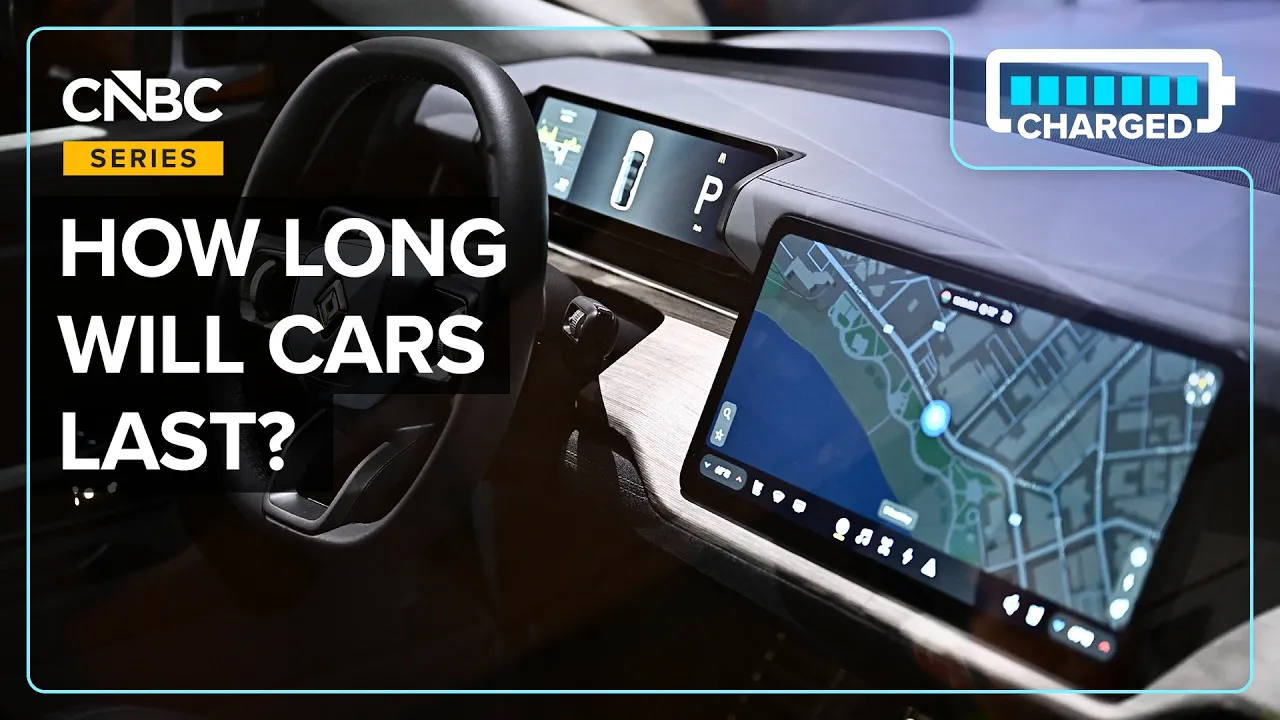
But these vehicles are complex. Repairing them requires new tools, skills, and access to data, and some in the industry feel software defined vehicles will age more like smartphones than fine classics. We're already seeing problems with hardware not being able to deal with new software. We honestly don't know how long these these vehicles will last. CNBC talked to key figures in the industry to see what they have to say about how long a software driven car can run on the road.
A software defined vehicle is really a vehicle which is no longer stale in time. It's a vehicle which continues to improve over time through over-the-air updates. Automakers have been adding computers to cars for decades, but historically they've been simple and scattered throughout the vehicle. Companies like Tesla and Rivian streamlined a lot of that hardware and connected it all through software, which in turn can be updated over the air.
This opens up a lot of new possibilities. When Consumer Reports refused to recommend the Tesla Model three because the car performed poorly in braking tests, Tesla said it could adjust the brakes through a software update, and it did, securing the recommendation. Rivian is used updates to add new drive modes, improve ride quality, and introduce an AI assistant, among other things. We're able to update the entire brain of the car.
Legacy automakers are also beginning to take this approach. As you pull up to your house and the software updates on its own over the air, we're going to see that more and more and rely less and less on the regular maintenance of going to the mechanic. But that software, the brain of the vehicle, as Ben said, calls it, needs to be maintained. And some wonder how long companies can afford to do that for any given car.
Then there is the hardware challenge. It needs to be capable of handling software updates over the course of several years. The average age of a vehicle on US roads is nearly 13 years, a record. Many last much longer than that. The life cycles of devices like smartphones pose the question of how long vehicle hardware can handle these updates. There's going to be functions that you can't get updated because the hardware.
The rest of the hardware on the vehicle just doesn't support it. And it's not necessarily economically viable to update all that hardware. In Tesla's case, this appears to have happened despite expectations. Tesla said in 2016 that every vehicle then being produced had the hardware needed for full self-driving, and Musk reaffirmed in 2019 that Tesla's Hardware three computer would support it. But by 2026. Unfortunately, hardware three.
I wish it were otherwise, but hardware three simply does not have the capability to achieve unsupervised FSD. Tesla said qualifying customers could receive either a hardware upgrade or a discounted trade in. Nevertheless, companies are trying to build in space for potential upgrades. We like to set a duration in time, which is we will continue to improving the car through new features from 7 to 10 years. We model that based on the average ownership duration in the United States, but it's really important to note that post this period, the car will be fully functional and if there is any security safety update which is necessary.
We as a brand are fully committed to continue those updates. It will just be a non software defined car in the sense that it will not keep improving over time through new features. Your vehicle will stay fully functional, fully safe, whatever the duration of the ownership is. And for many owners that might be good enough. Just keep the car running. Not getting updates is not the end of the world. The car in my garage is 36 years old now.
It was not updatable from the time it was built. You know, it's never it's never had an update and it still runs great. But even a vehicle not receiving software upgrades will still have to be maintained and fixed. Rivian doesn't have a dealership network, but it has service centers, a mobile service fleet, and certified third party shops, a collection of independent repair shops, aftermarket suppliers, customers and others want to go further.
The right to repair movement has spread across an array of industries including electronics, farm equipment and automotive. Broadly, it's the idea that people should be able to repair the things they own or seek out mechanics or technicians of their choice. So-called right to repair laws are spreading. This is actually a topic which is really dear to to my heart, one of the upcoming updates that we will have is actually to unblock what we call the service menu within the car and really allow our owners to perform more actions, uh, in line with the right to repair regulations.
But then we want to go even above and beyond that and really allow that possibility for owners within the car to perform a full diagnostic check using our AI assistant, using the on screen menus, and then perform some of the basic repairs. When those vehicles become classics, how are they going to be maintained? And will there be this undercurrent of of tech bros who decide our job is going to be to fix a Fisker and make sure it continues to run going forward so that classic cars still remain a thing beyond 1930s Duesenbergs.
That's going to be the hard part is the potential for somebody to come up with a an AutoZone of software. After support ends for a particular software platform. It's not unreasonable to have an expectation that the manufacturers should release that software so that if somebody wants to continue to update it, wants to make changes to it, they can do that. I think that would go a long way to addressing some of the concerns that people have.
I'm more optimistic than I used to be. There are Toyota pickups that have run for a million miles. Software defined vehicles may beat their more analog rivals on many metrics. Time will tell if they can beat them on this one.
The words are the caption track's own and nothing is reworded or re-transcribed. Paragraph breaks are placed between sentences so the text reads as prose.
Free tools for your own script: paste a draft and see where it stands before you record it.
Paste your draft and see where viewers are likely to drop off, with a rewrite for each weak line.
Paste the first 30 seconds of your own draft for a hook score and rewrites.
Check your draft against YouTube's advertiser-friendly guidelines before you record it.
Read this channel's public videos and transcripts, and download a writing brief for it.