Getting the transcript
Reading the captions from YouTube. A video nobody has opened here before takes 10 to 30 seconds; this page fills in on its own.
Getting the transcript
Reading the captions from YouTube. A video nobody has opened here before takes 10 to 30 seconds; this page fills in on its own.
Trash Sound Design · @TrashSoundDesign
Where viewers went back to watch this video again, from YouTube's public Most replayed graph, lined up with what was said at that moment.
Most replayed moment #1
3:285.7x the video's typical replay level
processing chain and that way we can use short fragments of it to add some flair to the loop and keep [music] it interesting. Bit glidder by your windows to add some bit crushing. Then run it through Transporter [music] to loop short fragments of it. Just have the loop A on, add some more minimum length, add some
Said at 3:21
Most replayed moment #2
5:395.5x the video's typical replay level
>> Now, I'll experiment with the arrangement, add some drums, and I'll come back to you with a full track. >> [music]
Said at 5:37
Most replayed moment #3
4:032.9x the video's typical replay level
[music] >> Start adding the processed chops to the main loop.
Said at 4:00
The graph counts replays. It does not show where viewers stopped watching.
Words
644
Runtime
7:14
Speaking pace
89wpm
Reading time
3min
89 words per minute, below the 160 25th percentile of 349 measured videos. That distribution comes from the 349-video hook study.
Opening (first 30 seconds)
What do Jan Jelinek, Burial, and J Dilla have in common? Let's find out. We all love sampling. There's nothing better than finding a perfect loop in an obscure 1960s Icelandic [music] chamber jazz record. Whether it's vinyl or YouTube, sampling is always fun. Today,
45 words, the words spoken in the first 30 seconds at 89 words per minute.
Free, no signup. See how the first 30 seconds hold attention, with rewrites.
Sentence shape
| Measure | This transcript |
|---|---|
| Sentences | 48 |
| Average words per sentence | 13.4 |
| Longest sentence | 39 words |
| Questions asked | 1 |
| Sentences containing a number | 3 |
Most used terms
Filler phrases
5 in total: like 3 · actually 1 · basically 1.
A literal whole-word count of the same phrase list the Prepublish browser extension uses, so a phrase inside another word is not counted and a phrase used in its ordinary sense still is. It is a count and not a judgement.
Run the check on the words above: where attention is likely to drop, with a rewrite for each weak line. The free check shows the scores and the one issue costing the most.
What this transcript is
Every word below is the caption track YouTube publishes for this video, pulled from the video itself and reproduced unchanged. It is not Prepublish's writing, not a summary, and not a re-transcription: it is the video's own published captions. English captions, generated automatically by YouTube, in the video’s original language. Source: the video on YouTube. A channel that would rather this page did not exist can ask for its removal through the contact page, and it is removed.
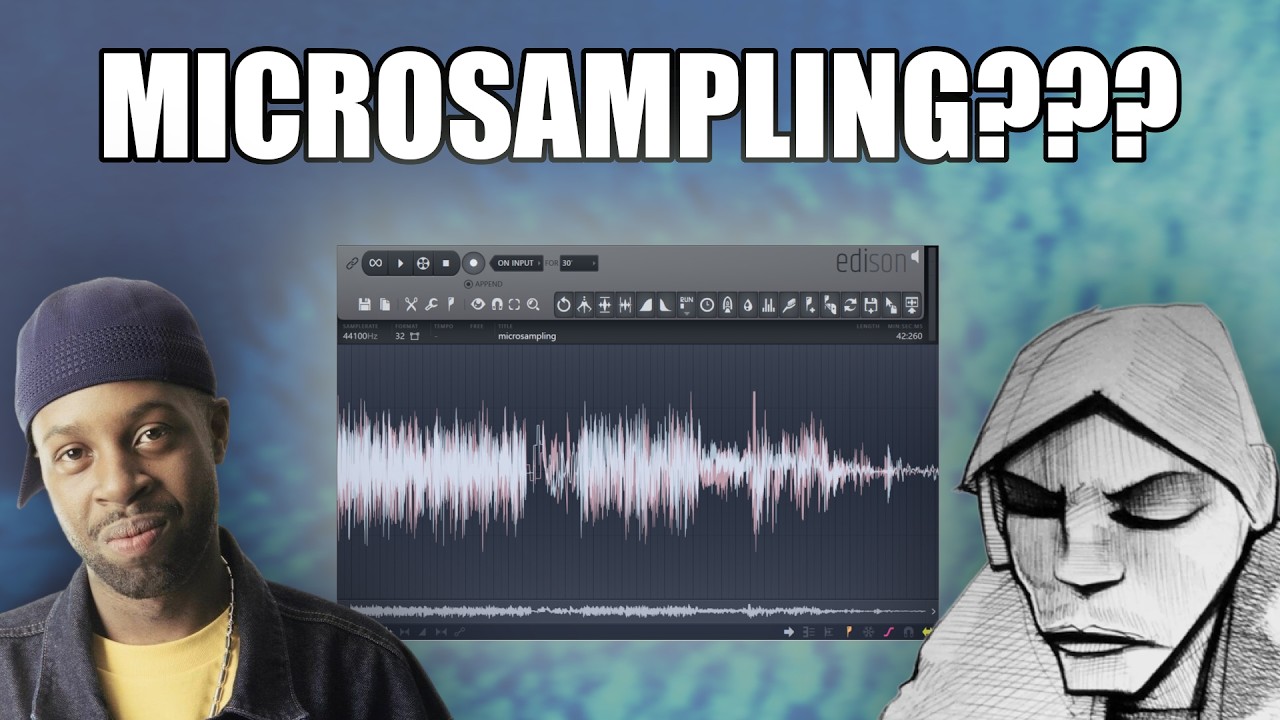
What do Jan Jelinek, Burial, and J Dilla have in common? Let's find out. We all love sampling. There's nothing better than finding a perfect loop in an obscure 1960s Icelandic [music] chamber jazz record. Whether it's vinyl or YouTube, sampling is always fun. Today, I want to focus on one specific technique called micro sampling, which involves surgically chopping the samples into short fragments and rearranging them in an unrecognizable way.
There are plenty of artists using micro sampling. J Dilla, Sora, Jan Jelinek, Hieroglyphic Oval, Burial. The list could go on forever. The main appeal of this method are the limitation that it brings, forcing [music] you to come up with creative ideas and solutions using only short fragments of sounds. It's essentially the same technique [music] as making collage artwork, but with sounds. Now, grab a sample. Doesn't matter what genre it is.
Have a listen to it and let's get to work. Here's the sample I'm going to use. >> [music] >> Let's start by chopping short fragments of the sample. You can use Fruity Slicer >> [music] >> or [music] just slice manually, which is what I'm going to do. >> [music] >> Now, here's what we have. >> [music] [music] >> Let's rearrange the first loop. It's basically like solving a puzzle. Test out different chopped sounds together.
Swap their positions and keep working on it until it starts sounding cohesive. >> [music] [music] >> Now once you have your first loop ready, we need some variation. If you want to copy the pattern but want it to sound a bit different each time, just [music] press S to turn on the slip function which allows you to move the waveform around in your individual chop. It's fantastic [music] because when we initially choose our sounds, we don't really have a clear vision of what the loop will sound like.
But once you have the foundations, you might find that the parts you skipped at the beginning are actually [music] the best fit for this particular phrase. >> [music] [music] >> I will now repeat the process for the next few bars. >> [music] >> I'm quite happy with the loop for now. Let's add some ear candy. What I like to do is run the whole sample through a processing chain and that way we can use short fragments of it to add some flair to the loop and keep [music] it interesting.
Bit glidder by your windows to add some bit crushing. Then run it through Transporter [music] to loop short fragments of it. Just have the loop A on, add some more minimum length, add some [music] reverse and shift. >> [music] >> Then I will add the glitch shifter to manipulate the rhythm of the loops. Plenty of feedback and sign all the way down. I will record everything through Edison and chop it. >> [music] [music] >> Start adding the processed chops to the main loop. >> [music] [music] >> Here's what we have so far. >> [music] [music] >> If you're bothered by those clicks in between [music] the chops, set the clicking mode to smooth.
I now want to record the loop and give it the good old stretching algorithm treatment. Now, record the loop in Edison, stretch it. >> [music] >> You might want to pitch it down a bit. I'm going with minus 500 cent. >> [music] [music] >> Now, we can pitch the original and processed chops 500 cents down and then layer it with the stretched [music] sample. >> [music] [music] >> Now, I'll experiment with the arrangement, add some drums, and I'll come back to you with a full track. >> [music] [music] >> And there we have it.
That's it for the video. Hope you guys enjoyed it and I'll see you in a bit.
The words are the caption track's own and nothing is reworded or re-transcribed. Paragraph breaks are placed between sentences so the text reads as prose.
Free tools for your own script: paste a draft and see where it stands before you record it.
Paste your draft and see where viewers are likely to drop off, with a rewrite for each weak line.
Paste the first 30 seconds of your own draft for a hook score and rewrites.
Check your draft against YouTube's advertiser-friendly guidelines before you record it.
Read this channel's public videos and transcripts, and download a writing brief for it.