Getting the transcript
Reading the captions from YouTube. A video nobody has opened here before takes 10 to 30 seconds; this page fills in on its own.
Getting the transcript
Reading the captions from YouTube. A video nobody has opened here before takes 10 to 30 seconds; this page fills in on its own.
IBM Technology · @IBMTechnology
This video has no Most replayed graph yet: YouTube shows one only once a video has enough views. These are the moments viewers replayed most in IBM Technology's most watched videos.
Most replayed moment at 4:03
2.6x that video's typical replay level
want our system to do, so the behavior, the constraints that we want. And that specific uh, specification is then used like a contract to create a requirements. And this requirements is going to be kind of the main hierarchy of how this project is going to work. So how we want the
Said at 3:56
Most replayed moment at 6:11
1.6x that video's typical replay level
Some combinations of these roles have become quite popular, so you may have heard of the ReAct pattern, which includes an action step, which is a tool operator role;
Said at 6:10
The graph counts replays. It does not show where viewers stopped watching.
Words
882
Runtime
7:15
Speaking pace
122wpm
Reading time
4min
122 words per minute, below the 160 25th percentile of 349 measured videos. That distribution comes from the 349-video hook study.
Opening (first 30 seconds)
Today, moving from prompt to production seems so simple with AI. I just tell it my project idea, and agented coding IDEs can get right to work, building every part of the workflow from that first line of code all the way to actually deploying it. Let's explore what it actually takes and why writing code is increasingly becoming the easiest
61 words, the words spoken in the first 30 seconds at 122 words per minute.
Free, no signup. See how the first 30 seconds hold attention, with rewrites.
Sentence shape
| Measure | This transcript |
|---|---|
| Sentences | 64 |
| Average words per sentence | 13.8 |
| Longest sentence | 35 words |
| Questions asked | 6 |
| Sentences containing a number | 2 |
Most used terms
Filler phrases
4 in total: actually 4.
A literal whole-word count of the same phrase list the Prepublish browser extension uses, so a phrase inside another word is not counted and a phrase used in its ordinary sense still is. It is a count and not a judgement.
Run the check on the words above: where attention is likely to drop, with a rewrite for each weak line. The free check shows the scores and the one issue costing the most.
What this transcript is
Every word below is the caption track YouTube publishes for this video, pulled from the video itself and reproduced unchanged. It is not Prepublish's writing, not a summary, and not a re-transcription: it is the video's own published captions. English captions, published by the channel, in the video’s original language. Source: the video on YouTube. A channel that would rather this page did not exist can ask for its removal through the contact page, and it is removed.
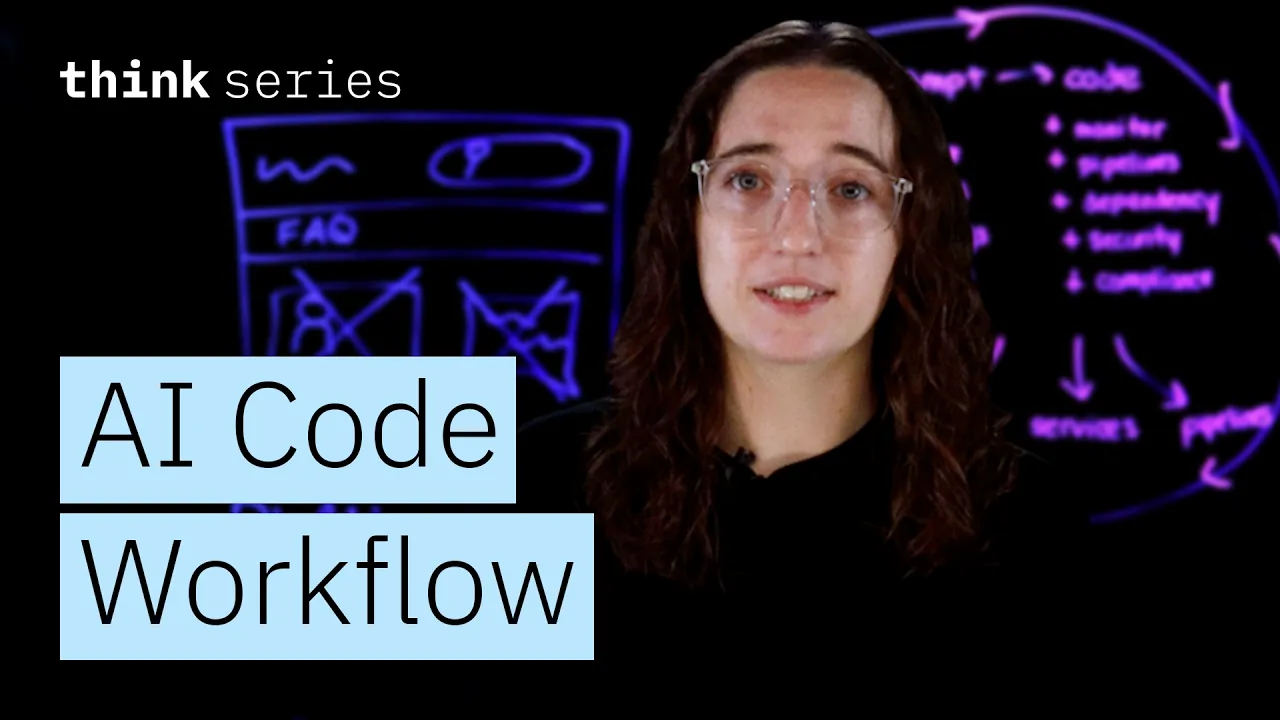
Today, moving from prompt to production seems so simple with AI. I just tell it my project idea, and agented coding IDEs can get right to work, building every part of the workflow from that first line of code all the way to actually deploying it. Let's explore what it actually takes and why writing code is increasingly becoming the easiest part of that journey from idea to outcome. The same way you don't start pouring concrete before designing a building, Complex engineering work starts with a detailed plan.
Effective AI workflows must understand intent, assess impact, and reason about which steps are needed to complete the work successfully. As a consequence, the quality of the solution is often determined long before that first line of code is even written. Let's say I have a website, and I prompt my AI coding assistant to help customers find information faster. In my code, an AI agent could do any of the following. It could build a search bar, author an FAQ section, display personalized recommendations, or even create an AI chat bot.
AI coding tools are incredibly capable and could implement any of these with high speed and quality. But you, the prompter, need to set the stage of what is important for success and why. Maybe we don't have the customer data to be able to personalize or the budget to enable an AI assistant or licensing for a particular tech stack. Planning is now more important than ever. As AI helps execute your vision to deliver the best outcomes.
In fact, much of modern software development is less about writing code. And more about navigating dependencies, workflows, architecture decisions, and trade-offs across these increasingly complex systems. As AI makes implementation cheaper, choosing the right approach becomes even more important. Once we've designed the right solution, it's time to have the AI execute, and that's where things get interesting. When you think of a code change, it's easy to see it as going from prompt to code.
You or an AI write the code, commit it, and are done. But implementing changes is actually a much larger workflow where the code change is often just a small part of it. You may need to update code, tests, configs, infrastructure, documentation, monitoring, pipelines, dependencies, security, compliance, the list goes on. And a lot of times these updates need to be coordinated across a variety of. Different repositories, services, or delivery pipelines.
An agented coding system isn't valuable due to its ability to write a simple function. It's valuable because of its ability to tie together execution, validation, dependencies, and testing all into one workflow that it coordinates across all of these domains for you. And being agents, these aren't just one-shot actions. Coding assistance built. Run tests, find any failures, fix those failures, run security scans, validate dependencies, and continually evaluate and rebuild.
Agented code systems create this self-correcting workflow where execution and validation happen together, driving toward efficient outcomes. For a while now, the main challenge hasn't been just generating code, but rather coordinating all of the changes around it. But after the agent is successful, there's still one lingering question. How do we know it worked? For years, software development was limited by execution.
Writing code, migrating systems, and testing all took time. But AI changes that. Today, an agent can update hundreds of files, touch multiple repos, modify tests, pipelines, and configs in a matter of minutes. That's output. The challenge is, AI can scale execution dramatically faster than humans can scale verification. If an agent updates five files, that's no sweat. I can review that myself. If it updates 500 files across multiple repos, tests, and deployment pipelines, I can't realistically review every change.
As execution takes less time, the bottleneck becomes our confidence that the solution's outcomes are successful. As developers, we need concrete answers to these simple questions. What changed? Why did it change? What could break? How does this impact downstream systems? And did we actually achieve the objective? I don't care if AI changed 1000 lines of code, I care that the right 1000 lines changed and that they moved us closer to the outcome we needed.
When used right, AI doesn't just have to produce code. It should generate evidence. Evidence through testing, validation, impact analysis, and explanations. And that in turn produces developer confidence in the outcomes. Trust isn't generated by seeing more output or someone simply telling you the answer. Trust comes from knowing the solution works, understanding its impact and risks, and having confidence the objective was achieved.
Great AI workflows accelerate not just execution, but confidence at scale. AI coding tools have come a long way in just a few years, initially focused on just ability to generate working code. We can now use agentic code systems within entire software development workflows, streamlining the hardest part, coordination. As AI is making this execution cheaper, it is shifting the prioritized skills of modern developers. From planning to architecture to governance, engineering judgment and thinking have become even more valuable.
We are now far past prompt code. The future is prompt to production. The strongest AI workflows will connect planning, execution, validation, and verification into a continuous path from idea to outcome.
The words are the caption track's own and nothing is reworded or re-transcribed. Paragraph breaks are placed between sentences so the text reads as prose.
Free tools for your own script: paste a draft and see where it stands before you record it.
Paste your draft and see where viewers are likely to drop off, with a rewrite for each weak line.
Paste the first 30 seconds of your own draft for a hook score and rewrites.
Check your draft against YouTube's advertiser-friendly guidelines before you record it.
Read this channel's public videos and transcripts, and download a writing brief for it.