Getting the transcript
Reading the captions from YouTube. A video nobody has opened here before takes 10 to 30 seconds; this page fills in on its own.
Getting the transcript
Reading the captions from YouTube. A video nobody has opened here before takes 10 to 30 seconds; this page fills in on its own.
Professor Historian · @TheHistorianProfessor
This video has no Most replayed graph yet: YouTube shows one only once a video has enough views. These are the moments viewers replayed most in Professor Historian's most watched videos.
Most replayed moment at 14:07
4.5x that video's typical replay level
mountain. The Voynich Manuscript. Sometime in the early 1400s, someone wrote a 240-page book in a language that has never been identified. The pages are filled with illustrations
Said at 14:01
Most replayed moment at 8:41
3.4x that video's typical replay level
Somewhere out there is a plant that made people feel like gods, and we lost it. Number four, henbane, the berserker drug. It's the 9th century AD somewhere in Scandinavia, and a band of Viking
Said at 8:34
Most replayed moment at 7:42
4.5x that video's typical replay level
is basically a case study in what happens when you give unlimited power to someone who would rather play dress-up. Number four, Ibrahim I of the Ottoman Empire, the Mad Sultan. It's 1640 and Ibrahim has been locked inside the
Said at 7:36
The graph counts replays. It does not show where viewers stopped watching.
Words
2,175
Runtime
13:52
Speaking pace
157wpm
Reading time
9min
157 words per minute, below the 160 25th percentile of 349 measured videos. That distribution comes from the 349-video hook study.
Opening (first 30 seconds)
The Inca Empire. It's the 15th century, high in the Andes, and a Chesky runner is sprinting a mountain relay route at 12,000 ft of elevation with a wad of cocoa leaves packed against his cheek. The altitude alone would drop most people to their knees. He's covering up to 240 km a day, carrying messages for the emperor, passing the message off to the next runner in a chain that spans the entire empire without a single horse.
79 words, the words spoken in the first 30 seconds at 157 words per minute.
Free, no signup. See how the first 30 seconds hold attention, with rewrites.
Sentence shape
| Measure | This transcript |
|---|---|
| Sentences | 129 |
| Average words per sentence | 16.9 |
| Longest sentence | 46 words |
| Questions asked | 0 |
| Sentences containing a number | 17 |
Most used terms
Filler phrases
5 in total: like 3 · actually 1 · kind of 1.
A literal whole-word count of the same phrase list the Prepublish browser extension uses, so a phrase inside another word is not counted and a phrase used in its ordinary sense still is. It is a count and not a judgement.
What this transcript is
Every word below is the caption track YouTube publishes for this video, pulled from the video itself and reproduced unchanged. It is not Prepublish's writing, not a summary, and not a re-transcription: it is the video's own published captions. English captions, generated automatically by YouTube, in the video’s original language. Source: the video on YouTube. A channel that would rather this page did not exist can ask for its removal through the contact page, and it is removed.
The Inca Empire. It's the 15th century, high in the Andes, and a Chesky runner is sprinting a mountain relay route at 12,000 ft of elevation with a wad of cocoa leaves packed against his cheek. The altitude alone would drop most people to their knees. He's covering up to 240 km a day, carrying messages for the emperor, passing the message off to the next runner in a chain that spans the entire empire without a single horse.
The cocoa mixed with a pinch of ash called yipa to pull the alkoids out is what keeps his lungs working and his hunger quiet. The Inca state controls the cocoa fields directly. Commoners get rationed amounts doled out for festivals and heavy labor. Priests get more. The sappa Inca, the emperor himself gets the best of it because cocoa isn't just a stimulant here. It's sacred. Leaves get burned as offerings to patchchamama, buried with the dead so they have something to chew on in the next life.
Chewed by priests before they read the future in the guts of a llama. When Spanish concistadors arrive in the 1530s, they're horrified by how central cocoa is to Incan religion and try to ban it outright. Then they realize enslaved miners chewing cocoa work longer shifts in the silver mines at Possi without collapsing from hunger or the altitude. The ban quietly disappears and the Spanish start taxing the leaf instead.
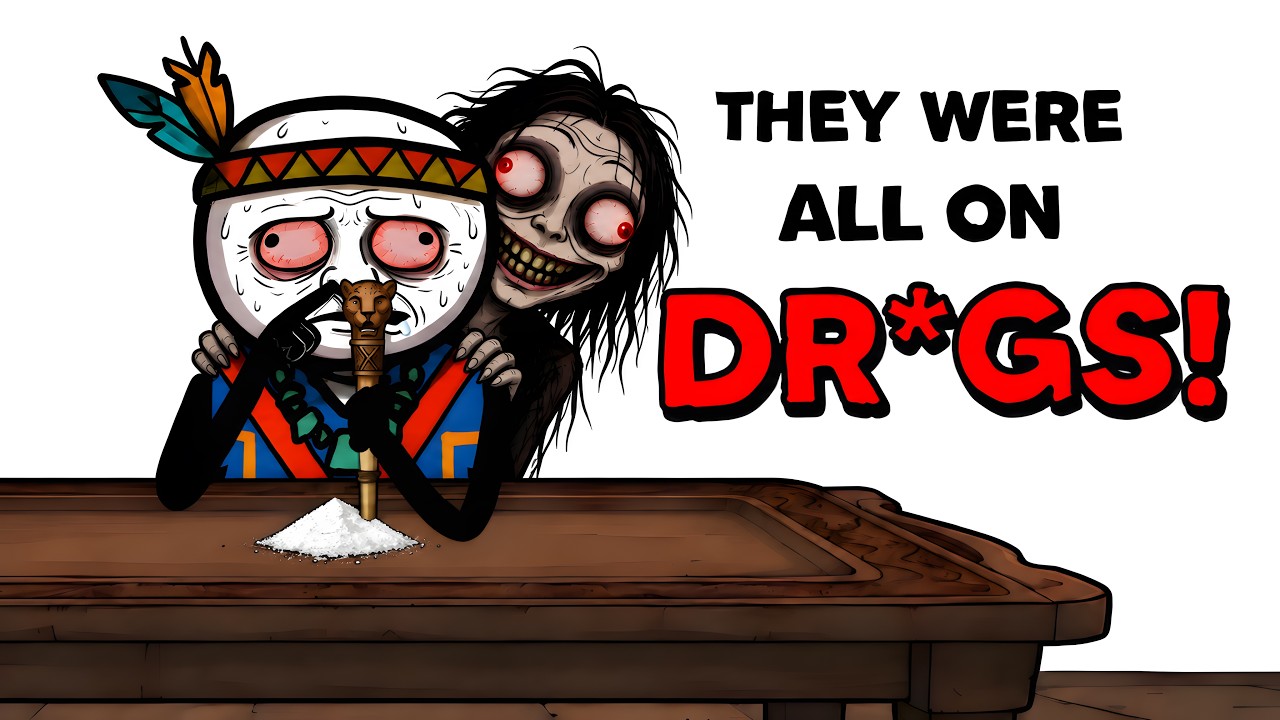
The Wari Empire. Four centuries before the Inca even exists, the Wari are running a different kind of ritual 700 km to the north. Around 800 CE, a Wari priest kneels over a carved wooden tray dusted with a fine dark powder ground from Vila seeds. A tree bean loaded with compounds close to DMT. He presses one nostril shut, lifts a hollow bone tube to the other, and inhales sharply. Within a minute, the visions hit hard and fast, closer to a blast than a slow burn, and the priest's body goes rigid as the chamber around him seems to fold inward.
Archaeologists later dig up entire snuff kits at worry sites scattered across the highlands. Wooden tablets carved with fanged figures bearing their teeth. Tubes worn smooth from handling. Small spoons all packed together like a ritual toolkit passed down between priest and initiate for generations. Vilka isn't recreational and it isn't for everyone. It's reserved for the people running the religion, the ones claiming direct contact with mountain gods and ancestor spirits watching from the peaks.
The Wari Empire leans on that authority to hold together a sprawling network of colonies stretching across Peru's highlands. And the vision priest snorting powdered tree seeds alone in a stone chamber is in a very real sense part of the machinery keeping the whole state together. The Aztec Empire. It's 1502 and Mckazuma 2 is being crowned emperor of Tino Titlan in front of nobles gathered from across Meso America. Spanish chronicers later record what happens at the feast afterward.
Baskets of small dark mushrooms get passed hand to hand around the hall. What the Nhawa call tona, flesh of the gods. Guests eat them with honey to cut the bitterness, washing them down while musicians play. Within the hour, the hall is full of men crying, laughing, seeing visions of animals and ancestors climbing the walls around them. Priests use the same mushrooms in private, more controlled settings to communicate directly with Tescat Lapoka and other gods, treating what they see not as hallucination, but as an actual message being delivered.
Frier Bernardino Desagon interviews Aztec elders decades after the conquest and writes down entire accounts of these ceremonies. Some men weeping with dread at what they see. Some singing uncontrollably. Some simply sitting in silence, staring at something no one else in the room can perceive. When the Spanish arrive in 1519, they try to stamp the practice out entirely, branding it devil worship and burning what records they can find.
It survives anyway, pushed into hiding in remote mountain villages, passed quietly from healer to healer for the next 400 years. The Maya civilization. Deep in a limestone temple in the Yucatan, a Maya priest is preparing Balchce, a drink fermented from the bark of the Balchce tree, soaked in honey and water inside a hollowed log buried in the ground. It ferments for days in the heat until it turns mildly psychoactive and intoxicating.
The smell alone thick enough to signal the ceremony is close. But drinking it is only half the ritual. Maya priests also administer it as an enema. Using long clay or bone syringes carved specifically for the purpose because absorbing the compounds through the rectum hits faster and skips the vomiting that comes from drinking too much on an empty stomach. Painted vessels from the classic period show exactly this. Robed figures bent over administering the enema to each other in scenes scholars believe depict rain ceremonies tied to Cha, the storm god who controls whether crops survive the season.
The logic isn't shame or secrecy. It's efficiency. Faster onset, stronger visions, less wasted substance in a ritual that has to work. These ceremonies coincide precisely with the agricultural calendar, timed to beg the sky for rain before planting season begins. To the Maya, getting the ritual chemistry exactly right is as serious as getting the astronomy right. And their priests track both with the same obsessive, unforgiving precision.
Ancient Egypt. On the wall of a tomb near thieves, painted more than 3,300 years ago, nobles sit at a banquet holding blue flowers up to their noses, while servants pour wine into wide bowls where more of the same flowers are floating on the surface. This is nymphia karolia, the blue lotus. And Egyptians soak it in wine because the alcohol pulls out its mildly seditive, faintly euphoric compounds far more effectively than water could.
Guests at these banquetss describe a loosening warmth spreading through the body. A dreamlike calm settling over the room, sometimes mild visions creeping in at higher doses late into the night. The flower shows up everywhere in Egyptian religious art. After that, held by gods, wrapped around mummies as part of the burial preparation, carved into temple columns because it closes at night and reopens at dawn. A daily resurrection Egyptians tie directly to raw crossing through the underworld and being reborn each morning without fail.
Toutin Commons tomb is packed with blue lotus imagery when it's finally opened in 1922. Garlands of it draped across the young king's remains. Whether it's purely ceremonial or genuinely recreational at these late night banquetss is still debated by historians today. But the wine bowls don't lie. Someone at that table is feeling something they came looking for. The Sethians. Heroditus writing around 450 B.CE describes something he claims to have witnessed that he clearly finds bizarre even by his own welltraveled standards.
Cythian nomads on the steps north of the Black Sea build a small tent, place red hot stones inside, and throw handfuls of hemp seeds directly onto the glowing rock. The seeds smoke instantly, thick and sweet, and the Cythians crawl inside and inhale it deeply, and according to Heroditus, howl with pleasure at what it does to them. This isn't recreational either. It'serary. They do it after burying their dead, treating it as a purification right meant to cleanse themselves of death's contamination before rejoining the living community.
For centuries, this account gets dismissed by later historians as Greek exaggeration, a traveler's tall tale. Then in the 1940s, Soviet archaeologists dig into the frozen peseric burial mounds in Siberia and find preserved by perafrost for 2,400 years almost perfectly intact, an actual felt tent, a bronze sensor and charred cannabis seed still sitting inside it exactly where they were left. Herodotus was right the entire time.
The Cytheians are warriors first, feared across the ancient world for their brutal mounted archery, but their grief rituals involve getting an entire funeral party stoned inside a smoke tent on the open windswept step. Ancient Greece on Cree around 1300 B.CE. A small clay figurine is being shaped by Manoan hands in a workshop near Gazi. It shows a goddess with three seed pods sticking straight up from a crown on her head.
Each one slit exactly the way you'd cut a poppy capsule to drain its opium sap. Archaeologists later named her the poppy goddess, and her closed, heavy-litted eyes suggest an artist who understood the drug's effects firsthand. Centuries after her, Greek physicians formalize opium into actual medicine rather than pure ritual. Hypocrates working around 400 B.CEE prescribes poppy juice for pain, insomnia, and grief, naming it directly in his writings on treatment and dosage.
Soldiers wounded on the battlefield get dosed with it before rough field surgery. One of the only things in the ancient world that reliably dulls agony enough for a surgeon to work. Poppy imagery spreads through Greek religion, too. tied closely to Deer and her daughter Pphanany, goddesses of the harvest and the underworld. Sleep and death bundled into the same drooping red flower. By the time Alexander's armies march east, three centuries later, opium poppies are growing in cultivated fields stretching from the Aian coast all the way to the edge of India.
The Roman Empire. A Roman physician named Dascoridities is writing his pharmacology text Demateriamedica around 65 CE and he includes detailed instructions for Mandre wine steeped from the root of a plant whose forked shape looks disturbingly like a human body complete with what pass for legs. Patients drink it before surgery and go under fully sedated, sometimes for hours at a time, making mandre one of the only real anesthetics the ancient world actually has access to.
Plenny the Elder writes that Roman physicians administer it before the knife ever touches skin, specifically because the shock of unanested surgery alone can kill a patient outright. But mandre carries folklore heavier than any other plant on this list. Romans believe the root screams when it's pulled from the ground. a scream loud enough to kill or drive mad anyone unlucky enough to hear it directly. Harvesters supposedly tie a dog to the base of the plant and let the dog yank it free from a safe distance instead of doing it themselves.
The line between medicine and superstition barely exists in Rome. The same route that knocks a soldier unconscious for an amputation on the battlefield is also nailed above doorways back home to ward off evil spirits. The Chavein civilization. Inside the stone galleries of Chavein Deuantar, a temple complex built around 900 B.CE. high in the Peruvian Andes. A carved granite shaft called the Lanzone rises through total darkness like a blade buried in the earth.
Priests descend into these tunnels after ingesting San Pedro cactus, a tall column cactus loaded with measculine. And the carvings surrounding them are built specifically to be experienced while hallucinating, not admired in daylight. Stone reliefs show human figures mid-transformation into snarling jaguars, fangs erupting from human mouths, hands twisting into claws mid-motion. Sound is engineered into the architecture, too.
Conshell trumpets called Putitus echo through hidden stone channels designed to make the noise seem to come from everywhere in the tunnel at once, disorienting anyone inside. Further, a tripping initiate walking through these passages for the first time isn't just looking at religious art on a wall. They're moving through a machine built specifically to convince them the transformation carved into the stone is happening to their own body in real time.
Chave's influence spreads across the central Andes for roughly seven centuries. Less through military conquest and more through pilgrims who make the journey once and carry this exact experience home with them. Norse civilization at Furat, a Viking ring fortress in Denmark dating to around 980 CE. Archaeologists excavating a woman's grave centuries later find a small leather pouch buried at her side containing seeds later identified as henbane. a plant thick with delirant compounds that cause hallucinations, disorientation, and violent aggression at higher doses.
Residue analysis on Viking age drinking containers found elsewhere turns up henbane traces mixed directly into beer, not an accidental contamination, but a deliberate additive brewed in on purpose. Some historians connect this directly to the berserkers warriors described across Norse sagas as fighting in a trance state, howling, biting down on the rims of their own shields. Feeling no pain and apparently no fear at all in the middle of battle.
Henbane fits that description disturbingly well. A plant that strips away caution entirely and floods the body with irrational, uncontrollable fury. Whether every berserker rage on record is chemically induced or partly cultural performance passed down through storytelling is still argued among historians today. But the seeds buried in that fearcat grave suggest at least some Norse ritual specialists understood exactly what this plant did to the body and mind and used it on purpose centuries before anyone had a word for psychoactive at all.
The words are the caption track's own and nothing is reworded or re-transcribed. Paragraph breaks are placed between sentences so the text reads as prose.
Free tools for your own script. No signup, no login.
Paste your draft and see where viewers are likely to drop off, with a rewrite for each weak line.
Paste the first 30 seconds of your own draft for a hook score and rewrites.
Check your draft against YouTube's advertiser-friendly guidelines before you record it.
Read this channel's public videos and transcripts, and download a writing brief for it.