Getting the transcript
Reading the captions from YouTube. A video nobody has opened here before takes 10 to 30 seconds; this page fills in on its own.
Getting the transcript
Reading the captions from YouTube. A video nobody has opened here before takes 10 to 30 seconds; this page fills in on its own.
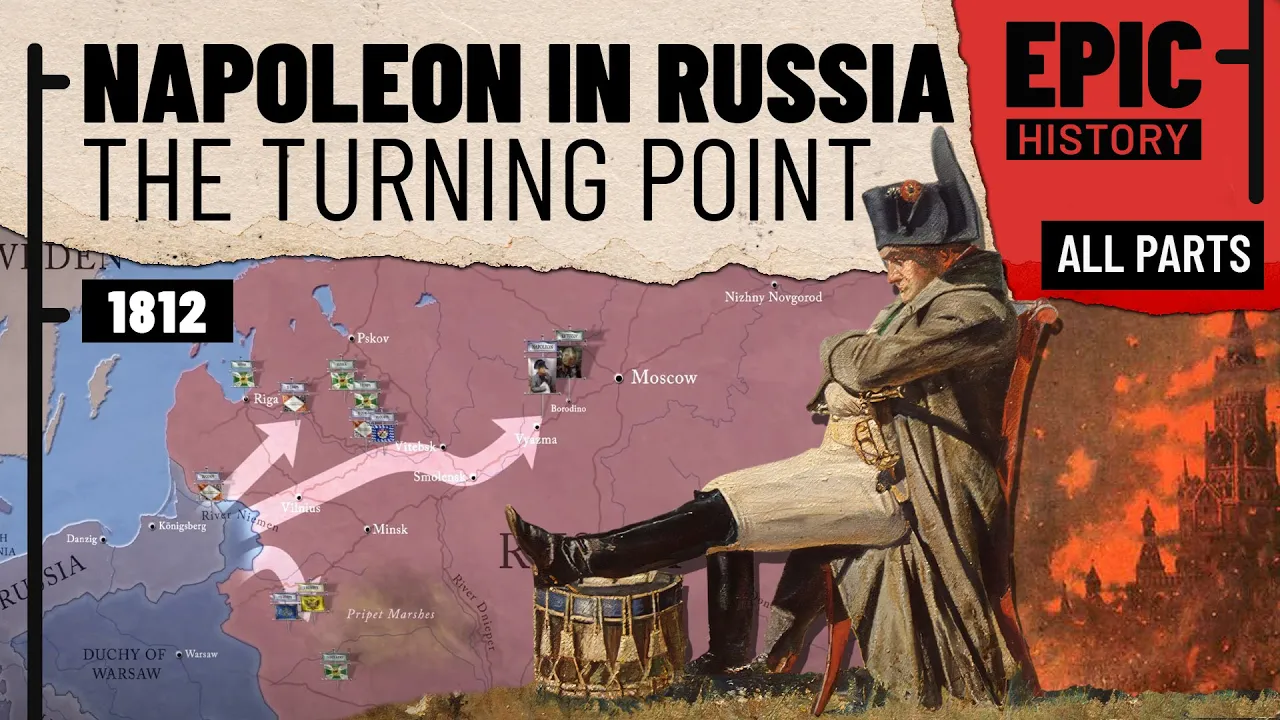
Epic History · @EpichistoryTv
Where viewers went back to watch this video again, from YouTube's public Most replayed graph, lined up with what was said at that moment.
Most replayed moment #1
4:247.7x the video's typical replay level
Terribilita is available now in paperback, eBook and Audiobook. Thank you to Terribilita and Cinder Block Publishing for sponsoring this video.
Said at 4:16
Most replayed moment #2
55:236.6x the video's typical replay level
in place to defend the crossing. On the east bank, General Partonneux’s 12th Division – 4,000 relatively fresh troops from Victor’s Ninth Corps - formed the rearguard.
Said at 55:19
Most replayed moment #3
18:156.4x the video's typical replay level
But now he was just 230 miles from Moscow. A century earlier, Peter the Great had moved Russia’s capital to St.Petersburg, but Moscow remained its historic and spiritual heart – a prize for which the Russians had to
Said at 18:09
The graph counts replays. It does not show where viewers stopped watching.
Words
6,846
Runtime
1:02:56
Speaking pace
109wpm
Reading time
29min
109 words per minute, below the 160 25th percentile of 349 measured videos. That distribution comes from the 349-video hook study.
Opening (first 30 seconds)
Russia, 1812. Napoleon invades his former ally with the largest army Europe has ever seen. But for the French Emperor, the decisive blow remains frustratingly beyond reach. Russia’s resilience is unlike anything he’s ever encountered. And as winter closes in, his army begins the most infamous retreat in history. In 1807, following his defeat of
55 words, the words spoken in the first 30 seconds at 109 words per minute.
Free, no signup. See how the first 30 seconds hold attention, with rewrites.
Sentence shape
| Measure | This transcript |
|---|---|
| Sentences | 377 |
| Average words per sentence | 18.2 |
| Longest sentence | 63 words |
| Questions asked | 1 |
| Sentences containing a number | 75 |
Most used terms
Filler phrases
2 in total: kind of 1 · like 1.
A literal whole-word count of the same phrase list the Prepublish browser extension uses, so a phrase inside another word is not counted and a phrase used in its ordinary sense still is. It is a count and not a judgement.
Run the check on the words above: where attention is likely to drop, with a rewrite for each weak line. The free check shows the scores and the one issue costing the most.
What this transcript is
Every word below is the caption track YouTube publishes for this video, pulled from the video itself and reproduced unchanged. It is not Prepublish's writing, not a summary, and not a re-transcription: it is the video's own published captions. English captions, published by the channel, in the video’s original language. Source: the video on YouTube. A channel that would rather this page did not exist can ask for its removal through the contact page, and it is removed.
Russia, 1812. Napoleon invades his former ally with the largest army Europe has ever seen. But for the French Emperor, the decisive blow remains frustratingly beyond reach. Russia’s resilience is unlike anything he’s ever encountered. And as winter closes in, his army begins the most infamous retreat in history. In 1807, following his defeat of the Russian army at Friedland, Napoleon had travelled to Tilsit to meet the Russian Emperor, Alexander.
During their celebrated encounter, the two emperors formed a friendship, and made an alliance. But it was not to last… Over the next five years, relations between France and Russia cooled dramatically. The Russians were irritated by Napoleon’s creation of a ‘Duchy of Warsaw’ in Poland, which they regarded as meddling in their own front yard. They feared it would lead to the return of a fully-fledged Polish state – a traditional thorn in Russia’s side.
Then there was Napoleon’s offer to marry Alexander’s sister, Grand Duchess Anna Pavlovna, to cement their alliance. But the Romanovs hated the idea, and after a year of Russian prevarication, Napoleon married Marie Louise, daughter of the Austrian Emperor, instead. Later that year, Napoleon broke a guarantee made at Tilsit, and annexed the Duchy of Oldenburg, ruled by Alexander’s sister’s father-in-law. Worst of all, was the fallout over ‘the Continental System’, Napoleon’s not very effective economic blockade against Britain, designed to cripple his most steadfast enemy.
Alexander had agreed to join the Continental System at Tilsit, but it was hugely unpopular in Russia, and ruinous to her finances during a period of economic crisis. When Napoleon found out that Russia was flouting the rules of the System, and had resumed an illicit trade with Britain, he was furious. With both emperors accusing the other of bad faith, their two countries began preparing for war. This video is sponsored by Cinder Block Publishing, and the new historical fiction novel Terribilita, by Ben Wyckoff Shore.
It tells the dramatic story of a family caught in the turbulent tides of 19th century Italian history: The patriarch – a hero of the Italian Risorgimento, who served with Garibaldi. His son, whose act of political defiance brings disaster crashing down on his family. A grandson, who seeks refuge and anonymity amid the last great age of sail. This fast-paced story is crammed with great historical characters and events, from Italy’s brutal and forgotten empire-building in East Africa, to the devastating Battle of Solferino – where Napoleon the Third tried to recapture his uncle’s glory with his own Italian campaign, that ended in slaughter.
The bloodshed so shocked a young Swiss observer, Henri Dunant – one of many historical figures that we meet in the novel - that he went on to found the International Committee for the Red Cross. This new novel is a perfect read for any history fan, and has been getting great reviews. Terribilita is available now in paperback, eBook and Audiobook. Thank you to Terribilita and Cinder Block Publishing for sponsoring this video.
Napoleon knew an invasion of Russia was a massive undertaking – especially as he still had an unfinished war in Spain, that was tying down more than 200,000 troops. Nevertheless in 1811 he began to assemble the largest army Europe had ever seen… Around 600,000 men… though less than half of them were French. The rest came from allied states across Europe. There was a Polish corps from the Duchy of Warsaw, led by Prince Poniatowski, a corps from each of the German Kingdoms of Saxony, Westphalia and Bavaria, from the Kingdom of Italy, as well as Swiss, Dutch, Croat, Spanish and Portuguese units scattered throughout the army.
There were even contingents from Prussia and Austria – France’s recent enemies, now uneasy allies. Some of these allied troops, such as the Poles and Germans, were as reliable as their French counterparts. Others were very inexperienced, or like the Prussians and Austrians – reluctant to be there at all. This gigantic formation was deployed in three armies, the main force under Napoleon himself, another led by his stepson Eugène, Viceroy of Italy, and a third led by his younger brother Jérôme, King of Westphalia.
Neither of these two were experienced commanders, though one would distinguish himself on campaign… the other would not. On their left flank Marshal Macdonald led Tenth Corps, with a large Prussian contingent… While the right flank was guarded by General Schwarzenberg’s Austrian Corps. Another 100,000 troops were in reserve, including Marshal Victor’s Ninth Corps. Initially the Russians only had 220,000 men to face this juggernaut, organised into Barclay de Tolly’s First Army; Prince Bagration’s Second Army; and General Tormasov’s Third Army.
They would be outnumbered two-to-one. But in the run-up to war, Russia scored two crucial diplomatic triumphs: Sweden had been at war with Russia just three years earlier, a conflict which cost her Finland. By a curious turn of events, Sweden was now ruled by Napoleon’s ex-marshal, Bernadotte. But after Napoleon occupied Swedish Pomerania without warning, a furious Bernadotte promised Russia that Sweden would remain neutral.
Meanwhile a peace treaty with the Ottoman Empire ended Russia’s six-year war against its southern rival. These two agreements secured Russia’s flanks from any strategic threat, and freed up troops to face Napoleon’s invasion. On 24th June 1812, French troops began crossing the Niemen River into Russian territory. The army was so large, the crossing took five days. Napoleon’s plan was to attack north of the impassable Pripet Marshes, and defeat Barclay’s army, while Jérôme pinned Bagration in place.
French forces would then swing south to trap Bagration. Napoleon expected the campaign to be over in five weeks. But the sheer size of the French army convinced the cautious Barclay that retreat was his only option. Prince Bagration, a much more aggressive commander by instinct, and often Barclay’s fierce critic, was forced to agree. As they withdrew they burned villages and crops - part of a scorched earth strategy to deny supplies to the enemy.
In four days Napoleon had reached Vilnius, but Barclay was gone. To the south, Jérôme failed to pin down Bagration, so when Davout’s First Corps swung southeast to trap him, he’d already withdrawn to safety. Napoleon’s younger brother was out of his depth. Stung by the Emperor’s criticism, humiliated when his troops were put under Marshal Davout’s command, he resigned his post and returned to Westphalia. The campaign was already beginning to expose serious flaws in Napoleon’s plan.
Knowing his troops would struggle to live off the land in this impoverished region, he’d organised huge supply depots and transport units to feed the army. But wagons rolled slowly along Russia’s bad roads, which were turned to rivers of mud by summer thunderstorms. The army had to make frequent stops to allow its supplies to catch up – bad news for Napoleon’s plan to catch the Russians, but a much-needed relief for the many thousands of young conscripts in his army, not used to hard marches day after day.
Many were soon dropping out with exhaustion; others deserted. There were also huge problems of command and control, over a vast, multi-national army that was three times bigger than any Napoleon had commanded before. La Grande Armée, once famed for its speed of manoeuvre, had become a lumbering beast. After a pause to rest and regroup at Vilnius, Napoleon resumed his advance. Barclay continued his retreat to Vitebsk, where he hoped Bagration’s Second Army would be able to join him.
But Davout blocked Bagration’s path at Saltanovka, forcing him to make for Smolensk instead. At Vitebsk, Napoleon clashed with Barclay’s rearguard, but once more the Russians escaped, after setting fire to all the stores they couldn’t take with them. Meanwhile, 300 miles away, on Napoleon’s southern flank, Russian Third Army attacked and defeated the Saxon Seventh Corps, forcing Napoleon to divert Schwarzenberg’s Austrian corps to their aid.
By the end of July, Napoleon had advanced 250 miles into Russia – much further than he’d planned. And the long marches in extreme, summer heat continued to take a heavy toll on his men. Without fighting a major battle, the army had already suffered 20% casualties - from exhaustion and illness, particularly typhus and dysentery. The army had entered Russia with quarter of a million horses, but they were now dying at a rate of a thousand every day, from exhaustion and lack of fodder.
It wasn’t just cavalry horses that were dying, but the very horses that were supposed to haul the army’s transport wagons, making a bad situation worse. This crisis in horsepower came just as the French light cavalry, Napoleon’s eyes and ears, met their match… in Russia’s Cossacks. Cossacks – self-reliant, proud, ruthless, and superb horseman - didn’t play by the same rules as other European cavalry. Every day they shadowed Napoleon’s army, swooping in whenever they saw an easy target, but melting away into the forests if they were attacked by a stronger force.
Cossacks, as well as Russian partisans, made hit and run attacks on French supply lines and depots, forcing Napoleon to divert thousands of troops to their defence. Alongside Russian regular light cavalry, they also prevented French patrols from carrying out reconnaissance, which meant that Napoleon often lacked good information about roads, or the enemy’s whereabouts. Napoleon stayed 16 days at Vitebsk, resting his troops and considering his options.
Among his many mounting concerns was the security of his long, exposed flanks. But at Vitebsk he received news that Schwarzenberg had defeated the Russians at Gorodeczna… A week later at Polotsk, a French-Bavarian force fought Wittgenstein’s Russian First Corps to a standstill. Napoleon’s flanks were secure, for now. Although his main force had been reduced to less than half its original strength, Napoleon decided to push on to Smolensk, and try to force the Russians into a decisive battle for the city.
Barclay was indeed under pressure to give battle, from fellow commander Prince Bagration and Emperor Alexander in St.Petersburg: the army’s morale and Russia’s honour required it, they told him. With the First and Second Russian Armies finally linking up near Smolensk, Barclay decided to attack Napoleon’s army, which he believed was concentrated around Rudnya. The offensive was led by General Platov’s Cossacks, who surprised a French cavalry division at Inkovo.
But alarmed by false reports that Eugène’s Fourth Corps was outflanking him to the north, Barclay called off the attack. Napoleon, reassured that Barclay’s offensive posed no real threat, began a grand outflanking move to the south, to take Smolensk and cut off the Russian retreat. The so-called ‘Smolensk Manoeuvre’ was Napoleon at his best. Using Murat’s cavalry to screen his movements and keep Barclay in the dark, the Emperor reached the Dnieper on the evening of 13th August.
His engineers quickly threw up four pontoon bridges, and by dawn the next day, his army was across. Marshal Davout led a second column across the river at Orsha. But a single Russian division, the 27th , fought a heroic fighting retreat from Krasny, delaying the French advance… and buying time for Bagration to reinforce the Smolensk garrison. The chance for a surprise assault on the city was lost. And as the Russian army began to pull back, Napoleon displayed an uncharacteristic lack of urgency, even halting the army for a parade to mark his 43rd birthday.
When the main attack on Smolensk began two days later, Napoleon opted for a frontal assault. 150 French guns battered the city, as three French corps attacked its medieval fortifications. The Russians resisted bravely. But Barclay, fearing encirclement, ordered another retreat. With Smolensk in flames, the Russians began to pull out… just as the French fought their way into the city, to scenes of utter devastation. Bagration’s Second Army withdrew first… As Barclay’s army followed, its rearguard was caught by Ney’s Third Corps at Valutino… General Junot, commanding the Westphalian Eighth Corps, had orders to cut off Barclay’s retreat - but having crossed the river, he did nothing, and the opportunity was lost.
A furious Napoleon swore that Junot would never now win his Marshal’s baton. The Battle of Smolensk cost both sides around 10,000 casualties, and destroyed one of Russia’s most historic and holy cities – but settled nothing. After the missed chance to defeat the Russians at Smolensk, Napoleon paused once more to consider his options. His men were weary and far from home, and it was already late in the campaigning season.
He considered sitting out the Russian winter at Smolensk, and resuming the campaign in 1813. But now he was just 230 miles from Moscow. A century earlier, Peter the Great had moved Russia’s capital to St.Petersburg, but Moscow remained its historic and spiritual heart – a prize for which the Russians had to fight. Napoleon, always a gambler, decided to push on. The Russians faced their own dilemma. Emperor Alexander had experienced a kind of religious epiphany that summer, and rallied the Russian people to the country’s defence, describing the war with Napoleon as a war to save Holy Mother Russia from the Antichrist.
For months the Emperor had received conflicting advice – to stand and fight, or retreat. Now he decided change was needed. The cautious General Barclay kept his job, but the Emperor summoned General Mikhail Kutuzov to take overall command of Russia’s armies. Kutuzov had been beaten by Napoleon at Austerlitz seven years before, but he’d since won several victories against the Ottoman Empire, and was a ‘true Russian’, loved by the troops.
Although Kutuzov agreed with Barclay’s strategy of delay, he saw that constant retreats were destroying the soldiers’ and the nation’s morale. If Moscow was given up without a battle, the fallout could be disastrous. And so, 70 miles west of the city, near the village of Borodino, the Russian army prepared to make a stand. Europe was about to witness the bloodiest day’s fighting of the Napoleonic Wars. September 1812. 10 weeks had passed since Napoleon invaded Russia with more than half a million men.
The French Emperor wanted a quick victory over the Russians, one that would force Emperor Alexander to make peace, and agree to French terms. But at Vitebsk, and then Smolensk, the outnumbered Russian army had narrowly escaped his clutches. The holy city of Smolensk had been virtually destroyed. Napoleon had advanced deep into Russia, and months of marching had left his army decimated by disease and exhaustion. It was now half its original strength, and summer was nearly over.
But finally, 70 miles west of Moscow, near the village of Borodino, the Russians had turned to offer battle. Napoleon would have a chance to win the decisive victory, that he believed would end the war. The Russian army, commanded by the 67-year-old, one-eyed veteran General Kutuzov, occupied a defensive position across the two main roads leading from Smolensk to Moscow. General Barclay de Tolly’s First Army was on the right, its front protected by the Kalatsha River, steep-banked but shallow and easily forded.
Prince Bagration’s Second Army was on the left, a more open position, but reinforced by major earthworks – the Great Redoubt, and what the French nicknamed, for their shape, the Flèches – the arrows. Another forward redoubt at Shevardino was expected to delay the enemy’s advance. Historians still dispute the size of the Russian army, but it’s likely Kutuzov had around 121,000 men and 680 guns at Borodino. On 5th September, Napoleon’s army began to arrive from the west: around 130,000 men, and 585 guns.
Napoleon quickly saw that the Shevardino Redoubt would have to be taken before he could deploy his army, and ordered an immediate assault. The attack was led by Compans’ 5th Division of the First Corps, supported by the Polish Fifth Corps to the south. In several hours of heavy fighting, the redoubt changed hands more than once. But late that evening the Russians finally withdrew to their main line, and the redoubt fell to the French.
Its capture had cost them an estimated 4,000 casualties, while the Russians lost around 6,000 men. Napoleon noted how few prisoners were taken – a worrying sign of the enemy’s unbroken resolve. Both sides spent the next day preparing for battle. Marshal Davout, commanding French First Corps, and widely considered Napoleon’s most able subordinate, appealed to the Emperor to use his Corps to make a wide, outflanking attack to the south… But Napoleon dismissed the idea as too risky, and instead began preparing for a massive frontal assault on the Russian defences.
Shortly after dawn on 7th September, Orthodox priests paraded one of Russia’s holiest icons, Our Lady of Smolensk, before the Russian army. It was a stirring sight for many devout, Russian soldiers, thousands of whom would not live to see dusk. The battle began at 6 am, as French batteries opened a deafening cannonade against the Russian defences. Eugène’s Fourth Corps advanced on Borodino village, lightly held by Jaegers of the Russian Imperial Guard.
After clearing the village, his infantry crossed the Kalatsha and advanced towards the Great Redoubt, but were driven back with heavy losses. The Russians burned the bridge across the river, but did not launch a counterattack, and Eugene was able to move cannon into the village, to put flanking fire on the Great Redoubt. In the centre, Davout’s First Corps began its advance against the Flèches, coming under heavy fire… While on the right, the Polish Fifth Corps, ordered to take Utitsa, got held up in the woods and ravines… Their slow advance allowed Tuchkov’s Third Corps to send a division north to reinforce the Fléches defences.
Kutuzov, at his headquarters in Gorki, took little part in the battle, leaving tactical decisions to his subordinates. Barclay.. and Bagration.. had spent most of the summer arguing furiously over strategy, but in the hour of crisis, they put their differences aside. They could see the main French attack was falling on the Russian centre and left… so Barclay ordered General Baggovut’s Second Corps south to reinforce Bagration.
Fighting around the Flèches intensified, as the French captured one of the earthworks, only to be driven out by a Russian counterattack. Davout himself was injured in the fighting as he fell from his dying horse, but he refused to leave the field. When Russian cavalry counterattacked, Marshal Murat himself led the French cavalry forward to meet them. Ney’s Third Corps now joined the attack on the Flèches. A charge by Russian cuirassiers forced Murat to take shelter in a square of Württemberg infantry.
Murat, with his flamboyant dress and reckless courage, had now even made a name for himself among the Russians – the Cossacks in particular saw him as a kindred spirit, and were eager to capture him alive if they could. To the south, Polish troops now took Utitsa, which the Russians set ablaze before withdrawing. But General Baggovut’s reinforcements arrived just in time to shore up the Russian flank. Around 10am, Eugène launched another attack on the Great Redoubt.
It was briefly captured by Morand’s First Division, before his men were thrown out by a ferocious Russian counterattack. The Russian army’s 27-year-old artillery commander, General Kutaisov, was killed leading one of these counterattacks. A heroic death, but a blow to the organisation of Russian artillery for the rest of the day. Fighting continued to rage around the Flèches earthworks. Some counted as many as six major French assaults, involving 45,000 troops, with hundreds of cannon on both sides pouring fire into the packed ranks.
More than once, French infantry fought their way into one of the Russian positions, only to be driven out again at bayonet point. Junot’s Westphalian Corps was sent forward in support, helping to clear Russian skirmishers from the woods to the south. General Bagration was close to the action, overseeing the defence of the Flèches, leading forward reinforcements and ordering counterattacks. Around 10am he was hit in the leg by shell fragments.
Mortally wounded, he was carried from the field. Shaken by the loss of their iconic commander, the exhausted Russian infantry began to fall back, and the French finally took the Flèches. Marshal Murat then led forward Friant’s division – First Corps’ last reserve – supported by waves of heavy cavalry on both flanks. Russian Grenadiers formed squares to ward off the French cuirassiers… While their own Guard cavalry fought the French in a giant, confused melee… with heavy losses on both sides.
The Russians resisted doggedly, but the combined onslaught of French artillery, cavalry and infantry proved irresistible. As the Russians pulled back, Friant’s infantry fought their way into the village of Semënovskaya. The Russian centre was in disarray… and seemed close to breaking. Surely now was the time for Napoleon to deliver the knockout blow. For most of the day, Napoleon remained at his headquarters near Shevardino.
Those around him later said that illness, as well as the exertions of the long campaign, had left him tired and irritable. As the Russian centre buckled, Murat and his staff urged him to send forward his last reserve, the Imperial Guard. The Emperor refused. “If there is another battle tomorrow,” he asked them, “where is my army?” But he did make one exception... Barclay was continuing to move troops from his unengaged right wing to bolster the centre.
As Ostermann-Tolstoy’s Fourth Corps arrived behind the Russian centre, French observers feared they were massing for an attack. So Napoleon ordered forward General Sorbier’s Guard artillery. His batteries opened a devastating fire on the enemy. Yet even as they were mown down in their ranks, the Russian infantry stood their ground. On the Russian right wing, all remained quiet, so General Platov, commander of the Don Cossacks, proposed that he lead an attack on the lightly-defended Borodino village.
Permission received, Generals Platov and Uvarov led a force of 8,000 Cossacks and cavalry across the Kalatsha River They fell on French and Italian troops around Borodino with complete surprise, spreading panic and disorder. Grouchy’s Third Cavalry Corps had to be pulled back across the river to drive off the Russians. Russian commanders saw this raid as a missed opportunity. But it had delayed the next French attack by two hours… and may have persuaded Napoleon that he was right to hold back his reserve.
Around 3pm, the French launched their biggest assault yet on the Great Redoubt.. Russian gunners targeted the French infantry advancing to their front, allowing French cavalry to outflank the Redoubt, and charge it from the rear. Saxon cavalry were first in, cutting down Russian infantry and gunners, almost to the last man. It was an astonishing feat by the horsemen, against all the rules of war – and testament to the ferocity of the fighting.
As Eugène’s infantry consolidated their hold on the Redoubt, he ordered forward all the available cavalry to exploit this success. But they were met, and checked by the last Russian cavalry reserves. Eugène now implored Napoleon to commit the Imperial Guard. But again, the Emperor refused. “I will not destroy my Guard,” he told his staff, “I am 800 leagues from France and I will not risk my last reserve.” By 5pm, both armies were in a state of utter exhaustion.
The battlefield was strewn with dead and wounded. Some infantry battalions could muster only a third of their strength. Cavalry could advance no faster than a trot. Gun crews were collapsing with fatigue. As dusk approached, fighting slowly died out across the battlefield. Napoleon and the French army expected the fighting to resume the next day. But by dawn, Kutuzov, having learned the full, horrifying scale of Russian losses, had ordered a withdrawal.
The losses on both sides were enormous. Russian casualties are estimated at 44,000. French losses: around 30,000, including 49 generals – 12 of them killed. Borodino would prove to be the bloodiest single day of the Napoleonic Wars. The Russian army could not fight another battle until it had received major reinforcements. And so Kutuzov decided that he must abandon Moscow. On 15th September, a week after his victory at Borodino, Napoleon entered the city.
He would find it virtually deserted, and already, the first fires starting to burn. 15th September 1812. 83 days after invading Russia; a week after his costly victory at Borodino; Napoleon entered Moscow. He expected to be greeted by dignitaries, formally offering the city’s surrender. Instead, he discovered that 90 per cent of Moscow’s inhabitants had fled. A fire had started the previous night, and was blamed on drunken soldiers.
But over the next 48 hours, fires continued to break out across Moscow, until most of the city was ablaze. Count Fyodor Rostopchin, the city’s governor, had ordered that Moscow be destroyed rather than allowed to fall into enemy hands. And now fires were being started deliberately by Russian criminals, freed from jail and acting on police orders. French soldiers rounded up and shot any they could catch, but the inferno was impossible to contain.
In four days, two-thirds of Moscow was destroyed. With the fires finally under control, Napoleon’s soldiers turned their attention to systematically looting the ruined city… While from his new quarters in the Kremlin, Napoleon sent a letter to Emperor Alexander in St. Petersburg, inviting him to make peace, and end the war. He received no reply. Napoleon waited, confident that Alexander would eventually negotiate. But as the days passed, he grew increasingly uneasy.
Cossack raids were disrupting his vital communications with Paris, as well as the arrival of supplies. While the steady attrition of French forces, and Russian reinforcements, meant Napoleon was outnumbered for the first time in the campaign. Rumours also reached him that his reluctant allies, Prussia and Austria, were in secret talks with his enemies. Napoleon had proposed that the army winter in Moscow – but that now looked too dangerous.
Reluctantly, he accepted that the army would have to move back to Smolensk to find safe winter quarters. Napoleon knew how severe Russian winters could be, but continued to put off his departure, reassured by fine October weather, and hoping that at the last minute, there might be a message from Alexander, offering peace. It never came. On 13th October, the first light snow fell. Five days later, Kutuzov launched a surprise attack on Murat’s advance guard at Vinkovo, and defeated it.
Napoleon, stung into action, gave the order for the army to leave Moscow the next day. 100,000 men of the Grande Armée left Moscow in a column 10 miles long, with an estimated 40,000 carriages and carts. There were women and children too: army wives and the vivandières, the women who cooked for the soldiers, as well as some civilians. Every wagon and pack was stuffed with as much food and loot as possible. As he set off, Sergeant Bourgogne of the Imperial Guard made an inventory of his pack.
It contained: “several pounds of sugar, some rice, some biscuit, half a bottle of liqueur, a woman's Chinese silk dress embroidered in gold and silver, several gold and silver ornaments, amongst them a piece of the cross of Ivan the Great... Besides these I had my uniform, a woman's large riding-cloak, two silver pictures in relief, 12 inches long and 8 high, all in the finest workmanship. Also several lockets and a Russian Prince's spittoon, set with precious stones.
I wore over my shirt a yellow silk waistcoat, which I had made myself out of a woman's skirt; over that a large cape lined with ermine, and a large pouch hung at my side by a silver cord. This was full of various things - amongst them, a crucifix in gold and silver and a little Chinese porcelain vase. Then there were my firearms, powder-flask and sixty cartridges in the box.” This heavily-encumbered army did not yet realise it was in a race against time.
The Russians were beginning to move against the flanks of Napoleon’s 550 mile-deep salient. That very day, Wittgenstein’s army was driving back Marshal Saint-Cyr’s outnumbered force at Polotsk… and drawing Victor’s Ninth Corps west to support them. In the south, Admiral Chichagov’s advance had Schwarzenberg’s Austrian corps falling back to cover Warsaw. The corridor was closing. And then there was the weather… though Napoleon was confident his army could reach winter quarters in Smolensk in twenty days – well before the more extreme temperatures were due to hit.
Napoleon planned to withdraw via Kaluga, through unspoilt country where the army could forage for supplies. But Kutuzov sent General Dokhturov’s Sixth Corps to block the road at Maloyaroslavets. In fierce fighting, Italian troops of Eugène’s Fourth Corps drove the Russians out of the town. It was a hard-won victory, reminiscent of the fighting at Borodino. Kutuzov now stood between Napoleon and Kaluga. Napoleon now took the unusual step of conferring with his marshals.
And after discussing various options, he decided that rather than seek another major battle, they would retreat the way they’d come, along the Smolensk road. Napoleon had hoped to avoid this route, as it meant marching back through country already stripped bare of supplies. The day after the fighting at Maloyaroslavets, Napoleon was nearly captured by a group of Cossacks, and saved only by General Rapp’s charge at the head of his escort.
After this close shave, Napoleon had a phial of poison made up, which he carried around his neck in case of capture. Napoleon’s army set off on its new course, shadowed, at a respectful distance, by Kutuzov’s army to the south. They passed the old battlefield of Borodino: a grisly, unnerving sight, where crows pecked at half-buried corpses. Relentless marching quickly began to tire out men and horses. A few days later, the temperature fell below freezing.
The army’s overworked, starving horses died en masse. Discipline began to break down, as some drivers simply dumped the sick and wounded by the roadside, to try to ensure their own survival. As the French column became increasingly strung out, General Miloradovich, commanding Kutuzov’s advance guard, fell on Davout’s rearguard outside Vyazma. For a few hours Davout’s First Corps was cut off, until Eugène and Ney came to his rescue.
The battle ended with street-fighting in Vyazma, as the French hastily evacuated the burning town. For the soldiers of the Grande Armée, so unaccustomed to retreats and routs, Vyazma was an alarming, demoralising blow. On 4th November it began to snow heavily. The next night temperatures plummeted to minus 20 degrees Centigrade. Few men or women had proper winter clothing, or access to shelter. Many froze to death overnight.
The next morning wagons and guns were abandoned. Many soldiers now sought to save themselves, ignoring officers, stealing horses and food, and leaving the column to scour the countryside for supplies. Many of these foragers were found by the Cossacks, some cut down or lanced, others robbed of every possession and left to freeze. In a few cases, they were handed over to peasants, eager for retribution against the foreign invaders who’d plundered all they owned.
As the army struggled on towards Smolensk through blizzards, Napoleon ordered Eugène’s Fourth Corps to strike out for Vitebsk, where there were large French supply depots. But Vitebsk had already fallen to the Russians. Fourth Corps was too weak to fight its way through, and rejoined the army, minus its artillery, and most of its baggage. A colonel who saw Fourth Corps at this stage described men ‘without shoes, almost without clothes, exhausted and famished, sitting on their packs, sleeping on their knees and only rousing themselves out of this stupor to grill slices of horsemeat or melt bits of ice’.
Just three weeks after leaving Moscow, a third of the army was dead or captured. About half the rest formed a growing army of stragglers: men without units, prepared to fight only to survive. Napoleon reached Smolensk on 9th November. The first troops into town ransacked the supply depots, leaving nothing for those who followed… including Ney’s rearguard, which arrived six days later. Napoleon had hoped to make Smolensk his winter base, but the state of the army and lack of supplies meant the retreat had to continue.
But the five days he spent there gave Kutuzov time to circle ahead and prepare an ambush. When the French retreat resumed, he struck thirty miles west of Smolensk at Krasny. In three days of desperate fighting through knee-deep snow, Napoleon used his Imperial Guard to hold open the road, as Eugène and Davout’s corps fought their way through the ambush with heavy losses. Two regiments of the Young Guard were ordered to make a sacrificial counterattack to keep the Russians at bay.. and were virtually annihilated.
Kutuzov held back many of his troops, and was blamed for not trying to destroy Napoleon’s army when he had the chance. It’s possible he was concerned at the number of raw conscripts in his own army, also suffering terribly in the freezing conditions. Not every French corps broke through at Krasny. Marshal Ney and his 6,000 strong rearguard arrived on 18th November, to find the road blocked by 60,000 Russian troops, and no sign of the promised support from Davout’s First Corps.
Ney’s men hurled themselves against the Russian lines with desperate courage, but were mown down. Rejecting several invitations to surrender, Ney led the survivors in a daring, night-crossing of the Dnieper river, then across 45 miles of open country under constant attack from Platov’s cossacks, to reach Orsha. By the time Ney rejoined the army, his rearguard was down to just 800 fighting men, leading a column of several thousand stragglers.
The army regarded his escape as a miracle, and when Napoleon heard of it, he immediately dubbed Marshal Ney ‘the bravest of the brave’. Napoleon had escaped one trap, but now three Russian armies were closing in from different directions, and outnumbered him nearly 3-to-1. From the east, Kutuzov’s main army, with 65,000 men. From the north, Wittgenstein with 30,000, steadily driving back Marshal Victor’s Ninth Corps.
And from the south, Admiral Chichagov’s Army of Moldavia, with 34,000, having detached General Osten-Sacken with 30,000, to prevent Schwarzenberg’s Austrians and Reynier’s Saxon corps marching to Napoleon’s aid. Napoleon was heading for Minsk, a major French supply base with vast stores of the food, clothing, shoes and ammunition that his army so desperately needed. But on 21st November, disastrous news arrived: Minsk had fallen to Chichagov.
He’d then marched on Borisov, driven out the Polish garrison, and captured its bridge over the Berezina River. By rights, the Berezina ought to have frozen solid by now, so Napoleon could have crossed anywhere, but a sudden thaw had turned the river into a torrent of ice and freezing water. Napoleon was, at least, joined by the hard-fighting Marshal Oudinot and his Second Corps, which hadn’t suffered as badly as the main column on its retreat from Polotsk.
Oudinot launched an immediate counterattack on Borisov and retook the town, but couldn’t stop the Russians burning the bridge. With no other bridge for miles in either direction, it seemed Napoleon’s exhausted army was finally doomed. But there was one sliver of hope - Polish cavalry had found a ford across the river near the village of Studienka. Napoleon issued a flurry of orders: Second Corps was to fake preparations for a river crossing south of Borisov, Victor’s Ninth Corps, arriving from the north, was to form a rearguard east of Studienka to hold the Russians at bay… while engineers worked as quickly as possible to build pontoon bridges across the river… and win Napoleon’s army a fighting chance of escape.
On the afternoon of 25th November, General Eblé’s Dutch engineers began building two 300-foot pontoon bridges across the Berezina River. They worked day and night, sometimes chest-deep in freezing water, and completed both bridges in less than 24 hours. Few of the engineers survived the ordeal. Chichagov had been totally fooled by the diversion south of Borisov, and was moving his troops south to face it – allowing Napoleon’s army to begin crossing its rickety bridges virtually unopposed.
Oudinot’s Second Corps led the way, to secure a bridgehead, followed the next day by the remnants of the main army. Priority was given to formed troops, still able to fight. For the time being, the army’s vast crowd of stragglers remained on the far bank. By the time Chichagov realised his mistake and began moving north, Napoleon had troops in place to defend the crossing. On the east bank, General Partonneux’s 12th Division – 4,000 relatively fresh troops from Victor’s Ninth Corps - formed the rearguard.
As Platov’s Cossacks approached from the east – the vanguard of Kutuzov’s main army – Partonneux tried to rejoin Ninth Corps. But caught in a swirling blizzard, with visibility down to 50 metres, he marched straight into Wittgenstein’s army. His entire division was killed or captured. The next morning, Chichagov and Wittgenstein launched co-ordinated attacks on both sides of the river. There was desperate fighting on the west bank, where Marshal Oudinot was (yet again) seriously wounded, but his Swiss infantry held the line… until General Doumerc’s cuirassiers, the army’s last heavy cavalry, charged and routed the Russians.
At great cost, Polish and German troops of Victor’s rearguard held off the Russians until dark… then pulled back across the bridges. For two nights, officers had been trying to get the vast camp of stragglers to cross the bridges when they weren’t being used. But with temperatures reaching minus 30 centigrade, they’d preferred to stay put, huddled around their fires. At dawn on the 29th, with the army leaving and the Russians approaching, thousands of stragglers surged in panic towards the bridges.
Dozens were crushed underfoot. Others fell or were pushed into the water, or tried to swim, which was certain death. When French engineers burned the bridges at 9am, thousands were cut off, and left to the mercy of the advancing Cossacks. Some became prisoners, others were simply put out of their misery. Since the retreat began 43 days earlier, the Grande Armée had marched nearly 500 miles - under constant attack, starved, exhausted… and for the last 23 days, in lethal sub-zero temperatures without proper clothing or shelter.
In that time, the fighting strength of the Grande Armée had been reduced from around 124,000 men to 20,000, with as many stragglers still following the army. As the retreat continued to Vilna, the weather turned even worse, with temperatures falling to minus 37 degrees centigrade. The Russian armies at least now held back, leaving the winter, Cossacks and Russian peasants to finish off the invaders. On 5th December, Napoleon left the army, travelling incognito across Europe at breakneck speed… and reaching Paris in just 13 days.
Naturally, English satirists capitalised on Napoleon seeming to abandon his defeated army… and many soldiers did regard it as an act of betrayal. But his generals supported his decision to leave – there’d already been one attempted coup against Napoleon in Paris, and there was much work to be done to rebuild the army, and reassure France’s allies. On 9th December, 51 days after the retreat began, around 20,000 ragged survivors of the Grande Armée began crossing the Niemen River, back into friendly, Polish territory.
According to legend, Marsal Ney was the last man across. Napoleon’s invasion of Russia had proved to be one of the greatest military disasters in history. He had made fatal miscalculations about geography, logistics, and above all: Russia’s political and strategic response to his invasion. These blunders cost his empire around half a million men… as well as a quarter of a million horses, and 1,000 cannon. Put another way, of every 12 men who marched into Russia with the Grande Armée: One was killed in action or died of wounds.
Two were taken prisoner, one of whom died in captivity. Seven died from disease or the effects of climate. Just two returned alive. Contrary to myth, many more soldiers had died in the summer advance - from heat, typhus and dysentery – than were lost in the winter retreat. Russian military casualties were estimated at 150,000, and a huge but unknown number of civilian deaths. The Russian campaign was a catastrophe for Napoleon.
Not just in lost troops and resources, but in damage to prestige and reputation. That winter all his enemies sensed weakness, and prepared to join forces against him for the first time… But the Emperor wasn’t going down without a fight. Back in Paris he admitted to his ministers, “Fortune has dazzled me, gentlemen. I’ve let it lead me astray. Instead of following my plan I went to Moscow. I thought I’d make peace there.
I stayed too long. I’ve made a grave mistake… but I’ll have the means to repair it.” Thank you to the artists Aleksandr Averyanov and Egor Zaitsev for kind permission to use their artwork in this video. And thanks as always to all our Patreon supporters for making this series possible. Find out how you too can support the channel and get ad-free early access to new videos, by visiting our Patreon page.
The words are the caption track's own and nothing is reworded or re-transcribed. Paragraph breaks are placed between sentences so the text reads as prose.
Free tools for your own script: paste a draft and see where it stands before you record it.
Paste your draft and see where viewers are likely to drop off, with a rewrite for each weak line.
Paste the first 30 seconds of your own draft for a hook score and rewrites.
Check your draft against YouTube's advertiser-friendly guidelines before you record it.
Read this channel's public videos and transcripts, and download a writing brief for it.