Getting the transcript
Reading the captions from YouTube. A video nobody has opened here before takes 10 to 30 seconds; this page fills in on its own.
Getting the transcript
Reading the captions from YouTube. A video nobody has opened here before takes 10 to 30 seconds; this page fills in on its own.
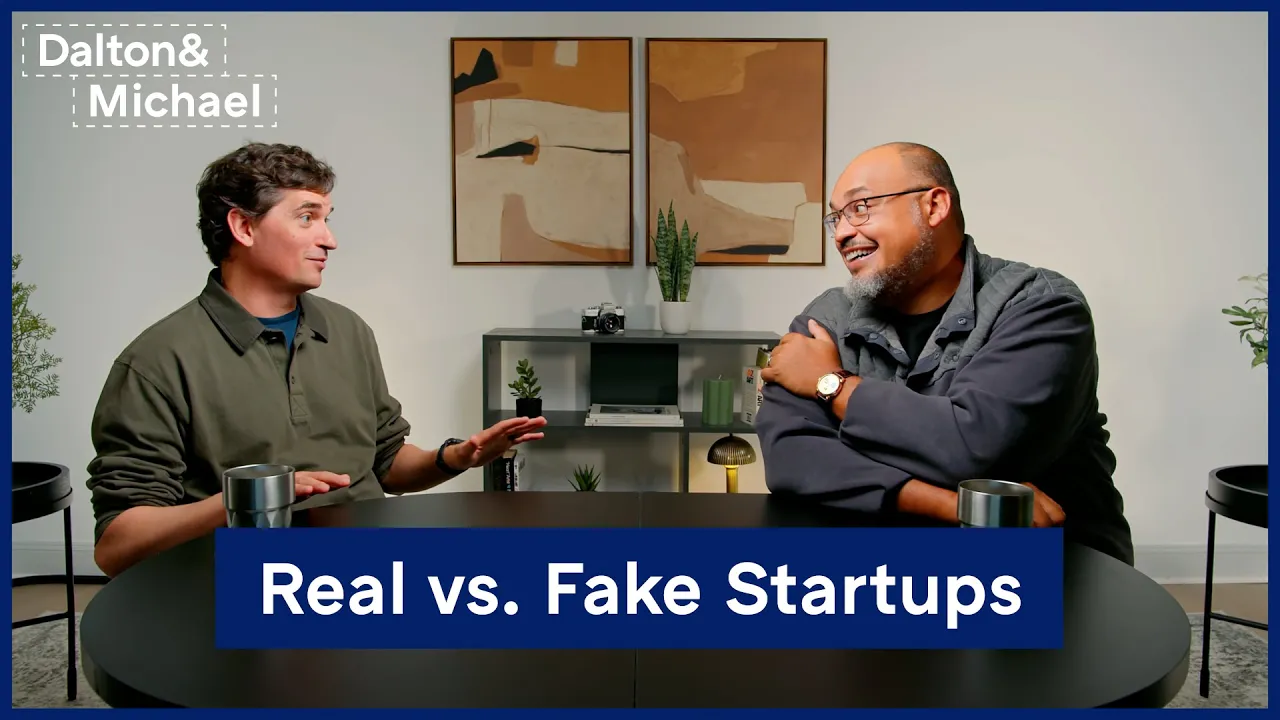
Dalton + Michael · @daltonplusmichael
Where viewers went back to watch this video again, from YouTube's public Most replayed graph, lined up with what was said at that moment.
Most replayed moment #1
1:382.6x the video's typical replay level
>> Yeah. The whole thing is a performance. >> Yeah. Yes. >> It's not real. So, what's a real start? >> So, or the cartoonish version. >> The cartoonish version of a real startup is where, you know, everyone is working 996. Yeah. >> And it's only programmers. There's not a single non-technical person in the business.
Said at 1:30
Most replayed moment #2
3:591.8x the video's typical replay level
you're just trying to go along with what everyone else seems like they're doing and no one's told you otherwise. I see people slip into fake startups when they have poor starting conditions but high urgency. >> So it's like I've got these poor starting conditions and maybe I'm in the wrong place. Maybe I can't work
Said at 3:52
Most replayed moment #3
6:481.7x the video's typical replay level
stuff you would already done. >> Yeah. >> That's not useful. Like what was that? Did you see the the tweet recently where it was like Ben Horwitz was like, "Oh, some VC told me to only hire a players." And I'm like, "Thanks, dumbass. That never would have occurred to me. Only hire a players. That's amazing advice. I
Said at 6:40
The graph counts replays. It does not show where viewers stopped watching.
Words
1,891
Runtime
9:04
Speaking pace
209wpm
Reading time
8min
209 words per minute, above the 201 75th percentile of 349 measured videos. That distribution comes from the 349-video hook study.
Opening (first 30 seconds)
I have encouraged a lot of founders [music] building technical tools, you know, developer tools to spend a lot of time posting about their [music] thing and telling the world about it because if no one knows that your technology exists, it's kind of game over. And that the the best technologies are good at marketing whether you admit it or not. Welcome to Dalton Plus Michael. Today we're going to talk about real startups versus fake startups. In this video, I'm going to say nice things and Dalton's going to make people mad. [laughter] >> What What is the definition here? What's the definition
105 words, the words spoken in the first 30 seconds at 209 words per minute.
Free, no signup. See how the first 30 seconds hold attention, with rewrites.
Sentence shape
| Measure | This transcript |
|---|---|
| Sentences | 170 |
| Average words per sentence | 11.1 |
| Longest sentence | 127 words |
| Questions asked | 16 |
| Sentences containing a number | 2 |
Most used terms
Filler phrases
100 in total: like 57 · kind of 13 · you know 11 · right? 7 · actually 4 · basically 2 · sort of 2 · um 2 · I mean 1 · uh 1.
A literal whole-word count of the same phrase list the Prepublish browser extension uses, so a phrase inside another word is not counted and a phrase used in its ordinary sense still is. It is a count and not a judgement.
Run the check on the words above: where attention is likely to drop, with a rewrite for each weak line. The free check shows the scores and the one issue costing the most.
What this transcript is
Every word below is the caption track YouTube publishes for this video, pulled from the video itself and reproduced unchanged. It is not Prepublish's writing, not a summary, and not a re-transcription: it is the video's own published captions. English captions, generated automatically by YouTube, in the video’s original language. Source: the video on YouTube. A channel that would rather this page did not exist can ask for its removal through the contact page, and it is removed.
I have encouraged a lot of founders [music] building technical tools, you know, developer tools to spend a lot of time posting about their [music] thing and telling the world about it because if no one knows that your technology exists, it's kind of game over. And that the the best technologies are good at marketing whether you admit it or not. Welcome to Dalton Plus Michael. Today we're going to talk about real startups versus fake startups.
In this video, I'm going to say nice things and Dalton's going to make people mad. [laughter] >> What What is the definition here? What's the definition of a fake startup? [laughter] >> Oh, okay. So, you're setting me up. >> I mean, I might be setting you up. >> Let's start with the extremes, right? Like with the cartoonish extremes. Yes. >> So, a cartoonishly extreme fake startup. >> Yes. >> Is a startup that >> never builds a product.
It never writes any code. It hires lots of people. The founders are on the 30 under 30 list somehow. [laughter] >> Somehow >> that was a that was a high priority. [laughter] >> Somehow that's the main work product. The founders have raised money >> despite never having um shipped a product or any customers. Basically, it's almost like performance art. It's like if you had a modern artist be like trying to to to disassemble the startup culture.
Yes. >> In some edgy way. Yes. >> That's a fake startup. Yes. I like that performance art. It's like Hamilton on stage versus actually being there. >> Yeah. The whole thing is a performance. >> Yeah. Yes. >> It's not real. So, what's a real start? >> So, or the cartoonish version. >> The cartoonish version of a real startup is where, you know, everyone is working 996. Yeah. >> And it's only programmers. There's not a single non-technical person in the business.
Nope. >> And they're all writing Rust. >> Yes. >> And maybe not even R. They're writing their own programming language >> to start obviously. >> To start, of course. >> Yes. Because it's got a scale. [laughter] They can't be bothered to do all sorts of things. They're just like super hardcore. They're super focused. >> Don't have to do any sales. >> They don't have to do any sales. It's all self-service. >> Yes. >> And I don't know.
Like I think back in our day when we were early founders, Google was like the textbook example that I was taught of like what real is >> just being hardcore. >> Yeah. Like they look at your SAT scores and they're trying to recruit you. So everything about Google my memory as a founder was we were trained that that >> that was the golden standard for a real >> hardcore organization. >> These are clear caricatures, right?
Right. Like you perfect example, Google's like one of the best sales companies in the world. I have an advertising business, right? Or like Stripe, which is perceived as this just like oh self-s serve thing. It's like one of the best enterprise software payments companies in the world. I think this real versus fake startup thing is interesting because we interact with a lot of founders who aren't taking a sober look at whether they're taking a real shot at the startup game or not.
What do you think causes someone to kind of kind of slide into the fake side? Cuz the problem with fake is like if you're not taking a real shot, this is so hard if you're taking a real shot on goal. If you're not even taking a real shot on goal, you're kind of wasting time. That's such a great question. Let's try to make the most um charitable explanation of someone that's doing what might seem like a fake startup. >> I think that humans are social animals.
The way we learn things is we look around the room and we try to see, you know, if you if you go to a new culture, you're like, "Okay, everyone's wearing this kind of hat. Everyone takes their shoes off." Okay. You just kind of like go through the motions. And so I think some of the most unintentionally funny uh performative startups >> might be someone that's just like they're like a merchant that's just trying to pretend >> if you're almost consuming startup culture solely on Twitter >> like depending on who you're following you might just be coercultting this thing that looks like startups business >> and you're like wait I thought this was >> but you don't realize you're doing it you're just trying to go along with what everyone else seems like they're doing and no one's told you otherwise.
I see people slip into fake startups when they have poor starting conditions but high urgency. >> So it's like I've got these poor starting conditions and maybe I'm in the wrong place. Maybe I can't work full-time. Maybe I don't know a technical co-ound like all these kind of like kind of non ideal starting conditions like you know Dalton that soil is full of rocks and it's nothing growing it and instead of asking themselves the question how do I fertilize that soil?
How do I improve my starting conditions? They kind of tell themselves grit alone can can overcome any starting condition. So yeah, I don't have tech co-founders. Let me just pay for a contractor to build one. Or yeah, I don't know what I'm doing yet, but let me put together a pitch deck and try to like it's just kind of like grit will see me through. And grit's important, but oftentimes I'm telling founders like use the grit to improve your starting conditions.
It's a lot more efficient use of grit. You know, it's like >> do high leverage work. Improving your sharp condition starting conditions is often high leverage work. You know, that's why we tell people to come to the Bay Area. >> Yes. >> Like all things being equal, your starting conditions are better here. I feel for the people who slip into fake because sometimes I think they're slipping into fake because they don't have any interest in winning, right?
They just want to be part of the game and look cool. But more often, I think they slip into fake because they feel as though they have to start right now. >> Yeah. Again, you you said the term cargo colting. Yeah. You know, to recap, if you want to out there want to look up what a cargo hold it is, it's where >> you would like performatively do something and expect it >> to have like a magical outcome. I don't know. You read the history of that on your own time, but it's pretty fascinating.
Yes. And so >> it'd be like, okay, let's rent an office. >> Yes. >> Let's hire people and put them in the office. >> Yes. >> And let's >> do investor meetings. >> Yes. >> That's what a startup is, right? If we put those three things together, Google pops out, right? Yeah. Like it's it's sort of like superficially >> building infrastructure without with missing the point that the reason Google worked wasn't that they had pastel colored balls, [laughter] >> served lunch, served lunch.
Those important parts. It was that they built a really good search engine was actually the high order bit. >> Yeah. Yes. What I have found at YC is like, you know, we tend to pick real startups, right? >> We do our best. >> We do our best. We tend to pick startups that are probably more on the I want to put my head down and build developer tools than on the I want to raise infinite money and what is software again. As a result, our advice is probably more let's call it sales and revenue oriented than people would expect.
How do you think about that? Like who who are we actually talking to when we're giving that advice? >> Advice is most helpful when it's something that you never would have done on your own. Yeah. >> Like if we're just telling you to do stuff you would already done. >> Yeah. >> That's not useful. Like what was that? Did you see the the tweet recently where it was like Ben Horwitz was like, "Oh, some VC told me to only hire a players." And I'm like, "Thanks, dumbass.
That never would have occurred to me. Only hire a players. That's amazing advice. I was going to hire." [laughter] >> So So basically, if you're just telling people they're already going to do. >> Yeah. >> That's not that useful. >> Yes. But telling people things that they never would have cooked up on their own. Yes. Or that they sort of need inspiration or a pep talk to do is actually pretty important. Yes. >> And so when we take some super technical teams >> and we're like no, you should you should hire sales people. >> Yeah. >> Or you should sell yourself. >> Yeah. >> Not try to talk customers and sell. >> That's transformative.
And so you'll notice at the beginning of this talk, we were talking about the extremes. I have encouraged a lot of founders building technical tools, you know, developer tools to spend a lot of time posting about their thing and telling the world about it because if no one knows that your technology exists, >> it's kind of game over. And that the the best technologies >> are good at marketing whether you admit it or not.
And that Stripe is great at marketing whether you're aware of it or not. Google is great in marketing and you know some of my newer startups like like Post Hog they do a lot of developer marketing and that's why people have heard of it. They couldn't just like wait in the ivory tower for people to hear about Post Hog. They have to market the heck out of that thing. I think that there are myths created about startups that people kind of model themselves after like oh like you know Google didn't do any marketing this guy didn't do this this guy didn't do that this was always self-s served forever and kind of when you take the startup that the company you think is one and you create a myth about it that's not true and then that's where you set your north star you really screwed yourself right you've really screwed yourself and I think that you make a really great point the best companies our whole job is to get them to be better at some of the things that don't come naturally >> cuz on the stuff that comes naturally, they're good.
You got it. Like just keep doing what you're doing. Like good work. >> And if we're in there saying like you should really build better software, like >> we probably made a mistake. All right, that's real versus fake startups. If you find yourself in the fake camp, do something about it. Cheers. All right. Thanks, Mike.
The words are the caption track's own and nothing is reworded or re-transcribed. Paragraph breaks are placed between sentences so the text reads as prose.
Free tools for your own script: paste a draft and see where it stands before you record it.
Paste your draft and see where viewers are likely to drop off, with a rewrite for each weak line.
Paste the first 30 seconds of your own draft for a hook score and rewrites.
Check your draft against YouTube's advertiser-friendly guidelines before you record it.
Read this channel's public videos and transcripts, and download a writing brief for it.