Getting the transcript
Reading the captions from YouTube. A video nobody has opened here before takes 10 to 30 seconds; this page fills in on its own.
Getting the transcript
Reading the captions from YouTube. A video nobody has opened here before takes 10 to 30 seconds; this page fills in on its own.
HealthyGamerGG · @HealthyGamerGG
Words
4,618
Runtime
22:03
Speaking pace
209wpm
Reading time
19min
209 words per minute, above the 201 75th percentile of 349 measured videos. That distribution comes from the 349-video hook study.
Opening (first 30 seconds)
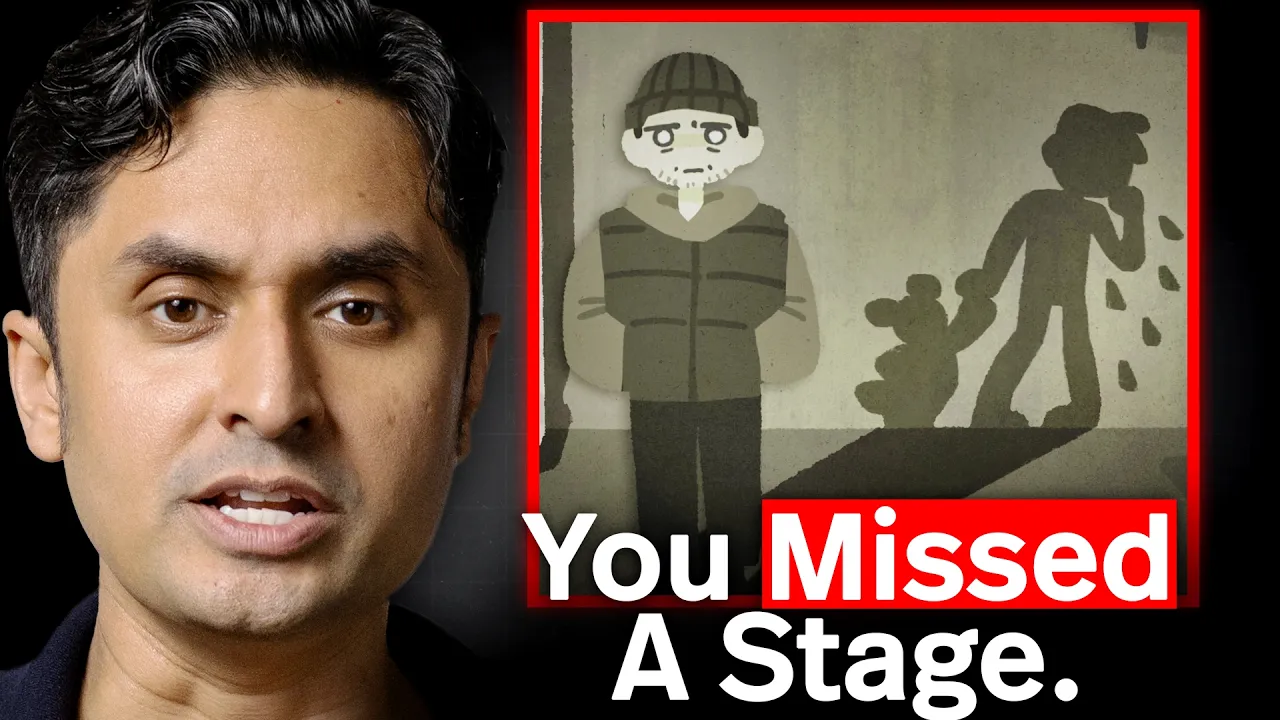
at a particular age you have to do a particular thing and once you learn how to do that thing then you can move on and so we have a series of challenges in life and when we fail to do a thing we actually become developmentally stuck and we have to sort of like fix that later in life. So if you missed a childhood, is there an element of accepting that that's gone? Absolutely. But growing into healing can grow into loss or growing into healing can grow into fullness, which from a simple standpoint is like what we call a corrective emotional
105 words, the words spoken in the first 30 seconds at 209 words per minute.
Free, no signup. See how the first 30 seconds hold attention, with rewrites.
Sentence shape
| Measure | This transcript |
|---|---|
| Sentences | 420 |
| Average words per sentence | 11.0 |
| Longest sentence | 113 words |
| Questions asked | 63 |
| Sentences containing a number | 11 |
Most used terms
Filler phrases
155 in total: like 96 · right? 32 · actually 8 · kind of 7 · you know 4 · sort of 3 · basically 2 · I mean 1 · literally 1 · uh 1.
A literal whole-word count of the same phrase list the Prepublish browser extension uses, so a phrase inside another word is not counted and a phrase used in its ordinary sense still is. It is a count and not a judgement.
Run the check on the words above: where attention is likely to drop, with a rewrite for each weak line. The free check shows the scores and the one issue costing the most.
What this transcript is
Every word below is the caption track YouTube publishes for this video, pulled from the video itself and reproduced unchanged. It is not Prepublish's writing, not a summary, and not a re-transcription: it is the video's own published captions. English captions, generated automatically by YouTube, in the video’s original language. Source: the video on YouTube. A channel that would rather this page did not exist can ask for its removal through the contact page, and it is removed.
No Script X-ray for this video: YouTube shows a Most replayed graph only once a video has enough views.
at a particular age you have to do a particular thing and once you learn how to do that thing then you can move on and so we have a series of challenges in life and when we fail to do a thing we actually become developmentally stuck and we have to sort of like fix that later in life. So if you missed a childhood, is there an element of accepting that that's gone? Absolutely. But growing into healing can grow into loss or growing into healing can grow into fullness, which from a simple standpoint is like what we call a corrective emotional experience.
In order to become an adult, you got to learn to let go of that childhood you didn't get. Like you can't pick up adulthood if you're still holding on to whatever it was you missed as a kid, falling through the cracks of what your parents missed as a kid. And I focus on this fault cuz I feel like growing into healing is growing into loss and losing that. And it's interesting cuz when I look back on my childhood, I have two memories.
Memories of what happened and the memories of what should have happened. And that keeps me from focusing on what's happening now. Every decision I make, I'm still trying to merge those somehow and win whatever I lost [music] when I was a kid. And so now I live in this world that I don't enjoy because I adopted this mindset of this incomplete little boy trying to travel back in time and fix whatever wasn't right. How much easier would it be to just accept that part of that was missed instead of putting my adult development on hold to wait around for it?
Cuz childhood is not a progress bar. [music] It's not task oriented. It ends with age. Whatever it was is what it was supposed to be. >> It's not a new responsibility, something you got [music] to go back and complete. It's it's done. You got to move away from that fault cuz only then can you pick up who you're supposed to be as an adult. >> So I love this because there's a lot of good stuff and there's a part of me that says if you do what he says you will end up the way that he is.
So we talk about acceptance. There's a lot of good stuff here, right? So like there's the childhood that I had and there's the childhood that I should have. that growing into healing is growing into loss and accepting that this is the way life is and I have to accept that right my childhood is gone it'll never come back I will never have that joy and if that's the path that you take this is the emotion that you will end up with because actually there's a fair amount of evidence from developmental psychology there's a lot of good stuff here and I I I respect this dude for making the poetry it's beautifully read you know really taps into something that's amazing and tragic about the triumph of the human spirit And I think it's like kind of wrong.
If we look at developmental psychology, we we learn a couple of really scary things. That life actually is a progress bar. And that if you just leave your childhood behind and you grow into an adult without that piece of childhood, and this is what happens to so many people, you will be a sad adult. You'll be an adult, but you'll be a sad adult. And this is the real tricky thing, right? Because we don't know how to reclaim that childhood.
And so we sort of resign ourselves to this adulthood without a childhood. But I I think that there's a lot of stuff. And today we're going to talk about someone called Eric Ericson. And Eric Ericson, I'm not trying to dunk on this guy, by the way. I genuinely think he's he's on to something really good. But I think it's it's poetry, right? There's poetry and there's science. And poetry speaks to the human experience and really taps into something that I think is very real.
But then there's the science of it. So Eric Ericson comes along and he develops this theory. And what he notices is that human beings have particular goals at certain stages of development. At a particular age, you have to do a particular thing. And once you learn how to do that thing, then you can move on. And so we have a series of challenges in life. And when we fail to do a thing, we actually become developmentally stuck and we have to sort of like fix that later in life.
So if you missed a childhood, is there an element of accepting that that's gone? Absolutely. But growing into healing can grow into loss or growing into healing can grow into fullness, which from a simple standpoint is like what we call a corrective emotional experience. Right? So if you were never loved as a child, you have to accept that you were not loved as a child. That's really healthy. But that's not where it ends.
The real way to fix that is to be loved as an adult. To be loved in the way that a child was loved as an adult, to be spoiled, to be indulgent. And I think there are a couple of really good examples of this through Eric Ericson which I think make a lot of sense. Here is the progress bar of childhood. When we're somewhere around 3 to 6 years old, we have this basic task of initiative versus guilt. So what does this mean?
So when a child is like two, they don't have choices. They can't demonstrate initiative. They don't like get to decide what we're doing today. They don't get to control or steer their life at all. But once we get to be about 3, four, five, and six, that's when we can demonstrate initiative. Hey, today I want to go to the zoo or if we go to the zoo, I want to see the anacondas, not the tigers. And a 5-year-old can demonstrate they can try to steer the car of their life in small ways.
And the way that people respond to that is really important. Okay. So when I want to do something, I want to see tigers or let's say I want to see snakes, which means that I have an initiative. And let's say that my parents have a phobia of snakes. So they say, "No, snakes are for Slytherins and we are Gryffindors. This is bad. How dare you like snakes?" So when a child demonstrates initiative, right? So sometimes I'll see this with like, you know, boys who want to wear dresses or girls who want to play with trucks, right?
Or any number of things. When you demonstrate initiative, does the world punish you for it or make you feel guilty? And there's a certain amount of guilt that's kind of healthy. Okay? It's like, oh, you want to stay up till midnight, like you can't do that. That is wrong. Like this is right, this is wrong. So there's a certain amount that's healthy. But basically, you have some kids who grow up in environments where what they want is punished.
They are taught that you're selfish. Your your step sibling wants this, you should give it to them. You're so selfish. Their desires, their wants, their needs, their initiative is met with punishment. And then they start to feel guilty. And unless they are supported enough, they will carry that forward into adulthood. And the way this this looks is as adults, their wants evoke guilt. Right? And you guys may have experienced this.
I shouldn't want this. I'm being selfish. Wanting something is selfish. This kind of initiative is something that I feel bad about. Right? So these people will sometimes do punishment. They will self-punish for initiative. They will sometimes self-punish for relaxing because these are kids where their initiative was, "Hey, can I play with my friends?" They're like, "No, how dare you? You have to clean the house today." So they carry these things forward.
They feel guilty for having wants. And the way to fix this, like if you're someone who goes through life like feeling fundamentally guilty for wanting stuff, like you think like, "Oh my god, I'm such a selfish person for wanting to take a vacation by myself. Such a selfish person for like wanting distance from my parents. Such a selfish person for not wanting to spend my weekends taking care of my siblings, right? Cuz people will guilt trip you to all hell." That's one picture.
Another picture is self-punishment for initiative. So you're someone who like it's so scary because some people who are kind of stuck in life, right? Like some people like life is happening to them. They are the object. It's like they're living life in passive voice. Cuz in writing people say like don't use passive voice. Alo is. We should have alok doing things. Alo sits, right? Not all Alo is. But some of us go through life being acted upon by life.
And if you're someone who's like frustrated with yourself and you say we call this, oh, I have no motivation. I have ADHD. I have executive dysfunction. Like those things can exist. Yes. But sometimes, this is why I love therapy, psychotherapy. This is why I love working with patients with ADHD because it's not just executive dysfunction. Sometimes it is, but most of the time it's not. And if you pay attention to you being stuck, what you will find if you you're stuck, you have no motivation, you feel like life is happening to you is that when you have an initiative, you punish yourself for it.
I keep seeing comments, Dr. K, how do I apply this to a situation in my life? That's [music] literally why we created a coaching program. Our coaches are certified on an evidence-based curriculum designed to help you get unstuck. [music] This involves analyzing your patterns, increasing your understanding, and working with you week [music] to week to help you develop a plan to create lasting change. So, if y'all are interested, check out the link in the description below.
The best example of this is people who do not allow themselves to want what they believe they cannot have. If you are someone who is numb and has no motivation, do you allow yourself to want the things that you cannot have? Because the want is the motivation. And often times what we'll do is we'll protect ourselves from an empty void of an unfilled desire by not allowing ourselves to want it in the first place. But then you end up stuck.
And what's really scary about this is if you want to fix this, sure, there's a certain amount of mourning the loss that's really healthy. like the guy is not wrong, right? So, you have to accept that your parents didn't provide this for you, they made you feel guilty, whatever. But the real corrective action, this is what Erikson kind of taught us, is you have to fix those things as adults. So, when I'm working with patients who have these particular things, right?
So, when a want evokes guilt, the corrective action is helping this person understand wanting things and being selfish are not one and the same. Just ask yourself, can I want things without being selfish? Is it fundamentally selfish to want? Cuz as long as those two things are tied together, you won't have that corrective experience, right? Because how what what is the what is the normal what is the healthy version of a a kid demonstrating initiative?
I want an ice cream. And their parents are supportive of that. They're not like, oh my god, how dare you? You're you know, your your brother and sister is lactose intolerant and when you want ice cream, they can't have it. And like you're making them feel terrible. How dare you? Whereas healthy parenting is like, look, you want ice cream? Okay, let's get you an ice cream. It's hard for your brother or sister because they want ice cream, too.
So then you can also talk to your brother or sister or at a minimum, let's take you out for ice cream. Let mom and and your brother or sister go do something. They can go get French fries. We're going to go get an ice cream. Well, let's get him a cookie. Whatever. This is where like the corrective action is is supporting those unmet needs, right? It's okay to relax in terms of initiative. Do you get punished historically?
Ask yourself this question. Did you get punished for initiative? Because if the answer is yes, you really need to take a look at that. Can you allow yourself to want something that you may not be able to have? And this is the tricky thing about that is like you have to have that first and then you it hurts, right? Because you can't get it and then you feel that loss. But that loss is also motivation. The want is motivation and the loss is motivation.
They took this away from me and I'm going to get it back. This is the corrective emotional experience and life is a progress bar. If you didn't pass a class when you were six, you need to pass it today. We'll go over another example. So the next stage is industry versus inferiority. This is the point where someone develops competence as a skill like they're competent in skills and pride in oneself. Okay, so here's like the healthy example.
I get a bad grade. Teacher says you can do better. Let's do some extra homework and then we get a good grade. What does a kid learn? Right? There are challenges in life. There are times where I will do poorly. But doing poorly is not destiny. That I have agency. When things don't go my way, I can exert some amount of effort and I can change the outcome. I have power in this world. I can pride in myself. It also teaches something really important about the world.
When I slip up, the world is a place that will sometimes help me out. So, we gain faith in the world. We gain faith in ourselves. We gain agency. We get pride. We hopefully get some skills acquisition and competence. So, let's look at the bad version. I get a 95 on test. And my parents say, "What the hell is wrong with you?" Roshnney Patel down the street got a 100. So you got an A and you are a POS. Industry versus inferior.
So what I love about Ericson is that he combines things that we don't normally combine. We think to ourselves, if I have low self-esteem, the goal is to feel better about myself. Actually, Eric says something different. The antidote to inferiority is industry, not superiority. Right? And we have some really interesting data behind that because we know that people who feel superior, I'm narcissistic, I'm arrogant, actually have an inferiority on the inside, right?
And this is something that we we grapple with all the time in coaching because people are coming in and they have no motivation. They make comparisons. And so you may think like low self-esteem, what's the antidote? The antidote is actually industry. It's getting them to do stuff and doing something, anything. will affect their esteem. So when we as children when we do things and even if we're successful, if we're compared, comparison is like the number one thing that leads to problems with industry and inferiority, right?
So this is like all these gifted kids who are burnt out. People make comparisons. We see this with like black sheep and golden child, right? You got an A. Why? You got a B. Your your brother, your sister got an A. Like there's a smart one, there's a stupid one. You're constantly made comparisons. You are not judged by your industry. And then this too creates all kinds of problems in adulthood. So this leads to a couple of problems.
Okay. So in adulthood when we do this we are left with persistent feelings of inadequacy. That's number one. Next thing we do is sidestep challenges that can result in failure. Right? Because we don't it's not about industry. It's about being number one. And if we can't be number one we're not even going to try. The most crippling is an identity that is based on achievement. So this is the idea that your worth equals accomplishments.
And the moment that this happens, you're kind of like so. This is where people like, so once you tie your worth to your accomplishments, you're screwed no matter what you do. Because if your worth is tied to your accomplishments and you accomplish, you're terrified of losing that worth and that accomplishment down the road. Even if you do well, and here's what's so painful about it, right? So if your worth is tied to your accomplishments, what'll happen over time is you'll rise in society.
So, you'll go to a community college, you'll do well. You'll go to a 4-year university, the competition there is harder. Then you'll go to graduate school, competition there is harder. You're maybe moving up a tier in universities each step of the way. This is why there's way more imposttor syndrome at Harvard Medical School than there is at like Houston Community College. So, even though you're accomplishing a lot, you still feel terrified.
You'll have a lot of imposttor syndrome. And then the other really crippling thing is that that imposttor syndrome, that anxiety, that concern, that sidest stepping of challenges because you don't want to be number two. You don't want to be number 100. You don't see it as, you know, what do you call the the person who graduates at the bottom of their class in medical school? You call them doctor. You don't see them that way.
You see it as this person is a loser. I don't want to be that loser. And then eventually that anxiety, that imposttor syndrome, those things will predispose you to failure, right? Cuz you've got a performance mindset instead of a growth mindset. All these other have growth mindsets. So when they get a B, they study harder. They dig deep. They believe in themselves. The world helps them. And I'm just panicking because I I knew I was stupid.
I knew I didn't belong. Oh my god, it's true. This is the beginning of the end. And then I panic. And then once I panic, the decay happens. The tumbling of the rocks. The avalanche has now started, right? Cuz I'm I'm building this thing up. I'm trying to keep it together, keep it together, keep it together. But it's not sustainable. I'm burning out. I feel like an impostor. And then everything comes crashing down like I knew it would.
And now I have a bigger problem, which is that I was I knew I was going to it up and I was right. [snorts] GG. But where does this come from? It comes from industry versus inferiority. And this is part of the progress bar of childhood. And if you do not beat this stage, this will carry forward as an adult. And so how do you fix this? My favorite thing to do is to have people demonstrate competence in isolation. This is all fueled by comparison for the most part.
So when you start doing things and being proud of yourself, when you see the worth in yourself by doing something that you set out to do and has nothing to do with anybody else, I'm going to plant a garden. I'm going to write a book. Not write a bestseller, just write a book. This is a goal that I have. I'm going to climb this mountain. I'm going to hike the Appalachian Trail. You got to start doing stuff. The antidote to inferiority is industry, not superiority, not even self-esteem.
It's doing things. Doing things where no one can see. And when you feel pride from in here for what you have done, you will carry that pride forward. Then what'll happen is you'll have that pride in here when things don't go your way in the real world because that happens eventually. And that will be the buffer. Then you've solved that problem, right? It goes back to the kid who got a B, worked hard, got an A, now they believe in themselves.
And you had all these setbacks and now you conquered those things. So now you believe in yourself. Life is a progress bar. So at the end of the day, I think this is one of those things where like there's the childhood you had and the childhood you should have had and is one of those needing to be grieved. Absolutely. But if you stop at grief, like you're just going to be left sad. What a lot of the camp of developmental psychology that I subscribe to, right?
So this isn't I'm not the speaker of truth teaches us and I think this is just like works so much better is reclaim your childhood. Be a kid. It's amazing. I strongly recommend it. If you were denied a childhood, the solution, sure, there's a certain amount of grief and a certain amount of blame and a certain amount of letting things go, but also like if you have a romantic relationship, let them spoil you. This is something that multiple people have told me about, but I've never heard talked about, which is the healthy infantilization in romantic relationships, and it's something it it blows my mind.
I've talked to half a dozen people who do this called baby voice. It's not like they got together and communicated. I've never heard this talked about. It's baby voice. that in romantic relationships that are secure, one of the partners, this isn't like diaper fetish or something like that. Like one of the partners will become a child and will adopt a voice and then somebody like their partner will like take care of them as a parent, right?
It it's so weird. Like I've heard this from half a dozen people at this point. And I'm curious, do you guys do baby voice? Yeah. See, this is what I'm talk like most people like, what the are you talking about? And some people like, yeah, we both did it. I love baby talking. Like this is so weird. One of my exes. Yes. in pass both me and my man. Okay, see this is the really interesting thing. Yes, this is me. This is like no one talks about baby voice and people are like this is I love this cuz this is this was how I felt about it.
Some people like this is disgusting. I hate this. Other people like yeah we do it. It's awesome. Freaks me out. Yes to my longtime girlfriend. I find it cringe. It's not like a particular kind. It's like I'm going to be a whiny little and I want you to take care of me. I don't think it's goooo gaga. It's not like baby baby. It's like I'm going to infantilize myself and you are going to support that infantilization. Right?
And what we know from psychiatry is like basically in therapy sometimes we try to provide these corrective emotional experiences but we don't do this thing is corrective emotional experience. The emotional experience is what's important. We do it a particular way in LAR. I love [laughter] dude. Hi, my name is Alo. In my free time, I lar as a parent for my romantic partners. [laughter] Yeah. So, this is great. So, I used to find it cringe, but I found my girl and now I can't stop doing it.
This is such a good comment. Okay, so here's what I I pieced together about baby voice. It is cringe until you enter this weird uncharted territory of like emotional safety. And then once you enter that territory, it like is what's the word? Fulfilling. Like, and some people are even asking, isn't that a normal part of relationship? I don't think so. Maybe a normal part of really healthy relationships. I I actually believe this.
We don't. No. See, it's not acting like a baby. Like, so this is not a nut that I've cracked yet. Okay. You don't act like a baby. It's not an act like you become infantilized and your partner accepts you in that infantilized state, which then makes you feel like really accepted. I mean, I've seen like unhealthy versions of this, which is like more what people think, right? which is like, oh, it's like this this kid has like some scat fetish or some diaper or whatever.
It's not like sucking your thumb. It's like, I'm going to signal to you that I need to be taken care of in a very and and we have a certain template for this, right? Which is like I'm going to be a baby. It can be cringe. There's like an organic development of this kind of thing. And then there's like the cringe imposing of this thing, right? So like when I'm texting you on a dating app and I'm like that's cringe. This comes out of a hell.
It like grows. It's like a truffle. Like you can't farm it. You can't create it. But in the right circumstances, if you sniff around for a while, you're going to find it. It's so fascinating to me. I I got to I got to see if there's any. Let's see. See, look. 1996. Talk to me, baby. Oh my god, dude. Brooks Publishing. Let us plum the depths of the internet. Chat studied most extensively as it is spoken by mothers to infants, but without attention is possible role.
We suggest that baby talk play such a role. Uh, no. This is about baby Oh, wait, wait. Which is the first empirical documentation that baby talk occurs in adult romances and friendships. Yeah. Look, individuals who had baby talk to friends or romantic partners tended to be more secure and less avoidant with regard to attachments in general. Within a particular romantic relationship, indicators of intimacy and attachment accounted for about 22% of the variance at baby talk frequency.
Oh, so partner's baby talking was the strongest predictor, accounting for about 42% of the variance. That's really interesting. That means that if your partner baby talks, that's the strongest influence in you baby talking. I love exploring [laughter] this stuff, but it's like it's hard because there not it's not like a term. Thanks for watching. A lot of people who struggle with an unfulfilling childhood carry around a lot of shame.
To help people overcome this, we have a great 2-hour lecture on our website about understanding shame. We get into how it shapes you in both positive and negative ways. So, check out the link in the description below and start your free trial.
The words are the caption track's own and nothing is reworded or re-transcribed. Paragraph breaks are placed between sentences so the text reads as prose.
Free tools for your own script: paste a draft and see where it stands before you record it.
Paste your draft and see where viewers are likely to drop off, with a rewrite for each weak line.
Paste the first 30 seconds of your own draft for a hook score and rewrites.
Check your draft against YouTube's advertiser-friendly guidelines before you record it.
Read this channel's public videos and transcripts, and download a writing brief for it.