Getting the transcript
Reading the captions from YouTube. A video nobody has opened here before takes 10 to 30 seconds; this page fills in on its own.
Getting the transcript
Reading the captions from YouTube. A video nobody has opened here before takes 10 to 30 seconds; this page fills in on its own.
Omnara · @OmnaraAI
Words
424
Runtime
2:28
Speaking pace
172wpm
Reading time
2min
172 words per minute, between the 160 25th percentile and the 181 median of 349 measured videos. That distribution comes from the 349-video hook study.
Opening (first 30 seconds)
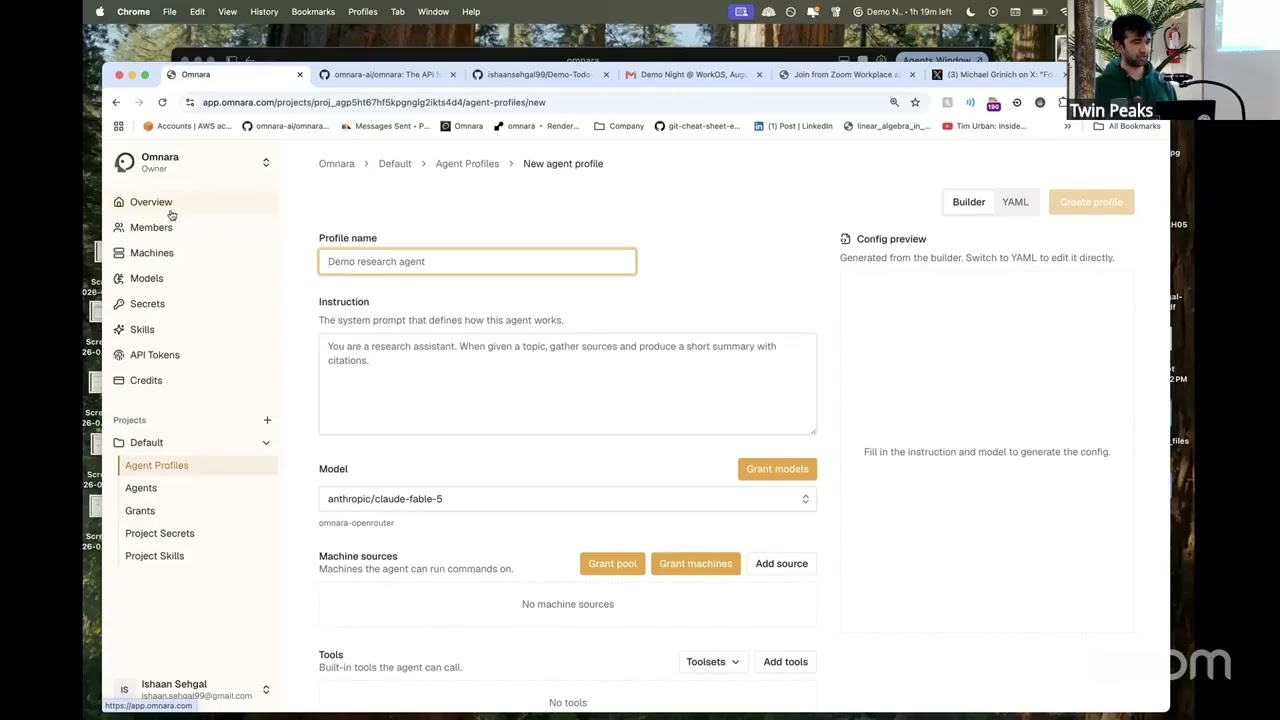
Right now the status quo is that agents run on your computer, so they run locally like Claude code or Codex. But when you want that agent to serve real users, you actually need to build a service so that people can access it. And that's what Amnara is. It's a control plane for building these production ready agents that are durable and then accessible for your users and your team. I'll just show you an example. This is an agent that I have running here
86 words, the words spoken in the first 30 seconds at 172 words per minute.
Free, no signup. See how the first 30 seconds hold attention, with rewrites.
Sentence shape
| Measure | This transcript |
|---|---|
| Sentences | 32 |
| Average words per sentence | 13.3 |
| Longest sentence | 32 words |
| Questions asked | 2 |
| Sentences containing a number | 1 |
Most used terms
Filler phrases
6 in total: actually 3 · like 3.
A literal whole-word count of the same phrase list the Prepublish browser extension uses, so a phrase inside another word is not counted and a phrase used in its ordinary sense still is. It is a count and not a judgement.
Run the check on the words above: where attention is likely to drop, with a rewrite for each weak line. The free check shows the scores and the one issue costing the most.
What this transcript is
Every word below is the caption track YouTube publishes for this video, pulled from the video itself and reproduced unchanged. It is not Prepublish's writing, not a summary, and not a re-transcription: it is the video's own published captions. English captions, generated automatically by YouTube, in the video’s original language. Source: the video on YouTube. A channel that would rather this page did not exist can ask for its removal through the contact page, and it is removed.
No Script X-ray for this video: YouTube shows a Most replayed graph only once a video has enough views.
Right now the status quo is that agents run on your computer, so they run locally like Claude code or Codex. But when you want that agent to serve real users, you actually need to build a service so that people can access it. And that's what Amnara is. It's a control plane for building these production ready agents that are durable and then accessible for your users and your team. I'll just show you an example. This is an agent that I have running here in my 2E.
And this is communicating with the Amnara control plane. So I'm just going to say hi. And so the agent responds to me. I'm going to ask it to run LS. So just tell me where it is right now. So that prints out the directory on my local computer. That's the project that I'm in right now. And then I can use my phone here and I can go to the web app and then say hey, say hi again. Okay. So you'll see that it'll show up here as well.
Does anybody know how that works? Like how I'm able to use my phone to communicate so now it says hi back. So I'll just tell you guys the agent loop is hosted somewhere. It's in the control plane. So any of these devices like the agent is independent of any process or any machine or any environment. It can be accessed from any interface. So I'm going to take this a step further and I'm actually going to close my laptop and then type a message on my phone and we could see what happens then.
So if I go ahead close my laptop and then I say the same can you run LS. So my machine is off which it originally the control plane was interacting with. So if I go to agents, so I just said this can you run LS on my phone?" And it responded, "Hey, your MacBook went offline." So, I went ahead and spun up a cloud sandbox and ran LS on there instead. It asked me if it wants to clone the repo, so I can continue working in there.
This is a very powerful concept. It gets into serverless agents, but also just the control plane, so that all of your devices or interfaces. And the point is that Amora is this underlying infrastructure, which is an API, which we actually open sourced it today, and that exposes all these primitives as an API.
The words are the caption track's own and nothing is reworded or re-transcribed. Paragraph breaks are placed between sentences so the text reads as prose.
Free tools for your own script: paste a draft and see where it stands before you record it.
Paste your draft and see where viewers are likely to drop off, with a rewrite for each weak line.
Paste the first 30 seconds of your own draft for a hook score and rewrites.
Check your draft against YouTube's advertiser-friendly guidelines before you record it.
Read this channel's public videos and transcripts, and download a writing brief for it.