Getting the transcript
Reading the captions from YouTube. A video nobody has opened here before takes 10 to 30 seconds; this page fills in on its own.
Getting the transcript
Reading the captions from YouTube. A video nobody has opened here before takes 10 to 30 seconds; this page fills in on its own.
Sandeep Swadia · @SandeepSwadia
This video has no Most replayed graph yet: YouTube shows one only once a video has enough views. These are the moments viewers replayed most in Sandeep Swadia's most watched videos.
Most replayed moment at 1:38
4.9x that video's typical replay level
extract. Open the voice mode in Chat GPT and say, "Listen, you're my chief of staff. Interview me for 20 minutes, 30 minutes, my background, my tone, my strategy, my blind spots."
Said at 1:33
Most replayed moment at 0:55
3.8x that video's typical replay level
call it ARR. If a task is autonomous, recurring, and reviewable, it's a strong candidate for an agent. If it needs live judgment, or it only happens once, or can't be reviewed clearly, then use a prompt. That one distinction alone will
Said at 0:48
Most replayed moment at 14:58
3.9x that video's typical replay level
because you're going to ask, "What's the connection between cause and effect?" Is it obvious? Then you're in a clear system. Is it discoverable through analysis? Then it would be a complicated system. Is it emergent and constantly changing and you can get to it only in hindsight? That could be a complex
Said at 14:51
The graph counts replays. It does not show where viewers stopped watching.
Words
2,696
Runtime
18:49
Speaking pace
143wpm
Reading time
11min
143 words per minute, below the 160 25th percentile of 349 measured videos. That distribution comes from the 349-video hook study.
Opening (first 30 seconds)
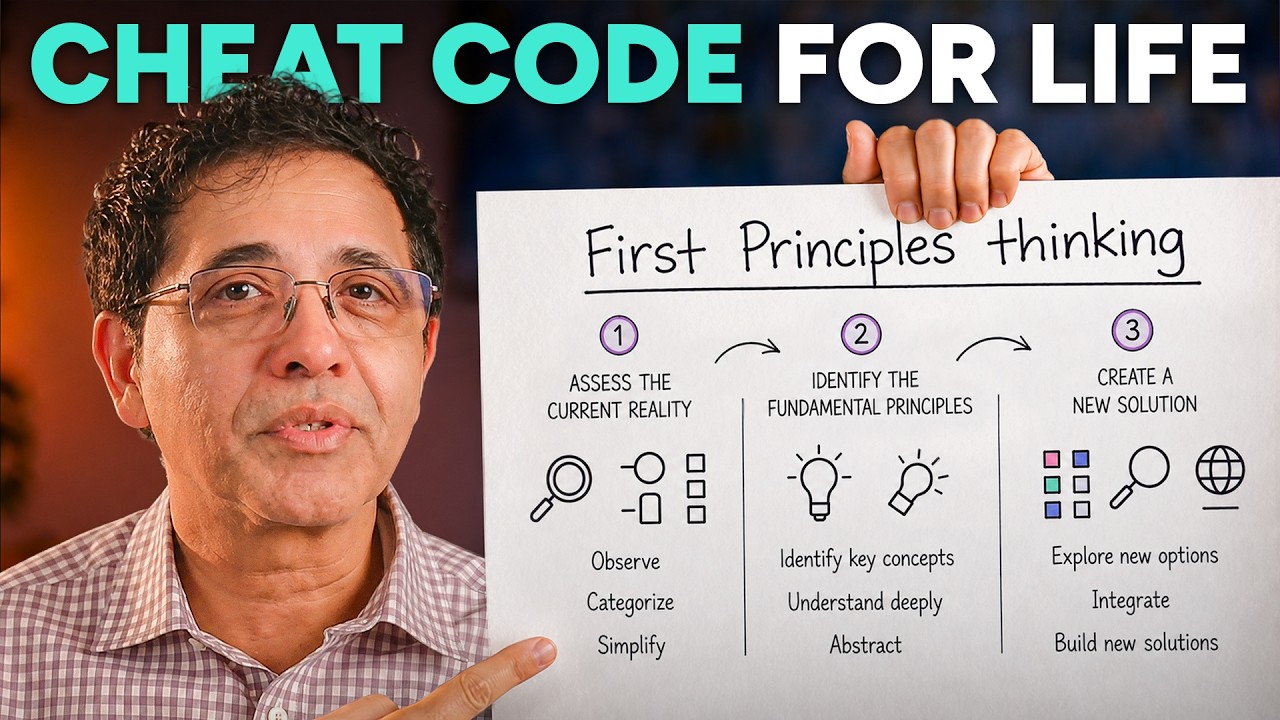
First principles thinking is the closest thing to a cheat code for life. Successful people from Elon Musk all the way to Kobe Bryant used it to break conventions and become one of a kind. First principles make you stand apart. I got to use it, too, from MIT all the way to billion-dollar boardrooms. If you're not careful, AI will make your thinking more average. So, I'll show you a four-step
72 words, the words spoken in the first 30 seconds at 143 words per minute.
Free, no signup. See how the first 30 seconds hold attention, with rewrites.
Sentence shape
| Measure | This transcript |
|---|---|
| Sentences | 245 |
| Average words per sentence | 11.0 |
| Longest sentence | 37 words |
| Questions asked | 21 |
| Sentences containing a number | 18 |
Most used terms
Filler phrases
18 in total: like 7 · actually 4 · you know 3 · kind of 1 · right? 1 · uh 1 · um 1.
A literal whole-word count of the same phrase list the Prepublish browser extension uses, so a phrase inside another word is not counted and a phrase used in its ordinary sense still is. It is a count and not a judgement.
Run the check on the words above: where attention is likely to drop, with a rewrite for each weak line. The free check shows the scores and the one issue costing the most.
What this transcript is
Every word below is the caption track YouTube publishes for this video, pulled from the video itself and reproduced unchanged. It is not Prepublish's writing, not a summary, and not a re-transcription: it is the video's own published captions. English captions, generated automatically by YouTube, in the video’s original language. Source: the video on YouTube. A channel that would rather this page did not exist can ask for its removal through the contact page, and it is removed.
First principles thinking is the closest thing to a cheat code for life. Successful people from Elon Musk all the way to Kobe Bryant used it to break conventions and become one of a kind. First principles make you stand apart. I got to use it, too, from MIT all the way to billion-dollar boardrooms. If you're not careful, AI will make your thinking more average. So, I'll show you a four-step framework to think so clearly that people who you meet walk away thinking you must be some kind of a genius.
Let's get started. For most of my last 12 years, I slept for less than four, five, six hours a night. >> [music] >> I was the CEO of one of the top 20 fastest-growing companies in the US. I worked at a large public company where we were growing like crazy, and I traveled nonstop, worked past midnight. So, every single morning when I woke up, I would always feel totally exhausted from the first minute, and I would load up on coffee, and [music] I would be ready for the day.
Then, um about 3 years ago, I retired from full-time operator executive work, and my schedule obviously changed dramatically. I had more control over my day. I was on boards, I was advising, I was investing, but it wasn't 7:00 a.m. till midnight every single day. But still, every morning I would wake up completely exhausted. That was strange. So, I reached out to a great pulmonologist and sleep specialist, and they did a sleep study on me, where they put me in a lab and measured how I slept and what happened in my brain.
The medical data completely blew my mind. The results showed that I was waking up 34 times an hour, every hour, all through the night. The structure of my jaw is such that it was blocking my airway. Now, I had no idea. I had spent years trying to normalize the problem by telling myself, "Oh, I need more sleep." Or, "I have to go through this. It's the grind. I need more coffee. I need to work less." The moment I stopped perpetuating the story and deconstructed the system from first principles up, that fixed the root cause.
And I realized the problem was not where I thought it was. That process of thinking is called the first principles thinking. We're going to build a four-step framework here and learn how to use AI to drive that process and how to build specific prompts for each of those steps. So, it's a bit dense, so I'll make a PDF as well, so you can see all of it in one place. Link is in the description. Of course, it's free. We never investigate our own assumptions.
We inherit them from our colleagues, our families, industries, experts, or our own previous experiences. First principles want you to begin somewhere else. What do I actually know for sure? What am I assuming? What else could produce this result? Which part can I test? Imagine buying a car, driving it once, and then throwing it away. That would sound insane, right? But for decades, that was how most rockets worked. Now, of course, rockets are not cars.
The physics is far more unforgiving. Obviously, it's called rocket science for a reason. But Elon Musk questioned the very assumption. Why couldn't the rocket land vertically and fly again? That question changed the economics of space travel. So, how do start thinking in terms of first principles? Maybe a couple of examples. Maybe you are thinking, "Mhm, I can't focus." Well, start digging in. Is it focus or sleep or phone addiction or unclear tasks, too many priorities, you're bored, there's no deadline, or are you doing work with no real impact?
What is it? Things are about to get worse because AI is here. Let's go there next. Consider how large language models actually work. They do not physically observe the universe we're in. They don't have the idea of reality, at least not yet. And they don't have the real-world experience. They're mathematical models that are very good at matching patterns. So, when we ask a question, it looks for the most likely thing that matches the pattern.
The most familiar answer seems like the best answer. That's the way AI is designed. And the better AI sounds, the less you will check. A general-purpose AI model does not naturally start from first principles. That's why you have to force AI to think differently. That's the four-part framework. We'll walk through each step, and we will also construct prompts for each step. So, let's go to the first step, which is D for decompose.
Let's say if you want to start a business or even something similar. Let's say you want to start a YouTube channel. If you talk to the experts and say, "Hey, I want to start a YouTube channel. What do I need?" What are they going to say? They'll say, "Oh, well, you need a studio, you need a professional camera, good lighting, uh you need an editor, you need a creative director, a production agency." And sure, if you can afford all of that, those things may save you some time and improve the final product so you can focus on content creation.
But, that's all conventional wisdom. What if you boiled it down to its essential components, decomposed? What do you really need? Just two things: a phone and a story. You can start tomorrow. You can start tonight. The same idea applies to starting a company. You can raise millions from some investors. You can rent a swanky office in New York City. But, there are thousands of successful companies that got started without any of that.
So, this step of decomposing is really about seeing the parts of the machinery. This is where AI is going to be tremendously useful. But, remember that these models are also trained to be very eager and very helpful. So, the moment they see a problem, they would want to solve it. You don't want that. You want them to break the problem down into its essential parts. Let's apply our friendly framework AIM to create a prompt.
I've covered the idea of AIM in this video before somewhere. But, if you haven't seen it, AIM stands for actor, input, mission. Tell the model who it's acting as. Give it the context or data it needs. And then, tell it what done looks like. So, here's the prompt. Act as a world-class first principles analyst. Your job in this step is decomposition only. You're penalized for introducing advice, solutions, assumptions, or standard playbooks.
Be my thought partner. Do not suck up to me. Intention. I want to understand exactly what this problem is made up of. My problem is, and then you will insert your problem. If the stated problem appears to contain a hidden or a deeper question, identify it in one sentence before decomposing the current problem. Ask whether I want you to decompose the original problem or the deeper one. Do not continue until I choose. Do not replace or reframe my problem until I tell you.
So, you see, you're trying to constrain what AI needs to focus on. And the third part is mission. Break the problem into its smallest useful constituent parts. Show the hierarchy clearly. The overall problem, its major components, and the smaller elements inside or under each component. Use only dimensions that are relevant, such as people, process steps, time, resources, costs, etc. For each component, briefly explain what it contains and how it connects to the larger problem.
Stop decomposing when going down further would no longer improve my understanding. Do not evaluate the components. Do not recommend solutions. Only show me what parts the problem is made up of. So, that was your first prompt. And I'm sorry if it was a bit long or complicated, but I'm hoping that it will give you clarity on how to boil down any problem into its essential parts. That's part of the first principles thinking.
And also, how to make sure that AI remains focused on the task that you give it. Now, let's go to step two, where we look at each of these parts and see whether it's a fact or an assumption. The most important first principles skill is auditing the assumptions. After the Second World War, American car companies had enormous factories that produced big American cars for the big American market. Now, Toyota was a very small company and they were based in Japan and we're talking about after World War II.
So, Japan was recovering, much less capital, fewer resources, and a much smaller market. So, copying Detroit would not have worked for Toyota. Toyota couldn't have afforded it. So, they audited the assumptions underneath the idea of mass production itself. Why make big cars? Why not small cars? Why produce them in huge batches? Why do you need to hold such a large inventory? What do you do when there's a defect? Are there different better ways to organize the processes and people?
That thinking became the foundation of just-in-time production and something that became so dramatically successful that American companies started implementing that and over time Toyota overtook GM to become the world's largest automaker. And, you know, years later I feel like history is repeating itself because then came Tesla that questioned the assumptions made by Toyota and all car makers. Because Tesla asked, why do you even need a combustion engine at all?
And by 2020, Tesla had overtaken Toyota as the world's most valuable automaker. Most conventions that we cling to are just assumptions that have survived. But, true innovation requires that you break the rule, that you ignore the conventions. And here's where AI can be a very valuable partner. You can use the model to perform that audit that we're talking about. Here's the prompt to do that and I'll just read the first part of the prompt and then we'll just put the entire prompt on the screen.
You can pause, and a screenshot or come back to it anytime you want. And of course, all of this is going to be in a nicely formatted PDF. You can get it for free. All right. Here's the prompt. Actor. Act as a skeptical red team analyst whose only job is to uncover and question inherited assumptions. Assume that every obvious part of the problem may be hiding a convention until evidence proves otherwise. Intention. I want to know which of the building blocks above are assumptions.
And so on. So, this is the entire prompt. Now, once you identify the assumption, you may feel like you may have destroyed the entire solution that you were thinking about. And that's a good thing. Because now you finally have the freedom to build a better solution from the ground up. And for that, we go to the next step, which is R for recombining. I think music gives us the simplest way to understand the idea of recombination.
Most modern Western music is built from 12 notes. If you're trained in Western music, that's your alphabet. You don't spend your entire life searching for a secret 13th note. But if you came from, let's say, Indian classical music tradition, I came from there, or Arabic music, they would use pitches that fall between the 12 notes of a Western piano. So, if you only listen to, let's say, American pop all your life, and you suddenly hear Arabic music, it may sound to you as if it's out of tune.
At first, at least. But it's not. It's just that your ear is set to a different set of rules. The power of convention. But even with those 12 notes, you can recombine them into millions and millions of songs and composition. Bach used them very differently than the Beatles, and Beatles used them very differently than Beyoncé. They all use the same 12 notes to create different magic. Same ingredients, millions of dishes.
That's where recombination comes into play. Innovation is not about looking for that secret 13th note. You just need the right combination of the 12 notes that you already have. AI is unusually powerful here because it can search millions of combinations at a scale no human being can. Here's the R prompt. I'm just going to put it on the screen, and of course, there's a PDF link. Here's the actor, the intention, here's the mission.
Now, you have a handful of possibilities. There are ways to combine these ideas, but they're still all theoretical. The final step is where the practical world gets to vote. That's our fourth step, E for experiment. You know, James Dyson, who was an inventor, noticed that these vacuum cleaners lost suction as their bags filled with dust. And it took him 5,127 prototypes over 5 years before he could reach his breakthrough design.
And it's the same reason Google used to run millions of experiments on what exact shade of blue color would encourage people to click on links. The first principle thinking is hard. It is counterintuitive, but it's still a clean process until the fourth step. The real-world experiments are inherently messy. They're hard, they're risky, and they have real consequences if you fail. That's why AI can be a very good simulator.
You can use AI to design these experiments for you. Here's the prompt for it. Here's the actor. Act as a skeptical scientist. Your job is to help me design the cheapest, fastest way to find out whether this holds up before it cost me anything real in time, money, effort, reputation. Don't try to sell me the idea. Give me the test I could actually run. So, that's the actor. Here's the intention. Here's the mission. And notice what it says at the bottom of the mission part of the prompt, and I like it a lot.
For each test, tell me what result would rule that solution out and what result would keep it alive and what I'd learn from the problem either way. Give me your view on which building block to revisit if all the tests fail. And the reason I like it is because the whole point of first principles thinking is to keep us learning about where our failures and successes are and what they're caused by. So, yay, we made it. It was a bit dense, but that was there.
And it's yours. Make it better. Share it with others. Make sure every prompt makes the machine show its work to you. And by the way, make sure that you are the decision maker. AI does the work. AI shows you the work. You keep the judgment. Now, one point I would make about first principles and the framework, they won't give you a surefire way to avoid failure. The goal is not to be right every time. It is to learn quickly why you were wrong.
Martin Short has been one of the most talented comedic actors for, I don't know, more than 40 years. And yet, most of his movies have flopped. But, he's still one of the most successful comedians in North America today. And he was talking to a a young comedian. He gave him a wonderful advice. He said, "In this business, you fail 98% of the time. Those are great odds." I love that line. Most of what I have tried in my life didn't work, either.
My failure rate is right around there, you know? Yours might be, too. But, even if you >> [music] >> have such a terrible hit rate as mine, the math eventually still works out in your favor. Because, when you find just that 2% that actually works, it can change >> [music] >> the entire trajectory of your life. You don't need 100 wins. You only need one. Thank you. And I love you.
The words are the caption track's own and nothing is reworded or re-transcribed. Paragraph breaks are placed between sentences so the text reads as prose.
Free tools for your own script: paste a draft and see where it stands before you record it.
Paste your draft and see where viewers are likely to drop off, with a rewrite for each weak line.
Paste the first 30 seconds of your own draft for a hook score and rewrites.
Check your draft against YouTube's advertiser-friendly guidelines before you record it.
Read this channel's public videos and transcripts, and download a writing brief for it.