Getting the transcript
Reading the captions from YouTube. A video nobody has opened here before takes 10 to 30 seconds; this page fills in on its own.
Getting the transcript
Reading the captions from YouTube. A video nobody has opened here before takes 10 to 30 seconds; this page fills in on its own.
The Space Community · @TheSpaceCommunityYT
Where viewers went back to watch this video again, from YouTube's public Most replayed graph, lined up with what was said at that moment.
Most replayed moment #1
10:0315.8x the video's typical replay level
the moon or beyond, this trade-off is considered worthwhile. As engineers continue their analysis, one of the key goals will be to determine how much margin the system actually had during re-entry. In other words, how close did the heat shield come to its design limits? Early indications suggest
Said at 9:56
Most replayed moment #2
3:455.1x the video's typical replay level
of the heat shield. The root cause was traced back to gas buildup beneath the ablative surface. The avat burned. Gases generated during the process became trapped, creating pressure pockets that eventually caused chunks of material to break free. While the spacecraft remained safe,
Said at 3:40
Most replayed moment #3
4:254.4x the video's typical replay level
more direct entry trajectory rather than the skip entry technique used on Artemis 1. This seemingly subtle adjustment had a major impact on how the heat shield behaved. By maintaining higher and more consistent temperatures throughout re-entry, the new trajectory prevented the cooling
Said at 4:18
The graph counts replays. It does not show where viewers stopped watching.
Words
1,955
Runtime
13:23
Speaking pace
146wpm
Reading time
8min
146 words per minute, below the 160 25th percentile of 349 measured videos. That distribution comes from the 349-video hook study.
Opening (first 30 seconds)
After the splashdown of Artemis 2's Orion capsule, with all four astronauts safely back on Earth, the number one question we kept getting was, "What happened to the heat shield? How did it perform under such extreme conditions?" Well, we heard you. We've been waiting for NASA to release detailed images and data, and now, finally, we've got an update. Welcome back to another episode of the space community. Over the past few
73 words, the words spoken in the first 30 seconds at 146 words per minute.
Free, no signup. See how the first 30 seconds hold attention, with rewrites.
Sentence shape
| Measure | This transcript |
|---|---|
| Sentences | 105 |
| Average words per sentence | 18.6 |
| Longest sentence | 42 words |
| Questions asked | 3 |
| Sentences containing a number | 18 |
Most used terms
Filler phrases
6 in total: like 3 · actually 2 · kind of 1.
A literal whole-word count of the same phrase list the Prepublish browser extension uses, so a phrase inside another word is not counted and a phrase used in its ordinary sense still is. It is a count and not a judgement.
Run the check on the words above: where attention is likely to drop, with a rewrite for each weak line. The free check shows the scores and the one issue costing the most.
What this transcript is
Every word below is the caption track YouTube publishes for this video, pulled from the video itself and reproduced unchanged. It is not Prepublish's writing, not a summary, and not a re-transcription: it is the video's own published captions. English captions, published by the channel, in the video’s original language. Source: the video on YouTube. A channel that would rather this page did not exist can ask for its removal through the contact page, and it is removed.
After the splashdown of Artemis 2's Orion capsule, with all four astronauts safely back on Earth, the number one question we kept getting was, "What happened to the heat shield? How did it perform under such extreme conditions?" Well, we heard you. We've been waiting for NASA to release detailed images and data, and now, finally, we've got an update. Welcome back to another episode of the space community. Over the past few days since Splashdown, we finally gotten some of the clearest looks yet at one of the most critical and most scrutinized components of the Aremis 2 mission, the Orion capsules heat shield tiles.
Following its high-speed return from a crude lunar flyby, Orion didn't just complete a historic mission. It also delivered a realworld stress test of NASA's thermal protection system under conditions we haven't seen with astronauts in more than half a century. Now with recovery images, close-up inspections, and early engineering insights starting to come in, we can begin to piece together exactly how these tiles perform, what they reveal about re-entry conditions, and why they matter so much for the future of missions.
The Aremis 2 mission pushed Orion into one of the most demanding flight environments possible. Carrying its fourperson crew, Reed Wisman, Victor Glover, Christina Cook, and Jeremy Hansen, Orion traveled hundreds of thousands of miles beyond Earth, looping around the moon before beginning its return. The spacecraft then re-entered Earth's atmosphere at nearly 24,000 mph. At those speeds, air doesn't just flow around the capsule.
It compresses and heats into a plasma envelope that can reach temperatures close to 5,000 degrees Fahrenheit. For roughly 13 minutes, Orion endured this intense heating phase with its heat shield acting as the only barrier between that extreme environment and the astronauts inside. Unlike reusable tilebased systems such as the space shuttle's silica tiles, Orion uses an ablative heat shield system called AV coat. This material behaves very differently.
Instead of resisting heat indefinitely, it is designed to gradually burn away in a controlled process carrying thermal energy away from the spacecraft. Embedded within a honeycomb like structure, each section of Avat effectively acts like a mini heat absorbing unit, vaporizing layer by layer during re-entry. The tiles seen on Orion are actually part of this larger ablative system, forming a continuous protective surface across the 16.5 ft wide base of the capsule.
Looking at the recovery images, one of the first things that stands out is just how uniform the surface appears after flight. From wide-angle shots of the capsule bobbing in the Pacific Ocean to closer inspection views inside the recovery ship, the heat shield shows a consistent darkened finish. Evidence of controlled ablation. This is exactly what engineers want to see. Rather than random damage or irregular burn patterns, the surface appears evenly charred, indicating that the material responded predictably to the thermal loads it encountered.
That uniformity becomes even more important when compared to what was observed on Artemis 1. During that uncrrewed test flight, engineers noticed unexpected char loss in multiple areas of the heat shield. The root cause was traced back to gas buildup beneath the ablative surface. The avat burned. Gases generated during the process became trapped, creating pressure pockets that eventually caused chunks of material to break free.
While the spacecraft remained safe, the phenomenon raised serious concerns about flying crew on the same system without adjustments. By the way, if you want quick, deep spaceflight updates, join our community. It's completely free. Just hit subscribe and you're in. For Artemis 2, instead of redesigning the material entirely, NASA made a critical change to the re-entry profile. The mission used a steeper, more direct entry trajectory rather than the skip entry technique used on Artemis 1.
This seemingly subtle adjustment had a major impact on how the heat shield behaved. By maintaining higher and more consistent temperatures throughout re-entry, the new trajectory prevented the cooling cycles that contributed to gas entrapment and pressure buildup. In simple terms, the heat shield stayed hot enough for gases to vent more smoothly, reducing the risk of spalling or material loss. The results of that decision are clearly visible in the post splashdown imagery.
Across multiple angles, the heat shield surface appears intact with no large cavities, missing sections, or widespread cracking. Even in high resolution close-ups, the texture looks rough but consistent with small variations in char depth that align with expected heating patterns. Darker near the center where heating is most intense and slightly lighter toward the edges. This gradient is a textbook example of how an ablative system should perform.
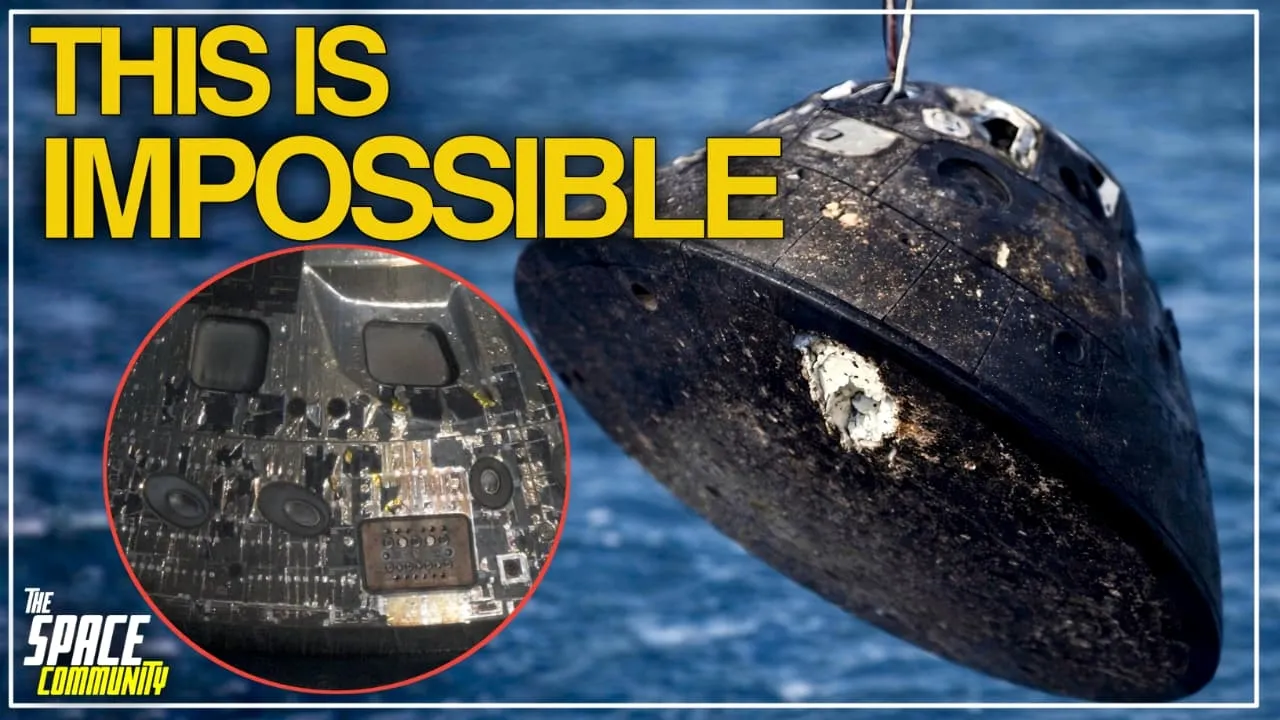
However, when we take a closer look at this image, it does suggest that there may have been a small area where material detached from the underside. While it's not yet fully confirmed, this localized anomaly could represent a minor instance of tile or surface loss during re-entry. It's important to emphasize that small-cale material shedding can be within expected limits for an ablative system, but it will undoubtedly be a key focus for engineers as they conduct detailed post-flight analysis.
Even minor deviations provide valuable data when refining models for future missions. NASA administrator Jared Isaacman responded to space journalist Eric Berger's post addressing concerns about the same Orion heat shield image. I want to be careful not to get ahead of a full data review, but I understand the curiosity within the space community, especially when images can suggest there might be an issue. As expected, our engineers quickly began inspecting the heat shield.
Starting with diver imagery shortly after splashdown and continuing with detailed reviews aboard the recovery ship, no unexpected conditions were found. I believe that once the official images are released, the difference in heat shield performance between Artemis 1 and Artemis 2 will be very clear. Regarding the specific concern, the discoloration seen is not due to any material loss. The white area corresponds to the compression pad region and aligns with expectations based on the local geometry, AV coat byproducts, and transitional heating effects.
This behavior was observed during arcjet testing and was anticipated in this area. We will complete a comprehensive data review across all systems including the thermal protection system and will make the findings publicly available. As the NASA administrator emphasized, the true story of the heat shield goes far beyond what can be seen on the surface. The most critical insights come from the data collected during flight.
Embedded sensors across the thermal protection system recorded temperature profiles, heat flux, and material response in real time. This data is now being retrieved and carefully analyzed, providing a much deeper understanding than imagery alone can offer. Engineers will use it to determine precise ablation rates, detect any microscale damage, and validate computational models that predict how the heat shield performs under extreme re-entry conditions.
Another interesting aspect visible in the images is how well the structural interfaces around the heat shield held up. Areas near windows, thruster ports, and attachment points show clean edges with no signs of excessive erosion or thermal degradation. This is crucial because these transition zones are often the most vulnerable parts of a heat shield system. The fact that they remained intact suggests that both the material and the overall design are performing within expected margins.
The recovery process itself also provides indirect insight into the heat shield's performance. After splashdown, the capsule remains stable in the water, supported by a flotation collar and stabilization balloons. The heat shield facing downward showed no signs of structural compromise that could have affected buoyancy or integrity. This stability is another indicator that the thermal protection system maintained its overall shape and strength throughout re-entry.
When comparing Artemis 2 to historical missions, the scale and complexity of Orion's heat shield become even more impressive. At 16.5 ft in diameter, it is significantly larger than the heat shields used during the Apollo program. This increased size is necessary to protect a larger crew module and support longer duration missions, but it also introduces new challenges in terms of material consistency, manufacturing, and thermal behavior.
Achieving uniform performance across such a large surface area is no small feat. It's also worth noting that Orion's heat shield is not designed for reuse in the same way as modern spacecraft like SpaceX's Dragon or Starship. Instead, it prioritizes reliability and safety for deep space missions where the stakes are significantly higher. The ablative approach ensures that heat is effectively managed even under the most extreme conditions, albeit at the cost of material being consumed during each flight.
For missions returning from the moon or beyond, this trade-off is considered worthwhile. As engineers continue their analysis, one of the key goals will be to determine how much margin the system actually had during re-entry. In other words, how close did the heat shield come to its design limits? Early indications suggest that the system performed comfortably within those limits with no signs of overheating. Inside the crew module, cabin temperatures remain stable and the astronauts reported a smooth and nominal re-entry experience.
Looking ahead, the insights gained from Artemis 2 will play a direct role in shaping Artemis 3 and future missions. While the current heat shield design appears to be performing well, there's always room for optimization. Engineers may explore ways to improve material efficiency, reduce weight, or further enhance resistance to localized damage. Even small improvements can have a significant impact when scaled across multiple missions.
Another area of interest will be the long-term behavior of the AV coat material under repeated exposure to extreme conditions. Although each Orion capsule uses a new heat shield, understanding how the material behaves across different missions and trajectories can help refine predictive models and improve confidence in future flights. This becomes especially important as NASA aims to establish a sustained presence on the moon and eventually send humans to Mars.
In many ways, the Artemis 2 heat shield tiles represent more than just a piece of hardware. They are a bridge between past and future exploration. They carry forward lessons learned from Apollo, incorporate modern engineering advancements, and provide the data needed to push human space flight even further. The fact that they performed as expected under such demanding conditions is a strong validation of both the design and the decisions made after Artemis 1.
At this stage, the capsule is being transported for more detailed inspections where engineers will examine the heat shield at a microscopic level. This process will take weeks, if not months, but it will ultimately provide a comprehensive understanding of how the system performed. From macrolevel imagery to microscale material analysis, every piece of data will contribute to improving the safety and reliability of future missions.
As we continue to get more updates, one thing is already clear. The Aremis 2 heat shield has demonstrated that Orion is capable of safely bringing astronauts back from deep space. While there may be small areas to investigate and refine, the overall performance appears to be a major step forward compared to previous tests. For a mission that marks humanity's return to crude lunar exploration, that's exactly the kind of result NASA was hoping for.
We will have to wait and see how the full analysis unfolds and what adjustments, if any, are made for Artemis 3. But based on what we've seen so far, the Orion heat shield tiles have not only done their job, they've provided a solid foundation for the next era of human space flight. Thanks for watching today's episode. Don't forget to subscribe and give us a thumbs up if you enjoyed it. Stay tuned for another great video tomorrow.
The words are the caption track's own and nothing is reworded or re-transcribed. Paragraph breaks are placed between sentences so the text reads as prose.
Free tools for your own script: paste a draft and see where it stands before you record it.
Paste your draft and see where viewers are likely to drop off, with a rewrite for each weak line.
Paste the first 30 seconds of your own draft for a hook score and rewrites.
Check your draft against YouTube's advertiser-friendly guidelines before you record it.
Read this channel's public videos and transcripts, and download a writing brief for it.