Getting the transcript
Reading the captions from YouTube. A video nobody has opened here before takes 10 to 30 seconds; this page fills in on its own.
Getting the transcript
Reading the captions from YouTube. A video nobody has opened here before takes 10 to 30 seconds; this page fills in on its own.
Words
757
Runtime
4:09
Speaking pace
182wpm
Reading time
3min
182 words per minute, just over the 181 median of 349 measured videos. That distribution comes from the 349-video hook study.
Opening (first 30 seconds)
So, we've been getting a lot of questions about what a manage agent really is. So, I want to explain what that term manage agent is and where the line sits between what you're expected to define and what infrastructure a manage agent should handle. So, until now, an agent has been a local process. Cloud code runs in your terminal, and so everything that the agent is lives in that process's memory. It's simple. Your files and credentials are already there. But that ties the agent's life to a process's
91 words, the words spoken in the first 30 seconds at 182 words per minute.
Free, no signup. See how the first 30 seconds hold attention, with rewrites.
Sentence shape
| Measure | This transcript |
|---|---|
| Sentences | 56 |
| Average words per sentence | 13.5 |
| Longest sentence | 69 words |
| Questions asked | 0 |
| Sentences containing a number | 1 |
Most used terms
Filler phrases
8 in total: actually 4 · like 3 · literally 1.
A literal whole-word count of the same phrase list the Prepublish browser extension uses, so a phrase inside another word is not counted and a phrase used in its ordinary sense still is. It is a count and not a judgement.
Run the check on the words above: where attention is likely to drop, with a rewrite for each weak line. The free check shows the scores and the one issue costing the most.
What this transcript is
Every word below is the caption track YouTube publishes for this video, pulled from the video itself and reproduced unchanged. It is not Prepublish's writing, not a summary, and not a re-transcription: it is the video's own published captions. English captions, generated automatically by YouTube, in the video’s original language. Source: the video on YouTube. A channel that would rather this page did not exist can ask for its removal through the contact page, and it is removed.
No Script X-ray for this video: YouTube shows a Most replayed graph only once a video has enough views.
So, we've been getting a lot of questions about what a manage agent really is. So, I want to explain what that term manage agent is and where the line sits between what you're expected to define and what infrastructure a manage agent should handle. So, until now, an agent has been a local process. Cloud code runs in your terminal, and so everything that the agent is lives in that process's memory. It's simple. Your files and credentials are already there.
But that ties the agent's life to a process's life. And we learned this the hard way. The very first version of Amnaro was a remote control for your agents from your phone. And this architecture constantly causes headaches. A closed laptop will actually kill the agent mid task because it's literally just a process. We wrote all sorts of hacks to recover that agent. But by and large, the agent was trapped in one interface.
You couldn't easily hand it between machines or give it to another teammate because the agent was the process. And also agents spent most of their lives just waiting between inputs or between tool calls. And so it still had to stay alive during that whole time or it was gone. And that was just a waste of resources. So if you strip an agent down, it's really just a loop. It calls a model, it runs tools, and it repeats.
This is taken from Dex's 12actor agents. And the big idea here is that you can just take the agents state out of this loop. And so infrastructure can run this loop against that state and that changes what the agent is. It's no longer the process on the machine. It's actually a durable object. And so a new agent is not a new process. It's actually it's a new row in a database. And so it can survive crashes, things going offline.
And any interface can reach it. The terminal, the phone, Slack, it can wait days for no cost because you don't have to keep a process alive. And then any machine, so sandboxes or your own laptop or VMs or containers, they can all attach to it like tools when there's work and then detach when there isn't. So this is super cool. Like an agent can outlive this for loop that really is the agent. The agent is data and everybody's waking up to this now.
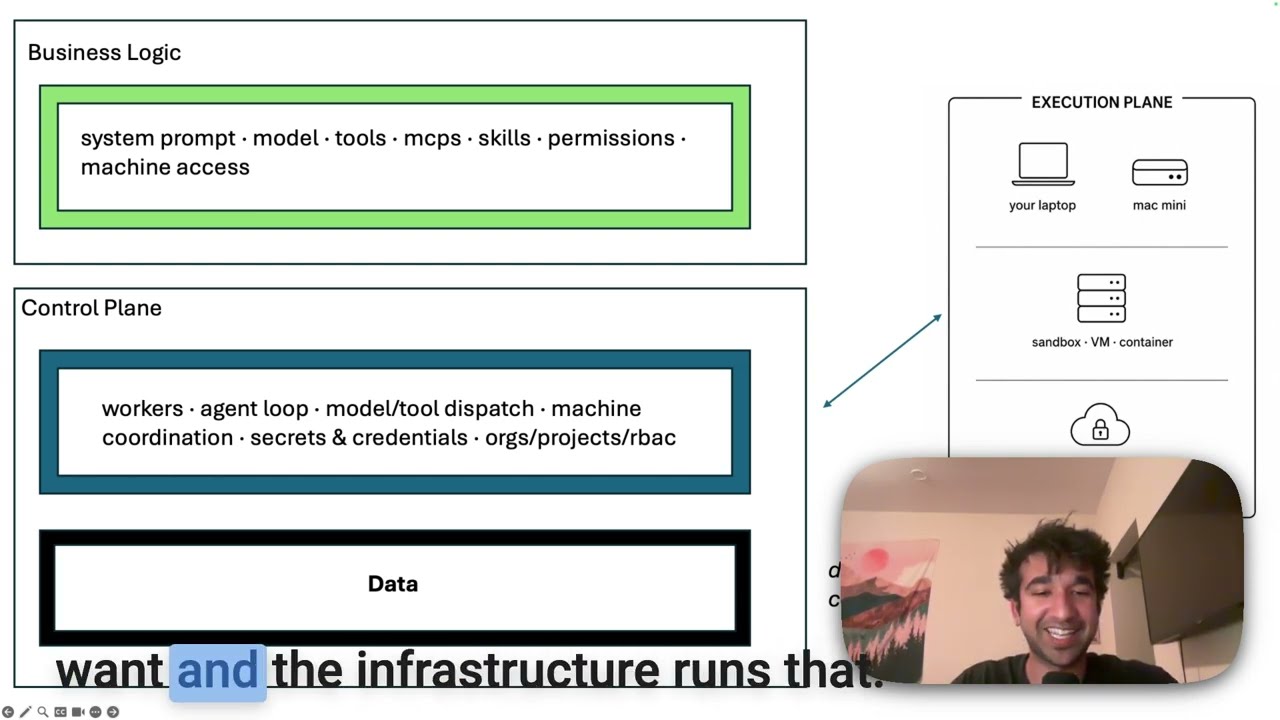
So the main point of this video was to show you this. Here's the boundary. Okay, above this control plane you see we have business logic and this is the judgment that you provide. So nobody can provide this part for you but this is where you define what the agent's job is, which models it uses, which tools it has, what permissions it has, which machines it can work on. And this is a configuration. And then below the line you have the infrastructure that runs the loop.
It saves every step as it happens so things don't get lost. It holds questions open until a human answers them. It can allow you to stream the agent live. It also governs access. So it's also responsible for who can do what. And then you can see at the bottom here the durable log in our case the database is what actually holds the state or the identity of the agent. You'll also see here what we call an execution plane.
So this is all the machines that the agent can use as execution environments and the way we handle that is we have a damon that initiates an outbound connection and that can be ran on any machine. So that's what allows you to bring your laptop we call it by machines to the control plane. So in closing that's what managed means. You describe the agent you want and the infrastructure runs that and we built that layer. It's called Nara.
It's open source. It's self-hostable. There are other alternatives out there like Claude manage agents and Gemini manage agents, but we believe that you should own your data and you shouldn't be locked into a specific model and you should be able to run everything yourself, bring your own machines even and that's really really important especially with how much these model providers want to own more and more of the stack and compete.
And that's why we're super excited about Omnara. It's the foundation for building agent products for your team or your users.
The words are the caption track's own and nothing is reworded or re-transcribed. Paragraph breaks are placed between sentences so the text reads as prose.
Free tools for your own script: paste a draft and see where it stands before you record it.
Paste your draft and see where viewers are likely to drop off, with a rewrite for each weak line.
Paste the first 30 seconds of your own draft for a hook score and rewrites.
Check your draft against YouTube's advertiser-friendly guidelines before you record it.
Read this channel's public videos and transcripts, and download a writing brief for it.