Getting the transcript
Reading the captions from YouTube. A video nobody has opened here before takes 10 to 30 seconds; this page fills in on its own.
Getting the transcript
Reading the captions from YouTube. A video nobody has opened here before takes 10 to 30 seconds; this page fills in on its own.
Mason Mignanelli · @MasonMignanelli
Where viewers went back to watch this video again, from YouTube's public Most replayed graph, lined up with what was said at that moment.
Most replayed moment #1
5:013.4x the video's typical replay level
performance of the same metal in two different alloys can vary wildly. Gold is not one thing. Think 18-karat platinum white gold versus 9-karat rose gold, very different alloy composition. Platinum [music] is also not one thing. Even silver is not one thing. A well-engineered silver alloy like Argentium can vastly
Said at 4:54
Most replayed moment #2
5:333.0x the video's typical replay level
hard to work with, hard to cast with, and it scratches more visibly than people expect. Platinum is durable, but it's not magically scratch-proof. It develops a soft gray patina quite quickly. So, the whole hierarchy is mostly cultural shorthand. In jewelry, the right metal is the one that best suits the job, not the
Said at 5:26
Most replayed moment #3
8:263.0x the video's typical replay level
diamond for a lab diamond, save potentially tens of thousands, and in many cases literally no one will know. But if you swap skilled hand labor for bad craftsmanship or factory-made pieces, that will be obvious immediately. No one notices invisible geology, but everyone notices bad claws.
Said at 8:20
The graph counts replays. It does not show where viewers stopped watching.
Words
2,302
Runtime
10:41
Speaking pace
215wpm
Reading time
10min
215 words per minute, above the 201 75th percentile of 349 measured videos. That distribution comes from the 349-video hook study.
Opening (first 30 seconds)
Jewelry is full of myths that sound true right up until your ring bends, your stone chips, or you realize you spent thousands of dollars following advice that was basically propaganda from a marketing department. Because jewelry is a sold through a romance, prestige, and tradition, but jewelry itself is not made of romance. It's made of metal, stones, stress points, surface chemistry, and craftsmanship. And physics doesn't care how traditional something sounds. So, today I'm breaking down seven of the most common jewelry myths people still believe and why some of them can cost you a lot more than money. Natural gems are always better than lab.
108 words, the words spoken in the first 30 seconds at 215 words per minute.
Free, no signup. See how the first 30 seconds hold attention, with rewrites.
Sentence shape
| Measure | This transcript |
|---|---|
| Sentences | 154 |
| Average words per sentence | 14.9 |
| Longest sentence | 47 words |
| Questions asked | 2 |
| Sentences containing a number | 6 |
Most used terms
Filler phrases
28 in total: like 11 · actually 10 · kind of 3 · sort of 2 · basically 1 · literally 1.
A literal whole-word count of the same phrase list the Prepublish browser extension uses, so a phrase inside another word is not counted and a phrase used in its ordinary sense still is. It is a count and not a judgement.
Run the check on the words above: where attention is likely to drop, with a rewrite for each weak line. The free check shows the scores and the one issue costing the most.
What this transcript is
Every word below is the caption track YouTube publishes for this video, pulled from the video itself and reproduced unchanged. It is not Prepublish's writing, not a summary, and not a re-transcription: it is the video's own published captions. English captions, generated automatically by YouTube, in the video’s original language. Source: the video on YouTube. A channel that would rather this page did not exist can ask for its removal through the contact page, and it is removed.
Jewelry is full of myths that sound true right up until your ring bends, your stone chips, or you realize you spent thousands of dollars following advice that was basically propaganda from a marketing department. Because jewelry is a sold through a romance, prestige, and tradition, but jewelry itself is not made of romance. It's made of metal, stones, stress points, surface chemistry, and craftsmanship. And physics doesn't care how traditional something sounds.
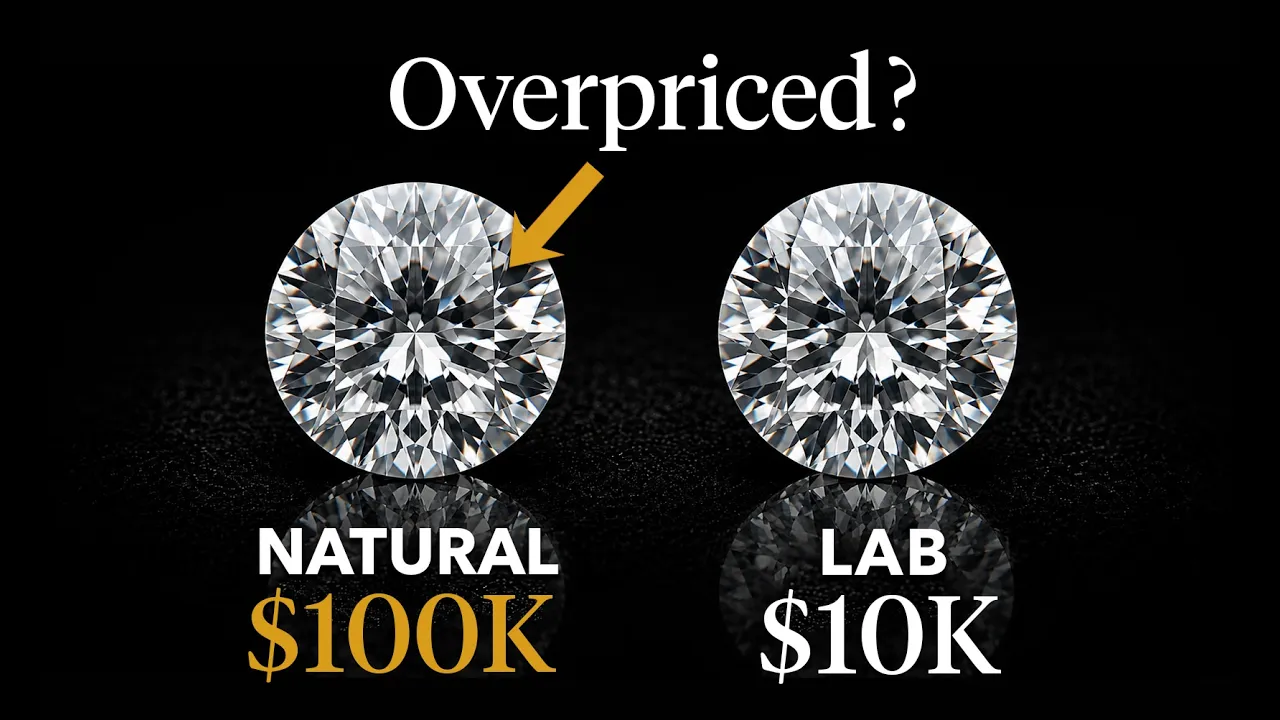
So, today I'm breaking down seven of the most common jewelry myths people still believe and why some of them can cost you a lot more than money. Natural gems are always better than lab. Natural means natural. That's a statement about origin and nothing else. It does not automatically mean better color, better clarity, better durability, or better value. And this is where jewelry gets a bit weird because people hear lab grown and think fake.
But a lab sapphire is still sapphire. A lab diamond is still diamond. It has the exact same crystal structure, chemistry, and hardness. The atoms don't really care whether they formed underground or in a machine. What natural often gives you is rarity, collector appeal, and romance, which is fine. Those things do matter, especially if you're the sort of person who cares about them. But that's not really the same thing as saying the stones are objectively better for jewelry.
In fact, a lot of the time the lab grown version is cleaner, more consistent, and dramatically better value, while the natural version is more expensive because it's rarer, and it's also more likely included and harder to source. And here's where it gets a little bit weird. Some people get very snobbish about lab grown stones then happily buy natural stones that have been heated, filled, oiled, radiated, or otherwise messed with after mining.
So, a stone grown in the factory is unnatural, but a pump stone full of resin and dye gets a free pass because it came out of the ground first. To me, that seems a little bit unfair. If you're an investor, natural definitely matters. If you care about geological rarity, natural definitely matters. And if the romance of deep time is important to you, natural matters. But if you're buying a stone to actually wear on your finger every day, natural does not automatically mean better.
A lot of the time it just means more expensive. And that same confusion between a tradition, romance, and actual performance shows up even more clearly with emotionally charged engagement rings. Diamonds are the only real engagement stone. No, they aren't. That idea feels ancient, but it really isn't. If you propose to someone 100 years ago with a plain diamond solitaire, they might not have seen it as the obvious romantic choice at all.
For most of our history, engagement rings were not locked to one white stone. People proposed with plain gold bands, posy rings engraved with private messages, sapphires for fidelity, rubies for passion, and all sorts of symbolic jewelry that actually meant something specific to the couple. [music] The diamond solitaire is not eternal tradition. It's a modern standardization dressed up as some eternal romantic myth. And to be clear, I'm not trying to on diamonds.
They're a great colorless stone, and lab diamonds are very good value these days. And mechanically, they're excellent. They keep a crisp polish, they're extremely hard, and they absolutely work as engagement stones. But they aren't the only real option. They just became the dominant option because the industry got very, very good at making it feel like the only option. Otherwise, you're a broke loser, and you hate your girlfriend.
So now people act like if the ring doesn't have a big diamond in the middle, it somehow it doesn't count, which is historically absurd. For most of human history, the meaning came from the symbolism, not from complying with a single retail template. And once the industry convinced people what stone they were supposed to buy, the next move was convincing them how much they were supposed to spend. Myth number three, you should spend three months salary on an engagement ring.
No, you shouldn't. Not if you don't want to. If you want to pay me three months salary to make a ring, I won't stop you, but it's absolutely not some ancient romantic tradition. It's a De Beers marketing campaign, and it is one of the most successful bits of sales psychology the jewelry industry ever pulled off. Because think about how weird it is. The correct budget for a ring has apparently nothing to do with the design, the craftsmanship, the stone quality, the durability, or whether your partner even likes the thing.
It's based on your salary, which is a very convenient coincidence for the people selling the ring. It's not really advice about jewelry, it's revenue maximization being pushed on you as romance. The brilliance of that campaign was that it didn't just tell men to spend more because you get a cooler ring, it made spending more feel morally correct. Like the size of the financial sacrifice proved the depth of the love, which is complete nonsense.
A well-made ring does not become better just because you overpaid for it or because the stone is 1.8 mm larger in diameter. And a thoughtful ring does not become less meaningful because you kept your finances intact and spent the 20k on a house deposit instead. If anything, blowing a 3-month income on a generic retail template because an ad campaign told you to is less romantic than just choosing something intelligently.
But engagement rings are the only place where jewelry advice gets reduced to lazy [music] rules. Myth number four, gold is better than silver, platinum is better than gold. Not really. It sounds intuitive because we've been trained on this weird prestige ladder, bronze, silver, gold, platinum, as if precious metals work like video game loot tiers. But in actual jewelry, it isn't quite that simple because you have to answer X metal is better at what?
Better color, hardness, tarnish resistance, better value, better everyday wear, better for setting stones in? These metals aren't really a ladder, they're different solutions to different problems. And the performance of the same metal in two different alloys can vary wildly. Gold is not one thing. Think 18-karat platinum white gold versus 9-karat rose gold, very different alloy composition. Platinum [music] is also not one thing.
Even silver is not one thing. A well-engineered silver alloy like Argentium can vastly outperform the cheap outdated version of silver people have in their heads. A sensible 14-karat gold alloy can be a much better everyday choice than 22-karat, even though a 22-karat is double the price. Platinum, as good as it is, is not some magical final form of jewelry that produces its own force field. It's excellent, but it has tradeoffs like everything else.
It's hard to work with, hard to cast with, and it scratches more visibly than people expect. Platinum is durable, but it's not magically scratch-proof. It develops a soft gray patina quite quickly. So, the whole hierarchy is mostly cultural shorthand. In jewelry, the right metal is the one that best suits the job, not the one sitting highest on some imaginary podium. And no metal has suffered more from that fake hierarchy than silver.
Myth number five, silver is for cheap jewelry. This one drives me slightly insane because people talk about silver like it's inherently unserious. Like gold is real jewelry and silver is just the stuff you buy from a market stall while someone burns incense next to you. But that's not really silver's fault. Silver got trapped in the wrong market category. For decades most people's experience with silver jewelry has been thin, mass-produced, poorly finished sterling silver.
Cheap chains, hollow rings, generic charms, that sort of thing. Jewelry designed to hit a price point rather than to survive for decades. So, people blamed the metal. But the problem was not the element silver. The problem was the cheap alloy choice, cheap construction, and cheap workmanship all stacked on top of each other. And that matters a lot because silver actually has properties that gold and platinum don't. It's the whitest precious metal.
It takes oxidation beautifully. It can create extreme contrast between bright polished highlights and deep black recesses. For sculptural, engraved, story-driven jewelry, that is incredibly useful. Gold can be rich and platinum can be noble, but silver can be graphic. [music] And that's why it's so strange that the high jewelry industry mostly abandoned it. Not because silver has no artistic value, but because the industry trained people to associate it with low-end jewelry.
And modern alloys make that even more frustrating. Argentium silver, for example, replaces some of the copper in traditional sterling with germanium. That gives you a whiter, more tarnish-resistant, more technically interesting silver alloy. So, when people say silver is cheap, what they usually mean is they've mostly seen cheap things made out of silver. It's not silver's fault everyone keeps turning it into sad little dolphin pendants.
Which brings us to another mistake that people make, confusing material cost with jewelry value. Myth number six, when you buy jewelry, you're just paying for the gold and gemstones. Not really, or at least not primarily. [music] If you want gold value, you should go buy a bullion. It will be emotionally dead, but very measurable. If you want a gemstone investment, go buy a collector grade stones, but a finished ring is not a little vault of raw commodity value.
In most good jewelry, what you're actually paying for is design ability, labor, engineering, finishing, setting, and taste. And to be clear, that includes my jewelry. If you buy one of my customs or one of the pieces on my website, you're not mainly paying for the value of the metal. You're paying for the fact I knew what to make, how to make it, and how to make it properly. And that isn't really a scam, it's kind of the whole point of jewelry.
Because think about it, you can take two jewelers, give them the exact same gold and the exact same stones, and one of them might make something incredible worth lots of money, while the other one makes something that looks clumsy, wears badly, and just falls apart. So, clearly the value was never in the ingredients. It's like saying the value of your Michelin star restaurant meal is in the weight of the pasta and the meat value of the steak.
It's why I find this whole lab diamond debate so interesting. You can swap a natural diamond for a lab diamond, save potentially tens of thousands, and in many cases literally no one will know. But if you swap skilled hand labor for bad craftsmanship or factory-made pieces, that will be obvious immediately. No one notices invisible geology, but everyone notices bad claws. Premium materials matter, of course they do. That's why I talk about alloy composition and gemstone properties so much.
But expensive ingredients do not automatically create a premium piece any more than expensive weight makes a good bowl of pasta. And as materials become easier to produce, for example, lab diamonds, craftsmanship matters more, not less. And once people realize craftsmanship matters, they often make the opposite mistake, assuming that more material automatically means better craftsmanship. Myth number seven, that heavier automatically means better made.
Sometimes heavier jewelry is better. More metal can absolutely improve durability, and I have minimum thicknesses and weights that I refuse to go under. Below a certain point, jewelry stops being refined and just starts being flimsy. But weight is only one variable, and I actually fell into this trap when I first started [music] making rings. I thought if I made them heavy, thick, and substantial, they would feel more expensive, more premium, and proper.
And at first, they kind of did. But then I actually had to wear the things all day, and I realized a lot of these bulky signet rings were just kind of annoying. They felt tight, and they felt heavy, and they didn't sit right on my finger. And because the face was so large and bulky, it acted like a counterweight. So, the ring would just spin around all day and I'd have to constantly readjust [music] it. So, then I overcorrected.
I started making pieces that were much thinner, sleeker, [music] and a way more comfortable to wear. And they definitely were nicer to wear, but some of them just weren't strong enough for real daily use. A good ring needs metal where the structure actually needs strength, [music] under stones, around stress points, through the shank, and in the claws, maybe in the shoulders, too. Anywhere the piece is going to take force over many years of wear, but adding bulk everywhere is not really craftsmanship.
At that point, you're just overbuilding. A ring can be thick, heavy, expensive, and still be really badly made. Same as a jacket made from heavy fabric with terrible stitching and an awful fit. Because good jewelry should feel substantial enough to trust, but refined enough that you actually want to wear it every day. Good jewelry is not just more material. If you want to go deeper into the physics, history, and other secrets of the jewelry industry, you can access my book for free in the description.
And if you're curious what this metallurgy actually looks like when it's applied in real life, the pieces I make are on my website. Otherwise, now you actually know what you're putting on your finger. I'll see you in the next one.
The words are the caption track's own and nothing is reworded or re-transcribed. Paragraph breaks are placed between sentences so the text reads as prose.
Free tools for your own script: paste a draft and see where it stands before you record it.
Paste your draft and see where viewers are likely to drop off, with a rewrite for each weak line.
Paste the first 30 seconds of your own draft for a hook score and rewrites.
Check your draft against YouTube's advertiser-friendly guidelines before you record it.
Read this channel's public videos and transcripts, and download a writing brief for it.