Getting the transcript
Reading the captions from YouTube. A video nobody has opened here before takes 10 to 30 seconds; this page fills in on its own.
Getting the transcript
Reading the captions from YouTube. A video nobody has opened here before takes 10 to 30 seconds; this page fills in on its own.
Mega Engineering · @MegaEngineering79
Words
2,340
Runtime
15:20
Speaking pace
153wpm
Reading time
10min
153 words per minute, below the 160 25th percentile of 349 measured videos. That distribution comes from the 349-video hook study.
Opening (first 30 seconds)
A 100-year mistake is eating the Parthenon. 2,500 years old, nearly destroyed by a single piece [music] of rusting metal. >> Built in 9 years, survived a war, survived an explosion, [music] survived a theft. It almost didn't survive being repaired. >> Here's the crazy part. The men who tried to save it in the 1800s used [music] the wrong metal, wrapped it wrong, and nobody noticed for 100 years. The damage was already inside the stone
77 words, the words spoken in the first 30 seconds at 153 words per minute.
Free, no signup. See how the first 30 seconds hold attention, with rewrites.
Sentence shape
| Measure | This transcript |
|---|---|
| Sentences | 186 |
| Average words per sentence | 12.6 |
| Longest sentence | 50 words |
| Questions asked | 5 |
| Sentences containing a number | 43 |
Most used terms
Filler phrases
9 in total: like 4 · actually 3 · literally 1 · you know 1.
A literal whole-word count of the same phrase list the Prepublish browser extension uses, so a phrase inside another word is not counted and a phrase used in its ordinary sense still is. It is a count and not a judgement.
Run the check on the words above: where attention is likely to drop, with a rewrite for each weak line. The free check shows the scores and the one issue costing the most.
What this transcript is
Every word below is the caption track YouTube publishes for this video, pulled from the video itself and reproduced unchanged. It is not Prepublish's writing, not a summary, and not a re-transcription: it is the video's own published captions. English captions, generated automatically by YouTube, in the video’s original language. Source: the video on YouTube. A channel that would rather this page did not exist can ask for its removal through the contact page, and it is removed.
No Script X-ray for this video: YouTube shows a Most replayed graph only once a video has enough views.
A 100-year mistake is eating the Parthenon. 2,500 years old, nearly destroyed by a single piece [music] of rusting metal. >> Built in 9 years, survived a war, survived an explosion, [music] survived a theft. It almost didn't survive being repaired. >> Here's the crazy part. The men who tried to save it in the 1800s used [music] the wrong metal, wrapped it wrong, and nobody noticed for 100 years. The damage was already inside the stone [music] before anyone knew to look.
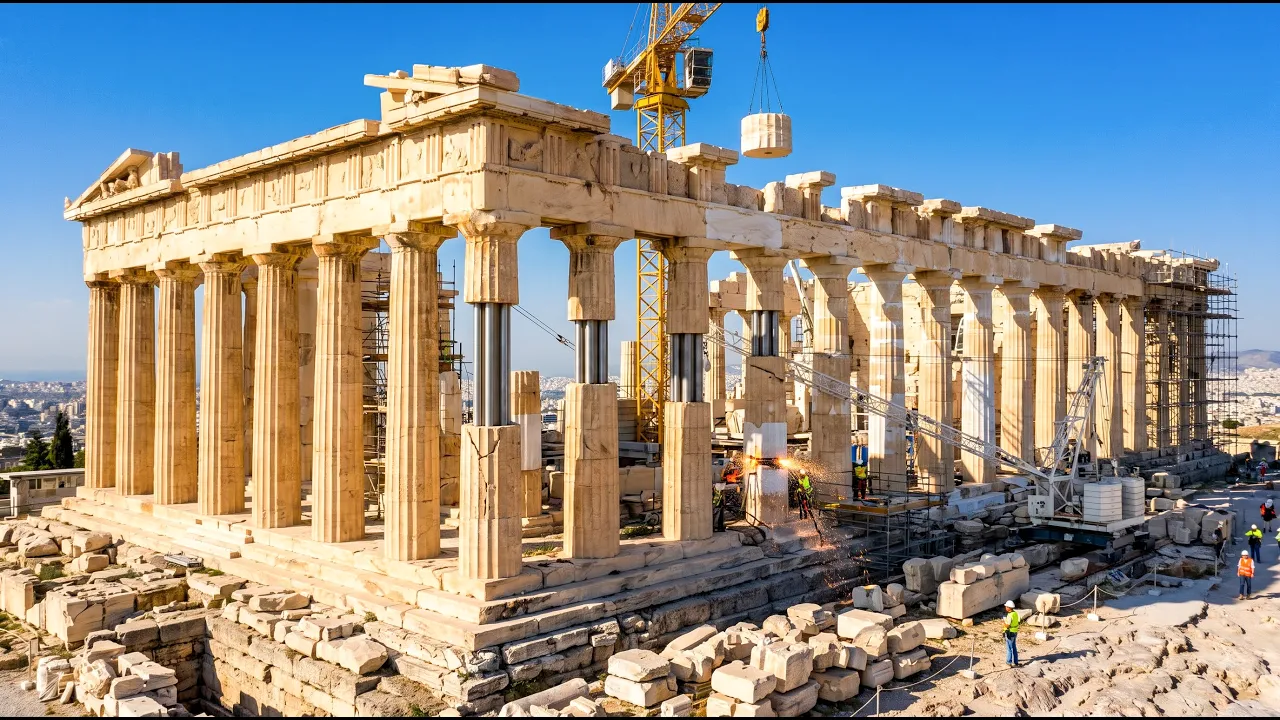
Now watch what it takes to undo a 100-year mistake, one hidden crack at a time. A rusting piece of metal sealed inside the most recognizable ruin on Earth has been trying to tear it [music] apart for over 100 years. Not an earthquake, not a bomb, a clamp. This is the Parthenon, built in just 9 years starting in [music] 447 BC. Pericles personally oversaw the entire project. In the first year alone, Athens spent [music] 5,000 talents of silver, an estimated $3 billion in today's [music] money.
Two architects, Ictinus and Callicrates, one sculptor, [music] Phidias, running the whole build. Workers cut 20,000 tons of marble by hand from Pentelicus [music] and hauled it up this hill. >> I'm standing where the west pediment used to be. In 1687, a single Venetian cannonball hit the gunpowder Ottoman soldiers [music] had stored inside this temple. >> The explosion tore out the entire center of the building in seconds.
Then came Lord Elgin. Between 1801 and 1816, he stripped away most of what survived that blast, friezes, statues, decades of sculpture, and shipped it to London. It's still there. By the time Greece [music] finally tried to put the Parthenon back together in the late 1800s, an engineer named Nikolaos Balanos had [music] a plan. Iron clamps holding the marble blocks in place. The ancient Greeks had used [music] iron clamps, too, but they wrapped every single one in lead to keep water out.
Balanos didn't. For the next 100 years, water got in. The iron rusted, and rusting iron doesn't just weaken, it swells. Enough to crack [music] solid marble from the inside, one clamp at a time. Nobody could see it happening. That's what made it dangerous. One rusting clamp hidden inside marble for a century could have cracked apart 2,500 [music] years of history. But how do you fix a mistake buried inside solid stone without tearing apart the very monument you're trying to save?
Run your hand across this block. Cold, solid, 2,500 years old. Nothing about it tells you what might be happening on the inside. That's the whole problem. You cannot see rust inside a block of marble, not from the outside, not until the stone itself starts to crack. Here's the crazy part. By the time a crack appears on the surface, the clamp underneath has usually been swelling for decades already. The damage [music] is always older than it looks.
So, how do you find a 100-year-old mistake hidden inside solid stone? You take the building apart, piece by piece, block >> [music] >> by block. But that creates a second problem. Nobody alive has the original blueprints. No architectural drawings from 447 [music] BC survive. None. The team restoring the Parthenon today has to figure out where every block goes using nothing but the blocks themselves. Watch why that matters.
Get one placement wrong, and you've repeated the exact mistake that started this [music] whole mess. Nikolaos Balanos didn't just use the wrong metal, he put entire column drums back in the [music] wrong position, permanently. The solution? >> Read the stone like a document. Chisel marks, mason symbols [music] cut into the marble by workers 25 centuries ago. >> Chief architect Manolis Korres has spent decades tracing individual blocks [music] back to the exact quarry on Pentelicus where they were cut.
Then there's the third problem. 70,000 [music] fragments. Some still on the hill, some in museums on the other side of the world. >> Match a piece to the wrong block and you don't just make [music] an error, you rewrite the historical record permanently in stone. >> Before they carve a single new [music] piece of marble, the team makes a plaster cast first. Then they use wet red clay pressed against the broken [music] edge to check the fit, down to the millimeter, before anything is cut for real.
Three problems. One rule connects them all. Nothing gets touched until it's verified. Now watch what they actually do when they find a rusted clamp. First, they remove the block, not smash it out, lift it whole and set it aside. Every block at the Parthenon is numbered and tracked like evidence at a crime scene. Then they find the clamp, drill it out of the marble socket where Balanos left it a hundred years ago, corroded and swollen.
Here's where it gets interesting. What goes back in isn't iron, it's titanium. Why titanium? Iron [music] rusts because it reacts with water and oxygen. That's the whole disaster you just watched unfold over a century. Titanium doesn't. It forms its own protective oxide layer the moment it's exposed to air and that layer doesn't wear off. No lead wrapping required. No coating [music] to fail decades later. The bar goes into the drilled socket.
Around it, a liquid cementitious [music] compound poured in wet, left to harden solid inside the stone. But here's the tension. How do you know the bond will actually hold? A titanium bar sitting loose inside 2,000-year-old [music] marble does nothing. >> Engineers pull out test it, literally trying to yank the bar back [music] out of the hole, measuring exactly how much force it takes to fail. >> Researchers published the results in 2019 [music] in a structural engineering journal.
Real data, not a guess. >> I watched them prep [music] one of these joints last week. The bar goes in and it just disappears into the stone. You'd never know it was there. That's the point. >> Anastylose, no holes, no foundation cracks. The restoration principle running through this entire [music] project says new material should only go in when it's absolutely necessary. And even then, it should be distinguishable [music] from the original if you look closely enough.
Nothing is hidden from history. It's just hidden from a casual glance. One joint at a time, one pull-out test at a time. Multiply that by decades [music] of work and you start to understand why this project has taken longer than the original construction by a factor of nearly six. The clamps were done. Now came the [music] real puzzle, putting 25 centuries of broken stone back together. This is the [music] part that never really stops.
Since 1975, a team under the Acropolis Restoration Service, YSMA, [music] has been doing this same process block by block, joint by joint, without a break for over 50 years. Watch this. >> [music] >> Between 2010 and 2015 alone, one funding phase, 7.39 million euros, entirely [music] paid the European Union, treated 300 individual architectural elements. Total weight, 700 tons. That's just the Parthenon and the Propylaea, the temple's monumental [music] gateway.
Two buildings, five years, 700 tons. Stay with me because the pace matters more than it sounds like it should. The original builders finished [music] the entire structure, walls, columns, roof, sculpture, in nine [music] years. The restoration team has been at this for over 50, and they're still not done. That's not [music] incompetence, that's the opposite. >> Every single [music] block gets the plaster cast, red clay, pull out tested treatment [music] you just watched. >> There is no shortcut version [music] of not destroying history.
Stand here long enough and you start to notice [music] the two kinds of marble. The ancient blocks, honey-colored from 25 centuries [music] of iron oxide bleeding out of the stone itself, and the new pieces, visibly, deliberately [music] whiter. Nobody's trying to fake the past. They're trying to save what's real. You'll see why [music] that distinction matters later, when the scaffolding finally comes down. For decades, the work concentrated on the eastern and northern sides.
Then the western facade, the most photographed face of the most photographed ruin on the planet, came [music] next. Here's the crazy part. While all of this was happening, block by block, [music] joint by joint, the money to pay for it was never guaranteed. This wasn't a project with a fixed budget and assigned contract. It ran on government funding, EU grants, and whatever Greece could spare, year after year, decade after decade.
And in 2014, that funding nearly ran out completely. But there was one problem Nobody had solved [music] at this scale before. And, it had nothing to do with marble. Then, the nightmare hit. Not an earthquake, not a design flaw, money. November 2014, [music] Greece was 3 years into a debt crisis so severe the country had [music] just avoided outright bankruptcy with a 110 billion euro rescue package from the EU and IMF.
The Acropolis [music] restoration service ran on public wages. And, those wages stopped. Some contract workers hadn't been paid in up to 16 months, about a hundred of them. The actual people cutting stone, testing titanium [music] bonds, matching 70,000 fragments by hand, walked out with bullhorns and banners [music] in the middle of a tour the culture minister was giving to journalists. Roughly 1,500 workers across the ministry were facing [music] the same problem.
Here's the part that matters. This wasn't a protest against the project. It was a protest to keep it alive. >> These were the people who'd spent years learning exactly how to drill a socket for a titanium bar without damaging 2,000-year-old marble. >> They were one paycheck away from walking off permanently. Culture Minister Pavlos Geroulanos didn't [music] deny it. He called the demands absolutely justified standing right there in front of the temple and promised action.
The money mostly came from the same place it always had, EU aid. By that point, roughly 33 million euros of the 43 million euros spent since 2001 had come from European funding, not the Greek state. The wages got paid. The government pledged the restoration would continue for at least another [music] decade. Problem absorbed. Nobody walked away. They kept going. A decade of continued funding meant a decade of continued work.
Same process, same pullout [music] tests, same plaster casts. The western facade, the face of the Parthenon that ends up on more postcards, >> [music] >> more textbook covers, more phone screens than any other angle of the building became the focus. For that work to happen safely, scaffolding went up. A full steel support structure wrapped around the most photographed [music] ruin on Earth. It stayed there for 20 years.
Two full decades where nobody, [music] not a tourist, not a head of state, not a single visitor among the millions who came, could see that side of the Parthenon [music] without steel bars in the frame. Here's the crazy part. Most of the people who visited [music] during that entire stretch had no idea the version they were seeing wasn't the real one. Every clamp checked, every socket [music] drilled and tested, every block verified before it went back into place.
One joint [music] closer to finished, one photo closer to what the temple is supposed to look like without a cage [music] around it. Then in October 2025, the work on that face reached a stopping point. Then it happened. October 12th, 2025. For the first time in [music] 20 years, workers took the scaffolding down off the Parthenon's west face. [music] Not gradually, not partially, all of it. >> On in one operation, [music] the steel bars that had framed every photo of that side of the temple for two decades removed. >> I was there [music] that morning.
People just stopped walking. Tourists who'd seen a hundred photos of this building were seeing it for the first time in their lives with nothing in the way. >> No cracks visible on the restored face, no shifted [music] blocks, no clamps in sight. Because that was always the point. [music] The titanium is supposed to disappear. The removal was temporary. More scaffolding, [music] smaller, less obtrusive, is expected to go back up to finish the remaining work.
The current phase [music] of restoration is targeted to wrap up by spring 2026, but for one clear stretch of days in October, the marble that a rusting mistake once threatened to destroy stood there, uncovered, unclamped, exposed to [music] the sky the same way it was in 438 BC. 20 years hidden. Then, for a moment, nothing in the way. A rusting piece of metal sealed inside [music] the most recognizable ruin on Earth spent a hundred years trying to tear it apart.
It nearly won. The Parthenon survived a war, survived an [music] explosion, survived a theft that emptied half its sculpture into a museum 4,000 km away, where most of it still sits today. What almost finished [music] the job wasn't any of that. It was a repair. For over 50 years, one team [music] has been undoing that repair, one titanium bar at a time, using a metal the original builders never knew existed to fix [music] a mistake made by restorers who thought they were helping.
Today, the Acropolis draws more than a million and a half visitors [music] a year. Most of them will never notice the titanium. That's the whole design. The temple that started as a nine-year building project has [music] now spent six times longer being saved than it did being built. Every clamp replaced [music] is a bet that this fix, unlike the last one, actually lasts. If you want to [music] understand how engineers rebuild the past without lying about it, watch how they're [music] doing it, one block at a time, on the hill above Athens.
The words are the caption track's own and nothing is reworded or re-transcribed. Paragraph breaks are placed between sentences so the text reads as prose.
Free tools for your own script: paste a draft and see where it stands before you record it.
Paste your draft and see where viewers are likely to drop off, with a rewrite for each weak line.
Paste the first 30 seconds of your own draft for a hook score and rewrites.
Check your draft against YouTube's advertiser-friendly guidelines before you record it.
Read this channel's public videos and transcripts, and download a writing brief for it.