Getting the transcript
Reading the captions from YouTube. A video nobody has opened here before takes 10 to 30 seconds; this page fills in on its own.
Getting the transcript
Reading the captions from YouTube. A video nobody has opened here before takes 10 to 30 seconds; this page fills in on its own.
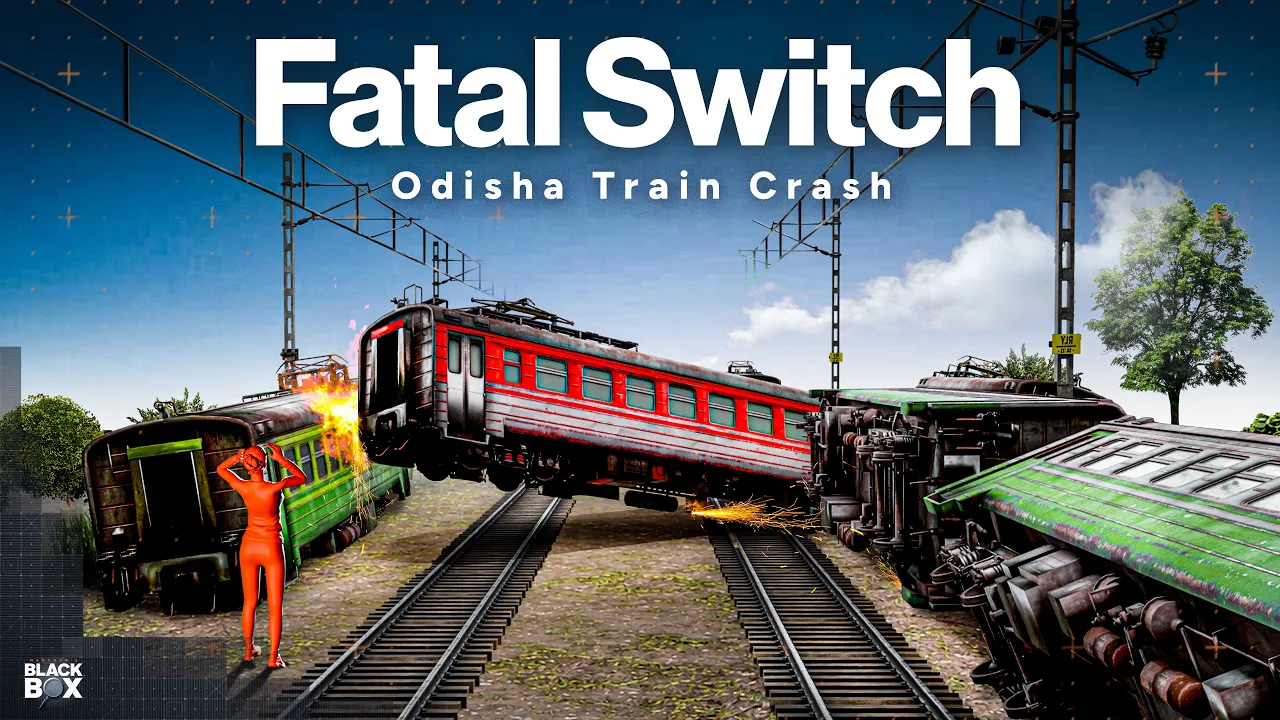
Mentour's Black Box · @MentourBlackBox
This video has no Most replayed graph yet: YouTube shows one only once a video has enough views. These are the moments viewers replayed most in Mentour's Black Box's most watched videos.
Most replayed moment at 17:12
3.9x that video's typical replay level
running or is shut down is that water must be kept circulating through the core, or else the reactor core will begin to destroy itself or using a word that I think everyone recognizes, [music] a nuclear meltdown will begin.
Said at 17:05
The graph counts replays. It does not show where viewers stopped watching.
Words
5,652
Runtime
39:14
Speaking pace
144wpm
Reading time
24min
144 words per minute, below the 160 25th percentile of 349 measured videos. That distribution comes from the 349-video hook study.
Opening (first 30 seconds)
It's 18:45 in the evening on Friday, June 2nd, 2023. Manikuttan was aboard the Coromandel Express watching the landscape blur past his [music] window as he took out his phone to capture the view for his family. The 50-year-old garments trader had boarded the Coromandel Express at Balasore only 15 minutes earlier. He was traveling to Cuttack, around 170 km away. Along a route that he knew well because it was a
72 words, the words spoken in the first 30 seconds at 144 words per minute.
Free, no signup. See how the first 30 seconds hold attention, with rewrites.
Sentence shape
| Measure | This transcript |
|---|---|
| Sentences | 337 |
| Average words per sentence | 16.8 |
| Longest sentence | 46 words |
| Questions asked | 10 |
| Sentences containing a number | 89 |
Most used terms
Filler phrases
28 in total: actually 11 · you know 6 · like 5 · right? 3 · kind of 2 · basically 1.
A literal whole-word count of the same phrase list the Prepublish browser extension uses, so a phrase inside another word is not counted and a phrase used in its ordinary sense still is. It is a count and not a judgement.
What this transcript is
Every word below is the caption track YouTube publishes for this video, pulled from the video itself and reproduced unchanged. It is not Prepublish's writing, not a summary, and not a re-transcription: it is the video's own published captions. English captions, generated automatically by YouTube, in the video’s original language. Source: the video on YouTube. A channel that would rather this page did not exist can ask for its removal through the contact page, and it is removed.
It's 18:45 in the evening on Friday, June 2nd, 2023. Manikuttan was aboard the Coromandel Express watching the landscape blur past his [music] window as he took out his phone to capture the view for his family. The 50-year-old garments trader had boarded the Coromandel Express at Balasore only 15 minutes earlier. He was traveling to Cuttack, around 170 km away. Along a route that he knew well because it was a journey that he made at least twice a week.
From his seat in coach S1 near the front of the train, Manikuttan started filming. Outside his window, the countryside slipped past calm and peaceful. What he couldn't have known was that he was filming the final peaceful moments of that journey. The Coromandel Express is one of the long-distance services linking Eastern India with the South. On June 2nd, it began its journey at Shalimar station in Kolkata at 15:20 that afternoon.
Bound for Chennai more than 1,600 km away. From Shalimar, it crossed the western edge of the city through Santragachi. Then accelerated southwest toward Kharagpur before continuing down the busy coastal railway line into Odisha. It stopped at Balasore shortly after 18:30 where Manikuttan boarded for his journey to Cuttack. Then once clear of the station, the train gathered speed again passing Nilgiri Road, Khantapara, and Bahanaga.
As it closed in on the small station of Bahanaga Bazar, >> [music] >> train 12841, the Coromandel Express, was a modern, high-performance long-distance passenger service made up of 23 coaches. And hauling those 23 coaches that evening was the most powerful passenger locomotive in the Indian Railways fleet, a WAP-7, a 6,125 horsepower electric locomotive drawing 25,000 volts from the overhead wires and specifically designed for high-speed passenger work.
At the head of the Coromandel Express were loco pilot Gunanidhi Mohanty and assistant loco pilot Hajari Kumar Behera. Mohanty was a veteran. He had joined the Indian Railways in and had accumulated roughly 27 years of railway service by the time of this story. A few minutes after they left Balasore, the Coromandel, with its over 1,250 passengers on board, was closing in on Bahanaga Bazar, a small station the train was scheduled to pass straight through without stopping, on its way to the next stop, which was Bhadrakh Station.
Now, the significance of the Bahanaga Station actually comes from its layout. Through the station, trains run on two tracks. Indian Railway convention labels them the up line and the down line. And beside each main track is a loop where one train can be held while another passes. Now, in normal operation, this is routine. Freight trains are often directed to the loops because faster passenger services are given priority on the main lines.
So, Bahanaga Bazar effectively had four running tracks, the up main, the down main, the up loop, and the down loop. When seen from above, it's an elegant piece of railway choreography. Four tracks allow four trains to occupy the station area without sharing the same path. But, what exactly determines if a train stays on the main line or branches out into the loop? The answer to that question is pretty obvious, right?
It's the track. Because I'm sure you know, unlike a car or an aircraft, a train can't steer freely. Its wheels are locked to the path laid out by the rails underneath it. So, that decision isn't really a decision as far as the train is concerned. The train's going to go wherever the track leads it. Now, at the junction between the main line and a loop is a set of movable rails known as points. These are controlled by the points operating equipment or POE, which is machinery that physically moves the rails from one route to the other.
At its core, the POE performs three jobs: movement, locking, and monitoring or detection. First, it moves the switch rails sideways until they line up with the selected track. Then, it locks them firmly in place, preventing them from shifting as the weight of a train passes over them. And finally, it confirms that the rails have reached the correct position and are securely locked. Now, in the past, points were actually operated manually.
A railway worker or a signalman pulled a large lever either beside the track or inside a signal box, and that movement was transferred to the switch rails through a series of rods, cranks, wires, [music] and pulleys. Today, POE are electromechanical. An electric motor turns gears, cranks, and linkages that move the switch rails, while also providing locking and electrical detection. So, the track determines what the train does, the POE determines what the track does.
Now, who or what controls the POE? The process begins when the stationmaster requests a route. For example, the stationmaster may use the control panel to request [music] that an approaching train continue along the main line. That request is passed into the electronic interlocking or EI, which is a computer programmed with the station safety logic. Before the EI moves the points, it must first check that every safety condition required for the route has been satisfied.
It must confirm that every section of track along the requested route is clear. And to know whether a section of railway is clear, the electronic interlocking relies on track detection systems. One of the oldest and most common is known as the track circuit. The two running rails are used as a part of a low voltage electrical circuit. When no train is present, the electric current travels freely to an electronic receiver at the far end, telling the interlocking that the section is clear.
But when a train enters, its metal wheels and axles electrically connect the two rails. This diverts the current away from the receiver, causing the system to report the section as occupied. It's pretty cool. Now, a more modern solution is the axle counter. Sensors count the wheel sets entering and leaving a section of track. If the number that enters matches the number that leaves, the system knows the section is clear.
And if they do not match, it is then defined as occupied. After the EI confirms all track sections on a requested route are clear, it then commands the necessary points to move and then waits for the electronic confirmation that each point has reached the correct position and is securely locked. Only after the entire path is clear, correctly aligned, and protected, does the EI lock the route and allow the green light signal.
That signal is the final instruction presented to the locomotive crew. >> [snorts] >> Similar to a road traffic light, red means stop, yellow means proceed with caution, and green means that the train may continue under the permitted conditions. And crucially, green means that the signaling system has established and protected the route ahead. So to the driver, that green light means way more than just permission to proceed.
It is the visible confirmation that the signaling system has checked the track, set and locked the points, excluded conflicting movements, and reserved a safe path ahead. Now on the other side of India, the city of Mumbai was battling a huge problem. Without proper waste management, most household trash ended up in nearby rivers, eventually flowing into the ocean. So last year, Planet Wild, who I have partnered with for this ad, decided to do something about it.
They installed a 42-m long low-tech floating barrier in Mumbai's storm drains. The trailing net skirts intercept waste while still allowing aquatic life to slip through. And the result? 10,000 kg of Mumbai's plastic is stopped from reaching the ocean every month. And that's just one of the many Planet Wild missions. Every month, their community of 25,000 members, including myself, crowdfunds a new environmental mission.
Cleaning oceans, restoring forests, or bringing back endangered species. And within 30 days, they share a YouTube video documenting their impact, just like they did in Mumbai. It keeps them accountable to us members, showcases real solutions, and restores hope that we can still protect nature. This kind of transparency is why I became a member. If you also want to join, you can pledge whatever amount feels right, and you can cancel anytime. >> [music] >> And as a special gift, the first 100 people to sign up with my code blackbox9, get their first month on me.
Just scan the QR code or click the link below. And if you want to see them in action first, check out their plastic mission also linked below. Now, let's get back to Odessa. The entire signaling system is designed to be fail-safe, which means that when something does break or when the system can't prove that a condition is safe, the system defaults to the more restrictive state. So, if power is lost, a wire is broken, a track section can't be confirmed clear, or the position of the points can't be detected, the EI should withhold the route and keep the signal at red.
In other words, the system should never assume that the railway is safe. It must positively prove that it is. Uncertainty is treated as danger, [music] and without complete confirmation, the train isn't given permission to proceed. So, can an automatic system like this that is designed to be fail-safe still fail? To answer that, we actually need to turn the clock back a little bit to August 8th, 2018, 5 years before our story, when maintenance work was scheduled to be carried out inside the North signal Goomty at Bahanaga Bazar.
By the way, a Goomty is just a small building that houses the electrical relays and equipment for the train station. Inside the Goomty at Bahanaga, a fault developed in the cable responsible for position detection for point 17A/B. [music] This crossover determined whether an approaching train remained on the up main or was diverted into the up loop. Also, just to keep our lingo straight, if you remember, a point is just a single piece of track that moves.
And a crossover is the entire section of two tracks that is joined by two or more points. Okay, back to the Goomtee. To bypass the defective cable, signaling staff rerouted the circuit through a different pair of cable cores, moving it from terminals 13 and 14 all the way to 23 and 24. When taken at face value, the fix appears to have been a pretty practical workaround. You know, rather than replace or repair the defective cable immediately, staff routed the detection circuit through another available pair of terminals.
But, as is often the case, the devil is always in the details. We now know that several important safety protocols were actually missed during that fix back in 2018. First, the change had allegedly been carried out without going through the required approval process. Technicians aren't supposed to improvise a permanent circuit change simply because a workaround is technically possible. The change should first be engineered, checked, and formally approved so that everyone working on the system is working to the same design.
Next comes the documentation. Signaling systems are maintained through detailed circuit drawings that define where every wire begins, where it terminates, and the function it performs. The proper sequence for repair is very straightforward. Technicians begin with the existing approved drawing. They then add any proposed changes. Then that marked-up drawing is submitted for verification and approval. Once approved, the physical work is carried out.
The modified circuit is tested, and finally a new updated master drawing is produced representing the system exactly as it now exists. That final step is critical because as you can imagine, sometime years later, some other technician may open that same cabinet with no knowledge of the work that came before. That is why it is imperative that the drawing be an exact [music] representation of the system. If the wiring has changed, but the master drawing hasn't, the technician is no longer looking at an accurate map of the equipment in front of them.
So, at Bahanaga Bazar, that rerouted .17A/B detection circuit wasn't properly reflected on that master drawing. Which means that drawing no longer reflected reality as of August 2018. And there was another problem. The physical labels on the terminal rack weren't updated, either. Which means that terminals that now carried a different circuit still retained their old identification. So, both sources of information that a future technician would rely on, the master circuit drawing and the wiring labels, could now mislead any future maintenance operation.
And this 2018 incident was not the first time the paperwork and the equipment had fallen out of sync. In 2015, an alteration to the signaling circuit had been approved and incorporated into the master drawing. But the corresponding circuit identification labels on the physical terminal rack weren't updated. And yet, fortunately, nothing dramatic happened. So, after the technicians rerouted the .17A/B detection circuit, the cabinet was closed, the station remained in service, and trains continued passing through Bahanaga Bazar.
The points still moved and signals still cleared as expected. For almost 5 years, the altered wiring caused no obvious disruption to everyday train movements. In engineering, this is known as a latent failure. A defect or weakness introduced into a system that remains hidden until our particular set of circumstances allows it to matter. Latent failures are especially dangerous because they can survive repeated successful operation.
Every uneventful day makes the system appear healthy. Equipment works, operators build confidence in it. All the while there's basically this time bomb just waiting for the right perfect circumstances to explode. It may be another maintenance action, another component failure, or one very specific operating condition before the weakness is exposed and allowed to wreak havoc. That is exactly what made the 2018 alteration so consequential.
It left behind a trap that could, you know, remain invisible for years waiting for someone sometime in the future to just trust the drawings and labels that no longer match the wiring inside and then unknowingly introduce a new change that triggers the failure. Okay, now with all that in place let's come back to June 2nd, 2023. Level crossing gate 94 just north of Bahanaga Bazar station. The barrier at the crossing was being replaced.
The job involved changing its electrical operation from a 110-V AC arrangement >> [music] >> to a 24-V DC system. It's a pretty big job which meant that the work couldn't be confined to the barrier mechanism beside the road. The scale of this job also reached into the railway signaling system and included the circuits inside the north signal goomty which is where we now know the trap had been set 5 years earlier. Contractor Rabindra Sasmal began work that morning at about 10:00.
And signal staff became involved as the day progressed. Senior section engineer Muhammad Amir Khan arrived at about 14:30. >> [music] >> And senior section engineer Arun Kumar Mahanta was supervising the work. Other railway technicians involved in the job included Abinash Mohanty and Pappu Kumar. [music] By mid-afternoon, the work had reached a point where the signaling circuits inside the North Goomty needed to be disconnected.
A formal disconnection creates a protected maintenance window during which the effective signaling equipment is taken out of normal service. Once the work is completed and tested, a reconnection is requested before normal operation resumes. At 15:45, permission for that disconnection was requested from the station master. The station master granted that window from 16:20 until 16:50, just 30 minutes. Inside the North Goomty, technicians began now altering the electrical connections required for gate 94.
And this is where the first major problem appears. There should have been an approved circuit drawing specifically showing how gate 94 at Bahanaga Bazar was to be modified. But there wasn't [music] one. The work was carried out without the proper approval and without an approved circuit diagram for this particular alteration. >> [music] >> Instead, the team had a circuit drawing from another nearby level crossing, gate 79.
But because gate 79 and gate 94 were not wired identically, the technicians couldn't just simply follow the borrowed drawing terminal by terminal. They had to interpret it on site, working out which parts of the gate 79 circuit corresponded to the equipment in front of them. Which connections had to be changed, and how the different wiring should be adapted to make the new barrier work. In effect, they were being asked to interpolate one installation from another, rather than execute a site-specific pre-engineered design.
That introduced judgment and improvisation into work being carried out inside a safety-critical signaling system. So, the maintenance personnel were now working on a circuit whose labels no longer match its true function, and using a drawing borrowed from another installation that didn't exactly match the one in front of them. What could possibly go wrong? A pair of terminals that appeared, based on old labeling and records, to belong to the gate 94 circuit, now also carried the rerouted detection path for point 17A/B.
During the repair process of the gate 94 barrier, the detection circuit used to detect the position of point 17A/B was disturbed. And now the altered wiring allowed voltage to reach the point detection circuit through an unintended path. Okay, what does that mean? The detection circuit, which is the circuit that verifies the position of the point, was supposed to receive its electrical feed solely from the contacts inside the point machine.
And those contacts only change state after the switch rails have physically moved into the position and locked. That way the EI could trust the returning voltage as proof that the rails outside had actually moved. But now, voltage could reach that detection circuit by another path. Now the EI could receive a point 17A/B is correctly set indication without the point machine having completed the corresponding movement.
So, an easy way to picture this is the EI asks the following question. Are the points set for the main line? Normally, the only way for the system to answer yes to this question was for the rails to physically move to the main line and close the correct detection contacts. But after the wiring error, the circuit could now answer yes electrically even while the rails remained [music] set toward the loop. To put it simply, the feedback had been bypassed. >> [music] >> And now the detection circuit was answering yes to every question the EI asked.
But there was a safeguard that could have potentially exposed this trap before a single wire was moved. So before altering an existing circuit, the technician should first verify the function of the physical circuit in front of them. That means operating and tracing out the existing equipment. Right? This is manually confirming that the electrical path they are looking at is in fact the one that they're supposed to be working on.
Had that been done at Bahanaga Bazaar, the technicians didn't need to know in advance that point 17A/B was involved, right? The manual wiring verification itself would have probably revealed it. The terminals they believed to have belonged to one circuit would have led them into the undocumented wiring left behind in 2018. And that discovery should have stopped the alteration until the discrepancy was totally understood and a correct site-specific circuit diagram was prepared.
But as we already know, the technicians were working against a very narrow 30-minute window. And as time [music] 16:50 approached, the pressure to restore the railway increased. At the end of that window, the technicians issued a reconnection memo, formally handing the signaling equipment back for normal train movements. But the work inside the North Goomty hadn't completely finished. The staff reportedly continued working after the reconnection, believing the remaining activity wouldn't affect train operations.
[music] Unfortunately, this wasn't the first time the railway had seen the ingredients of such a failure come together. Roughly 200 km away, but within the same Kharagpur railway division, an eerily similar incident had occurred at Bankra Nayabaz. On May 16th, 2022, a cable fault and incorrect wiring created a mismatch between the route shown by the signaling system and the route the train actually took. The electrical indication said one thing, while the physical points sent the train somewhere else.
Now, fortunately, nothing catastrophic happened at Bankra Nayabaz, but it [music] had exposed a dangerous failure mode in plain sight. Wrong wiring could break the link between what the signaling system believed and what the rails were actually doing. And Bankra wasn't the only warning. At Hosadurga, a similar situation came frighteningly close to becoming a disaster. The Sampark Kranti Express was standing on the common loop, waiting to be routed back onto the main line. >> [music] >> The correct path should have taken it onto the up main.
Instead, the signaling system presented a route toward the down main, where a freight train was already approaching. So, for a moment, the railway had created the conditions for two trains to be sent on a head-on collision course. These incidents and several similar cases were cited in the Railway Board's April 3rd, 2023 warning letter, >> [music] >> just 2 months before our story. The letter warned specifically about wrong wiring, reconnecting signaling equipment without proper testing, and cases where points were left set for one route, while the signal cleared for another.
So, the danger had already been identified. And the railway already knew what disaster this kind of mistake could cause. All that remained was to actually act on those warnings to make sure the same conditions could never be allowed. But tragically, nothing was done. And on the evening of June 2nd, that disaster was allowed to become a reality. The time is now 18:34. N/DDIP, a loaded iron ore freight train made up of 59 wagons, had arrived at Bahanaga Bazar.
At that same moment, the Coromandel Express, still roughly 45 km away, was barreling south toward the station. And at the same time, another passenger train was approaching Bahanaga Bazar from the opposite direction. Train 12864, the SMVT Bengaluru-Howrah Superfast Express, >> [music] >> was heading north on the adjacent down main. It had left Bengaluru the previous morning at about 10:40. Beginning a journey of nearly 2,000 km toward Howrah.
As the freight train N/DDIP arrived at Bahanaga Bazar, it was directed into the up loop and brought to a stop there so that the much faster Coromandel could pass straight through on the up main. Another freight train was also standing on the down loop, >> [music] >> leaving the down main clear for the approaching train 12864, the SMVT Bengaluru-Howrah Superfast Express. This was completely routine. Passenger Expresses are given priority over slower freight traffic all the time. >> [music] >> And using the loop to let one train overtake another is exactly what it's designed for.
So, the railway was now arranged exactly as intended. N/DDIP stood stationary on the up and the up main was clear for the Coromandel. The other freight train was on the down loop and the down main was clear for 12864. But, there was one important detail. The crossover that had guided N/DDIP from the up main into the loop, 0.17A/B, was still physically set toward the loop. Which actually was not yet a problem. Before the Coromandel arrived, the stationmaster simply needed to request a route along the up main.
Then the interlocking would command 0.17A/B back into the main line position, verify it had moved and locked correctly, and only then clear the signal for the approaching express. The stationmaster requested the route for the Coromandel Express to run straight through Bahanaga Bazar on the up main. That command went into the electronic interlocking. The system checked the route ahead, confirmed that the up main was clear, and then called for 0.17A/B to move away from the loop and back into the main line position.
Normally, this was a physical process that took time. For 0.17A/B, that process should have taken roughly 13 to 14 seconds. Earlier that evening, the stationmaster had actually ignored several unusual occurrences on the panel. The point operation time for movement of trains between the times of 16:21 and 18:35 was 37 seconds. More than twice the normal operation time. This was a clue that something was wrong. Then when the stationmaster requested the route for the Coromandel, the behavior swung in the opposite extreme.
This time there was no 37-second delay. There wasn't even the normal 13 to 14 seconds needed for the point machine to complete its movement. The panel indication changed almost immediately showing .17 A/B as having reached [music] and locked in the required position. That should have been yet another warning. If the indication appeared before the mechanism had enough time to move through that sequence, then the indication was no longer a trustworthy reflection of what the rails were actually doing outside.
And yet, the electronic representation of the route was assumed to be correct. While on the physical railway outside, .17 A/B was still set toward the up loop. The dominoes of disaster were now lined up perfectly. The Coromandel Express was now racing toward Bahanaga Bazar at high speed. In the cab, local pilot Mohanty looked ahead for the signal. Green. Now, to him, that meant that the route through the station had been cleared.
The interlocking had accepted the path and that the points were correctly set. The line ahead was supposed to be safe. At 128 km/h or almost 80 mph, the Coromandel Express was covering about 36 m, the height of a 12-story building, every second. The locomotive and its 23 packed coaches finally reached the crossover. Until that instant, everything visible to the crew had told them that they were continuing straight through Bahanaga Bazar.
But again, as we've already gone over, the wheels don't care what the signal says. The wheels follow the steel. Almost immediately, the locomotive began to diverge away from the main line and into the loop. For local pilots Mohanty and Behera, the situation must have changed in seconds. The green signal had promised them a clear main line. And now their locomotive was suddenly being carried sideways onto a track it was never supposed to enter at anything close to this speed.
And directly ahead was N/DIP, 59 loaded iron ore wagons standing motionless on the same loop. Whatever small distance remained between the Coromandel and the rear of that freight train, it was nowhere near enough to stop a passenger express traveling at 128 km/h. Even an immediate emergency brake application couldn't erase the enormous momentum of a train of that size in the few seconds that remained. At 18:56, the Coromandel Express slammed into the rear of the stationary iron ore train at very high speed.
The impact was enormous. The WAP-7 locomotive was forced upward and came to a rest on top of the freight train. Behind it, the sudden deceleration traveled through the Coromandel's coaches, causing 21 of the 23 coaches to derail or completely capsize, piling across the railway in a violent irregular chain. And at almost exactly the same moment, train 12864, the SMVT Bengaluru-Howrah Superfast Express, was passing Bahanaga Bazar in the opposite direction on the down main at about 116 km/h, roughly 72 mph.
Most of the train already made it through the station when the Coromandel struck N/DIP. Its locomotive and leading coaches escaped the wreckage. But the rear of 12864 was still alongside the crash site. As the Coromandel's derailed coaches spilled across the neighboring track, they struck the tail end of the Bengaluru-Howrah Express, and the last vehicles were violently thrown from the rails. The disaster had now involved all three trains.
The Coromandel had been diverted into the stationary freight train, and its derailed coaches had then reached across into the path of 12864. And in a matter of seconds, what had begun as a hidden wiring fault inside a small signal building had become one of the deadliest railway accidents in modern Indian history. In the first seconds after impact, Bahanaga Bazaar became a rescue scene on a scale few people there could have ever imagined.
Coaches were lying on their sides, some crushed against one another, others thrown across multiple tracks, with hundreds of passengers still trapped inside the twisted compartments. In the darkness, survivors began pulling themselves through the smashed windows [music] and torn openings in the coaches. Many Kulta Wari, the 50-year-old garments trader that we had mentioned in the beginning, remembers the entire compartment suddenly going dark and completely filling with dust.
He suffered a serious head wound, an injury to his arm, and broken ribs after being violently thrown around the inside of the coach. He later said he had no memory of exactly how he got out. Local residents were among the first to reach the wreckage, using whatever they had to help the victims before organized rescue teams could fully arrive. Accident relief trains and medical vans were dispatched from Kharagpur, Balasore, and Santragachi.
NDRF teams, state disaster response personnel, [music] railway crews, police, firefighters, doctors, and ambulance teams converged on the wreckage. By the following morning, more than 300 NDRF rescuers were working at the site. While hundreds of ambulances and medical teams moved the injured to hospitals all across Balasore, Soro, Bhadrak, Cuttack, and Bhubaneswar. By the time the scale of the disaster became clear, more than 280 people had been killed and well over 1,000 injured, making Bahanaga one of the deadliest railway accidents India had seen in decades.
The Commissioner of Railway Safety, or CRS, immediately launched an investigation. Its goal was to reconstruct the accident, examine the signaling system, study the wiring and maintenance history, and determine how a supposedly fail-safe railway had allowed this route to be created. On June 4th, Railway Minister Ashwini Vaishnaw announced that the Railway Board would recommend handing the case to the Central Bureau of Investigation, or CBI.
By then, railway officials had already suspected that the electronic interlocking system may have been deliberately [music] interfered with. And the possibility of sabotage was openly being discussed in the media. On June 6th, 2023, just 4 days after the crash, the CBI formally took over the case. CBI investigators were at Bahanaga Bazaar, examining the relay room, the north signal goomty, and maintenance records, and questioning people involved in the signaling work.
The investigation eventually focused on three members of the railway signaling staff. According to the CBI, the three accused were involved in the work surrounding the replacement of gate 94's electronic lifting barrier. All three were arrested in July of 2023. 2 months later, the CBI filed a charge sheet, accusing them of offenses including culpable homicide not amounting to murder under Section 304 part two of the Indian Penal Code, and endangering railway passengers under Section 153 of the Railways Act.
The CBI also made a much more serious allegation. It says that after the crash, the accused returned to the North Goomty and removed the incorrect wiring that had contributed to the accident. According to the prosecution argument recorded by the High Court, the three entered the Goomty at around 11:00 that night, removed the wrongly connected wires, and destroyed them. All three accused initially sought bail from the trial court, but their applications were rejected.
By 2024, after spending more than a year in custody, they took their applications to the Orissa High Court. And in October of 2024, the High Court granted bail to all three. And as of the filming of this video, the criminal trial remains ongoing with no final verdict yet delivered. In the end, >> [music] >> the Odisha disaster wasn't the story of one dramatic failure. It was a chain. This is what makes accidents like this so important to study because complex systems rarely fail in one spectacular moment.
More often, small discrepancies are allowed to survive, procedures are bent, documentation drifts away from the physical equipment, warning signs appear, but nothing happens immediately. So, confidence remains until one day all of those weaknesses line up perfectly for disaster to strike. The railway industry has been evolving for nearly two centuries now, >> [music] >> and it can be pretty easy to fall into a false sense of security and safety, especially with older and more robust technology like trains and rail travel.
But we all hope that this recent tragedy in Odisha serves as a strong lesson that even the most reliable and fail-safe systems and technology still have a lot of room for improvement. Now, this was my first video hosting on this channel, and if you made it all the way to the end, then I want to sincerely say thank you for watching. You know, I look forward to bringing you many more deep dives and interesting stories into the future.
So, let me know what you thought in the comments below, and if you have any feedback or, you know, thoughts on the story or ideas for future episodes. We really value your guys' input. Also, if you enjoyed this video, please make sure to give it a like and subscribe for more in the future. And lastly, please consider joining our Patreon by scanning the QR code or by going to patreon.com/join/mentorpilot. You know, this channel is pretty new and evolving very quickly.
So, your guys' support and feedback will go a long way. That's it for now. Again, my name is Jake Ryland. It was lovely being here with all of you, and I'll see you very soon.
The words are the caption track's own and nothing is reworded or re-transcribed. Paragraph breaks are placed between sentences so the text reads as prose.
Free tools for your own script. No signup, no login.
Paste your draft and see where viewers are likely to drop off, with a rewrite for each weak line.
Paste the first 30 seconds of your own draft for a hook score and rewrites.
Check your draft against YouTube's advertiser-friendly guidelines before you record it.
Read this channel's public videos and transcripts, and download a writing brief for it.