Getting the transcript
Reading the captions from YouTube. A video nobody has opened here before takes 10 to 30 seconds; this page fills in on its own.
Getting the transcript
Reading the captions from YouTube. A video nobody has opened here before takes 10 to 30 seconds; this page fills in on its own.
Money with Carla · @MoneywithCarla
Words
8,895
Runtime
44:17
Speaking pace
201wpm
Reading time
37min
201 words per minute, above the 201 75th percentile of 349 measured videos. That distribution comes from the 349-video hook study.
Opening (first 30 seconds)
SARS always gets paid first and your suppliers always [music] gets paid first before your heirs will actually get their money because you can have the intention in your will for your family to get all of these assets but if your [music] suppliers and SARS is more expensive they would get nothing. >> Most of the things that people try to do to dodge tax [music] SARS just puts a stop to it. A trust is not the answer to just miraculously not pay any tax. >> [music] >> But if you set up your trust and your company and
101 words, the words spoken in the first 30 seconds at 201 words per minute.
Free, no signup. See how the first 30 seconds hold attention, with rewrites.
Sentence shape
| Measure | This transcript |
|---|---|
| Sentences | 508 |
| Average words per sentence | 17.5 |
| Longest sentence | 155 words |
| Questions asked | 42 |
| Sentences containing a number | 64 |
Most used terms
Filler phrases
199 in total: um 52 · like 44 · you know 35 · uh 33 · actually 15 · I mean 8 · kind of 8 · right? 3 · basically 1.
A literal whole-word count of the same phrase list the Prepublish browser extension uses, so a phrase inside another word is not counted and a phrase used in its ordinary sense still is. It is a count and not a judgement.
Run the check on the words above: where attention is likely to drop, with a rewrite for each weak line. The free check shows the scores and the one issue costing the most.
What this transcript is
Every word below is the caption track YouTube publishes for this video, pulled from the video itself and reproduced unchanged. It is not Prepublish's writing, not a summary, and not a re-transcription: it is the video's own published captions. English captions, generated automatically by YouTube, in the video’s original language. Source: the video on YouTube. A channel that would rather this page did not exist can ask for its removal through the contact page, and it is removed.
No Script X-ray for this video: YouTube shows a Most replayed graph only once a video has enough views.
SARS always gets paid first and your suppliers always [music] gets paid first before your heirs will actually get their money because you can have the intention in your will for your family to get all of these assets but if your [music] suppliers and SARS is more expensive they would get nothing. >> Most of the things that people try to do to dodge tax [music] SARS just puts a stop to it. A trust is not the answer to just miraculously not pay any tax. >> [music] >> But if you set up your trust and your company and then buy the assets in [music] it before the time, none of those problems ever exist for you. >> Okay.
Oh my word, so many things to think about. [laughter] I think we need like this big mind map where we can go and show and >> Hi, Marissa. It's so great to have you back. I think people on this channel know you by now because you are the tax expert. And today we've got some interesting things to talk about cuz I want to do a deep dive on trusts and estates. And it's something that I don't talk about often enough on here and also something that I have a personal interest in at the moment is to figure things out and make sure it's structured well.
So I'm very happy to have you here. Um do how often do you work on these kind of topics? >> All the time. I have meetings like every Monday and Wednesday. And I feel like probably that's 12 meetings a week and probably 80% of it is on this topic. >> Okay. So you you know this by heart. >> Yes. >> And I think for for me the interesting things to talk about is foreign versus local trusts. Uh when do trusts make sense, when don't they?
Cuz it's not always the answer. I think there's a misconception there. And estates. Uh why do people get wrong most of the time? Cuz you've obviously seen people make mistakes. And I want you to share some insights to help the viewers prevent those mistakes for themselves. >> Yes. >> So maybe we talk about the first one or what is the most common mistake or misconception that you come across? >> So I think mistake is people buying assets in their personal name.
So building up wealth in their personal name because when you pass away there's a deemed sale of all your assets. So there's a deemed sale of your assets to your deceased estate the day that you pass away. And then there's capital gains tax payable. So that's up to 18%. And then those same assets go into your estate and it's subject to estate duty at 20 to 25%. And the calculations that I've done is that you can lose more than 40% of your asset value just because you died.
So the mistake is building your wealth and your asset uh you know portfolios, property portfolios, investments, things that you want for wealth and succession planning to for for next generations to build it in their personal names. >> So there is obviously this kind of there are some assets that are better to hold in your personal name, some are better in a trust. Um but also do you think about assets that you are specifically planning to use in retirement versus not?
How do you how how would you Is there like a quick checklist that you would say someone can use to think about assets in your personal name versus not in your personal name? >> Yes. So I would say anything that you want to use at retirement. So maybe you're building up your investment portfolio so that you can retire on that money. Keep that in your personal name because you'll pay 18% capital gains tax on that once you start uh withdrawing those.
Where if the trust holds it, you can still do the conduit principle which we can explain a bit later. But um for that I feel like that you hold in your personal name. Obviously your pensions, retirement annuities also you hold that personally as well as your home that you live in. So your primary residence because you get a 3 million rand primary residence exclusion that you don't want to hold in a trust cuz you lose that immediately once it's in the dust. >> And then something that or assets that you transfer to your spouse or can we can we just talk about that if you're married? >> Yes.
So if you're married, there's a rollover relief of that capital gains tax and estate duty. So there's nothing payable. So if you just have, you know, husband and wife and you don't have kids, so you don't really care about who's going to get your assets, then it doesn't really need to be in a trust at all, then it's just an expensive structure that you put up for um no no real tax benefit. So if it's husband and wife, you get those rollover reliefs.
And when you pass away there's a 3.5 million rand abatement in that year. So all your assets are added together like things are deducted and then 3.5 million rand is deducted before estate duty is calculated. So let's say you have husband and wife. Everything is left to the we I always say I don't know why we make this assumption but we always assume when I'm sitting in meetings and I I was at a presentation the other day and they say when your wife when the husband dies and it's just always this assumption we make that the wife is going to outlive the husband. >> Oh but I think data shows us that in most cases that is true on the average age I think women do live >> longer is much higher than men.
So whenever I talk to people, I always say, you know, your wife will still have all of this left over. And I have to stop that because I'm like, okay, well, the first dying spouse and the second dying spouse. So first dying spouse gets the 3.5 million rand, >> no capital gains, taxes payable, no estate duty. So depending on what else is in their estate, maybe that 3.5 million rand isn't even used at all. So now all the assets roll over to the wife and when she passes away or second survi um surviving spouse passes away then they get 7 million rand abatement in their estate.
So you know they they do get that tax benefit as well but the what needs to be considered is that then their estate is higher. It's maybe 5 10 20 years later after the first spouse died. So the value have increased. So, it's going to be subject to estate duty, but they do get the 7 million rand or whatever was left of the first spouse's abatement. Maybe they used 500,000 rand or something. What is left of the first spouse's abatement gets used by the second spouse. >> Okay.
And that abatement means that that first 7 million, for example, if you're using your spouse's, you're taking your spouse's relief, that would not be taxed. The first 7 million in value, right? >> Exactly. Yes. But I want to almost take a step back now and just understand or help everyone understand estate duty or the estate as a tax entity. I don't know if that's the right word. >> Yes, it is. >> It is. Okay. Better because that's a that's a specific calculation that only kicks in when someone passes away.
Um can you just help us explain the different taxes that are triggered just in a you know in the process of someone passing away? >> Yes. So when you obviously everyone has a tax number and we called the individual. So when you pass away then your tax number actually stops to exist and the whoever handles all of this needs to register a deceased tax number for you. So you then become that almost like in between person um and you get a deceased tax number and then uh when you an estate is also registered after that.
So there's almost three people, the individual, the deceased person, and then the estate. So the estate obviously takes quite a while to be registered and and until it gets to that point, there's almost like that inbetweener kind of person. >> Okay. And then what how let's say a typical person that has own a maybe they own a property, an investment property, um an or a what would that process then where what type of taxes would be triggered or or just duties along the way?
Yes. So then when you pass away, let's say you pass away now, we're in September. You've earned income up until now. So that tax still needs to be submitted to SARS up until the day that you pass away. So normal tax in that same tax return, all your assets that you own will be subject to capital gains tax. So a calculation will be done and that capital gains tax is paid in that final tax return of the deceased person.
So on that >> But wait, what? What capital gains tax? So any assets that you own is is deemed it's as if it's sold to your estate and for that reason there's a deemed sale and capital gains tax. So if you own your personal property, you have investment portfolio, you've got a property portfolio, um you know, anything that you own needs to be sold to the estate. >> Okay? >> But it's not sold. So where the problem here comes is there's no money flowing. you know, it goes for free to your estate and then the tax needs to be paid for whatever you sold to the estate. >> So, you get taxed at as if it was sold to your estate even though it wasn't sold.
And this is obviously where some people get into a problem in terms of cash flows. >> Correct. >> Cuz now they've got this tax bill that they need to cover, but they don't have any cash cuz they didn't sell the assets. >> Yes. >> And then they could be forced to sell the assets. >> Yes. And that's what I always say to people. You have to do estate planning because everyone thinks, you know, I have a will. Well, at least I I I hope 80% of people have wills.
But you can have a will. >> 100% right. >> I mean, yes, >> everyone 100% of listeners will listen. I hope everyone has a will, but I also want people to understand that you can have a will, but you can still have an estate problem because now um you have all your assets that's going to be subject to the capital gains tax and estate um duty and master fees and also the executive fees and all of that needs to be paid in cash.
So, if you don't have enough cash assets in your estate, people your family will need to start selling assets that probably wasn't ready to be sold. So that could be a property that they want to actually live in still, but if there's nothing else to sell or there's no money, they are forced to sell that asset in order to pay all the taxes. So once their money um or maybe an investment portfolio that wasn't ready to be sold cuz maybe at that stage the market isn't doing too well, but they're forced to sell it at a lower value because tax needs to be paid.
So what's very important is to have a will but also have an estate tax calculation done to make sure that there's going to be enough liquid assets to pay whatever needs to be paid. So life insurance policies are important. Make sure there's some money in the bank that can cover whatever needs to be paid. And I personally actually when I did my estate calculation I would have been in such I mean not me I would have been dead but everyone um no one would get a scent of my estate because of my business and this is also something a lot of people don't think about is that I mean I I have all these assets and they can go to whoever it needs to go to but now I have this business that also is subject to capital gains tax and estate duty and that would have liquidated my estate because I don't have anyone buying the shares of my business.
Uh so that was my biggest problem in my own personal estate. >> So how would they value that business then? >> So you can do a buy and sell agreement or key person individual um uh insurance and the insurance company has a specific uh you know you know the way that you do a normal company valuation. They have there's a slightly different um there's a way that they >> like a valuation method. >> Yes. Exactly. And then based on whatever that valuation is, the insurance premium needs to be paid.
And there's there's two things you can do is either you need to have a business partner. So either it's taxed or it's not taxed. So for it not to be taxed, it you can do a buy and sell agreement. And let's say you're a shareholder in my business, you can have the buy and sell agreement on my life. you need to pay the premiums and then when I die that uh policy will pay out to buy the shares from my estate. Okay? And then also I don't pay any tax on on it.
My estate won't pay any tax on it because of the way that it was set up before. In that case, I don't have an estate problem. My estate gets the money. It can pay the capital gains tax um and whatever else needs to be paid on that. But if you don't have that policy, which I didn't have and and luckily I did that calculation, so that would liquidate your estate completely. >> But if you're a soul owner, who how how would that work? >> So then you can have um I mean I still need to actually figure that part out, but you can either have someone with minority shares. you can you know like 5% maybe your husband you know give him 5% in your business and then he can that money can be used to buy it in that way or you can do a key person um insurance as well so that's the second one that I was getting to that one is not tax-free so you um it's only if the insurance product was set up in a way that your partner in business already owns the share and it's earmarked to buy the um shares from you and also you you're not allowed to pay the insurance premium premiums of it.
So, >> okay, >> those are the requirements and then you can have you can have a normal life insurance for it as well and it just needs to pay for the shares. >> Okay. >> Yeah. >> Okay. So, there's a especially for business owners obviously an additional thing to consider when it comes to estate planning. >> Yes. >> So, let's go back to the different type of taxes that are triggered when someone passes away and the assets that are included in that.
So, we've we've touched now on the business asset side of it. What else is there then to consider? So basically everything you own in your personal name and that is then like I said deemed as if it was sold and your personal tax needs to be wound up and it would then include your um your income as I said all your assets for capital gains tax and then you've got maybe your retirement annuity and your pensions and all of those things.
So that's all wound up in that tax return, your final tax return for the deceased um for you as an individual. And then after that everything that is uh I think like um received by your estate is then taxed on your new tax number which calls is called the deceased person's tax number. Um and then so you know like or let's say the assets that was now deemed sailed sold to your estate if that starts making income that income is still taxed in the for the in your new tax number.
So, if it earned any interest, if it was sold afterwards, tax will still continue to be paid on whatever is is sold. >> Okay? >> And then you've got your estate and until everything is wound up, you've gone through the whole process of um you had your executive and everything was given to whoever needs to be given and everything was paid that was paid. Up until then, you'll have that tax number and all the tax will need to be paid in in that deceased uh estate.
And the estate duty kicks in for the estate thing. >> For the estate. Yes. So >> before it's distributed. >> Before it's distributed. So S wants its money first. So the first thing is that all your assets will be um it goes into an L&D account. So a liquidation and distribution account where all your assets are are listed and all your expenses. Maybe you had debts and things like that. And so it's first all your assets the taxes calculated.
SARS always gets paid first and your suppliers always gets paid first before your heirs will actually get their money. So also very important why you need to make sure that your estate is liquid because you can have the intention in your will for your family to get all of these assets but if your suppliers and SARS is more expensive they will get nothing. So very important to >> what other kind of suppliers would you see on there besides for SARS? >> So anything that you owned like did you have a credit card?
Did you have a car car? Um, >> okay. And mortgages, >> mortgage, everything. So, this is now where it depends on are you married? Are you married in community of property, out of community of property, all of those things matter. Uh, but if you have a why, you know, if you're married, like we said, then the roll over will happen first before but the the debt still needs to be covered. Absolutely. >> And some assets are excluded from this like a retirement annuity for example.
In which part of the process does that exclusion fall fall in or when when is that considered? >> So it depends on who the beneficiary of your policies are. Like if you have a pension and an RA and a life insurance, those kind of things and it's the beneficiary of it is your estate. Then it goes into your estate and everything needs to wait for that to be wound up before anyone actually gets that money. So it's very important also from a cash perspective to make sure that you make your family the direct beneficiaries of those policies.
It will still be included in terms of the estate duty calculation but the money won't be stuck and it won't be brought in uh to the first part of everything. So an RA or pension fund which is directly uh attributed I don't know if that's the right word but to a beneficiary would then actually skip that it's estate duty um calculation. >> Correct. Cuz they'll pay the tax on those policies when it starts paying out like in a normal sense you know.
Yes. >> Okay. Okay. So that's a good one a very good thing to note um just in terms of an estate from an estate planning perspective. >> Yes. You don't want your estate to become the beneficiary of it. Make it the individual person. And then in terms of life insurance, uh it also depends on who is going to get the money. There's a few exemptions where it won't be taxed, but mostly it will be taxed. So it can go to the individual, but it will be brought in for your tax calculation purposes. >> Okay.
So I'm imagining an exemption would be for example if it's used specifically to buy a business out or business shares because then the business shares proceeds will be taxed anyway. Correct. Okay. Yes. Um and then like a few others is if there was an anti-natural contract um that had to there in terms of the court then that will be excluded. Okay. Uh and let's say something like um my sister and I was actually we were like okay you know how about we create some in inheritance for ourselves and we start taking out a life insurance on our parents' lives and we pay the premiums uh then we can get that money out when they pass away and we can do that but because we are related to my dad they will still be taxed on that.
If let's say it's somebody who's not related at all takes out a life insurance policy on someone's life, they pay the premiums themselves. The the the person who died never paid the premiums, then there's no tax payable on that life insurance. As long as the person wasn't related to them. >> Okay. Yes. I think that the [clears throat] thing is I feel like people always think there is some wealth hack when it comes to life insurance policies.
Oh, we're just going to pay some premiums and then we're going to get this big payout. Yes, obviously insurance companies will not go into the business of issuing policies that they're losing money out on. They price premiums accordingly accordingly to you know how long this person is expected to live etc etc. They're not you know it's not a charity and people need to realize that too. Um that's just like a side note because I think many people are going to be like oh we need to go and do this. >> No it's not a cheap exercise at all.
So and and I mean if you're going to have a parent who's going to live forever you're going to pay those premiums forever and wait for your money. Exactly. And insurance companies have a lot of data. They price these premiums according to how realistically how long these people are expected, how long someone is expected to live, but also so that it still makes sense for them. They that so that they make a profit out of this on average. >> So you really would probably only benefit from ra you could rather, for example, be investing those premiums that you're paying, right?
You would likely benefit if your parents pass away earlier than reasonably expected. And in some cases, like for estate planning purposes, it could make total sense to take something out so that you can have that cash flow available should you should an estate duty bill or a capital gains tax bill become payable. >> Yes. Thank you. I'm going to talk to my sister about that and say that's a better idea. >> Okay. Yeah, you should maybe rather be investing.
Okay. So, now that everyone understands the tax implications of passing away, they might be thinking I need to set up a trust because that is a way of not paying tax. First, can you just explain why you won't pay estate duty or capital gains tax for example when you have a trust in place? >> Yes. So, when you have a trust and your trust is set up in the way where the trust owns the assets and you don't own it, then you don't own anything when you pass away to pay capital gains tax and estate duty.
So, you get different kind of trust. You get a discretionary trust and a vested trust. And if you have I mean rights in a trust. If you have vested rights in a trust, that means that you actually own the assets in the trust and you can still end up paying capital gains tax and estate duty. So if it's a discretionary rights that you have in the trust, then that means the trustees need to make a discretionary decision to give you those assets or to give you that money.
If it's set up in that way, then you don't own anything to be able to pay any of that. So in that case then it could definitely be beneficial to have a trust that owns your assets and that creates long-term generational wealth and succession over generations then it's definitely something good to have but a trust isn't always the answer. >> Yes. So this is what I want to ask because there's a big misconception that a trust is just something that wealthy people put in place to dodge tax.
And I just want to say that I obviously studied like tax when I was at university as as part of my CTA and then subsequently I studied tax for my personal you know just research on what's the best way to structure my personal things but at trust in South Africa source is very smart they realize people start using things to dodge tax and then they put something in place to prevent that from happening so most of the things that people try to do to dodge tax just puts a stop to it.
Yes. So a trust is not the answer to just you know uh miraculously not pay any tax. Why? Well, first of all, why? Because tax trusts actually have quite high tax rates, right? Um can you just explain a little bit about why it's not this this like tax-saving miracle? >> Yeah. Well, to get anything into your trust, there's a lot of tax implications that happens to get it there. But a trust is the highest paying tax vehicle that you can get.
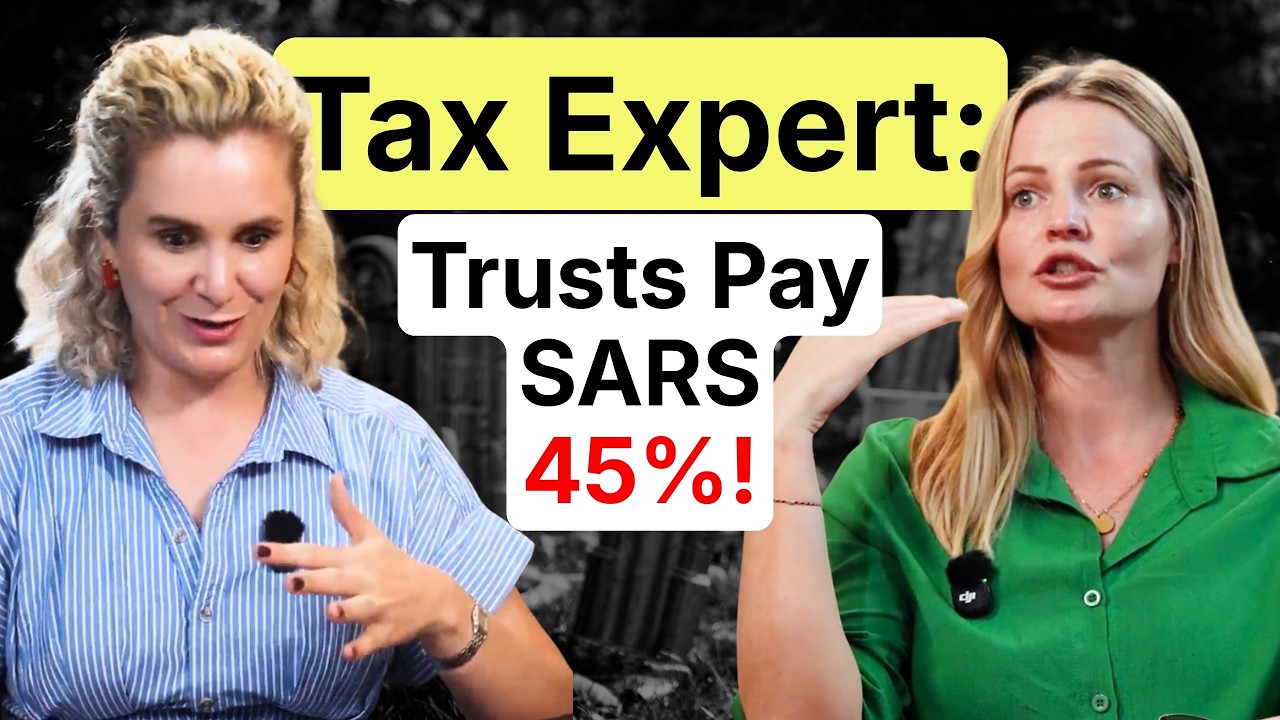
So income tax at 45% and and capital gains tax at 36%. So it's super high and like you say SARS always sees when people are up to schemes and then they start putting anti- avoidance rules in place. So like for many years uh people would have trust and they would have their kids in there and they would put all their assets in the trust and say okay you know I pay 45% tax. So let's put the property in the trust and the investment portfolio in the trust and then we just say that um my kids get all of this every year then we will pay less tax and that worked for a very long time until SARS put that anti- avoidance rule. >> When do you know like what year about that happened? >> I can't remember but it's been quite a while.
So it's section seven attribution rules. So what happens is um let me give you the full picture. So a trust never has its own money own money to to buy anything. You know if it's a newly set up trust it's got to have a founder. It's got to have a donor because the trust needs money. So the time when this really doesn't happen is when it's a trust that's been established for many years and it had its own assets and made its own income and then it can start buying things.
But to get its very first asset, somebody needs to give this trust money. And that gifting happens in one of two ways. So one, you donate assets to that trust, in which case you're going to pay 20 to 25% donations tax on whatever you give that trust. So let's say it was 10 million rand because you want this trust to start buying your investments. Then you're going to pay 20 to 25% donations tax. If you don't want to pay the donation tax, you can sell your assets to the trust on loan account.
And then S was like, okay, fine. We're going to give you another anti- avoidance rule and that is section 7 C. So whenever you loan money to your trust, the trust needs to pay you interest on that loan and that interest needs to be at the official rate which is the reper rate plus 1%. And if you earn any interest less than that, then the difference so the foregone interest. If you don't take that interest and pay tax on it, um it's seen as a deemed donation to the trust and then you have to pay the 20 to 25% uh donations tax every year.
So >> Oh my word. So it becomes like you can't you can't just put money or anything into a trust to try and not be taxed on it. >> Yeah, that's SA's way of saying okay closing that loophole closing that loophole. So saving tax while you are alive in a trust isn't why you are setting up a trust and in the past this is why it worked and this is why you'll also get a lot of people who sew against trust and said trust doesn't work anymore and for that reason I would say yes during your lifetime it doesn't work but when it really does work is when you if you want that long-term generational wealth because all the assets in the trust there will be no capital gains tax no state duty so that 40% that you pass away sorry Um so that 40% that you could lose when you pass away it's it doesn't get lost.
So your asset base keeps on growing in the trust. So in that case trust was still absolutely golden and you can continue doing doing trust for that reason. Uh and the reason for that I'm going to backtrack as well is let's say you didn't go the loan option. So your section 7C uh interest you went the donation route. Whenever you donate an asset to a trust and that trust starts making income on that asset, the income attributes back to you as the donor.
So this is during your lifetime now. So let's say this trust had properties and it earns rental income. Then you can do the condute principle. So let me explain that part as well. Is when a trust earns income, it's going to pay tax at 45% or it sells an asset, it pays 36% capital gains tax. it can use the flow through principle the condute where it says that income rental income we're going to distribute to the individual beneficiaries so we maybe have four individual beneficiaries and whenever you do a distribution it keeps it sore so then these individual beneficiaries in their personal name received rental income and they can then deduct whatever expenses there were so they're going to pay tax on the profit of that rental at their 18245% so it's not like the rental profit is going to pay 45% from the very first rand.
So it's very beneficial to do it that way. But now where the anti- avoidance rule comes in is that if you the donor donated that asset to the trust to avoid tax and you're saying I'm making that distribution to my wife because my wife doesn't work so she's going to pay less tax. So I says nope anti- avoidance rule you're going to pay tax on that money still. If your real reason to put that money into the trust was for long-term generational wealth and you then attribute or distribute that income to your wife, it's fine.
She won't pay the tax. But you have to motivate and prove that that wasn't your reason. If you do it to your kids who are minor, so they're under the age of 18, it's always going to attribute back to you and you'll pay the tax on that rental income. If you there's many others, but if you like it's so far that if that income is never distributed to anyone and the trust retains that profit, it attributes back to you as the donor.
So, you're almost always going to pay tax during your lifetime on the income of those assets. But the longevity is if you want to create that uh generational wealth. >> Okay. Well, it becomes very complex. >> Let me just get this straight. If there is an asset, a property within a trust that earns rental income, then you can either it either will be taxed within the trust or it has to be attributed to the beneficiaries for them to be taxed on it. >> Correct.
And when do you make this decision? The trustees do. So that's why you've got trustees and it's called a discretionary trust. So the trustes will decide that either we're keeping this income in the trust and we're going to pay 45% tax on it or we're going to distribute it to the individual beneficiaries and they are going to pay the tax on it. Sorry I I I keep saying individual beneficiaries. It could be that the trust has a company beneficiary or another trust beneficiary.
So whoever the beneficiaries are when the trustees make the decision to distribute the income to the beneficiaries then the beneficiaries pay the tax on it. You can still distribute income to the beneficiaries and the trustees can say we still want to pay the tax in the trust. So it's all decisions. >> But why would you do that? >> Because maybe the individuals are in a higher tax bracket too, you know. >> Okay. Also in the 45%. >> Exactly.
Yes. >> Okay. But um I'm just wondering all of this sounds like an admin nightmare. Can you every year decide okay this year the tax will pay the sorry the trust will pay tax. Next year they're beneficial. Well, can you like swap it around every year? >> Yes, you can decide every year. >> But this is admin nightmare. Um I hate admin. So can you just kind of hand this over to someone that takes responsibility for it? But what are they going to charge you for that service? >> Yeah.
So when you h set up a trust, you also make sure that you have an independent trustee. Otherwise, it's seen as a sham trust. So you'll maybe have you and your husband as being the trustees and then you'll have your accountant or your attorney who is the third indivi uh independent trustee and generally that person takes responsibility for these kind of things and you have to have an accountant who makes sure that the tax is handled properly and unfortunately that's not been the case for so many years and there is a new bill um out that they want to put in place that all trust has to have annual financial statements like I think it's the best thing that can happen because the administration of trust wasn't always dealt with properly and there's so many trusts who never did financial statements who never declared the divid the distributions that they made to individuals.
So that admin that you are talking about it was just never handled because a normal person who sets up a trust doesn't know these things and not everyone tells them that SARS is actually giving admin penalties now to trust who have not submitted their tax returns as well. So >> okay, >> make sure that the person that you get in your trust, the independent trustees may be an accountant who understands the taxing of trusts. >> Okay.
And then in terms of the uh the attribution rule, so you can attribute it to one of the beneficiaries especially or sorry not to one to I guess the the trusted will specify who which beneficiaries it can be attributed to >> but the the cash doesn't physically have to flow. No, >> it can be recorded as a loan. Correct. >> Okay. So, you can say potentially closer towards the end of the tax year, it looks like we should rather actually be distributing this by the trustees aside.
Sorry, not not >> Yeah. the trust the actual trustees aside. [laughter] We should want to distribute this to a beneficiary who's in a lower tax bracket. That's going to be make more tax sense and then it can the money doesn't physically have to be paid to them. It can be recorded as a loan. >> Correct. >> Okay. But then they are going to be have to pay more tax as a result. and obviously get that money from somewhere. >> Yes.
And also just very important to to understand that even though you do not pay that distribution out to the individual or to the beneficiary, even if it's kept in the trust as a loan, the taxing happens when that distribution happens. So even if I receive this distribution from the trust, but they're not giving it to me, they're not paying it to me, I'm going to pay tax on it. Tax happens at that moment in that tax year.
So then >> No, wait. I don't understand. Can you say that again? >> Okay. So let's say the trustees decide that we're going to give Marisa 100,000 rand this year as a distribution and we want her to pay the tax on it. It's from the rental the interest income from the trust. We don't want the trust to pay 45% tax. Then I have to declare it in my tax return and pay tax in that year not when I actually receive the 100,000 from the trust.
So very important to know that. But then if I later do receive the 100,000 rand I don't pay tax again at that stage. I paid tax when the distribution was uh disclosed to >> I understand. So that's for this reason the trust needs a proper accounting record so that you understand which of this is actually a loan versus what is it so that if it's recorded as a loan >> and it is the cash flows later it's not taxed again. >> Correct. >> Okay.
Very important. >> Very important to keep resolution. So when a trustee makes a decision it needs to be put on a resolution. So the resolution will say we are distributing 100,000 rand to each of these beneficiaries. They are going to pay the tax but we're keeping the money in the trust as unpaid distribution. So you'll have those resolutions on record for every year. >> Many people will now think I need to get this trust set up because I the intention of this assets is generational.
I want to give it over to my kids or to my family members. But getting money into the trust will trigger or putting the the property into a trust will then trigger a donations tax or other how how what is the most tax efficient way to get things into a trust. >> So whenever you put anything into your trust you're going to pay donations tax on that >> at 20% >> at 20 to 25%. So 20% up to 30 million rand and anything over 30 million rand you start paying 25% on that donation. >> Okay.
Okay. So, is that the most tax efficient way? >> It will depend. So, this is always why get tax advice because it it can be different in each situation. So, um it could work out better for you to pay that once or 20 to 25% donations tax rather than the annual section 7C interest uh donation that you have to pay. Remember I just explained if you're going to do the loan option then let's say you're sitting with a loan account to a trust of 10 million rand then every year you're going to pay 20% donation stacks on whatever the repay rate should have been.
So let's say it should have been 10% you're going to pay um you know interest on that amount donation on that amount. So it depends in this trust situation in this individual situation what is going to be the best option to do that. So to give you an example is I have clients who want to start giving their assets out of their personal name not to avoid estate duty tax but because their beneficiaries are in a different country and they're going to pay a lot of tax if they inherit the money.
So they don't mind paying this donations tax now rather. So it's going to always depend on the individual's situation what they depend what they want to do. And then something to consider as well, if you do give it to your trust on loan account, then that loan is an asset in your estate as well and you're going to pay a state duty tax on that loan. So important to know that. What a lot of people do to get around that is you get a life insurance policy.
And this is why estate tax planning is so important is to make sure that everything that you own or are owed to you to make sure that there's going to be money to pay the estate duty on it. So get a life insurance that can cover enough to pay the tax. >> So the donation tax implication is clear now. But do you get a deduction for that tax that you're going to pay >> in your personal tax? No, you don't. Unless obviously the trust is a registered uh nonprofit organization.
So you only ever get a deduction for donations in your personal tax if you donate it to a >> NO. So you get a section 18A certificate for that donation that you made and then it's limited to 10% of your taxable income. >> Okay. Yeah. So that's also not a way to avoid it. >> No. So it's not that's not really going to be the reason for for making the donation. >> So it's either it's it's interesting. Obviously SARS is smart, but it's either you're going to pay donations tax to get that assets into the trust now at 20 to 25% or your estate is going to be taxed at 20 to 25% in future.
Correct. Right. But how do you prevent that ongoing tax on a donation? >> So the loan, the annual one, so you can reduce your loan every year with your exempt donation. Each person gets 150,000 per year that you can donate taxfree. So you use that exempt to for one of two reasons. one either to write off the loan every year but then you're going to pay your deemed donations tax to SARS that 20% or you use that 150,000 rand to reduce your deemed donation in terms of section 7C.
So let's say you have to pay SARS 200,000 rand because you didn't earn the interest. So your deemed donation says you have to pay them 200,000 rand. You can use your 150,000 rand exemption and then only pay s 50,000 rand. So you can decide either reduce the amount you pay SARS annually or reduce your loan every year. >> Okay. Okay. It becomes quite complex. >> Yes. So if you're um someone a young person listening to this now and you're okay I mean young is also is also relative but um h how would you suggest a young person thinks about their you know wealth planning in terms of setting up a trust you know if they're still going to build up a lot of assets in the future.
That's such a valid question and I feel like what people should do is before just buying assets in your personal name when you are young or when you start building like you say age is is that's irrelevant really. It's when you realize you're going to build wealth or maybe you don't realize you're going to build wealth but you know I'm starting to buy properties. I'm starting to get investments. Register your trust while you still have nothing or you're planning to buy it.
Register your trust. Register a PTY company and you give the shares of the PTY to the trust immediately. There's no tax payable because the PTY doesn't own any doesn't have a value. So all of this is just registering a trust, registering a company and the trust is a shareholder of the company and you are the beneficiary, the trustee, the you know all of that of the trust. Then any assets that you buy, you buy that in the PTY and you can have several PTY.
You can have a a company for uh property. So you want to maybe have a property portfolio. You buy all those properties in a company that is owned by the trust >> except your primary residence. >> Except your primary residence. If you want to have an investment portfolio that's not going to be your retirement money, this is something you want to build generational wealth. You want this investments to continue making money.
Then you'll maybe have a trust, a holding company, your property company, your investing company, and maybe you know whatever else you want to do. So, if you have this structure set up before you buy any assets, it's you're not going to it's not going to you're not going to pay end up paying donation stacks or capital gain stacks because what happens a lot in the meetings that I have with people and the mistake that they make is buying all their assets in their personal name and then realizing they could lose more than 40% or how much over like 20% 30% of their asset value to tax when they pass away.
Then they say okay let's put it in a structure. Now to do that there's a lot of tax that you need to pay because you are essentially selling your assets to the company and for that reason there's a capital gains tax payable. If it's property there's transfer duty that's payable and then to uh so so you'll do to get that assets in the trust you also have to donate that to the trust and then there's that 20% donations tax or the section 7C interest payable.
So where that really works and how that whole process works is you can transfer your assets to a company without paying any tax and that's called a section 42 swap. So you'll give for example your property to the company and then uh in turn you get shares for that. So you can't get cash then there's no capital gains tax or transfer duty payable but you still own shares in your name now. So your estate duty problem isn't gone.
You still you know you just own a different asset. then you have to wait 18 months. Anti- avoidance rule says that if you sell those shares or the the company sells that property maybe within 18 months, the whole section 42 is reversed and you you pay the tax as if that never happened. So now you wait 18 months to then transfer your shares in this company to the trust and then you know the trust owns the shares. So you don't have that problem anymore.
Estate duty solved. But to get your shares of that PTY into the trust, you have to donate it to the trust or sell it to the trust on loan account. And that's where the 20% donations tax is payable. And then on that second leg, getting your shares into the trust, you have to pay capital gains tax on whatever your value is of those shares. And if the company's market value consists of more than 50% of residential properties, you must also pay transfer duty to get that your >> shares into the trust.
So, it's capital gains tax, transfer duty, then either donations tax because the trust doesn't have money to buy it from you, or you're going to go the loan option and then pay the annual section 7C in deemed interest um donations tax. But then you still have an asset in your hands. you're still sitting with the loan that the trust owes you now and in that case then you get a life insurance that's that's going to cover the tax on that but you have created generational wealth now because you're not going to pay tax when you pass away so what I always say to people is do the calculation and see what is your actual tax going to be on this structure if you passed away with all of this in your personal name and you don't just look at the value of today you look at the the future value of this you know you're maybe going to pass away 10 years 20 years 30 years from now, you have to look at that future value and how much that's going to cost your estate to pass away um compared to paying that one off cost now of moving it to the trust.
But if you set up your trust and your company and then buy the assets in it before the time, none of those problems ever exist for you. The thing is if you're a high earnner but you're employed, you earn your salary in your personal name, then it's not as you obviously then have to get that money into the trust or buy the assets and then put the assets into the trust. The easiest thing would be to use that uh swap principle and then wait 18 months.
Is that what is that probably it? >> Well, it's expensive then. But what you can do is you're saying now, okay, you've set up the structure and you have the money. How are you getting it into the structure to start buying things? Is that the question? So then you can do a loan to the company and the company can repay you the loan eventually. So you make a loan to your company. So it's an investment into your company and your company can start buying the property or or investments that it wants to. there might still be section 7C um applications just because if you're a connected person to the trust and you make a loan to the company that is owned by the trust, section 7C still applies.
So, um there's still that. But the benefit here is that you can take money out of your company as a loan repayment instead of dividends if you if that was your plan to take money out of it. >> Okay. Oh my word, so many things to think about. [laughter] I think we need like this big mind map where you can go and show and get everything flowing. So in conclusion, rather pay for a tax consultation than make a few hundred thousand or even potentially millions mistake in terms of your planning uh and get an expert on board to make sure that all of your structures is smart.
I mean for me personally I feel at this moment my things are a little bit you know all over the place and this is why I'm I'm having a call in the compound club with you now where the people part of the compound club will ask be asking you questions but I'm also going to throw in all of my personal questions there. So I'm really excited for that and I'm going to have my little brain um my mind map going. Um but thank you Marisa so much value as always and I look back um I look forward to having you back next time.
Thank you. And I'm glad you brought up that topic because I always say to people that people think tax advice is so expensive. It's not expensive. It's not the expensive part. The making the mistake and then needing to pay millions to unwind that mistake. That's the the expensive part. >> So tax mistakes are more expensive than tax advice. >> Yes. >> Okay. That's a great slogan. >> I love it. >> Thanks, Riska. [music] Thank you. >> [music]
The words are the caption track's own and nothing is reworded or re-transcribed. Paragraph breaks are placed between sentences so the text reads as prose.
Free tools for your own script: paste a draft and see where it stands before you record it.
Paste your draft and see where viewers are likely to drop off, with a rewrite for each weak line.
Paste the first 30 seconds of your own draft for a hook score and rewrites.
Check your draft against YouTube's advertiser-friendly guidelines before you record it.
Read this channel's public videos and transcripts, and download a writing brief for it.