Getting the transcript
Reading the captions from YouTube. A video nobody has opened here before takes 10 to 30 seconds; this page fills in on its own.
Getting the transcript
Reading the captions from YouTube. A video nobody has opened here before takes 10 to 30 seconds; this page fills in on its own.
Sergio C · @ImSergioCardenas
Words
6,157
Runtime
27:03
Speaking pace
228wpm
Reading time
26min
228 words per minute, above the 201 75th percentile of 349 measured videos. That distribution comes from the 349-video hook study.
Opening (first 30 seconds)
One of the brands we took on was doing about $6000000 a year. A few months later on the same ad spend, we increased revenue by 45%. We didn't give them a bigger budget, we just changed where every dollar was going. Because right now, since Meta's Andromeda update, everyone is telling you the same thing. Pump out 15, 20 new creatives and let the AI find your winners. And that's fine if you have the budget to feed it, but if you're spending $30 a day or at a smaller scale than these big companies, all that does is spread your money so thin that no single ad ever gets enough to prove
114 words, the words spoken in the first 30 seconds at 228 words per minute.
Free, no signup. See how the first 30 seconds hold attention, with rewrites.
Sentence shape
| Measure | This transcript |
|---|---|
| Sentences | 315 |
| Average words per sentence | 19.5 |
| Longest sentence | 80 words |
| Questions asked | 31 |
| Sentences containing a number | 65 |
Most used terms
Filler phrases
84 in total: actually 45 · like 15 · right? 10 · you know 7 · basically 3 · kind of 3 · um 1.
A literal whole-word count of the same phrase list the Prepublish browser extension uses, so a phrase inside another word is not counted and a phrase used in its ordinary sense still is. It is a count and not a judgement.
Run the check on the words above: where attention is likely to drop, with a rewrite for each weak line. The free check shows the scores and the one issue costing the most.
What this transcript is
Every word below is the caption track YouTube publishes for this video, pulled from the video itself and reproduced unchanged. It is not Prepublish's writing, not a summary, and not a re-transcription: it is the video's own published captions. English captions, generated automatically by YouTube, in the video’s original language. Source: the video on YouTube. A channel that would rather this page did not exist can ask for its removal through the contact page, and it is removed.
No Script X-ray for this video: YouTube shows a Most replayed graph only once a video has enough views.
One of the brands we took on was doing about $6000000 a year. A few months later on the same ad spend, we increased revenue by 45%. We didn't give them a bigger budget, we just changed where every dollar was going. Because right now, since Meta's Andromeda update, everyone is telling you the same thing. Pump out 15, 20 new creatives and let the AI find your winners. And that's fine if you have the budget to feed it, but if you're spending $30 a day or at a smaller scale than these big companies, all that does is spread your money so thin that no single ad ever gets enough to prove anything.
So, in this video, I'll show you how we actually scale Facebook ads on a small budget by forcing every dollar into ads already working. Instead of spraying it across 20 new ones and hoping one hits. On my screen, you've probably heard some version of this advice over the last year. Create more ads, more concepts, more hooks. Giving Meta more variety or different concepts to let the system decide what actually works, fueling Andromeda.
And the idea behind that is not completely wrong. They are right. In simple terms, Meta is using the creative itself as part of the targeting. It looks at the image, the video, the copy, the people engaging with that ad, and it uses that data to try to match it with more people who are likely to respond. So, yes, more creative variety can give Meta more opportunity to find a similar buyer. Some buyers engage with the UGC, others engage with maybe a more lifestyle infographic image.
But the part that always gets left out is that every one of those ads needs enough budget to actually fuel that Andromeda flywheel. All of these ads need budget to place out in the market, get the data signals, and then allow Meta to keep deploying it to find your ideal audience. And this strategy works for those people spending $1000 a day, $5000 a day, or upwards of $50000 a day. And it's exactly what they should be doing.
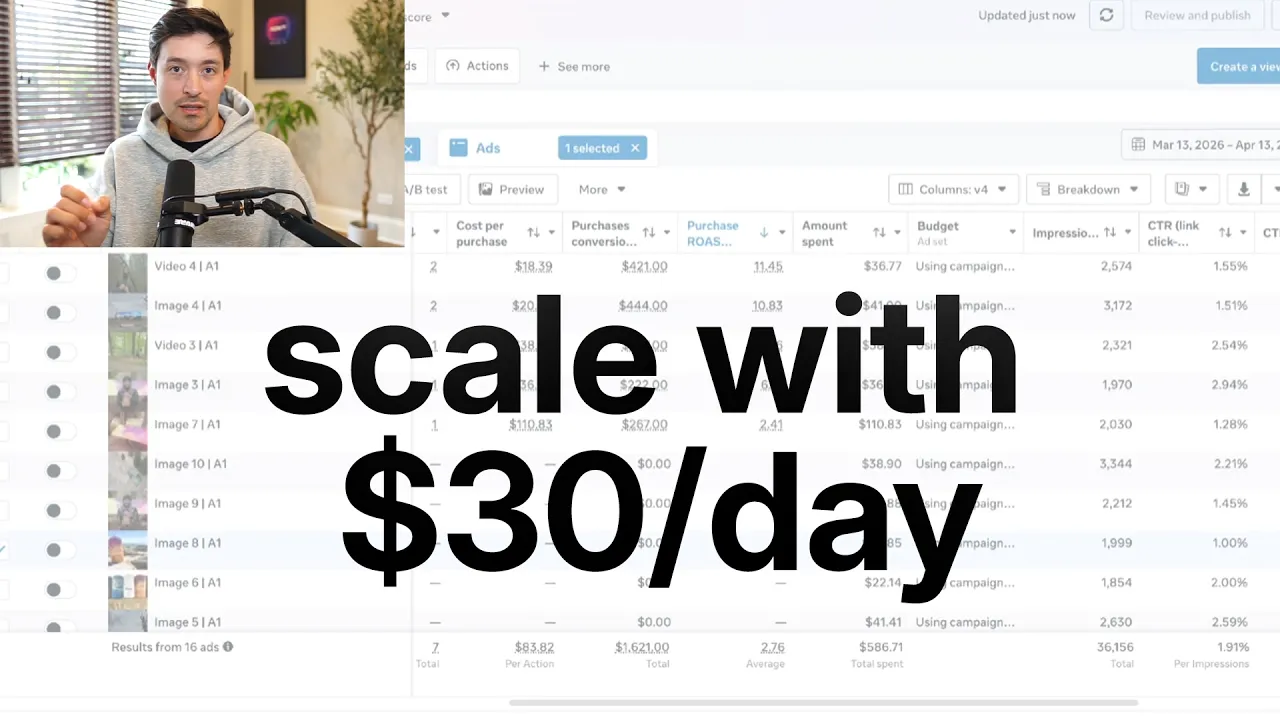
But it's just wrong for smaller accounts who are maybe just getting started and don't have the capital to actually spend thousands a day. And if they do try that strategy, you'll see down here with smaller budgets, it doesn't really work. A handful of ads will steal the spend. This one got $12, $6, $3, and the others are getting pennies. Never able to prove themselves in the market and never able to let the algorithm actually work as it's intended.
And if you look in your account right now, you can probably see that something is very similarly happening in your account. Maybe a couple of the ads are getting 80, 90% of the budget, and the rest are only getting dollars. Not able to actually fund the growth, not able to actually fuel performance, and actually weighing down the account average. And unfortunately, this structure doesn't work when you're not able to feed it enough data.
You won't see the results you're hoping for. And no, the answer isn't you just need more creatives. With smaller budgets, you actually have to do the opposite of that advice. We take control of where money goes, and that starts with finding what actually works. And if we pull up this account here, you can see it's a brand new client. They came to us, no history in the ad account. You can see everything here is completely empty all the way up until March 13th, which was our first start date.
And they were a brand new startup, you know, they had limited budget, under $100 a day, and they told us, "Hey, we want to make sure that we can grow, have a roadmap, actually understand what's working, understand what's not working, and more importantly, keep our profitability in mind." And so, if we look at the first 30 days of our service with them, that's exactly what we did. And we started with something called the creative test.
So, what that means is, well, before I even talk about targeting or before I talk about the product page or before I talk about price incentives or shipping rates or shipping thresholds or anything like that, I have to make sure that the ads we're actually using and leveraging with this client are top performers, are ads that the market actually wants to see. And more importantly, we're going to make sure that we cut the ads that the market doesn't want to see, ensuring that we remove the fat from the account, and overall keeping the average return on investment for this account as high as it possibly can be.
And so, the very first order of business when working with any new client or even phasing into an existing account is making sure that creative assets are where they should be. And so, we start with a creative test. It was the first campaign that we launched inside of this brand new ad account. And you can see, fun fact, as we move up our stairway and go through our process with every client within the first 30 days, you can see that results get better and better and better.
And that's not just because of, you know, some campaign hack, that's because we're able to take the learnings from test number one, apply it in test number two, take the learnings from both of those tests, apply it in test number three, and overall get more and more efficient because we begin to leverage only winning assets while cutting the losers or the fat to make sure, again, that return stays high. But, you can see here, we start with a creative test.
This is a very simple structured campaign. I can go more into how we build this in another video, but essentially it's a CBO campaign where the budget is on the campaign level. It's broad targeting because we don't want to add in an audience pool to add another variable to our testing. Right now, what I'm concerned about are the creative media assets. And here is where you can see, we tested 16 ads with this client. We wanted to figure out what were the three to four best ads in here, so we can cut out the 13 or 12 that were just weighing the account down.
Now, usually what would happen is you would take all 16 of these ads and you would say, "Hey, let's let Andromeda figure it out. Let's put all of them in the campaign. Let's put our max budget on that campaign and over time Facebook will spend on the winners." But, what you would see happen is one ad is going to get out of this total $586 spend, one ad would probably get $450, another ad would get $50, another ad here would get $20, and all of these would get less than $10 all the way down till they're 20 cents or even lower.
And the issue that I have with that is that those ads that have 20 cents of spend, I don't believe that they were ever out in the market enough or a long enough time to prove themselves to tell me that they actually aren't good assets. And the thing is, when we've done our AB test, as I'm going to show you here, sometimes we find that the ads that Andromeda does not favor are actually the winning ads, they're the golden nuggets in the account.
And when they're actually able to get volume behind them, they tend to be top performers. Now, this doesn't mean that every underutilized ad is going to be your top performer. You need this clear AB test. And how we do that is, well, I went to my team and I said, "Okay, if we want to be able to identify a top performer, what do we have to do?" Well, we have to get market signals, right? We have to put these ads out into the market, get impressions, get data on what the market says about it.
And so we said, "Okay, well, what's a reliable amount of data? We don't want to run this test for thousands of dollars. We want to find our winners as soon as possible and for as low cost as possible. And so we said, well, it depends on the client's budget, right? Because if we have about $30 a day, an average CPM is about $28, $30. It depends, like if we're going to be running 16 ads, it'll probably take 16 days. We don't really want to do that.
So if a client has more budget, we can say, "Okay, let's maybe do 1,000, 2,000, 3,000 impressions just to really get enough data." Now, the reason for this is I like 1,000 impressions to be the absolute minimum that we go to. And because it's essentially a flash in the pan of what the market believes about your ad. Now, it's not going to be the most accurate result, and that's because 1,000 impressions is, again, only a flash in the pan.
Imagine if you have a neighborhood full of 1,000 houses and you only survey maybe 10 of those houses, you're not really getting the average neighborhood sentiment or the average neighborhood opinion on something. You have to talk to 100, 500 of those houses. And so it's almost the same exact thing here. We want to talk to as many people as we can, get their inputs on the assets that we deployed to them, and then from there understand the metrics and be able to cut the fat from the account and focus on our winners.
And so for this account here, because they had about $80 a day in total budget, we went with anywhere from 2 to 3,000 impressions in total to really give us good market information on what they think about these ads. And so what I do here is I let the ads just run as is, and I keep an eye out for when they are going to hit about 2 to 3,000 impressions. And then I manually turn them off before they get over 3,000 impressions, so then other ads will have the ability to get the spend.
This is basically forcing Andromeda and forcing meta to now spend on these other ads that weren't getting the spend in the first place. And so, now by the end of all of this test, it may take a week or so, you're going to be able to have all of these ads hit 2 to 3,000 impressions or at least 1,000 impressions. They're all going to be turned off. And now, what you're going to have is a really cool scorecard here. You're going to be able to look and see, okay, they've all been out in the market for the same amount of time.
What are the differences of supporting metrics? And so, what I'm looking at are CTR all, CTR link click-through rate, and CPM. Now, if I sort by all of these metrics, you can see that we have some with a CTR all of 6.5, 6%, which is really, really healthy. And the important part of this test is we're also able to identify ads that are on the lower end of the spectrum, basically giving us a 2% click-through rate. Now, the reason why this is important because if we're taking 2% versus 6%, that's a difference of a three-times engagement rate.
And so, we probably want an ad that engages with our audience at a three-times higher rate. That means three times more attention, three times hopefully more link click-through rates, and three times more opportunity for purchases, which is the end goal of this client. CTR, again, is just the tip of the iceberg. I'm looking at all of these different metrics. Some of these other ads brought us a almost 3% link click-through rate, while others almost a 1%.
So, again, three times the opportunity for sales. And I'm also looking at CPM because different ads will give us different CPMs. We can spend the same amount, or actually not spend the same amount. We can get the same amount of impressions from two different ads. This one had to spend $36 to get in front of 2,000 people. This one had to spend over three times the amount just because Facebook gave it a higher CPM. And so, that tells me right there, it is probably just not a cost-effective ad for right now, right for the beginning of an ad account.
We want to make sure that we can get in front of people at a cost-effective rate, that it's engaging at a higher rate, that people are actually link clicking through, and then they have the opportunity to be on the site to buy. Now, these are three supporting metrics that I look at, but of course, I also look at supporting metrics in the funnel. I look at add to cart rate, checkouts initiated, overall purchases, what ad drove the highest return on ad spend.
Now again, the reason why this test is important is because you can see all of these ads were out in the market for the equal amount of time or very close to equal amount of time. You can see that some of these ads got a 11, 10 times, seven times return on ad spend when a lot of these, there's hundreds of dollars spent down here on different assets that resulted in no sales and sometimes not even any buying behavior.
And so, this is a very important key because imagine if we kept leaving it up to Andromeda and they would maybe favor one of these ads, who knows, right? And if they did, how much money would be bleeding silently from our account? We want to make sure that every single one of our dollars, especially at a lower spend, especially at a starting stage, goes to effective ads. This is where you create margin. This is where you create return on ad spend.
This is where you create profit and you're able to then go to the next stepping stone because this fuels maybe a next inventory order. Maybe this fuels more learning. This ultimately gives you more time, right? Because if you're getting revenue in, you can have more time in the market. And so, right now, the goal of this test is to identify what are our winners and what are our losers and make sure we can identify and capitalize on the winners for the next test.
And when I say a winner, I do not mean an ad with a five times return on ad spend after spending just $12. You have to let this test run. I want to find the ads that actually finish the impression limit and produce the behavior we care about. I know it's hard to turn off a 10 times ROAS ad just because it hits the impression limit, but this is purely just a test campaign that we need clear results on. If it's a winner, then don't worry because we'll be running it again in the very near future.
So, usually, I'm just trying to build a short list of two to five real performers. I still look at the supporting metrics, the CTR, link click through rate, CPM, cost per landing page view, cost per purchase, return on ad spend, but this is not a full data breakdown. On a small budget, I need a reason for every active ad to be there. And once I know a few real winners, the next move is the one a lot of brands with small budgets don't actually want to make.
Now, this sounds obvious, but it's usually the part brands resist. They think that reducing the amount of ads means that they're shrinking their account. But, on a small budget, every underperforming or underfunded ad is competing with a live one for the same limited dollars. Remember, you don't have thousands of dollars a day to spend on this. You are not spending less when you cut the fat. You're funneling your dollars to exactly what performs.
Putting it behind fewer, better creatives. So, the account may look smaller, but the signal becomes stronger and the money becomes more concentrated. Now, what I'm showing you is an account starting from scratch, but you can also do this exact process if you're already spending, generating sales, and just want to maximize returns, making the engine more efficient, even with larger budgets exceeding thousands of dollars a day.
We worked with a brand doing around $6 million of revenue that had over 100 creatives in the mix, a usual structure at that kind of scale. There was plenty of concepts, styles, hooks. And I remember the founder told me, "I don't want you to get better results just by increasing our ad spend. I want the same exact ad spend, but reduce our cost per purchase and improve our return on ad spend." After a quick audit, I saw the issue immediately.
The budget was being spread amongst all of those assets, leaving the top performers with only a small percentage of the actual daily ad spend. They had good ads, but also had 70 others weighing down the account. They thought variety was needed, and at that stage it is, but there is a very clear difference between variety and underperforming assets. We narrowed all of that variety and all of those concepts down to our top 30 ads, and we focused the ads around what was actually performing that have already proven itself while cutting the fat.
We did our process, and in the following months, revenue increased by 45% without spending a dollar more, and that extra revenue allowed them to finally scale. And we worked with them for about 15 more months, getting them up to $35 million in revenue. That's a five times growth at a seven to eight figure level. And I'm not saying that the ads were the only reason for their growth, but removing the fat and focusing our ad spend on what was actually performing gave more breathing room to the account, allowing the founder and the rest of the business and the team to now be able to focus on new initiatives, new products, expand to new regions, and ultimately make better decisions for the business because they weren't just above water with their ad spend.
And this is the process in our company when we work with clients. Establish a baseline, remove what isn't working and pulling overall average down, and start our next test from already proven concepts, allowing us to move down river, making sure that every dollar goes as far as it can. And we're able to do this time and time again with current client accounts, no matter the size. This business up 33% to 2.3 million from last year, same ad spend.
We're just now putting the dollars towards more efficient assets. This company here, $500,000 a year, a little bit smaller of an account, but almost up 200% same ad spend as well. And I want to stress that it this isn't some magic trick or CBO versus This is actually just taking back control of where every single one of your dollars is going. Now, if you're looking at your own account, thinking you have no idea what ads are actually giving you the most leverage, well, that's the exact thing my team does for brands every single day.
If you're running meta and the spend just isn't turning to growth like you want, there's a link below to work with us. If you'd rather run it yourself, good, stay with me because this next part is where small budgets leak the most money. Once I identify my winning assets in our CT, I graduate that into our next campaign, which is called a LT here. Now, this campaign is very unique because we have our winning assets, right?
We know what gets a click, we know what's cost efficient in the market, we know what leads to click through. Now, the next variable that actually makes the most sense is, well, where do we take that user, right? We want to be able to control the landing page. We want to be able to see what landing page actually influences more bounce rate, which one has a higher add to cart rate, which one leads to a better checkout process and less overall drop off?
So, I move forward into a LT, which is another very simple campaign. Now, what this is is one campaign and now I have multiple ad sets and these ad sets are different based on the landing page I want to use. I'm going to use my winning ad from my creative testing. You can see all of these have the same image for winning ad. And so, my media is not a variable anymore. The variable that I want to test is the landing page.
Now, a lot of the times it may sound good on paper to say, "Well, if we're showing an ad for a t-shirt or a coffee mug, we need to take people directly to that coffee mug page. There's no sense in taking them and having them search around." Well, in concept and in theory, that is correct. But, the thing is I've seen time and time again that sometimes other pages influence buying behavior. So, for example, the product page of that coffee cup might just be a description, no reviews, add to cart button.
This may work for someone who has high intent, who's ready to buy. But, a lot of your traffic, if they're cold traffic audiences, are not at that stage yet. They still need a little bit of credibility. They need social proof. They need to see why this product is valuable to them. So, sometimes the home page actually has assets that the product page doesn't, which leads to higher overall conversion rate. So, this is why we want to AB test everything.
For this client specifically, we tested our winning ad going to the home page, to the collections page, to product page with these smaller variant of the product, product page now with these larger variant selected, just to see if we can influence a higher AOV. But, of course, as you can see here, this led to zero sales. Maybe price point and seeing that high price point from the first time they visited the website was actually a deterrent.
And so, this is something that we learned through this test. We took people to the featured page, which showed credibility and featured on and, you know, platforms that this client has been on. And also a unique landing page that the client personally made for their persona, talking about pain points that they may have and why this product was valuable to this specific demographic. And so, it was very different than the original product page.
Now, what I'm looking at is I want to make sure each one of these ad sets has equal amount of budget per day. Now, this is how we control it, right? Cuz now we can see that having these all spend the same amount of budget, we can see the difference of buying behavior. And if I sort by return on ad spend, it looks like the unique landing page actually resulted in healthy add to carts, more people moving through the funnel because I know that this featured page and smaller variants of the product page actually had more add to carts, but there was actually some resistance in the funnel.
The unique landing page had less overall resistance and an extra sale. So, this tells me maybe over a long enough time horizon that the unique landing page would probably be the better option for us to choose. Now, imagine if we just started taking everyone to the homepage just off of because we never tested this. We would likely have overall half the add to carts, less overall purchases, and maybe even less than half the return on ad spend.
So, this isn't again like some CBO versus or O Andromeda trick. This is controlling where the budget goes and understanding that every variable matters even down to the point of the URL that you use on your ads. We want to make sure we have a solid structure and learning around this for us to be able to move on to the next stage because once we know what ad to use and where to take them, now we can focus on who do we target with these winning assets.
And once I have my winners, I simplify the structure around them. That usually means fewer campaigns, fewer ad sets, and fewer active ads in most brands want to run. And I'm not saying that every account in the world should use one campaign with one ad set. I'm saying that the structure has to match the amount of money available. So, if you're spending about $30 a day and money is being divided into four different campaigns, 10 ad sets, and 20 ads, the budget is already gone before you could even do anything.
And so, the next campaigns that I launch is an ASC, so an advantage sales campaign, and also interest. So, this is basically leveraging we know what ads, we know where to take them. Now, let me try some interest targeting to figure out who I want to target with these winning assets, but also I'm not forgetting about Andromeda, right? I want to leverage the algorithm. I want to leverage the machine that they built, the brain that they built, and say, "Hey, I have the assets I want you guys to use.
I don't want to give you 16 creatives and have you try to figure it out. I have the top four creatives you can see here. We chose four creatives here and not just the one. We wanted to pick our sample three to four winning assets from our CT. And we said, "Hey, we found the assets for you. We even found the URL that we want to use on this campaign. Now, we want you to leverage your algorithm to help us find buyers." So, we're almost making it less complex and we're leveraging the part that's really, really strong about Andromeda.
And so, this campaign here, and keep in mind guys, this is our first 30 days still, right? This isn't 3 months down the road and learning and building data and yada, yada, yada, all this spend. No, like within our first month, we have campaign spending $500 in total and getting almost 6.7 times return on ad spend back. But, I also want to be able to see, well, can I target a little bit better? What if we actually hone in on like who exactly is our persona?
So, the algorithm and the pixel could actually learn maybe a little bit on where we want to direct our attention. So, you can see here I have climbing, mountaineering, camping. This is a outdoors kind of brand. When we were able to target these audiences, we're able to get in front of our ideal persona with the unique landing page, with ads that they actually care about, and now get a 16 times return, eight times return.
I don't want to boost these numbers cuz it's still very early spend, but you can see how within our first month, we're not at a two times return and learning. We're actually moving through the process, we're understanding what works, we're actually like having these internal discussions with the client and saying, "Hey guys, like this certain photo actually works for your brand and this video. Can you maybe make some more like that?" And these are actually what didn't work.
These assets, maybe this type of photo didn't work. A product image style ad didn't really work. So, let's move away from those and let's work on what actually your market cares about. And hey, your unique landing page that you made was a home run. What if we make another one for a different audience persona? How do we build off of this momentum to actually get better and better results? And so, this isn't the end of the road.
You're actually learning instead of just saying, "Okay, let me set up one campaign. Let me let Andromeda do everything." And then from there, what do you learn? You learn where it spent the most money, and maybe where you got a two times return. Like, you need to make sure that you understand what's happening so you can grow the brand and be in control of the return on ad spend, and more importantly, the profit. Now, I think it's important to note that I also don't really crazily raise the budget at this point.
Just because this is getting a 16 times return, if you've ran ads in the past, you kind of understand that. But, I don't take an ad that was doing a 16 times return and immediately force it to carry $150 tomorrow just because one day looked good. If you've ran ads before, you understand that performance doesn't scale one-to-one. So, I want controlled increases. Maybe at this point, when the client's getting a five, six times return, I can say, "Hey, do you want to add 20 more dollars a day?" With that budget, I can launch another audience, find something that gets us close to that eight, 10 times return that we're seeing with other audiences.
Or, at this point, if they also have more creatives that they want to test, maybe a batch of 10 more new creatives, I can say, "Great, we're going to keep our normal campaigns running as is to not disturb the current performance that we've built, but we're going to just restart our CT on the side." This is why it's important to have it on a side campaign on its own, so you can always go back to it. And then now, when you launch your new ad batch, you can compare it to your original, and you can see did anything from the new batch outperform our current assets?
And if they did, great, phase them into your main campaigns and allow them to also get budget while cutting the now new fat, which is maybe that first batch of creative. But, if those new creatives in your CT that you relaunched didn't outperform what is already running, then now you know better to not spend more money on them. You know better to turn them off in the CT, and you know to keep moving forward with your initial batch because they just get better results at the end of the day.
And this is how the flywheel should work on a limited budget. You graduate into volume as the account grows. You don't start with volume just because the account can afford it. And there's one more lever to make a small account punch way above its weight and it has nothing to do with the ads. Everything we've discussed now is purely ads, audiences, landing pages, everything to get people to the website and convert. But we have to remember to actually look at the supporting metrics in the funnel.
I look at where the website is losing people. So I'm going to sort by what we were running with our winning assets and be able to look here and say, "Okay, what are these funnel metrics? Where are we losing people?" Are link clicks actually becoming people who add to cart? Are the add to cart people moving to checkout? Are they completing the purchase? If the site converts more of the traffic already coming in, Meta needs fewer dollars to make more sales.
And that's why sometimes the cheapest growth is actually stuff that happens after the click, after the ad. So sometimes instead of asking what new creatives and you know, what new things we should launch, sometimes the better question is how to stop wasting the traffic that we're already paying for and we're bringing to the website because scaling is not only about raising budget, it's increasing the amount of output the business gets from every single dollar.
Um so I'm looking at 3,600 content views to 177 add to carts. We know from our KPIs inside of ADVT that this is below our 10% threshold. So that means that this is constraint number one. People are getting to the product pages or the unique landing page, but they're not adding to cart at a healthy enough rate. Now, the return on ad spend is still very healthy at a six times, but that is mainly because the AOV on this brand is about $250 and so they don't need that many sales to get a good return.
But imagine if their AOV was $50, this return would be much lower. So we would have to look at this constraint and go, "How do we make sure we get 10% of people to add to cart?" And then from here, I don't like to see more than a 50% drop to checkout initiated. And so we do have a higher than 50% drop here. So constraint number one is content view to add to cart and then constraint number two can be add to cart to check out initiated.
And again, another 50% drop I don't really love to see here, but this is more within our standards, right? These two are the bigger opportunities. So, I can go to the brand and tell them, "Hey, what if we consolidate some of the bloated product description? Maybe we can remove some of the images on the website because there's so many here that is not helping with the user flow." And from content view to add to cart, there are certain things that we can tell the brand.
Maybe adding a different color to the add to cart button cuz sometimes brands have it as just a white background. We want to make that button pop. There's many things that we can do to help with content view to add to cart. And then from add to cart to checkout, this could potentially be a shipping rate issue. I know this brand has shipping costs, and so maybe people are getting to the checkout and they're saying, "Well, $2.50, I agree to that, but maybe not a $10 additional shipping." What if we did a shipping discount in our retargeting funnel?
And so, doing all of these things makes the budget more efficient, allowing us to hit the end goal of this brand and fuel them for a even more profitable second month. None of this was a campaign hack. Every move was about taking back control. We found a few ads that actually earned the spend. We removed the things stealing money from them. We simplified the structure so the budget wasn't being weighed down. We scaled the winner in measured steps, one variable at a time.
Then we added new tests, new audiences when the account could afford them. And we improved the economics after the click so every visitor became more valuable without increasing the ad spend. More budget does not create efficiency. It amplifies what's already underneath it. And if you have a broken foundation, then more budget only ensures you lose more money, even if you don't realize it, like that $6 million a year business.
Budget is fuel. A small brand may not be able to outspend the biggest advertiser in the market, but it can always be more disciplined about where every dollar goes, giving them the best chance to reach that second stepping stone and fund their growth. So, that's how you scale on a small budget. It was never about spending more. It's about deciding where your money goes instead of handing your budget to Meta and hoping the algorithm sorts out.
If you get that right, your $30, $100 a day starts to behave like a lot more. And if you want to see exactly how I read in the account to find those top performers in the first place, that's the one I'd watch next.
The words are the caption track's own and nothing is reworded or re-transcribed. Paragraph breaks are placed between sentences so the text reads as prose.
Free tools for your own script: paste a draft and see where it stands before you record it.
Paste your draft and see where viewers are likely to drop off, with a rewrite for each weak line.
Paste the first 30 seconds of your own draft for a hook score and rewrites.
Check your draft against YouTube's advertiser-friendly guidelines before you record it.
Read this channel's public videos and transcripts, and download a writing brief for it.