Getting the transcript
Reading the captions from YouTube. A video nobody has opened here before takes 10 to 30 seconds; this page fills in on its own.
Getting the transcript
Reading the captions from YouTube. A video nobody has opened here before takes 10 to 30 seconds; this page fills in on its own.
Mystic Arts · @Dadi-MysticArts
This video has no Most replayed graph yet: YouTube shows one only once a video has enough views. These are the moments viewers replayed most in Mystic Arts's most watched videos.
Most replayed moment at 11:26
5.1x that video's typical replay level
to help. But she has no legal authority or power over the situation. So, she'll fund the player characters and beg them to help because without them, Riverfell will collapse. Hang on. Do you see what I did with the kids there? The Duke and the kids. Ugly. Bad. Good. Hell, the
Said at 11:19
The graph counts replays. It does not show where viewers stopped watching.
Words
2,001
Runtime
9:56
Speaking pace
201wpm
Reading time
8min
201 words per minute, above the 201 75th percentile of 349 measured videos. That distribution comes from the 349-video hook study.
Opening (first 30 seconds)
One of the first things you learn on a film set is the director is in charge of the whole show. But the director can't set up the lights or the camera themselves. They have to rely on collaborators that they trust and enjoy working with. So, everyone on the film set is also a creative in their own right with their own opinions about how a problem should be solved. It's a big group of creative people where everyone has their own opinion and those opinions often contradict one another. You'll hear the director ask for something and what happens
101 words, the words spoken in the first 30 seconds at 201 words per minute.
Free, no signup. See how the first 30 seconds hold attention, with rewrites.
Sentence shape
| Measure | This transcript |
|---|---|
| Sentences | 150 |
| Average words per sentence | 13.3 |
| Longest sentence | 39 words |
| Questions asked | 8 |
| Sentences containing a number | 2 |
Most used terms
Filler phrases
22 in total: like 10 · basically 3 · you know 3 · I mean 2 · uh 2 · kind of 1 · um 1.
A literal whole-word count of the same phrase list the Prepublish browser extension uses, so a phrase inside another word is not counted and a phrase used in its ordinary sense still is. It is a count and not a judgement.
Run the check on the words above: where attention is likely to drop, with a rewrite for each weak line. The free check shows the scores and the one issue costing the most.
What this transcript is
Every word below is the caption track YouTube publishes for this video, pulled from the video itself and reproduced unchanged. It is not Prepublish's writing, not a summary, and not a re-transcription: it is the video's own published captions. English captions, generated automatically by YouTube, in the video’s original language. Source: the video on YouTube. A channel that would rather this page did not exist can ask for its removal through the contact page, and it is removed.
One of the first things you learn on a film set is the director is in charge of the whole show. But the director can't set up the lights or the camera themselves. They have to rely on collaborators that they trust and enjoy working with. So, everyone on the film set is also a creative in their own right with their own opinions about how a problem should be solved. It's a big group of creative people where everyone has their own opinion and those opinions often contradict one another.
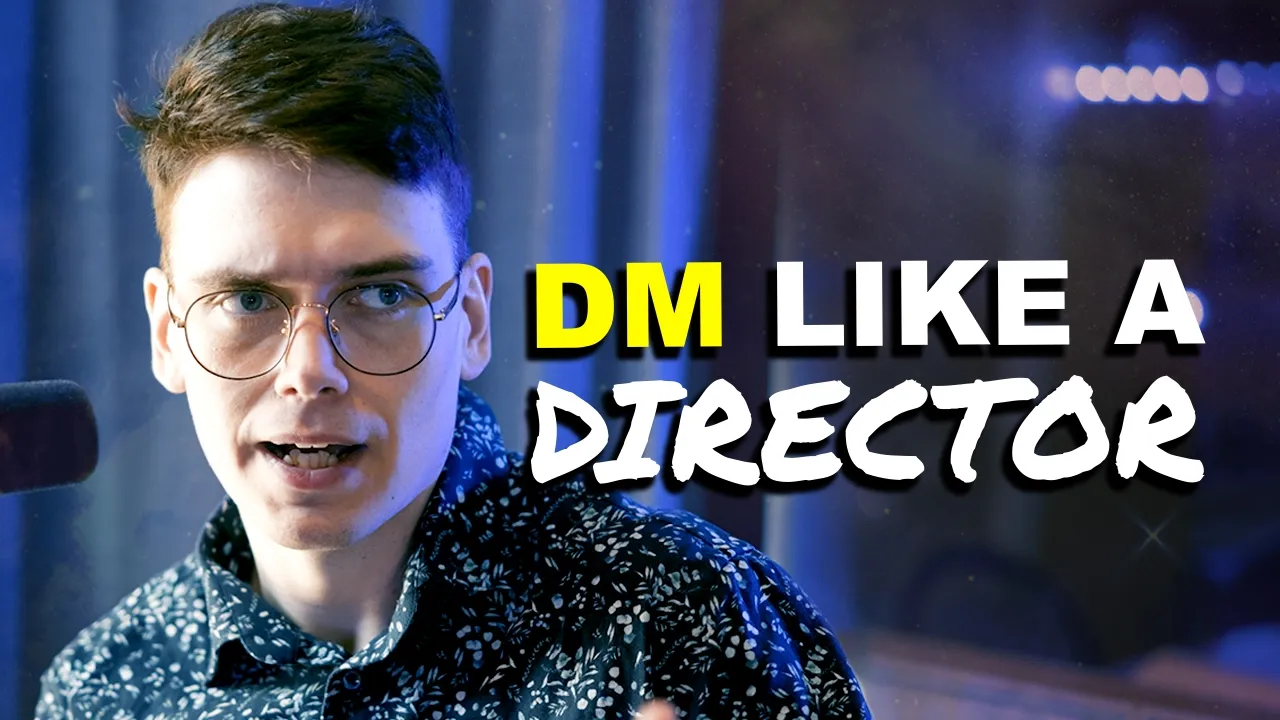
You'll hear the director ask for something and what happens next is a negotiation as creatives collaborate on creating something they'll both enjoy. So I think we should DM like directors. Welcome to Mystic Arts where I tell you dice camera action still confuses me because I'm more used to the original phrase. My name is Dolly. I'm professional writer and director and I've been DMing for over 10 years. Let's talk about that word director because the word is an author but okay fellow film nerds.
Yeah, the French otter movement exists and otters are directors, but the existence of that movement and of that word kind of illustrates my point. We call them directors because they're different than the lion share of directors. Directors aren't authors. Their job is to pick a direction and keep the project moving in that direction. We're going to Morocco, says the director, but the director didn't specify the route, the stops, the exact location in Morocco, or the length of the stay, just the direction.
The collaborators on a film set, that's the producers, actors, cinematographers, gaffers, production designers lead their individual fields to help head in that direction in a way they think is best on a movie. That's genre, setting, tone, mood, but framing is up to the cinematographer. Budget is up to the studio, and countless other factors are decided by various people that make up a film crew. At a D&D table, you, the DM, are the director.
You'll have to pick a direction. If you're running Curse of Strand, it's Gothic horror where the bad guy is Strad Vonzarovich and inevitably the direction is squarely pointed at the Gothic Castle dungeon that is Castle Ravenloft. But the direction is the extent of your control. Really, the rest is up to your players. How they do things, what they do, in what order, if they skip the optional stuff or engage, do they fall in love, start fights, kick out the mayor, or start a bakery, whatever.
Who knows how many players played that adventure. But I'm willing to bet all the money in my pockets that none of them played it the same way. That's the beauty of this hobby. I mean, as long as it's serving the direction you all agreed on, you're being collaborative and directed. You, as the director, might decide that a bakery isn't really Gothic horror. So, you can adjudicate that. Maybe it's through a chat with your players outside the game, or maybe you have a brilliant idea for how to make a bakery be Gothicore.
Moldy Bread. It's run by gargoyless rat infestation. Maybe there's no flower in Bovia, so they have to grind bone. Go full-on Sweeney Todd. Once you pick that direction and start leaning that way, your players will lean in with you. That's the power of direction. You lean, they will want to follow. That's something I think a lot of people are missing. As a director, my primary job is being the hype man. When someone's got an idea that fits with the direction, I hype it up.
I raise that banner. I highlight their brilliance and we run off in that direction together. When I'm at work, at my day job directing, a lot of my job is about getting people excited about the project. I tell them why we're making the decisions we're making, even if they're not the decisions that I picked. I carry the banner of the project and I wave it proudly. I mean, I basically pitch non-stop, which isn't that what you're doing as a DM?
You're always trying to take whatever's going on and describe it in a way we all like. If you've ever watched any episode of Critical Role, you've seen Matt Mercer do just that. How Do You Want to Do This is followed by something like, "Hey, punch him in the nuts." And then Mercer goes on to render the most cinematic sack in the history of mankind. He pitches the player's ideas back to them and then makes it sound awesome.
Basically saying, "Yeah, your idea, but leveled up." If you're listening to me and asking the question, "What have you directed exactly?" then I invite you to stay tuned to the channel for a little bit longer. Something tells me that's all going to become clear any day now. Okay, but what if your players don't care about anything you put forward? What if they're already making non-stop dick jokes and there is no reigning them in? 90% of directing is casting.
That feels very accurate to me. Your work doesn't start on set. It starts way before. And your work as a DM doesn't start at the table or even in prep. When you're starting a campaign, you're best off doing work to get everybody on board with the idea. Session zero is one way to do it. I talked about the investment questionnaire in a video on why I personally don't do session zero. That's all a part of casting. But another part is getting the right sorts of players.
If the direction you're after is serious and your players aren't on board, they just don't want it, there may be very little you can do to change that. Some players might not be interested in your direction, or maybe they could be one day, but they're not right now. Not every actor is perfect for every role. When I start a standalone adventure, I often cast players from my extended play group based on which of them I think would enjoy that genre and setting the most.
I cast a play group. You can do that. Run the types of adventures your players might like. Or find players that will enjoy your types of adventures. It's not an easy task, but I curated my group of players over the course of a decade to be the group that fit me perfectly. And every step along the way, I had more and more fun. But you can also cast individuals in your group. If you got four players who want to do the serious thing and one player who just wants to be silly, you could hype them up to play an explicitly silly character while the rest can do the melodrama.
Four emos and Slappy the clown. That sounds like a brilliant premise. The existence of the tin can and the talking dog don't reduce Luke Skywalker's arc. Neither did the existence of Groot. In fact, just allowing someone to explicitly be the comic relief in an otherwise serious campaign puts that player in the splash zone. A bit of the drama is going to splash onto them. You know that intro I say at the beginning of every video, I'm a professional writer and director of a gamers.
Well, it's gotten a bit of flack from certain communities online because they assume that since I work as a director, I am a dictatorial DM. that it's my way or the highway and that I DM for a table of passive inactive players who are merely all passengers in my story. Frankly, that's absurd. My sessions aren't like that. Nothing could be further from the truth because, let me be upfront about this. That's a bad way to DM.
Don't do that. The reason you're running the game and not writing a novel is because you want to collaborate, which is also why I became a director and not an author. I prepare a lot. something that many people assume means I write an A to B to C version of the story which I don't. For me, preparation is about being, as the word implies, prepared. I prepare because I want to have answers at my fingertips. I think of preparation like creating an armory I can use to arm myself for that inevitable moment when the players decide to do something I hadn't accounted for.
You know that supposed Eisenhower quote, "No plan survives contact with the enemy." Or the even better Mike Tyson quote, "Everyone has a plan until they're punched in the mouth." Well, there's a more telling quote I think of regularly, also from Eisenhower. Plans are useless, but planning is indispensable. The mere act of planning is what makes me prepared. Not because I'm going to tell my story come hell or high water, but because I want to create that armory.
I want to be ready for anything. And that's where preparation comes in to be prepared like a boy scout. It's same for when I'm directing. Before heading to set, I sit down with a script and I diagnose the words on the page. Basically, I prep. I look at the lines of dialogue and try and determine why is this line here? Why did the character say that? And I'll write down my answer. But those notes aren't my direction. My direction exists between the diagnosis and the actor's performances.
It's the feedback I give. As an example, we might be about to start filming a scene and I'll do a little bit of scene setting with the actors. Just saying things like this scene comes just after the argument you had in the bank bolt or you're cooking and then she starts shouting at you or whatever. just enough to get us started. Good DM advice. But that's usually it. Then I let the actors get to work on showing me their raw interpretation of that scene.
I let them loose. So why did I bother with the script diagnosis? Well, because I want to be able to refer to those notes later if I'm in doubt about, you know, a specific performance. When I think, why did that feel off? I want to refer to my notes and see if I can meet the actor halfway. But I don't lead with a diagnosis. That would be bad direction. What we call result direction. It's when a director asks for a result and in return they typically get exactly that result and it feels dead hollow, empty inside.
As a director, I want the actors to bring their influence into the scene because the more lived experiences brought to a piece of art, the deeper it can be. And the same is true for RPGs. I want the players to bring their own lived experiences to the game. If it were all me all the time, it would suck. I routinely only prepare one session ahead of time, and I think you should, too. I typically have no idea where we'll be in a few sessions time, and I have absolutely no idea on what my players plans are.
That head-on-head collision, their plans versus my plans, that collision is the game. It's why we're all addicted to role playing games. Lean into it. Invite your players to be your collaborators. And that's where we'll pick it up next time. Thanks so much for watching this video. This channel is run by me and my girlfriend. And if you want to support us directly, I can't read the teleprompter. Um, uh, Patreon, uh, good.
And if you're feeling especially generous, you might like the video, comment, share, or subscribe, and hit the bell to be notified when we release new videos. Until next time, keep studying the mystic arts.
The words are the caption track's own and nothing is reworded or re-transcribed. Paragraph breaks are placed between sentences so the text reads as prose.
Free tools for your own script: paste a draft and see where it stands before you record it.
Paste your draft and see where viewers are likely to drop off, with a rewrite for each weak line.
Paste the first 30 seconds of your own draft for a hook score and rewrites.
Check your draft against YouTube's advertiser-friendly guidelines before you record it.
Read this channel's public videos and transcripts, and download a writing brief for it.