Getting the transcript
Reading the captions from YouTube. A video nobody has opened here before takes 10 to 30 seconds; this page fills in on its own.
Getting the transcript
Reading the captions from YouTube. A video nobody has opened here before takes 10 to 30 seconds; this page fills in on its own.
steven fiorillo · @stevenfiorillo1
Words
1,345
Runtime
10:36
Speaking pace
127wpm
Reading time
6min
127 words per minute, below the 160 25th percentile of 349 measured videos. That distribution comes from the 349-video hook study.
Opening (first 30 seconds)
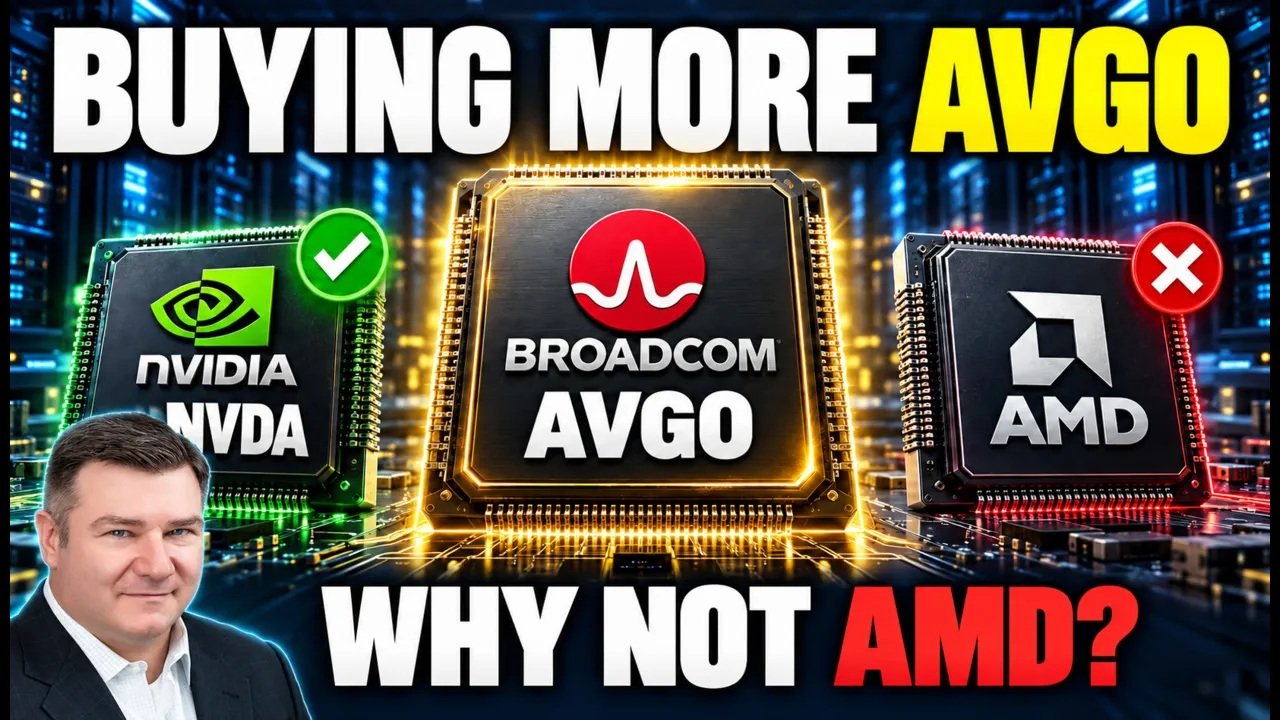
All right, everybody. Too many of you have been reaching out to me about AMD, Broadcom, and Nvidia. This video is intended to outline why I am buying Broadcom, why I own Nvidia, and why I am not buying AMD. So, before we get started, I'm using my own system that I built, and all the data I am paying for, it is all
64 words, the words spoken in the first 30 seconds at 127 words per minute.
Free, no signup. See how the first 30 seconds hold attention, with rewrites.
Sentence shape
| Measure | This transcript |
|---|---|
| Sentences | 132 |
| Average words per sentence | 10.2 |
| Longest sentence | 43 words |
| Questions asked | 13 |
| Sentences containing a number | 51 |
Most used terms
Filler phrases
4 in total: like 4.
A literal whole-word count of the same phrase list the Prepublish browser extension uses, so a phrase inside another word is not counted and a phrase used in its ordinary sense still is. It is a count and not a judgement.
Run the check on the words above: where attention is likely to drop, with a rewrite for each weak line. The free check shows the scores and the one issue costing the most.
What this transcript is
Every word below is the caption track YouTube publishes for this video, pulled from the video itself and reproduced unchanged. It is not Prepublish's writing, not a summary, and not a re-transcription: it is the video's own published captions. English captions, generated automatically by YouTube, in the video’s original language. Source: the video on YouTube. A channel that would rather this page did not exist can ask for its removal through the contact page, and it is removed.
No Script X-ray for this video: YouTube shows a Most replayed graph only once a video has enough views.
All right, everybody. Too many of you have been reaching out to me about AMD, Broadcom, and Nvidia. This video is intended to outline why I am buying Broadcom, why I own Nvidia, and why I am not buying AMD. So, before we get started, I'm using my own system that I built, and all the data I am paying for, it is all 50 years worth of data from the same place RBC, Franklin Templeton, and all those places get their data.
Now, let's start out with AMD. Incredible company, okay? I don't take anything away from AMD. It's been a rocket ship. They have done incredible things. I think Lisa Su, one of the best CEOs in the game. Revenue in Q2, up 50% year-over-year, 11.5 billion. Gross profit margin 53.8%. Operating margin 17%. Operating cash flow up 18% year-over-year, 2.4 billion. Free cash flow 1.6 billion. 66% free cash flow margin. These are great numbers.
Now, when I look at this, question is, how much is AMD run? What am I paying today? Every investment that you make, every investment that I make, is the present value of all future cash flow. So, let's look. Let's see. AMD and Broadcom. Before we get Nvidia in here, let's look at these two companies. Let's make it a little bigger for everybody so you can see. Okay. AMD's a $1 trillion company. Once again, hats off to them, incredible company.
Broadcom $1.68 trillion. Now, the first thing I want to say is return on equity and return on invested capital. Now, I built this across everything I look at to compare companies. AMD, 10% return on equity, 7.6% return on invested capital. Broadcom, 43.9% return on equity, and 24% return on invested capital. Absolutely incredible. We look at the actual profitability being generated, Broadcom leaps and bounds more. More than double the revenue, almost triple the gross profit, more than 5x the EBITDA, operating income about 6 1/2x, net income about 6x.
Margins, Broadcom has larger margins across the board by a country mile. Now, none of this means AMD's a bad company. AMD's great. Broadcom, 39.4 billion free cash flow. AMD, 8.4. At some point, you have to call a spade a spade and say, "What am I paying for this?" Well, I'm paying 108x AMD's EBITDA. I'm paying 158x AMD's operating income. I'm paying 122x free cash flow, and I'm paying 159x net income. Broadcom, 39x operating income, 32x EBITDA, 42.6x free cash flow.
Looks completely different. And when I look at everything, Broadcom wins in 37 out of the 43 categories that I care about. Now, let's look at the forward EPS. I'm not even going to bring in video in there because we all know Nvidia's margins are just much better. So, let's do Broadcom and AMD. Forward numbers. Now, this pulls in the consensus estimates for this year, next year, and the following year. Because companies do not report on calendar years, they report on fiscal years.
I have coded my system to show me the current fiscal year, the next fiscal year, and the following fiscal year. And when I look at this, Broadcom is expected to do $11.67 of EPS this fiscal year, next fiscal year, in 2028. AMD, 763 this year, 1590 next year, $22.87 the following year. You are paying 82.7 times for AMD right now. But, you're paying 27.6 times 2028 earnings. AMD is expected to grow its earnings by 199.9 percent over the next 2 years.
That's incredible. I don't know many companies that are doing that at AMD's scale. Now, I think AMD valuation is a little stretched. That doesn't mean that we need a dramatic sell-off. AMD looks like it's going to grow into the valuation. Question is, how much growth has already happened? How much growth is being pulled forward? I look at Broadcom, I'm still getting 161.5% EPS growth over the next 2 years, and I'm paying 11.6 times for that EPS growth.
I would rather buy Broadcom right here than AMD. That does not mean AMD is not a great company. AMD is a phenomenal company. I just think there's more value in Broadcom. And when we bring Nvidia into it, some would say you go with Jensen. Nvidia trading at 10.5 times forward earnings. This is incredible. They're expected to do 21.35 EPS in 2028 their 2029 fiscal year. 130% EPS growth over the next 2 years. The reason I'm not buying Nvidia here is because it's my largest position.
Now, if Nvidia was to fall under 200, I probably wouldn't have a choice. I would probably need to average up because it would just be a deal that I can't say no to if the investment thesis isn't broken. Incredible growth. 130% over the next two fiscal years on EPS. Today as it stands, Broadcom is not nearly the size of a position that Nvidia is for me. Do I want more Broadcom? Yes. Would I buy more Nvidia? Yes, at the right price.
Even though it's trading at a cheaper valuation, I think the market is holding Nvidia down because of how much of the S&P it represents. It's over 8%. I think that psychologically for the market, Broadcom will have an easier time going from 1.6 to 3.2 trillion than Nvidia goes from 5.5 to 11 trillion market cap. Now, AMD. I I hate it. I think it's a great investment. I think it's going to do considerably well if the time frame was 5 or 10 years, I think AMD is a great buy.
Based on today's multiples though. Putting capital to work for me and nobody should follow me. Do your own due diligence. I'm showing you why I am buying Broadcom over AMD right now because it's the question I get asked the most. Why am I buying Broadcom? Well, it's the numbers. Hock Tan came out on the last earnings call a couple weeks ago and said $30 of EPS in 2028. He went on Mad Money. Kramer interviewed him and Kramer said $20 of EPS this is incredible and Hock Tan said, "No, 30 not 20 Jim, 30." The street has them at $3.53.
If you simply put a 20 multiple on those earnings, this is $600 stock and let's think about it like this. Maybe Broadcom doesn't catch a bid. Maybe it goes the rest of this year and next year not catching a bid. Well, if that happens, we get rid of the 1167. Now we're at 1925. So, what? We're not going to put a 20 multiple or an 18 multiple on 1925? Well, it's trading at 30 times right now. If it stayed flat today, okay?
If it stayed flat today, next year it would trade at 18 times this year's earnings when it trades at 30 times right now. And then the following year 11.6 times and EPS will probably be what? 35, 40, 45 the next several years. All the TPU contracts are 5-year contracts. So, I'm not worried about it. I think if we go through the rest of '26 and '27 without Broadcom really appreciating, we end up in 2028. I don't think it's going to trade at 11.6 times.
I think on that year's earnings it'll be at least 20. And at 20 multiple on $30 a share of EPS, that's 600. Broadcom's trading for around 350, 355. Talk about a pretty big ROI in a year and a half to 2 and 1/2 years from now. So, for that reason I'm buying Broadcom. Now, if I didn't have the position that I have in Nvidia, I'd be splitting the money between Broadcom and Nvidia. That's my numbers, raw thoughts, just the math, nothing about the business.
This is just the math and the valuation. That is why I'm buying Broadcom. If you want more short videos like this, let me know in the comments section, especially if you want more valuation videos like this. Thank you very much. Enjoy.
The words are the caption track's own and nothing is reworded or re-transcribed. Paragraph breaks are placed between sentences so the text reads as prose.
Free tools for your own script: paste a draft and see where it stands before you record it.
Paste your draft and see where viewers are likely to drop off, with a rewrite for each weak line.
Paste the first 30 seconds of your own draft for a hook score and rewrites.
Check your draft against YouTube's advertiser-friendly guidelines before you record it.
Read this channel's public videos and transcripts, and download a writing brief for it.