Getting the transcript
Reading the captions from YouTube. A video nobody has opened here before takes 10 to 30 seconds; this page fills in on its own.
Getting the transcript
Reading the captions from YouTube. A video nobody has opened here before takes 10 to 30 seconds; this page fills in on its own.
Brighter with Herbert · @BrighterwithHerbert
Words
6,402
Runtime
34:12
Speaking pace
187wpm
Reading time
27min
187 words per minute, between the 181 median and the 201 75th percentile of 349 measured videos. That distribution comes from the 349-video hook study.
Opening (first 30 seconds)
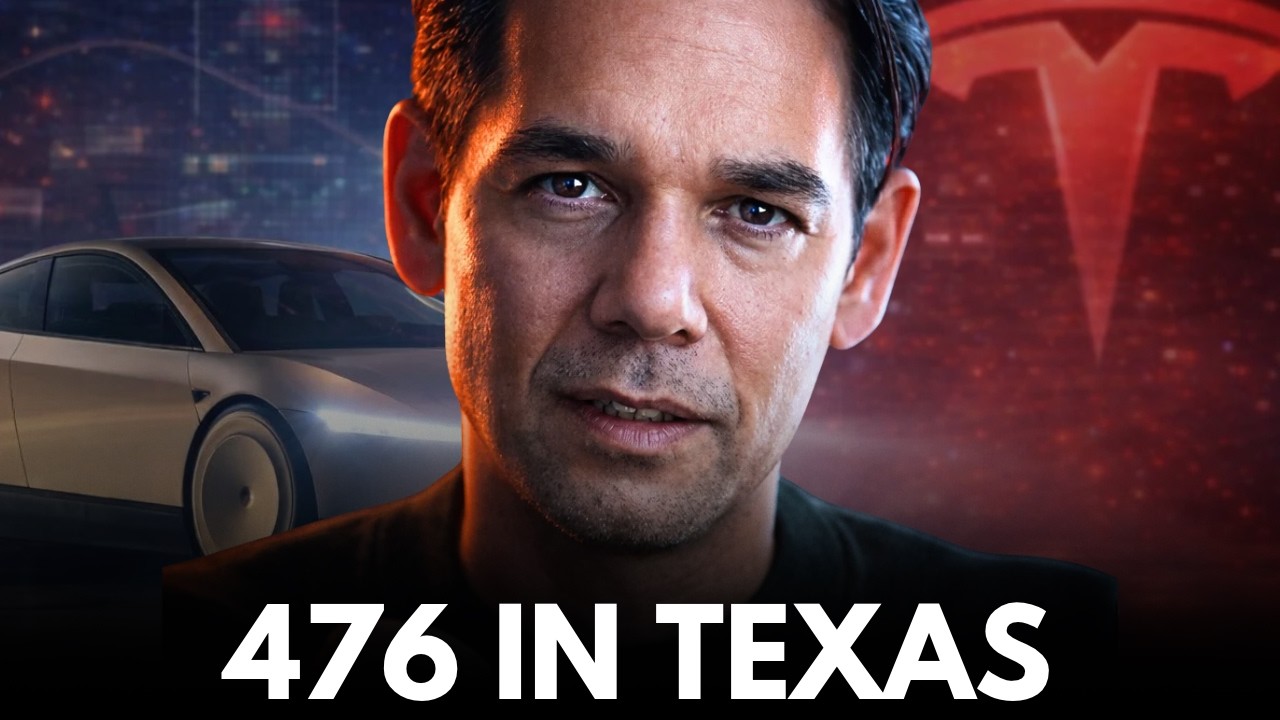
Big things happened for Tesla investors yesterday. Tesla added 28 cars to its robotaxi fleet all at once. Factory workers already training Optimus with cameras on their heads. >> [music] >> And Tesla's own chip just hit silicon in Texas. First, let's talk robotaxi. A whopping 28 robotaxis were registered yesterday, 19 Model Ys and nine Cybertrucks. That's 476 vehicles in Texas, 67 of them Cybertrucks. About 50% bigger than launch day. And writers keep posting in the words of one, "What a time to be alive." Second, for the first time ever, Tesla
94 words, the words spoken in the first 30 seconds at 187 words per minute.
Free, no signup. See how the first 30 seconds hold attention, with rewrites.
Sentence shape
| Measure | This transcript |
|---|---|
| Sentences | 549 |
| Average words per sentence | 11.7 |
| Longest sentence | 59 words |
| Questions asked | 70 |
| Sentences containing a number | 89 |
Most used terms
Filler phrases
221 in total: like 68 · uh 47 · you know 33 · I mean 23 · right? 15 · actually 12 · um 10 · kind of 8 · basically 5.
A literal whole-word count of the same phrase list the Prepublish browser extension uses, so a phrase inside another word is not counted and a phrase used in its ordinary sense still is. It is a count and not a judgement.
Run the check on the words above: where attention is likely to drop, with a rewrite for each weak line. The free check shows the scores and the one issue costing the most.
What this transcript is
Every word below is the caption track YouTube publishes for this video, pulled from the video itself and reproduced unchanged. It is not Prepublish's writing, not a summary, and not a re-transcription: it is the video's own published captions. English captions, generated automatically by YouTube, in the video’s original language. Source: the video on YouTube. A channel that would rather this page did not exist can ask for its removal through the contact page, and it is removed.
No Script X-ray for this video: YouTube shows a Most replayed graph only once a video has enough views.
Big things happened for Tesla investors yesterday. Tesla added 28 cars to its robotaxi fleet all at once. Factory workers already training Optimus with cameras on their heads. >> [music] >> And Tesla's own chip just hit silicon in Texas. First, let's talk robotaxi. A whopping 28 robotaxis were registered yesterday, 19 Model Ys and nine Cybertrucks. That's 476 vehicles in Texas, 67 of them Cybertrucks. About 50% bigger than launch day.
And writers keep posting in the words of one, "What a time to be alive." Second, for the first time ever, Tesla has publicly shown what could be the consumer-facing software for privately-owned Cybertrucks. It turns out the Cybertruck touring Australia is showing something new on its screen, consumer software. It basically looks like the software in a Model 3, but it's the Cybertruck. It's what you might expect to see if you yourself own this vehicle.
It's the first public hint of what a privately-owned Cybertruck might look like. Third, FSD licensing. When someone suggested that Tesla's intentionally keeping full self-driving as an in-house advantage for a couple more years before wanting to license it out to other automakers, Elon corrected him saying that actually Tesla has been openly inviting automakers for years. It's just that none have accepted so far. Fourth, Tesla has started training Optimus in their factories.
An Optimus prototype is sitting behind frosted glass at Giga Berlin. And the factory confirmed that workers there are already wearing camera backpacks and helmets recording their movements to train Optimus. And finally, the AI 5 chip. Samsung has reportedly started trial production on its 2 nanometer line in Taylor, Texas. The chip meant for Optimus, AI data centers, and future cars with volume production targeted for 2027.
We got Joe back to here with us today. He's an economist, investor, and tech entrepreneur. He has a YouTube channel covering both Tesla and AGI. Check out his website and community at minerlands.org. Welcome, Joe. >> Good to be back. >> Appreciate that. So, here we have uh big moves, big jumps. Uh just, you know, yesterday, a few hours ago, actually, another 28 vehicles were added, just like that. 19 Model Ys and nine Cybercabs to the Tesla Robotaxi fleet.
Um you can see 28 added today. These are registered uh to the Texas DMV. So, we don't know exactly how many are in active service, but as this grows, it's an indicator that they're having more in active service. So, now there's 476 uh total vehicles in Texas. 409 are Model Ys. 67 vehicles are Cybercabs. 67 vehicles are Cybercabs. So, uh on Friday, just a few days before, right? This weekend, there was nine added. And then now, uh how many now? 28 more today.
So, that's 37 in just a few days. Uh and then Robotaxi themselves, Tesla's account said Cybercab 67 joined the fleet. So, they've added 67, nine. And here's the the nine that was there, and then now we have 28 new ones. What is going on, Joe? >> Well, we also track these things based on the tracker, right? That spots them on the street, and we are still stuck at 42. That could be a tracker issue. So, there's always the differential between what is registered and what is live.
Uh because every vehicle that gets registered, these 67 Cybercabs on Texas, they exist. They need to be real Cybercabs. So, that's why Tesla shows them. But, are they deployed? Can they be seen in the wild? That's what we are tracking on our uh minerlands tracker. And so far, we are still at 42. But, it doesn't matter. There's some lag between that and uh deployment, probably. Or people haven't tracked it yet. So, in any case, we see scaling.
For me, the magical number will be 100. I think that's the first number that, you know, the stock investors will just see and become a little more interested in, especially if you see that translate into real cyber caps in the wild. Because once we scale into the multiple hundreds, I think that will be the first mini catalyst for the stock, where people think, "Oh, maybe this time it's not going to be so slow." >> Yeah, but Joe, it's like boiling a frog in water.
It's like slowly. And nine more today, 20 more next week, 20 more the next week, and 50 more, whatever. It's very slow growth. People just absorb it, move on. It's not this shock, right? For the investors, don't they need to see a surprise? Like, "Oh my god, 500. Boom. Okay, that wakes everybody up." But if it's like just 20, >> we still have the psychological It's not going to be over. They wake up, it's 100, and suddenly we go to 500.
But, I think, you know, as long as it's below 100, and also not clear how many are in the real tracker are visible, people will still discount it. It's like, "Mhm, could still be very slow." I think if we get to 100 We are already at 67. If you get to 100, this is clearly faster than in the first rollout. And so, people will start to pay more attention. I think they are not that stupid. They're going to track like, "Okay, are we a significantly on a different trajectory than last year in June?" Cuz I think right now people still assume it's going to be the same trajectory.
Because it kind of is, maybe. Maybe It's hard to tell at these numbers. So, once it becomes clearer, that's how I see it in my mind. You have the old trajectory from June to last year to this year. Are we on the same trajectory? Is it going to be painfully slow and nothing really happens? Or is it different? And if you would have 100, let's say, in October, it's clearly different. They will see, "Oh, this is a different trajectory we are on." And if they don't see it, they will see it on our channel.
So. >> Yeah. It It You know, the cool thing is like, there are 67 Cybertrucks now. I'm going to take out the music here. This is a video that Tesla themselves dropped. And of course, it's having fun, right? The wings are going up and down. It's funny. But, they said themselves this is uh Cybertruck number 67. Can you believe it's crazy if you think about it? 67 Cybertrucks uh already in the in registered. >> Yeah, but it launched just on September 3rd.
It's September 20th. >> yesterday we showed [clears throat] that the growth of Cybertruck production could be 300 per week already. Like it's it's like it's it's it's it's out there. It's like growing really fast in terms of how fast that they're they're So, there's many Cybertrucks out there still being tested, but 67. So, once If you can put 67 If you can put 67 Cybertrucks Now, again, we don't know how many are actually in service, but 67 are registered.
If you can do 67, you can do a thousand, right? I mean, like, am I wrong or am I not? I mean, like, these cars work, right? >> That's the big question. >> No. >> But, I mean >> Yeah. >> I think so. I I think now, I mean, I get very confident that we hit like multiple thousands this year, but let's see. The year is short. There's not much left. Uh which now shifts my focus more to this Nitsa audit because that's also going to be very interesting.
I said they cannot pass the audit. It's very clear to me. Uh >> What? >> two timelines. I think they ordered the Nitsa audit. It's very clear that Tesla will not pass this audit. There's basically no way to pass it. That's what I said from the beginning. I said in my first video, they will not pass the audit, but the way out of this is if before the audit actually concludes, Nitsa uh uh passes that amendment, which is likely to happen if you look at the timelines, then they will pass the audit because the underlying rules will change.
Because they cannot pass the audit right now, the regulations are crystal clear, you need brakes. They're the wrong regulations, everyone knows they're wrong, but they are active. So, in my opinion, it's very binary, but the good news is it's very likely it works. But if the audit would just proceed without that rule amendment, they will fail. I'm I'm 90% sure they're not going to pass it. >> It's It's all about >> also 90% sure it will The amendment will go through before the audit because it The timing is November or December or something. >> All right.
It's There's nuance in what you're positioning, but uh just You know this already. That NHTSA came out and they already changed five uh regulations already. Done. That's done. There's more, but the whole point is, you know, they videoed you know, the John Jonathan Morrison was interviewed, they had the list, we have the whole analysis by Sheren Basher and others. They The whole reason why they're doing the audit is so that they can pass these uh the these things.
And then the ones that they've identified as um as uh not applicable, they'll just agree to it. So, they don't have to pass everything because they already know that there's a lot that are not applicable. And then the ones that they will change, they'll change. So, but yeah. Yeah, I mean, I I you know, clearly you don't know how regulations work. >> the scenes there's drama. I think it will just work. That's my takeaway, but if they do not get these things passed before, which is already like the commentary period is already over, it's already, you know, finalized.
I'm just saying there's drama behind the scenes and they're using this probably internally to create pressure. It's not completely without risk, and there's competition. The competition is also there, right? So, the Nitsa cannot just be nice. There's Google, Waymo, there's Uber, they're pushing these people to say, "Kick them out." Like you and and Zoox. So, you cannot just ask down and then note them. So, Nitsa has to say, "Well, that was different, Zoox, because we didn't approve this thing." But then they have to approve it and so it's like a there's a little drama. >> Sure.
Agreed with you there. We never know what's going to happen. Okay. Um So, is the Cybertruck going to be sold to consumers? Elon is betting MKBHD, he doubled down on it a week ago saying he's sure he does not want to have his he does want his hair to be shaved. Meaning to say that Elon is still now saying, "Yeah, he's pretty confident we're going to be selling the Cybertruck to consumers." Here's the biggest sign that it's very likely going to happen.
So, this guy is in Australia and he got into a Cybertruck there and he was shocked to find out that he could play with the software. For some reason, Tesla for the left it open have publicly shown what could be, he thinks, the consumer-facing software for privately-owned Cybertruck. So, basically looks just like the software in a Model 3 or Y. And um >> [clears throat] >> I guess this is the car the the Car Sauce YouTube channel got access to the Cybertruck and this is what he found.
It's a really well-done video, by the way. I really like this Car Sauce. >> The star of the show, this screen is absolutely massive. I don't know the exact size, but I am wouldn't surprise me if it was over 20 in as you can see we can control a lot of the car features just like you would in any other Tesla. We can open up our boot here, we can also open up the maps, zoom around, and it's extremely responsive as you'd expect from a Tesla.
Okay, but how am I going to keep my brain rot at bay? Well, uh of course Tesla have thought of that. So, you've got Tesla theater, which is pretty cool. We can open up YouTube and oh my god. >> Also charge faster. >> They've got they've got really high-quality content already pre-loaded. That's amazing. I knew there was something smart about this car. Another thing I can do that's really cool is I can adjust the seat through the screen here.
So, I can recline it heaps. Like, seriously heaps. And it can even move the entire bench forward which just gives me a ridiculous amount of space. And I got to say, this is very very comfortable. I could imagine myself falling asleep in one of these things and just forgetting to get out. Which I think might be a problem that Tesla have to address. >> All right. So, just I was in a cyber cab earlier this month and when I saw the software, it did not have this bit right here.
I don't I don't see that. Um and then the second half of this, of course, it had all of that. The the ability to move the screen uh to move your your your seats and all that. That was all there. So, but this part it was very interesting. This part right here. That was not there at the time. >> Well, I mean, I have a hard time figuring out how this would work if they sell it to consumers. So, let's assume they start sales in December, pre-sales or something.
They have another year to complete that, probably, then. Longer would be a little embarrassing. And then what is the plan? So, what I see right now, the one option why fleets, privately owned fleets, make sense outside Tesla, because I did I ran the math on the margins and everything and that's why I always said there is no real incentive for Tesla to sell these cyber cabs because they make much more money owning and deploying them themselves.
But there's one caveat to that and that is outside major metropolitan areas because there it becomes a problem to maintain these fleets for Tesla centralized. Right? Imagine you're like in Czechoslovakia and like the 10th district outside Prague. Like, how is Tesla going to build that, you know, chargers and all that kind of stuff? Or like randomly in like some South Dakota, you know, district. Like it's just not fun to do that and it's very cumbersome for Tesla.
And for local fleet owners, it's much easier. You're local, you're maybe business owner, you know how to do this. So, I think selling fleets will happen. Because if you want to cover the entire planet with these things, the infrastructure required to do that cannot be built by Tesla. However, Tesla is probably likely to maintain the major metropolitan areas because it's so profitable. It's just so much more profitable to to own these caps.
So, you want to basically balance it out and say you privately you can take it all outside New York City, outside Austin, outside LA, uh but we keep the main things and make the most money. But then everyone can build fleets all over the place and create these little maintenance hubs. So, that's what I see could happen. But the issue is selling individual Cybertrucks. That seems to be nonsensical to me. I mean, you could argue why not?
You could just have a fleet of one and you you maintain it maybe. I have to think this through. Maybe that is a interesting model. Why a fleet if you can have one? Uh maybe. But then if you have one in some remote area, you don't have a fleet and then no one uses it because you need network effects. So, that I don't know. They would need to manage this somehow, right? If you sell one Cybertruck to a random dude in the middle of Wyoming.
Uh so, that dude will won't have luck sending that to work because there's 10 hours wait time then. So, I don't know. There are 10 million questions here. Uh but maybe you could just start it in Tesla uh in a Tesla strategy and just sell it to everyone and then determine network effects. You have have year to figure it out or something. I mean, there are many ways of doing that, but I'm saying this is non-trivial because you need to build network effects. >> Yeah.
I I don't expect this for What do you think? 2 years? >> Yeah, but I don't understand why Elon then is pushing this so hard in this whole bet. >> Well, I think he is You're right. It's going to be a fleet. A fleet owner. The fleet shepherd, he called it, right? So, he'll sell like 10 or whatever 50 20 to to somebody to just prove the concept and get >> started. >> Yeah. >> Not to an individual. I just can't all see it, like you said. >> Yeah, individuals just There's insane complexity to do that.
Fleets, I think >> I mean, could be one scenario they could do is go, "Joe, you can pay for We'll let you pay for it. Go ahead and pay for it. But, it stays in Austin. They still have it. It's just that Cybercab number 68 69, [laughter] okay. Cybercab number 69 is Joe. Joe paid for it. I sponsored this car. I own it. >> I paid money for it, but it's still managed by them. It's still in Austin. It's just as if it's They owned it, and some parts are being used. >> I mean, just as a financing strategy, I don't know if that makes sense. >> You know, a lot of people have done the math, and they think the opposite, right?
Which is it doesn't make sense for a Tesla to own this straight out. That they For the The amount of the money you're going to pay, whatever it is, $30,000 right off the bat that they get right now, is makes more sense for them to launch this at scale. >> But, I kind of disagree. But, this is a pure simple financing thing. I I just, you know, okay. I mean, I'm in finance. I like finance. The problem is this is a very simple problem in terms of financing, right?
If If you have all the money to determine, okay, we have so much This is a margin. This is a CapEx. Boom, boom, boom. They could go to Wall Street and raise 50 billion in debt. >> They They Exactly. >> Like, why would you create such a mess? Like, maybe you get better terms because people are too dumb to understand the exact financing logic and if Blackstone says, "Oh, I give you 50 billion." And Tesla says, "You know what?
If you just launch it online, we get a better interest rate, an effective interest rate on this whole situation." Maybe. But if when I look at the at the math, it just doesn't make sense because people want to make money with the cyber cabs, but why would Tesla allow them to make any significant amounts of money because that eats directly in the bottom line of Tesla. So, it doesn't make any sense. >> I agree with you. >> It only makes sense if you are not the if you are becoming the operator. >> Yeah.
And if it's a rural area, like you said, or the area they're not. That's where it makes sense, but not the way I described it. Okay. So, people are really enjoying these cyber cabs. Uh what time to be alive, this guy says. Crazy. >> I mean, this is just a completely superior pro- I mean, there's there's just no doubt that every person in the world is going to use a cyber cab. >> Yeah. That guy is DHS, GHH. He's a founder of um Basecamp and others, well-known 37signals, well-known um Silicon Valley guy.
Cyber Um this guy comes out. I don't know who he is. I should have looked him up. Uh Blake Scholl. But he says this, his prediction. Tesla will keep FSD as an in-house advantage for a couple years, and then once others start getting close with will begin licensing it for other cars, just as they open up the supercharger network. So, he's kind of hinting kind of indi- He's kind of saying that oh, it's on purpose. Tesla actually does not want to license it now.
They're keeping it in-house because it gives them an advantage. And then only when others start getting close, when they start cutting their own FSD, that's when Tesla will decide to license it for other cars. Just the way they open the supercharger. So, Ayar replied to him saying, "Tesla has for years openly invited other automakers to license FSD. None of them accepted." And Elon said, "Exactly." So, uh we know that, but I don't know if this guy knew that. >> No, he doesn't know.
And when it comes to FSD, by the way, I predicted like a long time ago that there will be a commoditization of FSD around 2029 or something with AGI. Uh but we have to understand this is non-trivial. We have to understand this is not a random thing. You need regulators to approve that. And what do they approve? They currently do not approve FSD. They approve the cars and the maker, right? So, if Tesla would license FSD to Ford, I extremely doubt that they would get the approval with it.
Ford would need to go through the whole thing. They would need to prove, "Oh, here we have these 10 cars with full self-driving. Of course, we get it from Tesla, but here's all our data that our cars actually work in the current regulatory framework." So, of course, if you get an update, but that's very tricky because I don't know if you can just do that. What if someone implements FSD wrong? What if someone has the wrong cameras?
What if What if these Ford cameras break all day long? Right? So, you rely on Ford hardware. So, can NHTSA actually approve FSD and allow licensing it into other hardware? Like, I don't think so. What about the chips? You know, what do they have hardware five? Are they buying it from Tesla? Like, there are 10 million questions. So, we're dealing with cars on the road that kill people if they go off. NHTSA's not going to say, "Oh, whatever.
Who cares about the details? Who cares about the chips? Who cares about the cameras? Who cares about all the little uh connectors in the car?" Like, no. NHTSA's going to say, "If you're Ford and you have full self-driving system, you need to you need to get approval. You can't just drive with it because one component's from Tesla." And so, it's not that simple, and that's also true for AGI. If if OpenAI invents super AGI, that in theory allows your iPhone to plug into your Mercedes-Benz and then drive it somehow, that doesn't mean it's legal.
Mercedes-Benz needs an approval for this. And they can't just allow your iPhone and then someone's Android to plug in. They say, "No, it needs to be in the car. It needs to be the car driving itself, not some random components all over the place." Unless you change all regulations, but that's going to take a decade, because that would be not a small change. That would be an insane change. So, what I'm saying is uh people simplify this a little bit too much.
You have cars that can kill people. These cars need approval that they can drive themselves. And each car needs to have its own approval, in my opinion. Regardless what the components are that go into that. You can't just say, "So, this This is also why I think commoditization is not as dangerous as people think to Tesla, because commoditization doesn't help. You need the cars." So, then whoever has the cars needs to go through the entire process to show that this stuff actually works, and it's not just a neural net.
It's not just a model. It's the chips in the car, the cameras in the car. It's like the whole system. So, people trivialize it a little bit too much, in my opinion. >> And And by then, let's say 3 years, 4 years from now, where is Tesla? How many LiDAR cams? What is their cost? What is their service offering? The network effects, all that is got to figure it out. >> Yeah, and when whenever the commoditization happens, which I think will happen before 2030, pretty sure, you will need another 3, 4, 5 years for an automaker to just implement that stuff, get all the miles on record, and learn how to do all these things, and learn how to build all the hardware.
Uh because what's not going to be commoditized is the hardware, obviously. I mean >> Yeah. No, but Joe, where do you stand on this? Some people think that in the future, um everybody will everything will just, uh, go to become robo-taxis. And others say, "No, actually I see a future where, uh, car ownership still survives and people want to buy their own car and yet it has, you know, self self-driving capabilities." Um, some people, you know, what are these then?
What do you think the future will be? >> totally I totally don't buy that. Like, in 100 years, will there be some billionaire who has a car? Of course. Like, they also have horses. They play play polo. Like, they sit on horses and hit little balls. >> Sure. >> Sure, right? They are they are like runners and hikers. They hike on mountains, but is that like a hobby or is it something you actually do in your everyday life?
So, I think 100% who needs a car A car is the most annoying thing. If you're 16, sure, it's nice. Ooh, I'm I can drive away from mom and dad. That's great. But, if you are 30 and you have to work, who the hell needs a car? If you want to do some car driving, you go to a racetrack or to some off-road enduro thing for the weekend and have your fun, but no one wants to mix fun and work. You don't want to sit in LA traffic with your stupid little hands on the steering wheel while you could to be productive.
Like, no one wants that, in my opinion. >> No, you can have your own car that is self-driving. But, uh, I did a show where I think that it will move to subscription where you can say, "Hey, I want this car in my garage for the next 6 months next year." You can do that. But, you're just paying them and then later you go, "Oh, send it out and go ahead and I'm going on vacation, so go ahead and rent it out." Or just leave it in the garage.
You can do that. >> mind, I think the way because I had didn't have a car for a long time now. I was like, I don't care. Like, I rent a car if I need it. I travel too much. Like, I can't take my car everywhere. I can't put it in a plane. So, why? Why? And once you, especially in the United States where it's like per but even in Europe, like the rentals are so easy and perfect. You get all these cool different cars and you can drive around with them.
I enjoy this much more. I mean in LA I had a car that's of course in LA maybe in 20 years still everyone in LA will have a car, but that's not except. >> Yeah, okay. Let's uh next story. Take a look at this. This is in Giga Berlin. Behind this glass there is an Optimus. It says work in progress. Okay. And uh what this is this guy says this is new. This is translated from German. In Giga Berlin fact Giga Berlin the prototype of an Optimus robot is currently located behind frosted glass.
The factory management confirms upon inquiry. This is coming from this guy. Starting in mid-August selected which is already you know last month. Selected teams from Giga Berlin Brandenburg will be part of the global training for Optimus. This means that the selected employees will wear special backpacks and helmets with cameras during the work to record their movements as a basis for Optimus. We're very proud to be part of this development and to make sure make such a decisive contribution to our future.
The two will be connected to you knows that's what this guy says. So yeah. Yeah. >> I mean it's definitely happening. There's also >> sure. >> There's also report from China that these deliveries have started of all the components that they are being delivered in the thousands of Optimus units in pieces of course. And uh we also see you know you just interviewed Brett Adcock. At what's his name? Adcock? Adcock? >> Adcock. >> Adcock.
And uh they're making tremendous progress. The Chinese make progress. So I always said with Optimus the way to predict this is not just how much progress Tesla makes, but also this is a highly competitive space and Tesla simply cannot just not do it. So and you know this is how it they they are converging functions in a competitive space. You know one is going to just sit there and not do anything, especially not the leader like Tesla.
So, we can predict that next year there will be just hardcore Optimus launch also commercially. And it's very clear right now they're building them in the thousands and they're deploying them and train them and figure out how to get it done by next year. I think there's no doubt about this and there will be tens of thousands probably manufacturing capacity by end of next year. >> Yeah. And and actually the the thing that I get out of this is So, it's obvious that Tesla is in the background making robots now in Fremont and that they're going to need to have people wearing you know, training them with gloves and glasses to train them a task in the factory.
What do I get out of this is that this is Giga Berlin. So, you know that they're they're not just doing you know, just Fremont or just Giga Texas. They're going to do every factory, every office that they have. Which and [clears throat] maybe even their suppliers by the way. That justifies having a thousand, 10,000, 100,000 robots, 20,000 robots out there and then many of them. >> easily deploy like let's say 10,000 internally without any issue like globally. >> I think that's the that's the right number.
It's a lot of kind of high, but yeah, could >> But it's it's like a not by the end of the year, but like, you know, very soon. But I like there's this big discussion with Chris Camillo probably because Chris came out very strongly against cyber cabin said this can never make money and everything. And it's all about Optimus, the entire Tesla bet is Optimus. And I really disagree with Chris. A lot of people disagree with him, but Chris is normally a very smart cookie and he always changes his mind when he sees, you know, I think he's just out there with his thesis.
Uh I I see it I see it as the inverse over the next 3 years. I think Optimus is incredibly messy. I think it's I'm all for it, but I would have no delusions that these robots will be very problematic for the next 3 years even. This is a very complicated thing. You know, before they really are productive. Whereas cyber cab is productive now. Like, it transports you from A to B better than anything else. That's I mean, Optimus is extremely far away from that, and every other robot is extremely far away from that, because it would mean the robot does a better job than a human.
When is this going to happen? Not next year, I'm pretty sure. Uh, but the cybercap does a better job than any other car today. You can argue like maybe in 1% of cases not. But, uh, that means it can make, I think cybercaps can make, you know, between 30 and 50,000 on the high end in margin per year. That's >> Yeah. >> insane. When you know anything about cars, that's insane. [gasps] >> I tried to >> deploy millions of these things.
Millions and millions of these things, and there's no real hurdle once you get through the regulations and the tech. And the tech is like, I mean, you are even more a fan than me of the tech, but I think it's it's clear the next 6 months or something, this will be completely flawless, the thing. >> Mhm. >> And and then the regulations, I mean, it's Trump. It's the administration. It's David Sacks and all these people in the administration.
They're saying like, "Dude, they're not going to stand in the way of America taking the lead." So, I think this is just an enormous cash, you know, tsunami coming towards Tesla starting next year. That's what I think. >> Yeah, I I interviewed Eric earlier, or I met him at the uh, party at the uh, cybercap launch day, and I had spent quite a long time talking to him. And one of the questions he wouldn't answer, but I pressed him on was, "How much revenue does each cybercap deliver for Tesla?" And I said, "You don't have to tell me the number, but I just want to know, are you thinking 30,000?
Are you thinking 50,000? Are you thinking over 100,000? Blink twice if it's over 100,000 per car." Because I've seen some people forecast that one cybercap can bring 100,000 per year. Per year. Some people I I stick with the number 30,000. But there's people out there going, you know, theoretically and usage and all that. Anyways, he wouldn't answer that, of course, but it made it sound like it's higher than the 30,000.
Okay, next one. I think this was last week's info, but new but basically it's the AI 5 chip. It's now reportedly hitting actual silicon. Samsung reportedly fired a trial production on its cutting edge 2 nanometer line in Taylor, Texas, testing the chip that could eventually power Optimus, Tesla's AI data centers and future vehicles. The line production target is for 2027. So, it just it's just a trial production. Larry Goldberg told me last Friday that this is normal, that these kind of chips, you know, they go through trial, they get out, and then they might fail.
But if it succeeds and it's it, we're ahead. But it's or or at least on time. So, yeah. >> I mean, that's also I mean, Tesla is a very different animal as stock than, for example, Nvidia or Micron. Because everything is always a a disruptive innovation. Whereas for Nvidia, it's incremental innovation. I'm not bashing Nvidia, but it's much more better planable. We know where a Reuben, we know the next thing coming, we can plan the CapEx, we know when it happens, it's like fine-tuning.
Whereas for Tesla, it's about unlocking these insane new things all the time. It's like when does robotics unlock, when does Optimus unlock, and so on and so forth, when does Terafab unlock? And the interesting thing when you model that is like, "Ooh, there's all this risk of delays and blah blah blah." But what's very interesting is when you understand the first principles of these trajectories that are right now in, there is no risk anymore of that actually happening.
There's not even risk of it happening in the next 24 months. So, we're just putting sliders on a timeline. Is it going to be in 3 months or in 6 months or in 9 months, or in 12 months. While you have an enormous amount of cash flow backing this whole thing, absolutely zero risk of failure in a way, like really close to zero risk of failure, you just push the little uh >> Don't forget the failure though. >> [laughter] >> Yeah, but I don't know >> I mean it took a lot longer.
Yeah, it's not a viable thing. >> for cyber trucks, it's like no, this is not going to >> just go buy four trucks. Yeah, you don't need Well, we'll see. We'll see. >> And for Optimus, Optimus is much harder to assess, but I think the extreme functions converging all over the world towards robots, I mean that it's clear that it's an insanely complicated thing. It's very difficult, but also the money behind it, the value that comes out of it, and the competition is so extreme that I think we will just grind through this quickly in the next 3 years to get to something pretty mind-boggling by 2029.
And you can make billions before that thing is even perfect, cuz there will be so many pilot needs all over the world from every business. It's like buy 100, buy 1,000. You need to start learning before they're perfect. So, that will accelerate the adoption. So, I think there will be definitely a market for millions of these things by 2028. >> Yeah. Yeah, for sure. Okay, thank you so much Joe. Follow him on his website.
Go check out his community at pioneerlands.org. Thanks, everybody.
The words are the caption track's own and nothing is reworded or re-transcribed. Paragraph breaks are placed between sentences so the text reads as prose.
Free tools for your own script: paste a draft and see where it stands before you record it.
Paste your draft and see where viewers are likely to drop off, with a rewrite for each weak line.
Paste the first 30 seconds of your own draft for a hook score and rewrites.
Check your draft against YouTube's advertiser-friendly guidelines before you record it.
Read this channel's public videos and transcripts, and download a writing brief for it.