Getting the transcript
Reading the captions from YouTube. A video nobody has opened here before takes 10 to 30 seconds; this page fills in on its own.
Getting the transcript
Reading the captions from YouTube. A video nobody has opened here before takes 10 to 30 seconds; this page fills in on its own.
Project Kamp · @ProjectKamp
Where viewers went back to watch this video again, from YouTube's public Most replayed graph, lined up with what was said at that moment.
Most replayed moment #1
22:3610.3x the video's typical replay level
just join and we don't have to make a separate dish. And it's also very easy in the kitchen because if you work with meat then cleaning becomes a whole more difficult thing and with just veggies it's h it's more easy. >> Hey Arian, where is the land?
Said at 22:29
Most replayed moment #2
22:036.2x the video's typical replay level
always asking for and what actually a routinary life is. And that's what we try to do. Hey Julie, can people just visit project camp? >> No, unfortunately we don't have the capacity to host way more people than we already have here and everyone is quite
Said at 21:57
Most replayed moment #3
20:595.0x the video's typical replay level
baby. So in general all year round place for a baby needs to be a bit more controlled. And here's not the case yet. >> Hey Colleen, where is >> out there in the world being a mother which is not really aligning with
Said at 20:52
The graph counts replays. It does not show where viewers stopped watching.
Words
4,830
Runtime
26:53
Speaking pace
180wpm
Reading time
20min
180 words per minute, just under the 181 median of 349 measured videos. That distribution comes from the 349-video hook study.
Opening (first 30 seconds)
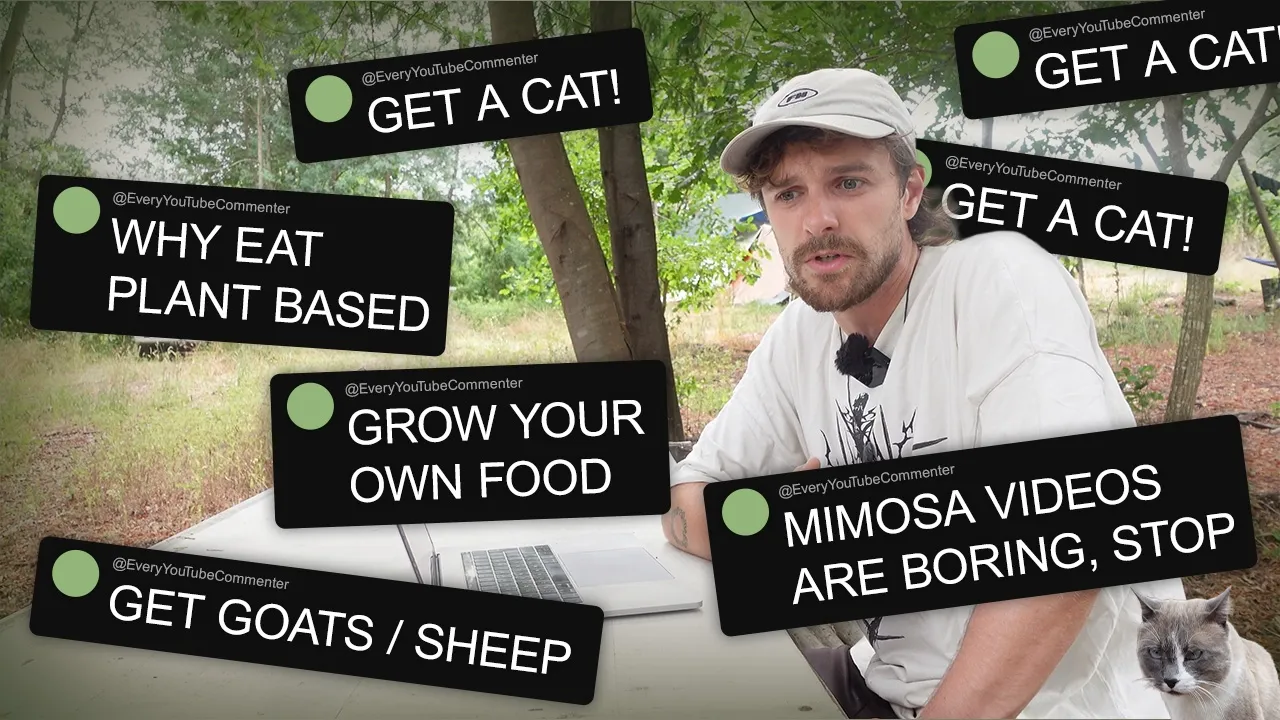
Six years ago, we bought this abandoned piece of land in [music] Portugal to try and find another way of living. And so far, we have been Oh, hey, I'm a new person. My name is Tom. I'm from the video pot and I'm new here at Project Camp. This is my first full season here at Project Camp and I just have a lot of questions. Why are they not growing their own food? And why don't they have animals? I am planning to get to the bottom of
90 words, the words spoken in the first 30 seconds at 180 words per minute.
Free, no signup. See how the first 30 seconds hold attention, with rewrites.
Sentence shape
| Measure | This transcript |
|---|---|
| Sentences | 326 |
| Average words per sentence | 14.8 |
| Longest sentence | 91 words |
| Questions asked | 31 |
| Sentences containing a number | 18 |
Most used terms
Filler phrases
123 in total: uh 39 · like 36 · um 16 · kind of 14 · actually 12 · I mean 2 · basically 2 · you know 2.
A literal whole-word count of the same phrase list the Prepublish browser extension uses, so a phrase inside another word is not counted and a phrase used in its ordinary sense still is. It is a count and not a judgement.
Run the check on the words above: where attention is likely to drop, with a rewrite for each weak line. The free check shows the scores and the one issue costing the most.
What this transcript is
Every word below is the caption track YouTube publishes for this video, pulled from the video itself and reproduced unchanged. It is not Prepublish's writing, not a summary, and not a re-transcription: it is the video's own published captions. English captions, generated automatically by YouTube, in the video’s original language. Source: the video on YouTube. A channel that would rather this page did not exist can ask for its removal through the contact page, and it is removed.
Six years ago, we bought this abandoned piece of land in [music] Portugal to try and find another way of living. And so far, we have been Oh, hey, I'm a new person. My name is Tom. I'm from the video pot and I'm new here at Project Camp. This is my first full season here at Project Camp and I just have a lot of questions. Why are they not growing their own food? And why don't they have animals? I am planning to get to the bottom of all of these questions.
So, let's get started. As you might know, every 10th [music] video we do a challenges video and it always falls on the eighth 158, [music] 148, 138 and so forth. But in this challenge video, I also wanted to introduce some [music] new segments. But first, let's dive into the ongoing and new challenges of the project and then we get into the new stuff. One thing that [music] always comes first is the health and safety of our campers.
So, let's see what Jav has to say about that. >> Okay, safety and health. So uh so far this year we didn't have much of a problem with health but last year you know we had some group of people getting sick recurrently for a bit of time and it took us a while to find the reason for it and we never actually communicated to you. So now I'm going to take the opportunity to explain you a bit why it was. [music] So we have this tap which has drinkable water.
It goes through filtering system and a UV filter. And the problem is that last year we changed the whole water system. So what happened with that is that this [music] tab was outputting double flow of water that it used to and the UV filter simply couldn't hold that much. [music] So by just changing this and reducing the pressure, it became the right amount of uh filtering for the UV filter. So then it was good. Uh so no issues so far.
The other one we had with uh safety and health was about the rats. So we have our lovely compost beans which were secured in a previous update and also we had the rat traps which work quite well. So far we didn't see any other rats around. And last part of safety we want to talk about is fire safety. This is always an ongoing challenge and we kind of work hard towards that. So we improve [music] our protocols. We're going to make a fire drill and definitely landscaping team is doing a lot of work with [music] the fire breaks.
So it was zoom five the beginning of the season and now we are chopping some more other stuff in [music] the middleland that we will show you later because also we don't want to make a spoiler on that but maybe to explain also one challenge that we have actually is kind of new around fire safety is fuel management but Jacob is going to tell you a bit more about it. Okay, so fuel management. A couple of months ago, we got this little flyer from the municipality and they kind of tried to explain what is fuel management, how to deal with it.
And fuel management is kind of basically everything on our land that can fuel a fire. So trees, everything. We pile chemicals, fuel for for the chainsaws, that all is kind of fuel. So they have kind of guidelines how to manage the plants regarding structures, surrounding structures. We got that information in March because we attended like a thing that the firefighters organized. They already updated the law in January, but we're not constantly looking into the law.
What is changing? Like, but now since we know it, we kind of try to adapt it. But then this plan is already set for the season. Everyone arriving in March, then we want to cut some fire breaks, which are also really important for like fire safety. But now we're a little bit behind on pruning the trees regarding the fire regulations. But we're on it. We're hopefully going to be finishing it soon. But yeah, on top of that, there's the coming and going of the fire regulations um which are already on for like 3 weeks.
So we can only kind of work from 8 till 11. We're just slow. We can't progress as fast as we like. Um so that's I guess the topic of fuel management. >> Another challenge we have is the zones 5 behind me. Um a lot of you guys are asking about it. What are our plans? what is going on. And the whole thing in general is like a full challenge for us because we wanted it to be cut in March, beginning of season 5. So they were here in January after season 5.
So before season 6 started. Um that was one company. They cut it down. And then there's another company that said like, "Yeah, we're going to pick up the wood and then we get a little money for it. It's nice. Cool." Um, so they wanted to come in the beginning of March season 6. Now we are end of June season 6 and still there's wood to be picked up. So we're still waiting and waiting. So we don't really know what we we will be left with.
Um, we definitely have it in our mind to plan around it. So maybe we have to do some action with the digger. Maybe we try neighbors with animals. Like there's infinite possibilities. Um, but this is to be planned, but we're kind of still waiting on on other companies to like get rid of this and then we can actually start and know what we are what we have left with. So, that's what's coming for this big piece of land behind me.
But come to think of it, I think the project was also planning on buying a new piece of land last season. Let's ask Julie what the situation about that is. >> So, here we are in the waterfall with a challenge. Last year we got offered to buy this place and we thought an easy shot but it turned a bit more complicated than we thought. Let me explain you. In rural Portugal there is a lot of land that have been passed down the different generations.
As parents used to have several children. The land inherited got divided transforming once big properties into small plots and also very scattered as you might have inherited from an uncle or a grandfather. On top of that, many people just have their property registered in old papers where boundaries are often unclear or areas not properly measured. And then so far there's only been marking the end and the beginning of lands with metal sticks like this or rocks, which you can imagine it's not very easy to identify that through all these bushes.
And sometimes you're also ending up with weird situations like we had the hole in the middle of our land some years ago. Now we fit it together but before it was a bit of a random hector there. So since the last months we have spent quite a lot of time with the neighbors and this because of we're searching through all the papers looking at their lands looking at their registrations and also searching for all these pots and pens and bit by bit we are puzzling and puzzling and more puzzling and we realize the land is not one hector but actually two.
That's quite funny because they didn't know about this either. And seeing this all together, it's a bigger job and maybe also a bigger decision than we thought. Okay, so we have been talking quite a bit about this decision and the end conclusion is we go for it. We take the challenge even though this means that you will need to do two times the amount of maintenance work and two times the amount of finances to be covering actually the price of the land.
And last year we started to do some sponsorships for this to be able to buy bit by bit the first hector and this year we tried to do the same with the second one. So luckily we have very friendly neighbors and they are up to save the land for us until we actually got the finances and that also helps them to not have any scattered land of square meter around. Funny situation with this waterfall challenge. Now we're going to go for double the size of the land but also double the price.
So let's get some sponsors. See you next challenge. >> So, another ongoing challenge that we have this season is the growth of the YouTube channel. As you might know, the views are a little bit declining over the years, but so far the views are similar to season 5 from what we've seen, which to us feels good. And I'm here with Felipe, my co- video manager. So the reason why we have two video managers this season is I focus a little bit more on the future strategies to uh see what we can improve on the video part and it kind of takes a while to implement those strategies sometimes and for example there's always new media always new things to implement in the videos but we also need to stop for a while and think about what we're implementing because everything we implement in these videos for example will be there for the long run.
Uh that's kind of what I am involved in and Philipe is more working on the stories and making sure that there's good videos being put out every single week for you guys. So yeah, what are some challenges that you run into as the video manager? Yeah, I think uh when we started when we did the plan for season 6, we already talked about uh telling a bit more different stories that we won't have the same amount of building videos this year.
Like even though we are the video pod, we are kind of just doing what you call postp production >> and we cannot just invent stories of what is happening at camp. We're still following uh the style that project camp has while we're starting to experiment with new ways like like I said, but I think you will you will see a few cool things or might already have seen a few cool things of of what we've we've been trying of new stuff.
The pizza oven challenge, I guess. And another one I think a lot of people really like was the gardening episode. >> And I think it's these stories that can have a little bit more of this highlight this season compared to only like building videos. >> Yeah. [clears throat] >> And from what I've seen in the comments, a lot of you guys seem to like it so far. So I think that's good. >> Yep. One more important part of of this like of of the new stories is also is also the the computer workers, the knowledge workers, the people that design websites, that do animations, that edit videos, that come up with different ideas to to get them on camera and to tell these stories for people that are actually interested in this sustainable community that is camp.
It's it's also something that we're we're going to take on this year and uh we hope to find very engaging and interesting uh ways to do that. >> Mhm. So, while we talked with Philipe about shedding a light on some people here at camp that you don't normally see, I was thinking maybe let's check with all of the campers here at camp to see what their personal challenges are and shed a light on them. >> Look, what do you struggle with?
Um, sometimes I can struggle with a nice balance between my own personal time and the activities we do at camp here. And especially in the evening, I sometimes need some time for myself. >> It's tough living in a tent for 7 months. Uh, it's only month three. I got four more to go. >> Hey, landscaping team. >> Wow. >> You have any personal challenges? >> Live with other people. >> Cutting [music] mimosa tops the whole day with a dull saw blade slowly turning into the Hulk.
Well, I hope it washes off, but maybe maybe a new person. I don't know. >> You know what? I mean, it's [laughter] hard to live with people like this. >> Like, for example, there's certain things that are essential for the running of camp or at least make things way more convenient, like getting a proper spray bottle or buying a thermometer. And sometimes those things just aren't available without shipping from halfway around the world or without buying something cheap.
And it's nice to find secondhand things, but there aren't secondhand things with everything. >> So before you come here, you have a life somewhere and a job and a house, friends, [music] something like this. And then you come here, it's nice. Maybe you come again and again and suddenly you end up with this double life. One here, one there. How do you [music] sustain both? Do you sustain both? How to deal with this? Um, in the moment I have some responsibilities I have to take care outside of camp and it's sometimes not so easy to fit everything under one head and uh be sure that everything works out. >> You see many people coming and going with a lot of input, new experiences, new energy.
Everything is really cool. At the beginning, you get to know each other. Then you enjoy each other. So everything is fun but then that's it stops. It's a short time relation. So relation don't grow to really build trust or to have really a solid relation with other people here. >> Every year when I come back all the people they're different and the place is completely the same but um it feels sometimes very strange and unfriendly and a bit like a stranger in your own home.
That's my That's my problem with the strangers. Yeah. Who are you guys? [laughter] >> I don't have a car here. So, um you get kind of uh uh locked in [music] at camp on the weekends. Like you might want to go somewhere. Another challenge was that I broke my glasses, [music] but I managed to repair them with a bit of glue and wire. So, you have to get a bit resourceful here sometimes. >> I have too many personal projects that I want to do. and I thought I would have more time for my tiny things.
So, yeah, need to balance that. >> Uh, one thing that's challenging is um people that own bikes and people that don't own bikes. It's very handy to have one, of course, but um yeah, if you don't have one, you have to keep asking people to uh borrow theirs. And besides that, thorns [music] and everything, they they really mess up your inner tires. and most of them are either empty or there's something wrong with the gears, stuff like that. >> My personal challenge is that um we live on a big piece of land but we use a small piece of land and that everything is combined.
So the place where I work is [music] the place where I relax is the place where I live. It's the place where I socialize. Um so it's difficult to separate [music] things sometimes and then especially I mean work. If I go to the kitchen to make a snack, I am immediately in my work space with my colleagues as well, which are also my friends. It's all uh very tangled up and sometimes [music] that can be challenging. >> What is your personal challenge? >> My personal challenge is uh not being able to see all my friends newborns. >> Yep. >> Oh, that's sad. >> Yeah, it's a sad one.
I'm trying to be more time [music] out of camp, but my challenge is to say no and to let a go tasks. And actually, I find myself busy again with lots of st of [music] tasks for camp while I have other stuff to do. [snorts] >> Hey, Felipe, what is your personal challenge? >> Uh, being a manager and an editor at the same time. like the manager is very structured and makes meetings and sets a date to talk to everyone and the editor is super focused and just forgets all those meetings.
So that's the challenge I have. Hey man, what's your personal challenge? [laughter] Got a problem? We'll talk about it. No, my personal challenge is um that there's only two per person. I would like to have four per person. Hey Ross, what is your personal challenge? >> My personal challenge is uh not having an intro. >> And whose [music] fault is that? >> Uh I think that might be the guy behind the camera. [laughter] >> Sorry.
No, it's [music] okay. >> Next season. >> Hey, tell me what's your personal challenge? >> Uh for me it's that I've been alone in the kitchen a lot lately and that's very draining. A challenge we have at the moment in the kitchen is that uh because of something unexpected, we are understaffed. So, normally we have two cooks. At the moment, we only have one. That's doable for a short time. People from other pots have been kindly helping us with groceries and shopping, but that's not really something that's uh sustainable for the long term.
Also, because people that have been helping us don't necessarily have the right skill set, so everything falls on the shoulders of Tommy and I also have to jump in more in the kitchen. So, if you are a cook and you really want to come to Project Camp, go to support.procamp.com and maybe you'll become the hero of season 6 and help us at this moment. >> So, I still have a lot of questions and I think a lot of these questions already have been asked by a lot of people in the comments and also do think that they might have also been answered by people here at camp.
But since the Q&A is now only available for people on Patreon, sign up. I think it's nice that we make a video where we have all of these questions in one place. So if anyone ever asks this question, we can just refer to them in the comments to this video. So let's go around and see if I can get some answers to my questions from people that know more than me. There's at least one question that I can answer, and that is who am I?
Hello, I am Tom. I'm 30 years old and I'm from the Netherlands. I love to design, draw, and make music. What interests me is sharing knowledge on these topics. I used to have a YouTube channel on my own where I shared graphic design [music] techniques and tips for freelancers. At some point, I realized that although I like sharing my knowledge through my YouTube channel, doing it living in the city was not for me. It was time for a new chapter.
[music] So, I made the choice to build a van together with my girlfriend Lopka to come to Project Camp where I can help out with my expertise in running a YouTube channel. So far, it's been a really inspiring experience. What interests me most about the project is how they share their research in an open source model. [music] I hope that one day I'd be able to build my own place on which I can teach and inspire other people the [music] way I get inspired by things.
But for now, I'd like to take things slow here at camp, [music] learning and absorbing knowledge and sunlight. And of course, keep working on videos. Let's get back to it. >> Hey Cameron, why do we not grow our own food? So growing our own food on the land would require a lot of dedication like people here all year round and lots of manpower when we can dedicate that to other projects. And thanks to the donations and the money that we receive for the project, we can use our buying power, our purchasing power for local organic farmers and that supports them in the region.
And otherwise, we are happy to continue the way we're doing. And we do have some fruit trees with some fruits coming through, but no plans in the near future for food. >> Hey Aran, how do we finance the project? >> So we finance basically from three different sources. One is YouTube, one is donations, and the main one at the moment is Patreon. So we have a big amount of people that support us monthly, and that's our best and most steady income at the moment.
Hey Cameron, why do we use gas? Isn't that really unsustainable? >> So, there's two types of gas that we use on the land. One is the propane that comes from underground. It's not very sustainable fossil fuels. And the other is the bio gas which we produce from our food scraps. And we do use this in small amounts for cooking. But with our current solar setup and the amount that produces, we're not able to meet all of our demands.
So for hot charge, for cooking large amounts of food for 20 people, we do have to resort to this. Uh it's just a bit of a compromise because we're then able to keep people comfortable enough to fulfill other projects on the land and in the meantime we are thinking for future solutions when we have the community center. >> Hey Julie, why do we not have goats or sheep? >> Would be nice but for now there is a lot of things to take care of and if we are here not during winter who's then going to take care of all these goats and sheep so who knows maybe in the future as well.
Hey Jav, do people get paid at Project? >> Well, there is uh some people that do get a little money. I would say like a pocket money monthly. Uh especially the ones that are longer term here and got more commitment. So long-term people, managers mostly. We wouldn't consider this like a salary or that you get paid, but more like a support for people to to to be able to keep doing stuff at camp because still people need to pay for their insurance.
Also some people work have side jobs uh but yeah you cannot really be full-time on that. So it's always good if we can give a little income to these people but again it's not really much and we cannot really call it payment. >> Hey Arian, why are there no babies in camp? >> So there's no babies in camp because at the moment we don't have conditions for it. So it's still hard to live here. We live off grid. We sometimes don't have electricity.
We just have one shower outside which is not ideal to clean a baby. So in general all year round place for a baby needs to be a bit more controlled. And here's not the case yet. >> Hey Colleen, where is >> out there in the world being a mother which is not really aligning with project camp. So we see her from time to time, but otherwise she's out there with a little cute baby being a mother, which is very intense. >> Hey Jav, why do you always repeat video topics? >> So certainly when we started it was super exciting to set up base camp and explore the land, but over time the task that we need to do become a bit repetitive.
No, like chopping mimosas, rebuilding things, uh setting camp into winter mode. So all these things happen every year and that's actually what life is. Uh because what we need to do is what we kind of show and always we try to give it a little twist, a little uh wiggle here to make it a bit different, have a different flavor. Uh but in the end there's always going to be a clash between the newness that YouTube is always asking for and what actually a routinary life is.
And that's what we try to do. Hey Julie, can people just visit project camp? >> No, unfortunately we don't have the capacity to host way more people than we already have here and everyone is quite busy. So maybe in the future. >> Hey Kau, why do we eat vegan? >> Because uh we chose vegan because it's the most sustainable if done in a good way if you source the food locally. And it's also inclusive. So if anyone comes here that eats vegan, they can just join and we don't have to make a separate dish.
And it's also very easy in the kitchen because if you work with meat then cleaning becomes a whole more difficult thing and with just veggies it's h it's more easy. >> Hey Arian, where is the land? >> So the land is owned by an association. So it's an NGO in Portugal. So actually nobody really owns the land and nobody can sell it. >> Uh so we finally got a camp cat. >> Well, not really. This is goody. So similar as with goats, uh we are not getting an animal to have for the project because it will mean that somebody will need to care for the animal year round.
But still some of the campers bring their pets. And in this case, we got Goody, which is very cozy cat. And so far he's doing well. Catch uh some mice. Uh no birds, no lizards so far. So, we think it's safe for nature. Not rats so far because we didn't see more. But yeah, let's see what he finds. So far, temporary cat, not prey cam cat, but we like him. >> So, this was nice. I hope it was also useful to you. And if people have any questions in the future, you can direct them to this video.
As you might know and realize, we have a lot of eyes on us through YouTube. And a lot of people can also have criticism on the things that we do, especially in building projects, for example. And it's always good to have criticism because we can learn from it. But some comments can just be straight up rude. And it's very easy to get hung up on those negative comments. And it's also not really something that we want to highlight too much.
But something that we want to highlight is that there's actually a lot of [music] nice things happening in the comments. And I thought this might be a cool element that we can now use in the challenge videos moving forward. So, the first one is a donation by [music] the YouTube name of Kasuk Kask4479. Sorry, I had to peek there. Uh, but this person donated [music] €10 to our neighbor George to get some beer or some cigarettes or some fuel for his tractor.
So, let's go to George and see what he thinks of us. >> Okay, so we got George here. So, we're gonna tell him the comment. See, [music] no. foreign. No, no, no. Okay. Okay. [laughter] [music] Okay. Thank you. >> So George was thankful, but he'd also like to give us the beers. It was a little bit hard to convince him to keep the money, so we might just treat him to the beers in the future. >> All right, that's it for this update video.
I hope you enjoyed and [music] please do let us know what you think of these new segments in the challenges videos. If you want to support the project, go do that on Patreon where you can get the videos in 4K [music] without ads two weeks ahead. If not, you can also subscribe to the YouTube channel and then [music] we'll see you in the same time, same place. See you next week.
The words are the caption track's own and nothing is reworded or re-transcribed. Paragraph breaks are placed between sentences so the text reads as prose.
Free tools for your own script: paste a draft and see where it stands before you record it.
Paste your draft and see where viewers are likely to drop off, with a rewrite for each weak line.
Paste the first 30 seconds of your own draft for a hook score and rewrites.
Check your draft against YouTube's advertiser-friendly guidelines before you record it.
Read this channel's public videos and transcripts, and download a writing brief for it.