Getting the transcript
Reading the captions from YouTube. A video nobody has opened here before takes 10 to 30 seconds; this page fills in on its own.
Getting the transcript
Reading the captions from YouTube. A video nobody has opened here before takes 10 to 30 seconds; this page fills in on its own.
Jon Walland · @jonwallandcoach
Words
2,822
Runtime
11:49
Speaking pace
239wpm
Reading time
12min
239 words per minute, above the 201 75th percentile of 349 measured videos. That distribution comes from the 349-video hook study.
Opening (first 30 seconds)
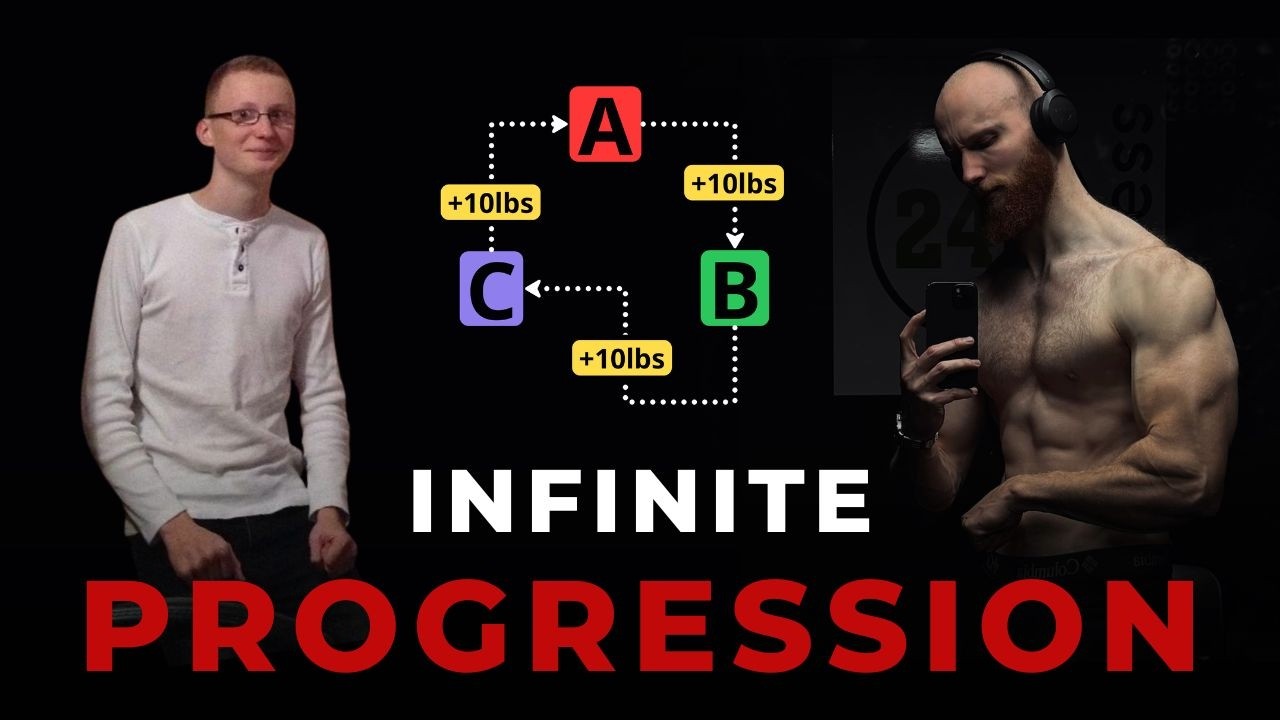
In this video, I'm going to show you exactly how to engineer the conditions that are required for infinite progression, both in terms of muscle growth and gaining strength. This is using the IP method, and the way that this works is by cycling between multiple variations of the same movement pattern. In doing so, we are able to continually strengthen different sectors of the movement pattern, as well as identify and reinforce specific weak points that we can expose along the way. This is ultimately what kills plateaus and allows you to build more muscle and get stronger indefinitely. This is the same method that I used to grow my weighted pull-ups to wrapping 60 kilos on my belt,
120 words, the words spoken in the first 30 seconds at 239 words per minute.
Free, no signup. See how the first 30 seconds hold attention, with rewrites.
Sentence shape
| Measure | This transcript |
|---|---|
| Sentences | 136 |
| Average words per sentence | 20.8 |
| Longest sentence | 58 words |
| Questions asked | 3 |
| Sentences containing a number | 6 |
Most used terms
Filler phrases
14 in total: you know 5 · right? 3 · like 2 · actually 1 · basically 1 · kind of 1 · literally 1.
A literal whole-word count of the same phrase list the Prepublish browser extension uses, so a phrase inside another word is not counted and a phrase used in its ordinary sense still is. It is a count and not a judgement.
Run the check on the words above: where attention is likely to drop, with a rewrite for each weak line. The free check shows the scores and the one issue costing the most.
What this transcript is
Every word below is the caption track YouTube publishes for this video, pulled from the video itself and reproduced unchanged. It is not Prepublish's writing, not a summary, and not a re-transcription: it is the video's own published captions. English captions, generated automatically by YouTube, in the video’s original language. Source: the video on YouTube. A channel that would rather this page did not exist can ask for its removal through the contact page, and it is removed.
No Script X-ray for this video: YouTube shows a Most replayed graph only once a video has enough views.
In this video, I'm going to show you exactly how to engineer the conditions that are required for infinite progression, both in terms of muscle growth and gaining strength. This is using the IP method, and the way that this works is by cycling between multiple variations of the same movement pattern. In doing so, we are able to continually strengthen different sectors of the movement pattern, as well as identify and reinforce specific weak points that we can expose along the way.
This is ultimately what kills plateaus and allows you to build more muscle and get stronger indefinitely. This is the same method that I used to grow my weighted pull-ups to wrapping 60 kilos on my belt, 200 kilo RDLs, and of course the transformation that you can see here as well. But my objective for this video is just to give you absolutely everything that you need to execute on this, so that once you've watched it all the way through, you can take action.
Now, this is going to be very valuable if you're someone who's spent some time in the gym already. You're getting to that point now where progression has slowed down. Maybe you've got some stubborn plateaus that you're trying to push through at the moment. This is ultimately a training style that systematizes the effort you're already applying inside the gym, so that you can make way more progress from way less effort.
Because the reality is, if you're not hitting PRs every single week consistently, regardless of how long you've spent training, that is a problem that needs solving, and that's exactly what we're going to do as we move through this video. If you are brand new to the gym, by the way, you are still going to find some value from this video, but it might just be a bit much information. Either way, just make sure that you've got a notepad and pen in front of you because, as I said, I actually want you to take action and benefit from this.
Now, in order to understand how to engineer the conditions for infinite progression, what we first need to do is understand why progression would even slow down in the first place, which is why what I want to start by doing is dissecting what a plateau is, why they exist, and how to avoid them. Now, every exercise will eventually plateau. This is an inevitability of training consistently over a long enough time period.
You cannot simply add weight to the bar every single week forever, because if that was the case, well, everyone would have a 500-lb bench right now. There wouldn't be a need for a video like this. And it eventually gets to a point where progressive overload on one exercise becomes impossible to do, which is why I want to present to you the concept of an exercise life cycle, which is essentially the duration within which you are able to continually apply progressive overload.
This ends the moment when progressive overload becomes unsustainable to apply consistently. And what we essentially want to do is just increase the duration of this life cycle for as long as physically possible. Now, provided that we are progressively overloading, we are giving the muscle a reason to adapt. We are giving it a reason to grow bigger or to gain more strength. And the moment that we stop doing that, the muscle stops adapting, which is why we can mark the life cycle into two distinct categories, a productive and unproductive territory.
The productive territory is simply where there is a greater stimulus being applied to the muscle over time. And the unproductive territory is where that stimulus stays still. And once you move into this unproductive territory, there's a few things that you could do. You know, you could just keep training with the same exercise forever, never really changing anything. That's probably not you because, you know, you're watching this video cuz you're genuinely interested in progressing, right?
We're both oriented by that sense of forward motion. What you're probably going to do is one of a few different things. And I'm guilty of all three of these, by the way. The first of which is just simply allowing your form to degrade in order to move more weight. Maybe not intentionally, but if you haven't built the strength required to handle this additional weight, what inevitably happens is supporting muscles start to take over.
And this is what exposes you to injury. The vast majority of injuries that I've seen in my career have been from guys who simply hit a plateau, they hit a wall in their training, and they simply have to degrade their form in order to match the weight that they're using. What this also does is it just takes tension off of the target muscle, so it's just unproductive all round. Another thing that you could do, and again, I've done this before, is just increase the volume of your training.
If you're not able to add weight to the bar anymore, well, what you could do is just add on additional sets. But what this also does is it drives up your fatigue levels to the point where you're no longer able to recover, not just from the sets that you're currently doing on that one exercise, but also all of the other exercises that you're doing. That becomes the limitation. And this is going to affect all parts of your training.
It's going to affect your appetite, your sleep, your levels of energy. And the only way to recover from on is by taking time off training or deloading. I used to take deloads all of the time. With the IP method, provided that you manage your fatigue levels properly, there is no need to deload. But essentially, the point I'm trying to make is that every exercise has a productive lifespan. And this ends when progressive overload becomes unsustainable.
And this is also the reason why anyone telling you that they have the best exercise for growing the pecs or the best exercise for growing a wider back, well, it doesn't really exist. Every exercise eventually plateaus. So, even the best exercises eventually going to hit a wall that unless you figure out the reason why, you will never going to be able to progress beyond the level that you're at. And this is why exercise loyalty always fails.
Now, if we know that exercises can only be progressed for a duration of time, what we need to do instead is focus our attention on progressing the movement pattern. And this is where we're going to start talking about the six fundamental movement patterns. This These are the horizontal press, vertical pull, vertical press, horizontal pull, squat, and hinge. And of course, there are an infinite number of variations that exist within these six fundamental movement patterns.
And we can use each and every one of them as tools to progress on the movement pattern. Every time the movement pattern gets stronger, every variation that exists within it also gets stronger because the movement pattern itself has been reinforced. And to use an example of this, I want to just single out the horizontal pull for absolutely no reason, by the way. This is just illustrative. But I've written a few examples of horizontal pulls.
These are all rowing exercises. We've got the barbell row, chest-supported dumbbell row, and cork row. And you instinctively know that these exercises are different. Despite the fact that they all train the same muscles, despite the fact they all belong to the same movement pattern, they are all fundamentally different exercises. And the reason for this is because, well, they are different. They all have their own set of demands and requirements from the body.
And what we can basically do here is map this out on a constraint profile. So, a constraint profile is just a way to map out the unique set of demands and requirements from an exercise. So, some exercises might demand more stability than other exercises. Some exercises might demand more strength in the top range of the movement, and some exercises might demand more strength in the bottom range of the movement. Every variation that you train with has its own leverage.
We can train a different sector of the movement pattern based on which variation we are using. Now, the way that the IP method works is by rotating between multiple variations of the same movement pattern. So, in this example, the barbell row, chest supported dumbbell row, and quad row, because they all train the horizontal pull in slightly different ways, they all train slightly different sectors of the movement pattern.
It makes sense to rotate between them over the course of many months, and sometimes even years. And the way that this looks over time is as we stack these constraint profiles on top of one another, what we end up with is a much wider strength profile within the movement pattern. And the way that this looks in real time is we build strength, we build adaptations on variation A. Maybe this is a variation that deliberately biases one specific sector of the movement pattern.
Maybe it's stability, right? What we can then do is apply these new strength adaptations to variation B, which allows us to make even more progress than we were able to before. And then maybe variation B biases another sector of the movement pattern, which we can then leverage, of course, as we apply those strength adaptations over to variation C. What I want to make very clear is that starting a new variation does not reset your strength, provided that they all exist within the same movement pattern, and they train the same muscles.
All that this does is it just builds upon the existing strength you've already gained, and you have an infinite menu to choose from. What I want to do in the next section of the video is show you how that selection process should go, because what happens invariably is that most guys will instinctively switch exercises when they plateau, but they will never address the specific weak points that are limiting their progression.
Because if you're watching up until this point, and you're like, "Oh, well, I, you know, I do this already, right? I I get to a plateau, I can't progress anymore, I get fed up, I switch to something new." Well, if you've not addressed the specific reason why you couldn't progress further than you already did, then what inevitably happens is that you're going to return to that same exercise with the same strength level that you already have, and you're never going to be able to progress beyond that.
This is why it becomes really good, really useful I should say, to look at our strength profile. This really, really matters when it comes to deploying the IP method, because if we can look at our strength profile, and we can see that we have a specific strength deficiency in one specific sector of the movement pattern, then all that we need to do is focus on strengthening that one sector of the movement pattern. And what you can see here, this is a illustration of a strength profile, and it's pretty well balanced, you know, stability, skill, power, these are all pretty well developed skills and strength.
But once you get to the top range of the motion, you can see a very clear strength deficiency. And this, if left unchecked, becomes a massive hindrance to the movement pattern. When you have these glaring weak points in the movement pattern, which naturally occur, maybe due to genetics, maybe due to poor training, it could be a number of different reasons why weak points occur. Once you move past the beginner stage of lifting, weak points are an inevitability.
But if left unchecked, what inevitably happens is that all of the variations that exist within the movement pattern are now capped. There is now a ceiling that is being imposed across the entire movement pattern. And this is a problem. This is something that we need to fix. So, the process that this follows is essentially choosing a variation, which you'll see in red, that biases that one specific sector of the movement pattern.
It biases this top range of the exercise, which forces the muscles to adapt to that new stimulus. It forces an adaptation to take place in that one sector of the movement pattern where there was a strength deficiency. And when we apply the correct progression model, and we're very patient, and we allow progressive overload to take place, what inevitably happens is that our strength profile changes shape. This strength deficiency no longer exists, and we can then apply that strength to the next variation that we're training with.
The way that this looks is as follows. We've got variation A, which strengthens one sector of the movement pattern, which we are then applying to variation B, and then again to variation C. And because variation B and variation C both strengthen that one specific weak point, when we return back to variation A, we are now taking with us all of the strength adaptations that we built and we are applying it to the exercise we originally started with.
This is how we are able to engineer the conditions for infinite progression because this can be repeated indefinitely. This is the key. Because there are an infinite number of variations that exist within each movement pattern, there are an infinite number of ways that we can apply this. And ultimately, if you can do this over each and every one of the six fundamental movement patterns, what you are left with is a ever-evolving roster of exercise variations that you can rely on to continually get stronger.
You are going to learn exactly what your weak points are and be able to continually reinforce them. Most people have maybe just one or two weak points that have hindered their progression and I've seen this with guys that have been stuck for literally years. The problem is when I see a lot of guys trying to apply this method, if you don't understand what your weak points are, then it becomes very difficult to correct them.
And even if you know which weak points you have, it's a whole other game knowing exactly what variations are going to help fix that, which is why I've put out so much content trying to help people with this. But this is also something that I do for guys already. If you are genuinely interested in taking your training to the next level, I want to extend an invitation to apply to work one-on-one with me. Now, I am very selective over the people that I do work with.
All of the guys here simply did what was required, but it didn't mean taking up extra time out of their day. The reality is most guys are spending so long training and not making progress. I've got my guy Jonathan here who worked 80-hour weeks as a surgeon. I have Vetle here, you'll see his testimonial on my YouTube channel. He got married and moved properties during the process of smashing every single plateau he had and getting shredded at the same time.
My guy Ollie, again, you'll see his testimonial. He was plateaued on bench press for 6 months before working with me. And in the first 8 weeks, we hit two plates on his bench press and he got shredded at the same time. Again, I'm very selective over the people that I work with. So, if you do drink alcohol regularly and you're not willing to give that up, don't apply. If you're not willing to train consistently or commit to at least 4 hours of training each week, or if you just genuinely don't want to achieve an exceptional physique.
If you're just someone who kind of just shows up and just goes through the motions and you're just picking up information online, I want I want with guys who take action. I want to work with guys who do what's required. And if that is you, the first link in the description is a link to book a call with me. We can go through exactly how to apply the IP method to your specific situation. Beyond that, you can reach out to me on Instagram to ask me any questions that you have.
You can write a comment on the video and I'll respond to every single one. Other than that, have a good rest of the day and we'll speak on the other side.
The words are the caption track's own and nothing is reworded or re-transcribed. Paragraph breaks are placed between sentences so the text reads as prose.
Free tools for your own script: paste a draft and see where it stands before you record it.
Paste your draft and see where viewers are likely to drop off, with a rewrite for each weak line.
Paste the first 30 seconds of your own draft for a hook score and rewrites.
Check your draft against YouTube's advertiser-friendly guidelines before you record it.
Read this channel's public videos and transcripts, and download a writing brief for it.