Getting the transcript
Reading the captions from YouTube. A video nobody has opened here before takes 10 to 30 seconds; this page fills in on its own.
Getting the transcript
Reading the captions from YouTube. A video nobody has opened here before takes 10 to 30 seconds; this page fills in on its own.
Blue Sense Digital · @bluesensedigital
Where viewers went back to watch this video again, from YouTube's public Most replayed graph, lined up with what was said at that moment.
Most replayed moment #1
1:31:182.4x the video's typical replay level
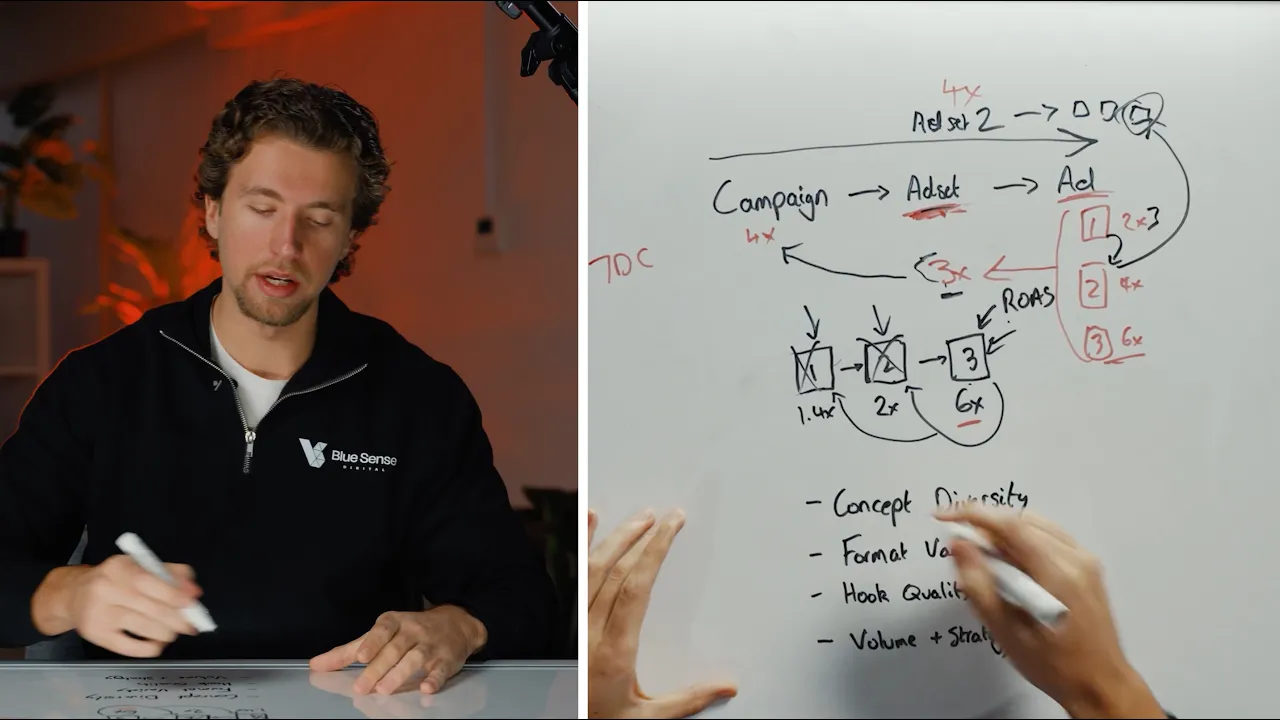
things are working, definitely don't go and launch more ads in here. If you go and make more ads for this concept, let's say the concept's crushing it, so you go and make 20 more ads, go and launch another ad set, right? And call it concept one and then like shoot two. Or obviously, whatever naming convention
Said at 1:31:11
Most replayed moment #2
25:172.3x the video's typical replay level
what he just said." What if my ad or my content has nothing to do with that audience? Well, then we've just pushed the creative to an audience that's not actually relevant. And people do this a lot. People's hook actually isn't as good as they think it is. People call out a persona without problem agitating. There's
Said at 25:10
Most replayed moment #3
1:27:052.2x the video's typical replay level
so going into the testing framework and how this then translates into the ad account, this is what the testing cycle looks like, which is that you build a hypothesis, which is you define what you're actually testing. So, when we're introducing new creative, generally the test is the concept, and particularly one of
Said at 1:26:58
The graph counts replays. It does not show where viewers stopped watching.
Words
20,748
Runtime
2:20:27
Speaking pace
148wpm
Reading time
86min
148 words per minute, below the 160 25th percentile of 349 measured videos. That distribution comes from the 349-video hook study.
Opening (first 30 seconds)
In 2026 and 2027, creative is the lever that sits within Meta ads. Media buying fundamentally is not your advantage right now. You need to become incredibly good at creative strategy, at creative design, production, then moving that into the ad account, and analyzing the creative to create this flywheel effect. By the end of this video, you'll know everything you need to know about creative for 2026. We're going to be running through
74 words, the words spoken in the first 30 seconds at 148 words per minute.
Free, no signup. See how the first 30 seconds hold attention, with rewrites.
Sentence shape
| Measure | This transcript |
|---|---|
| Sentences | 1,243 |
| Average words per sentence | 16.7 |
| Longest sentence | 80 words |
| Questions asked | 111 |
| Sentences containing a number | 130 |
Most used terms
Filler phrases
272 in total: actually 120 · like 82 · kind of 26 · uh 18 · right? 16 · you know 8 · I mean 1 · um 1.
A literal whole-word count of the same phrase list the Prepublish browser extension uses, so a phrase inside another word is not counted and a phrase used in its ordinary sense still is. It is a count and not a judgement.
Run the check on the words above: where attention is likely to drop, with a rewrite for each weak line. The free check shows the scores and the one issue costing the most.
What this transcript is
Every word below is the caption track YouTube publishes for this video, pulled from the video itself and reproduced unchanged. It is not Prepublish's writing, not a summary, and not a re-transcription: it is the video's own published captions. English captions, generated automatically by YouTube, in the video’s original language. Source: the video on YouTube. A channel that would rather this page did not exist can ask for its removal through the contact page, and it is removed.
In 2026 and 2027, creative is the lever that sits within Meta ads. Media buying fundamentally is not your advantage right now. You need to become incredibly good at creative strategy, at creative design, production, then moving that into the ad account, and analyzing the creative to create this flywheel effect. By the end of this video, you'll know everything you need to know about creative for 2026. We're going to be running through why creative is the growth lever, how Meta's algorithm actually works in 2026, concept architecture, hook strategies that actually scale, all the formats you can use and test, a testing framework to take that creative and actually put it into the account to get statistically relevant results.
We're then going to move into creative volume, creative diversity, and a financial model that ties it all together. We're going to talk about fatigue, scaling winners, portfolio management, creative production, so what do the teams, the briefing, and the process look like? And then lastly, we'll tie all of it together and package it into the 2026 playbook. So with that being said, diving into section number one, we have why creative is the growth lever.
I've been media buying on Facebook since 2018. So I've been about eight coming up on nine years in the Meta Ads Manager. And I remember back in 2018, 2019, 2020, there was so much leverage in media buying. You actually didn't need to be very good at creative, and as long as you had a massive edge on media buying, you could beat a lot of people. And the reason for that is that there was a massive skill gap. In fact, I would argue that any arbitrage opportunity that exists within a market is a product of the skill gap that exists at that point in time.
So, back then, the difference between someone that just goes and opens up the ad manager and someone that is a super advanced media buyer that spends 12 hours a day doing this and that's three years in, there was such an enormous difference that that difference allows for arbitrage and allowed for the opportunity. Now, over time, Meta has slowly compressed media buying. The targeting is now fully automated. I would recommend 99% of people are just running broad only, so there's no skill within interest targeting.
Andromeda now optimizes for the distribution of the creative. Consolidation is always favored across all of these digital platforms now because conversion data consolidates, which allows for better machine learning modeling. And all of the media buying hacks that used to exist, like duplicating ad sets or using bidding models in a certain way, none of them really work that well anymore. None of them really give you a big arbitrage.
And so because of that, this arbitrage opportunity has compressed. And instead, where the big arbitrage opportunity exists right now, is in creative. And it is because most people, fortunately for you, are terrible at creative. And so because of that, there is this huge opportunity that if you simply become good at creative strategy, at understanding what a good ad looks like, and then being able to build a system that can churn out a ton of high-quality ads, this is where you now make all the money on that.
And by the end of this video, you should unlock this opportunity. So, the first thing I want you thinking through here is the portfolio model. So, let's say that you have $1,000 a day in ad spend, and there is two different scenarios here. Scenario one is you have one single creative that's holding that entire $1,000 per day, and you're at a 4x ROAS. And then you have another pathway that you could choose. You've got three ads holding $1,000 a day together, and this is also at a 4x ROAS blended across these three creatives.
Now, I would rather be in this situation every single day of the week. And the reason being is that this situation decreases risk enormously within the business, because any of these three creative can fatigue, and the other ones will pick up the slack, and you can continue operating at this efficiency, at this ad spend. >> [snorts] >> But over here, if this creative fatigues, you're done. And I say this out of PTSD, working with probably eight to 10 clients now over the course of the last six years who have come to us 40% down year-on-year in new customer acquisition.
Their business is in a terrible spot and they're going, "Our business is declining. It's because we built this eight-figure business off three creatives that held a million dollars in ad spend and now these three creatives are all fatiguing and we're trying to spin up variants and it's kind of keeping us at some reasonable level, but we just can't get back to the level and we keep declining." And my response these days is, "It's too late.
We're not taking on that account because you should have fixed that six to eight months ago." What people will do is they will get one or two winning ads that can hold a tremendous amount of ad spend. And then what they do is they just stop making more ads and they go, "Like, why would we spend money on creative production? That's useless. Let's just double down and put all our ad spend here and then focus on other areas of the business." Yeah, amazing until these creatives fatigue.
And the only reality of creatives in Meta ads is that every single creative will fatigue. Every single creative has a maximum spend threshold that it will reach. And so you want to be constantly thinking through creative production ad account management and creative through the lens of this portfolio model, which is that we want to get as many ads as possible holding as much spend as possible. We do not want to over leverage into one or two ads because this is ultimately what ends up destroying a lot of businesses.
Let me give you three common mistakes that most teams are making when it comes to creative. Number one is a lot of people confuse activity for strategy. I'll give you an example of this, which is recently in the last few months I've seen two ad accounts that are launching 2,000 plus new ads a month and they're barely able to crack quarter million dollars in ad spend per month. Now, for those that work on large ad accounts, you would know that that is insane.
You do not need two to 3,000 new ads a month on a quarter million dollar budget. That's so much volume. And they weren't profitable. And so you're looking at the fact that they're launching so much volume, they're not profitable, They're doing so much activity, but there's clearly a gap in strategy. Because if you were putting 2,000 great creative into the account with a good offer, with a good persona, with a good angle, then you shouldn't need anywhere near 2,000 ads a month.
And so yes, I think volume's good. I think you should be launching as many ads as humanly possible, but with a standard of quality and with a strategy behind the creative that's actually going into the account. So do not mistake activity for strategy. This is really common right now because people think they can just launch more ads and their brand will scale. In fact, I hear this all the time, which is people are like, "Okay, I need to double my business.
Do I just launch 40 more ads a month?" I was like, "If it's that simple, everyone would do it. There's a little bit more to just increasing activity." The second one is misdiagnosing bottlenecks. So with in creative, there is a ton of different bottlenecks that exist that could be holding you back. It could be the quality of the creative. It could be the format diversification. It could be the quantity that's sitting at the different stages of awareness or the stages of the funnel.
So you have nowhere near enough top of funnel assets to produce the scale that you actually want. This might be a bottleneck on not actually introducing partnership ads or employing different strategies into the ad account to unlock more spend. There's so many different bottlenecks that exist just within creative that holds a business back, and most people don't understand all the bottlenecks that exist. So they misdiagnose it.
They don't realize what the actual bottleneck is, and so then they focus on activity that doesn't actually move the needle. For example, those two brands that I spoke about before, they were not only mistaking activity for strategy, but they were also misdiagnosing the bottleneck in the business, which is that they thought just increasing sheer volume would suddenly unlock growth, but it's not doing anything for them.
And it's because they're trying to fix something that actually doesn't need to be fixed. And then the last one, which I hope people are getting over by now, but I still see it from time to time, which is that creative is seen as a cost center rather than a revenue driver. And this is fundamentally because of the shift away from media buying to creative, which is that back in the day when media buying had a lot of arbitrage behind it, you didn't need a lot of creative and a lot of volume of creative.
And so because of that, business owners would often see the ad spend in the platform, the spend on Google, the spend on Meta, the spend on TikTok, Pinterest, Microsoft as revenue driving, but the actual creative that's used to fuel that spend as a cost center. We want to minimize that cost as much as possible because we just want the platforms to find us customers, but that's the complete wrong way around. The creative is actually what is driving the revenue and Meta and these other platforms are just driving the distribution.
Now, the fact that you can actually just post this stuff on organic and get free distribution as well means that creative is also the revenue driver organically. And so if you're thinking that creative is a cost center, you've got the completely wrong approach. We're going to be diving into later in this video exactly how much spend you should have on creative production respective to your ad spend levels so you can know if you're currently under or over investing in creative.
Before diving into creative strategy, you first need to understand how Meta's algorithm works because this is the distribution tool for the assets that you're putting in it. Now, everyone's probably heard the word Andromeda. It's a massive buzzword. I've talked about it in a lot of content. And to put it simply, it's just an algorithm change that Meta made because they had a lot of GPUs for training AI for their metaverse that kind of fell flat, and so they repurposed all of those training chips towards a better ad serving platform.
With that, the mechanical shift that you need to be across is that before Andromeda, and to be honest, we weren't even doing this pre-Andromeda, but it's an easy way to simplify the concept and then I'll go a little bit more nuanced, which is that pre-Andromeda, you would choose the audience. So you would say, "Hey, here is our interest. Please target this interest." And you would then go and load all the creatives in.
And so you'd put creative one, creative two, maybe you're putting three creatives under this ad set. And you're saying, "Here's the interest, here's the ads, go and match them." Now, post-Andromeda, what happened is you actually do the opposite. So, you put the ads into the account, and you don't select any targeting. And then Meta goes and looks at the creatives, and it goes, "Okay, I think that these are going to resonate with these people based on the transcript, based on the words in the ads, based on the copy, based on my understanding of historical conversion data." And then it will go and find the people to target.
Now, this is fundamentally a way better system because interest targeting has a lot of downside. Okay, when you're doing interest targeting, you're effectively labeling people with an interest, let's say pets, and then just arbitrarily serving all your creative to people that are interested in pets. But the reality is is that it's not just people interested in pets that want your product. It's probably people that are interested in pets within a specific age range that also have other variables or psychographic data points that are similar between them.
And so, there's so much additional nuance that needs to be captured. And this serving mechanism ends up capturing that nuance better than the old one. Now, the reality is is that Meta was kind of already doing this pre-Andromeda. We haven't used interest targeting in most accounts for like two years. But what Andromeda really did is popularize this new approach to structuring an ad account. And so, there were still so many agencies and so many people running interest targeting, it was crazy, even though we have a video that was put out two years ago about this exact topic on the Meta algorithm.
And this was before Andromeda. So, I was explaining this concept before this whole update even rolled out, and why we don't use interest targeting. It's called How Machine Learning Works in 2025 on Meta Ads. But this has popularized this approach, and now this is really how you want to be thinking through the asset. Now, why this becomes important is because the creative that you loads in that you load in is the targeting.
So, if you load a bunch of creative that's all the the you end up just targeting the same person. You don't reach new people. If you end up loading in a bunch of creative that isn't clearly resonating with a specific target demographic, then it's going to get confused. For example, if you're calling out everyone in your ads, if you're like, "Hey, everyone, look at this product." Meta is going to be very confused cuz it's going to go, "What should we target the entire population?
Is there a subset? Who should we actually go after?" You also need to think through this targeting mechanism at an ad set level in terms of structuring because if you just put a bunch of ads together that are all targeting different people under the one ad set, the ad set will also get confused. Who are we targeting? So, there's a lot of of additional nuance that we'll break down here when we get into the structure and testing section of this video.
But, this is fundamentally the key concept that you need to understand here. There's also the creative similarity score that rolled out of Meta recently. Now, most people still can't access this in their ad accounts, but if you reach out to your dedicated Meta reps, they can get you this score. So, you can have an idea of what your similarity score is in the business. And as it currently works, the higher the number, the worse it is because the more similar your creatives.
Now, why this matters so much is because of Andromeda bundling. And so, if you have, as I said before, multiple different creatives here, let's say one, two, three, but they're all slight variants. Let's say they're the same campaign shoot, but the model's just standing in a slightly different position. Or let's say it's UGC, but maybe there's a slight variation in the script halfway through the video. Or let's say these are actually very different videos in terms of formatting, but they're all speaking to the exact same audience.
Well, what ends up happening is Andromeda will bundle them together and serve them all to the same pool of audience. Now, because of this, because they're similar creatives going to the same audience, what happens in the ad account is frequency goes up. So, frequency is how many times users are seeing your ads. Obviously, these ads are just going to serve to the same people over and over again, so frequency goes up. Your reach will go down, so you'll stop reaching that new users.
And as a function of this over time, your return on ad spend will go down. And so you will start seeing diminishing returns in the platform. So instead, the position that you actually want to be in here is launching three creatives into the account, but these three creatives talk to different people, and therefore reach their own audiences. And with that, frequency declines because you're reaching different people with these ads, it allows you to unlock more spend because as they scale, you can almost think about this circle expanding as it goes to cold on cold audiences.
But because these are talking to different people, you can see there's not much audience overlap. And as a function of that, you're going to be able to scale to new audiences effectively without just increasing frequency and saying efficiency decline. Another incredibly important concept here about how the platform algorithm actually works is in sequencing of creative and the reliability of return on ad spend as you decline through the account structure.
So when it comes to sequencing creative, the reality is, and I think everyone watching this will agree with this, which is that if you just serve one ad to a user once, will they buy? And the answer 99.99% of the time is no. Generally speaking, you need to see an ad more than once to be confident in purchasing. Now, yes, there are some people out there that are getting one hit by ads and suddenly buy, right? That does happen.
In fact, it's probably happened to me at one point in my life, but it's very, very rare and you definitely cannot build an efficient business off of those people. And so because of that, you need to serve them generally more than one ad. Now, you could serve them this ad again, a second time. However, Meta put out a article ages ago, it was like four or five years ago, which said that after two impressions of an identical creative, probability of purchase declines precipitously.
And so if you look at the probability of someone buying, let's say this is a percentage, and then you look at the amount of ads that they are seeing. So this is frequency of an identical ad. So we're talking about the same ad here. You're not showing them different ads, just the same ad. When you show them the ad once, there might be a certain percentage uh chance of them buying. Then, when you show them the ad twice, it might be the same.
It actually might even be slightly higher. Because on second viewing, now they're warmer and they're more likely to buy. But then on third viewing, it declines massively. And then on fourth, massively. And then it pretty much declines to zero. And so, there is very little purpose at all in showing a user the same identical ad more than twice. And the way to actually stress test this idea that I'm telling you right now in your own ad account is you can pull your ad account up, you can go down to the ad level, look at the last 30 days, 60 days, and look at frequency at an ad level on cold campaigns.
And what you will see is that cold ads almost never have a frequency above a two. And if they do, you have a creative fatigue issue. You do not have enough diversification and volume in your account, and that is a red flag. Any good account that we're running, which is all of them, um no one has a frequency above a two on a cold ad. Just doesn't happen. Because if we see this, immediate red flag. We need to fix it. We need more diversity.
We need more volume. Now, the big kicker here is that what Meta are published in that statement, and if I can go and find that article, I'll put it in the description below, is that if you then go and introduce a novel creative, the probability of purchase stays high. And so, after seeing the same ad once and then twice, if we go and serve a different ad in as the third impression, probability stays up here. And then if we go and serve a different ad as the fourth impression, probability stays up here.
And so, we can actually keep probability of purchase up by rotating in new novel creative. Now, the question becomes, how does the algorithm do this and how does it decide the sequencing of creatives to these users to try to get them to convert? And this is where sequencing comes into the ad account structure. When Meta is optimizing across serving users ads, they're optimizing across understanding what sequence of creative actually gets the purchase.
So, is showing users ad one, then ad two, then ad three going to get the click and purchase? Or is it showing users ad three as the opening creative, then ad two, then ad one going to get the purchase? Or is it some other kind of combination? Are we coming in here and then going back here? There's all of these different combinations of serving these ads in a particular order that might yield a click and might yield a conversion.
Now, the kicker here is that Meta only attributes based on last click attribution. So, if we assume that the first sequencing example is what is actually occurring. They're going 1 2 3. If the click occurs here, all of the return on ad spend, all of the revenue gets attributed to this ad and it looks really good. Let's say it's at a 6X ROAS. Ad two, maybe some people buy at this stage in the sequence, but not a lot. And two at a 2X.
And then on this top ad, we're down at like a 1.4X. When you look at this and you look at spend distribution, let's say spend is equal across all three creative. Naturally, you go in here and you go, "Oh, this is obvious. Turn ad one, turn ad two off." Cuz ad three's getting all the performance. But that would be a bad idea. And this is the concept in a lot of our content about do not turn a creative off when you are hitting KPI.
If this is hitting your performance goal overall as an ad set, don't touch anything. Because Meta is sequencing between these creatives on purpose and it is creating an outcome. Meta's optimization is not based on last click. Really important concept to understand. Meta's optimization is actually based on multi-click and view. And so, Meta sees that people are viewing this ad, viewing this ad, then clicking on this ad and buying, and therefore it distributes spend here, knowing that it played a role in the purchasing journey.
But you don't see that. Unfortunately, we don't get any visibility into this at all within the ads manager, which is actually really annoying. And so, as a product of that, we just need to trust the system. We also need to think about the creatives that we're putting into the account. How are they working through this purchasing journey? Normally, if you're good at creative, if you're good at creative strategy, you can look at these three creatives, and you can go, "Oh, it's pretty obvious to me that this is actually the opening ad.
This is then probably the second ad, and then this is the converting ad." Because this is a super unaware top of funnel creative. This is then a product aware creative, and then this is a bottom of funnel very aware creative. And so, it's super obvious to me just looking at the three ads that that's what the sequence looks like. But, if you don't understand creative strategy, you're going to look at this and go, "I don't understand what's going on.
Why are the ROAS like this? Turn off, turn off, turn off, destroy performance." We're going to go into this in a lot more detail later on once we start going through the testing structure and actually KPI'ing and understand what is a good ad, what is a bad ad, but this is a really important concept to be across. Second concept to be across is that the reliability of ROAS declines as you go down in the account structure.
So, everyone who's opened up a Meta ad account knows the basic structure, which is you have campaigns, you have ad sets, then you have ads. Right? The campaign, you set up the budget typically, and you set up the overall uh optimization of it. So, is it optimizing for sales, reach, etc. Ad set, this is where all the targeting occurs. Now, people forget that these days because people go, "Oh, targeting is just broad, so I don't even really know what's happening at the ad set level." But, it's really important to reinforce targeting is occurring at the ad set level.
And then down here, the ads, this is obviously the creative that gets served to the end user. Now, when we look down at the ad level, and we start assessing creative, the issue here is everything I just went through. We can look at the ROAS numbers, but they're kind of meaningless because they're last click attribution, and there's a multi-click or multi-view through journey occurring here. And so, I can go in and say, "Yeah, this has a 6x ROAS, is Let's like try to scale it or make more ads like that.
But it's often a bad decision. So instead, when we move up to the ad set level right here, now we can look at all of these returns as a group. And we can go, let's not go into the individual ads because the reliability of uh the attribution here is terrible because there's so much happening across these different sequences. So let's just go up to the ad set and look, okay, at the ad set level, what's our ROAS here? And maybe overall it's at a 3x.
Now this is a lot more reliable. It is worth noting that cross-serving of ads still occurs at the ad set level. So you can have uh multiple different ad sets. So if I just throw another ad set in up the top here, we'll call this ad set two. And let's just put a couple creatives under here. A sequence that can occur is that people see this ad in ad set one. They then see this ad. And then they get served another ad set.
Now it's not prioritized by the algorithm. The algorithm will always prioritize serving adjacent ads under an ad set due to the way that targeting is siloed, but there is cross-ad set targeting. And so because of that, we might have a 3x here. We might have a 4x up here. This ad set seems to be doing better, but it's actually just because this ad set is picking up some bottom-of-funnel conversions being generated from this ad set.
That can be completely avoided as long as your structure is good and you're diversifying concepts across the ad set level, you shouldn't have much cross targeting. And you can measure all this and we'll go into it later on, but the whole idea is ad set is better. We can trust this number. We can trust it more than the ad level. Then once you go all the way up to the campaign level, the campaign ROAS number, as long as it's on 7-day click attribution, is super reliable.
This is generally very congruent with the actual P&L as long as it's on 7-day click and as long as existing customers are excluded. And so because of that, when we're making decisions within Meta, when we're thinking about structure, when we're thinking about introducing creative, we want to be thinking about measuring at the ad set or the campaign level, not the ad level, and we want to be thinking through this idea of sequencing.
So, the practical implications of Andromeda and the way that the algorithm and ad platform currently works is fourfold. Number one, you need concept diversity. We're obviously going to go into what a concept is, how to break it down, how to come up with concepts, what diversity looks like later on, but number one is you need diversity within the creative going into the account. You also obviously need that introduced into the structure so that you're having a concept per ad set so you don't have any of this cross targeting going on.
Number two is you need format variety. Okay, you can't unfortunately just have the same format of all of your creative. And the reason being is that Meta will prioritize formats that people resonate with. I'll give you an example, which is that I never ever, and I could scroll my Instagram feed for the next 3 hours and show you, I will never get a piece of UGC under my profile. Just doesn't happen. And it's because I never click on them, I never resonate with them, and so Meta inherently knows that low-fi UGC content should not be served to me.
And so, if your ad account is just low-fi UGC, I'll never see it. Now, same thing actually for DPA ads. Now, DPA are very bottom of funnel. This isn't really cold, so I'd have to be already very, very product aware and on the website, but I don't think I have ever been served a DPA almost in the history of the ads that I get served on my personal profile. Now, that is likely a product of the fact that DPAs are not a creative type that I resonate with.
I never click on them. And so, if you just had UGC and DPAs, it's very unlikely you'd ever reach me. So, you need to be making sure you have as much diversity in format type, and I'm going to be giving you all the formats and how you should be mixing and matching them later on so that you can reach as many people as possible. We then have hook quality. So, this is going to be a big section of this video, but with Andromeda, any kind of persona call out that occurs within the actual creative is going to go and prioritize that persona.
So, if I make an ad and at the start I say, "If you're a business owner doing over $5 million a year," Andromeda is going to read the transcript, it auto transcribes every single ad, and it's going to go, "Okay, let's try to find a similar audience to what he just said." What if my ad or my content has nothing to do with that audience? Well, then we've just pushed the creative to an audience that's not actually relevant.
And people do this a lot. People's hook actually isn't as good as they think it is. People call out a persona without problem agitating. There's the so many different issues that actually lie in hooks, which is why we're spending so much time on it, cuz I think people are terrible at hooks. Most ads I see, they're just not good. And then lastly, is that with Andromeda, volume is absolutely critical. The spend capacity of most ads isn't very high.
Most ads that you went to the into the account, if we look at mean ad spend per ad unit, sits at about $700 to $1.5 thousand depending on the ad account. And so, generally, you can't get much spend through most ads. So, you need volume to compensate, but you also need strategy at the same time. Because if you're just putting sheer volume into the account, which I've seen so many people do, with no actual strategy behind the volume, it doesn't actually work.
So, let's run through concept architecture. This is how you need to be thinking through the segmentation of different creative. This is how your naming convention should be set up on Meta as well. This is how you should be ideating in a Google Sheet or whatever format you want to think through this. And we'll also talk about the AI implications into this ideation process. So, what actually is a concept? A concept is a persona, angle, and offer.
And so, to have diversity within the creative that's going into the account, you need one of these three variables to change. If the offer changes, it will resonate with a different audience, with a different pool of people, because it's either a different product, or if it's it's a different value proposition or packaging of the product. If the angle changes, obviously, it's going to resonate with with someone different, because you're problem agitating on something else.
And so, if you sold skin care, you might start by problem agitating on wrinkles, but then you might have another ad that problem agitates on that. They're going to reach two very different audiences even though it's the same product because the angle changed. And then lastly we have a persona change. Now the easiest way to think through a persona change is obviously who are we talking to, but also who is actually in the ad.
And so if there's a 60-year-old woman in the ad, it's obviously going to resonate with a very different target demographic than if there is a 20-year-old woman in the ad. And so because of that we can adjust the persona and that will inherently adjust who resonates with the creative and who it will target on the platform. And so one of the easiest ways to ideate here and come up with almost infinite creative concepts is to start ideating on who are all the different personas that we want to reach.
What are the core personas in the business? And you can go through and you can probably come up with two or three or four. And then if you really drill deeper, you can come up with tons more. So yeah, we could go like females age between 40 to 45, etc. But then we can start digging into like what are the actual pain points. And so females age 20 to 20 five dealing with acne. Females age between 30 to 35 dealing with acne which is a slightly different problem because acne shouldn't be occurring at that age so maybe it's hormonal acne.
And then we can go women age between 40 to 45 with acne as well. That's also a completely different problem that should be fixed by now and so what are the different underlying causes that we can then resonate within that persona. And so you can build personas out in ridiculous detail based on all of the problems that the product solves. By the way, this is the case in every industry as well as fashion. So in fashion people really struggle to get their head around concept architecture, but with personas, it's the same thing.
Most large retail fashion brands will break their target demographic down into like four core personas and they'll give them names. But the reality is you can go way deeper than this because a persona could be a particular problem that a particular person is facing. And so there's this particular person who's a mom age between 30 to 35 with young kids and the problem that they face is they need an affordable dress that can go from a work dress into a night dress on a Friday afternoon.
That is a persona. That's a persona that you could make infinite creative for for that exact particular pain point and circumstance. And you could probably think of 400 examples of that. When we move into angle, it's the presentation of how we're actually going after the problem. So, what is the angle? What is the value proposition? Why would you purchase the product? And then the offer is obviously really straightforward, which is what are we actually offering?
The key here is personas >> and demographics. They're archetypes that are defined by problems, desires, and buying triggers. So, we want to be thinking about who are our avatars. And you want to think hard on that. Spend 20 minutes on it. Then, what problems do we actually solve for these people? Then, what are the differences in pain points, language as to how we talk to this person, and the proof that is required for this person?
And once we understand these three, we should be able to build out a whole lot of personas, which you can then, once that is done manually, go to an LLM like Claude or ChatGPT or Gemini, give it the entire persona list, and tell it come up with 20 to 30 more, and give it as much context as possible, which you should already have loaded in there in some capacity about the business, about the target demographic, etc. Claude, OpenAI LLMs, they're only going to give you averages.
And so, if you just give it three or four personas, and you give it your website, and you say, "Hey, come up with some more personas," you're going to get an average outcome. And everyone's going to be doing it, and you're going to get the same as them, and you're going to revert to the mean. So, what you want to do is if you are going to do this, you need to put all the manual effort into actually building out proper 30 to 40 personas that are actually good, and then you need to give it an unbelievably wide amount of context as to the business and the target demographic and everything you can, so that it can actually ideate properly on another 20.
And of the 20 that it produces, you shouldn't just be putting that in there. You should be refining down, probably cut down to four to five, give that back in, say these four to five are good, ideate on another 10 to 20. And then that way you can beef this out from 20 to 30 personas or whatever you get to and double the number. One really important note here is that people die in persona work by keeping the personas too broad.
Broad personas end up producing forgettable creative that is nowhere near specific enough for the target demographic that you want to resonate with. And so if you come away with a persona while you're building this out, which is let's say women age between 25 to 45, this is a terrible persona. The creative that you're going to make for this audience is nowhere near specific enough that it's going to resonate with enough people to be able to hold a good amount of spend.
As an example, instead of going for the persona busy professional, which I actually see so much when when I tell people to do this concept build out, and instead you would want to delineate this into a consultant who flies twice a week and needs a carry-on wardrobe that works for boardrooms and bars. Way more specific. And now with that persona call out, you're already thinking about how to talk to this person. You can almost visualize who this is, what their problem is, what we need to solve, what the creative should look like.
It gives so much more specificity into the actual briefing and production process. And then guess what, we actually reach this audience properly. But when we say busy professional, what is a busy professional? That is so wide, there are so like the age is all over the place, their gender is all over the place. What do they actually do? What do they get up to? Why do they even need this product? This is so broad that you will you will end up with mediocre creative.
You are better off making five ads for this target demographic than five for this. Now five for this will scale harder. If you can actually do a proper unaware ad that is going to resonate with this entire pool of people, yes it's a bigger total addressable market, so yes you'll be able to hold more spend. But the reality of you making a good ad for an audience this broad is actually very unlikely. And so you are way better off making more ads for very specific personas, and then as you start to become a eight mid-eight figure brand, you can start to play around in trying to get ads to work for very broad audiences, but the skill level required here is so high and it is just not required for most ad accounts.
Most ad accounts you can just go hyper specific and get way better results than needing to go and try to target the entire of a population. Another example here is instead of doing, let's say, health conscious parent, you could target a mom who's tried six different supplements because her toddler won't eat vegetables. Once again, way more specific. Now, you could go away and you could write a script for that. You know exactly what that ad looks like.
You know who who should be in it. You know who you're talking to. You know what the proof needs to be for that particular target demographic. You know what the language needs to be and you know the pain points of that particular persona. Now, an angle is the specific argument or perspective that you take when you're speaking to a persona. This is where a lot of creative strategy actually ends up failing because brands default to product features rather than crafting genuine angles that resonate with the persona.
So, I'm going to give you a lot of tactical application here. Number one is you want to problem agitate in some capacity. You don't need to do this in all of your creatives. In fact, especially if people aren't even problem aware, then you can't even problem agitate, right? But you want to be leading with pain as much as possible and you want to make the viewer feel the pain, feel like they have been heard before you go and introduce the solution.
Another great angle here is approaching with a contrarian truth. So, you want to challenge a common belief that people have which allows them to reframe. An example of this, particularly just as a hook, is everything you've been told about X is wrong. Everything you've been told about the protein industry is wrong. And then you go into obviously an educational piece that then might problem agitate that then obviously loops into a solution.
You want to typically always have social proofing in the angle. You want to build some kind of authority or expertise in the domain. So, this is more specifically domain expertise. So, you don't need, for example, a doctor in a lab coat showing up in every single ad for every industry. Right? If you're selling a running product, you want a marathon runner showing up. You want someone with authority in the domain that you're trying to sell it.
Curiosity is great and is commonly in most angles that do well, and this is specifically creating what's called a curiosity gap. And so, when you open up a video asset, and you can actually do this in image assets, too, but when you open up the video, you open up and create a curiosity gap or an information gap. As an example, you'd say, "Here's what the top 1% of millionaires know about saving money that they don't want you to know about." And then you don't answer it straight away.
And you go into a story, and you go into something else. You go into any of these other aspects. You problem agitate. You have a contrarian truth. You go into some degree of social proofing, although that's probably stacked towards the back of the ad. And then eventually, the ad goes on and on and on. You pull people through this journey. You educate them on everything. And then you end up actually answering the curiosity gap.
And so, you didn't have any information. You want to get to the information, and eventually the information's provided to you. And so, that's how you hold people through an ad. All good angles also have some degree of comparison or objection handling. And so, often people who are watching your ad have tried to solve their problem through other solutions. And so, you want to tell them why your solution will work versus all of the competitors.
You've probably tried this. You've probably tried this. You've probably tried this. If it's a piece of user-generated content, you'll commonly see the actual person in the script going, "I tried this, just like you would have, and it didn't work for me. I then tried this. I thought it was overhyped. It didn't work. And then finally, I was like, okay, I'm going to give one more thing a shot, and it actually worked." And then this one is the least compliant, but it is the best performing component to add into an angle, so I'm going to throw it in, which is a transformation, aka a before versus after.
Uh before versus after's Meta does not like them. You have to sneak these into creatives in a way that the algorithm doesn't flag it. But these are some of the best performing creatives ever, because people want to see visually a before and after. I think this is basic human psychology. Before and after's will always crush for as long as they exist. And because of that, Meta doesn't like you uh running them. So, when we're thinking about the angle, we're starting at the persona and then we're thinking about what angle and approach do we need to be able to resonate with this target persona.
And what you will notice is I've given you a lot of tactical application that can be included or built together into a script that creates the angle. So, the real key with the angle is actually you can simplify it into a one sentence, which is if our persona is women with kids age 35 to 40 that are having energy issues, we're going to then sell them creatine powder and the angle is going to be that it solves energy issues based on particular studies and then we can continue training it out.
The thing is the angle realistically, if you're going to write this out properly, we're just talking about the script, okay? And so, you just want to write the whole script. If it's a static, this is obviously going to be a bit tighter and you could probably encapsulate this in a few sentences, but the idea is we want to figure out what angle are we approaching selling this person on with a myriad of different strategies that's going to resonate with them.
And so, if we take for example that, uh, woman age 40 to 45, uh, with creatine and energy issues, well, we're going to want social proofing, but we want to we're going to want social proofing for that particular persona. So, we're going to want either case studies around persons people like that or the clinical studies that we're going to reference, which is going to give us expertise and authority, needs to reference their particular age and gender.
We want to think about problem agitation on that particular persona. So, how are we going to agitate to that problem? Are we going to pull in some kind of contrarian truth or curiosity gap that's going to hold them into the asset? Can we do any kind of comparisons to stuff that they've tried in the past? Has this persona tried things or is this very new to them? And then, can we pull in any kind of transformation at the end as a piece of social proof to back into the creative?
And so, we choose the elements that we want, we think about how we're going to slice and dice these into a script and that becomes the angle. And we're going to build out some actual examples of this in a moment, but before we do, I want to talk about the testing priority order. Which of these three components has the largest impact? What should you be thinking about testing the most of or the least of? Number one at the top is angles.
So, this is exactly what we're just discussing. This is the message or the argument. The reason why this is such a high priority is because we can sell to any persona that is relevant to the product. You should be able to effectively look at who has bought from you in the past. What persona do they sit in? Why did they buy from you? And then, we just need to craft an angle to that particular persona. If that persona isn't purchasing from us, we know that it's actually really an angle or an offer issue.
It's not an issue with the persona cuz we've already proven that these people buy from us, okay? And so, when something's not working, we typically don't want to look at the persona as long as you did it well. Like, let's not do broad 25 to 45-year-old females. Let's get hyper specific into a very specific person that has purchased from us before, and let's target them. But then ultimately, it's going to come down to an angle or offer issue, which is why angle is the first thing you should test if things aren't working.
You need to rotate that and improve the angle. And then the second is the offer. Now, fundamentally, the offer actually might be the number one most important thing out of all of this, but the issue is is that you actually don't have much flexibility in changing the offer. What do I mean by that? The offer is two things. The offer is the product, and then the offer is the value proposition or the way that we're framing value.
Now, when it comes to the product, if you have a single product and ads aren't working, well, I can't really tell you to change the product, right? Now, you could. You could change the whole business, but the reality is is that the product is the product. We need to change the angle or the persona, right? So, even though this is the most important thing, the product ultimately is king out of anything, we don't have much flexibility here.
Now, if you have a very large skew count, and maybe this is a new product that's being launched into an existing 20-product portfolio, then sure. Then we can go and say, "Is this an offer issue? Is this an issue with the product?" And we can start to troubleshoot accordingly. But for most people, you're pretty stuck on the product. Then when it comes to the value proposition, the value proposition we've got a couple options, right?
We can go and try testing bundles, we can go and try testing like a gift with purchase, we can go and try all of these different repackaging of the offer, right? We can do like tid as well, so you get percentage off when you buy two or three. We can go and throw in like a subscription offer. So, there's a lot of testing that we can do here. And we do this with a lot of clients is we'll come up with a bunch of different offers and how we should reframe value to try and get the funnel working more effectively.
But ultimately, you are limited here. There's only so many offers you can test. And we run into this issue, which is like, "Ah, we've tested like seven variations of how we can spin these two to three products. And now we're relatively stuck. And the only way that we can increase the value perception on the offer is to just do harsh deep discount. And we don't want to do that. We don't want to go and just eat 40% into margin and build a brand off a heavy discount reliance." And so, although the offer is unbelievably important, this is a huge variable that we do a lot of testing on.
And we do a lot of offer testing for clients. It's something that eventually you're going to hit a wall on. There's only so much offer testing you can actually do. And once you've found the best performing offer, you're stuck on it. And so, that is where then we want to be doing a lot of switch ups in personas. And personas is ultimately what's actually going to give us breadth and volume in the account. And then I have number four in here.
There is actually a fourth component of concept design. Now, this didn't really used to exist pre-Andromeda, but it's an additional component that we've added in recently. And it's because of the way it then Andromeda will take different formats and serve it to different people. So, as I said before, I don't get UGC content. I don't get dynamic product ads. And so, you could do all the mix and matching that you want of personas, of angles, of offers to try to hit me, but if the only ads in the account is UGC and DPAs.
And so, there is a fourth component to be able to reach more people, which is the format. You can have the same persona, same angle, same offer, and you can change the format and you will reach a different audience. However, this is nowhere near as effective as these other components. If you do this and then you change the format, the reality is you're probably going to hit a lot of the same people cuz you are talking to the same people, you are going with the same angle, and you are offering them them the same thing.
You'll get a bit of novel reach, you'll obviously reach people that don't resonate with the current format, but this isn't like a huge unlock great variable in the account. And that's why it is down at number four in the testing priority. Now, the big issue here and the reason why I spent so much time going through the testing priority order is everyone gets this completely the wrong way round. People spend all of their time testing formats.
They go, "Oh, let's test some UGC cuz UGC will work." UGC as a concept doesn't work. It is the script, it is the persona, it is the angle, it is the offer that is contained within this type of content that is what works. Just like a professional photo shoot doesn't work. The format isn't what works, it's what's contained within the format. Then people move up to the persona and they go, "We need to reach different people." Okay, we understand that in Andromeda we need to talk to different people, so let's talk to different people.
This is the second priority. It is not because if your ads aren't working, fundamentally, you have bad messaging and you have bad arguments for why they should buy. The creative is just bad. And creative being bad is normally a function of the angle and the scripting. And so this is what you should be fixing. Changing up the persona is just you trying to target different people with terrible ads. Then they go to the offer and they say, "Well, all the big influencers, Hormozi, says offer is king.
That's the thing that matters the most, so we need to go to the offer." Sure, but you're going to once again fatigue offer testing pretty quickly. There's only so much you can do with your one or two product. And then they end up at the angle, which is their lowest priority, but it should be the highest. So this is how you need to be thinking through testing priority. Now, the practical application of thinking through this format type actually translates directly into the account structure, >> [snorts] >> which is that when you have a campaign, you want your ad sets to be segmented out based on concept.
And the reason being is that the targeting exists at the ad set level. And so if you go and put in, as I said before, a bunch of different ads that are a bunch of different concepts resonating with different people, well then the ad set that's trying to figure out who to target is going to get confused. It's going to go, "Wait a second, this is resonating with men, old men, this is resonating with young women. Like, why are there all these different angles in here?
Who do we actually target?" Now, yes, there is some siloing of target demographic targeting at an individual ad level, but a lot of it still sits at the ad set level. And so, you're going to get worse performance when you go and bundle all different concepts together. Not only that, because you can't trust the reliability of ROAS at an ad level very well, when you go and put all these together and you don't hit KPI, you do hit KPI, let's say you maybe you got a 3x ROAS here, well, then you're going to look at these ads and not actually understand what concept worked because there's three concepts here.
So, what is the learning from this ad set? Well, if it was all under one concept, one persona, one angle, one offer, we could go, "This concept works really well. Let's go and make more like this. Let's double down in this direction. Let's not over leverage. Let's think about portfolio management, but we should definitely put a little bit more resourcing here cuz there's a squeeze available." If instead you have three different concepts in here and it's hitting KPI, what what's the conclusion?
Is Is all the concepts working, but this one doesn't have a good ROAS? So, we know that ROAS at the ad level isn't reliable. So, like, what is it How do we draw conclusions out of a campaign structure with mixed-up concepts at the ad set level? You can't. It's very difficult to do. You just got to hope your ads are good and that you get a good return. But, if you want to actually have any kind of learning feedback loop, you want to be structuring the account based on concepts.
All right, so here's a full buildout that I've just put together of a persona, angle, and offer that I think would actually crush. The formats we can add as we go along here. So, and you're going to have to excuse my writing. Persona: casual runner training for a sub 4-hour marathon. It's a male. They're a gym-goer. So, they're not just a runner, but they've gone to the gym. They follow XYZ influencers. So, there's particular influencers that we've called out and we know that they're probably following them in some capacity.
And they make about 70k a year per annum. This is important in terms of framing value around what we're actually going to try to sell to them. So, where do they actually sit in terms of income level? In terms of the angle, we're going to come in with science backing because we know that this person probably follows someone like Andrew Huberman, so we can come in with at least an angle around him. We're going to go through how creatine improves recovery, but it doesn't improve recovery in general cuz we want to talk to this persona.
So, it improves recovery for the long run. Now, people are only going to be doing a long run if they're training for a marathon. That enables a 5-minute improvement on the marathon time. So, we're directly connecting the entire angle to the persona, and we're giving them an expected outcome. Then, the offer is relatively straightforward. Creatine gummies, buy two, get one free. Now, this offer was selected by myself just due to the income level here.
So, we probably won't increased perceived value cuz creatine gummies are generally quite expensive, and it's going to be hard to push it onto someone and to reframe them against creatine for running. The actual format here, this is where we can chop and change this, and we can have like 10 different ads, right? We could go into a VSL format. Probably not going to work as well on this age demographic, but it is a potential option.
We could go into UGC, which I think is going to be great. We could go into founder talking head. We could go into a more educational high-fi style piece. You could also actually translate this into a carousel. Formats go on and on, but they're probably the starting ones that I'd go for. VSL, I might just leave out for now because the age is too low for a VSL to work on. And so, that is one concept. We're now we can come into here, and we can start changing one of these variables to be able to mix and match it to different target demographics.
And so, the reality is is that this angle will also work for women that are training for a marathon. So, we can change over that persona, and we have now a whole different concept that we can start making an ads for. Now, we can tweak the angle a little bit, and rather than making it for long days, we could make it for people that are trying to get up to a 5K run. And if you're just started running and you're trying to get to a 5K run, creatine is a great way to build up initial improvements in recovery, and therefore we can now resonate with a different persona.
So, you can start to mix and match this accordingly to reach way more people. Now, on hook strategy, everyone thinks that the hook of an ad is a trick to try to get someone to watch the video. But, the hook of an ad is a play towards relevancy. What you are doing is promising the user that what they're about to watch is relevant and contextual to them. And that distinction matters enormously because a lot of people think that they should just be baiting people into watching.
They should be trying to hook them through some kind of meme at the start. And yes, that'll give you really high hook rates if that's what you want to optimize for, but it's not actually going to give you conversions. Now, there's actually three different layers to the hook. You have the visual. This is what's actually on the screen. You then have audio. This is obviously the underlying audio. And then you actually have the copy that overlays the visual.
This could also be the primary text that sits above the ad. Now, the reason why I'm even putting this as a section in the video is because the hook is so important in video assets because 80% of people never watch past the hook. And so, if you're going and serving ads into the marketplace and 80% of people never even watch your ad cuz they don't like the hook, so they just skip straight past it, well, it's pretty critical then for us to try to optimize the hook, okay?
If most people are never going to see past this point in the video, then let's make sure this video is relevant, providing value in some capacity. You're trying to pull people through the video that are relevant and need to watch. An example of this in terms of resource allocation is that you can spend an hour going and making two hooks and then five different bodies for this ad, or you can go and spend the same amount of time, but just make two bodies and then 15 hooks, and you will probably always get better performance here given that the actual scripting is good on the bodies.
And the reason being is that the delta available in performance increase is normally higher in the hook than it is in the body. Once again, assuming scripting's good. If you're not good at scripting, well then like one of these bodies might actually be a good script and then it will hit and you'll get a misrepresentation of the actual impact here of the different components of the ad. Now, in terms of rating whether a hook is good, cuz I do this a lot.
I do a lot of reaction videos on Instagram saying this is a bad hook, this is a good hook. And I'm rating how well people have done in putting a hook together. Well, there is actually a grading system that you can think through as to how good your hook actually is. Number one is clarity. Can a stranger understand what you are actually talking about within the first 3 seconds or are you just trying to confuse them as a way to hook them in?
Number two is relevance. Now, people mistake this for a persona call out. They mistake this for me taking the persona that I was talking about before and just calling them out at the start. Hey, if you're a mom that has kids and you're age 30 to 35 and you have this problem, well listen up. Persona call outs are super overrated and it's because no one wants to hear themselves called out. People want to hear the problem that they're actually dealing with and so you'll always see much better performance agitating on a problem than you will on any kind of persona call out.
And I have this from personal experience. Anytime I get an ad saying agency owners who need XYZ, listen up. I never watch the ad. I move on. But if they agitate on a specific problem, it feels much more genuine. I actually wants to I actually want to watch through and find out what the solution is to the problem that I am actually currently facing. So, you want it to be relevant but persona call outs are nowhere near as effective as just making the problem agitation relevant to the person.
We then have novelty. This isn't a requirement but this is a really good way to create white space within the ad that you're making. And so this concept of white space is also this concept of purple ocean theory, which is that you have a blue ocean over here. You then have a red ocean over here. Now, this is actually one of my favorite books that I've ever read. I actually reference it in a lot of content, blue ocean theory.
This is that you want to reposition your product into a market that differentiates you from everyone else so that you're not competing on pricing, you're not even getting compared, and you're seen as a completely novel product or service within the market. Red ocean means that you're selling the same stuff as everyone else, and then you're just getting priced down to zero. These are terrible businesses. These are incredible businesses.
The issue with blue oceans is they don't really exist because if you're going truly blue, you're selling something that's never been sold before, and that's kind of risky cuz there's no actual market knowledge. You need to do tons of education, and there's no proven product market fit, either. So, yeah, you could reposition into something that you think people might want, but they might not even want it. And so, you realistically want to sit like somewhere in the middle here where you're repositioning into something novel, but it still has proven product market fit.
It's still proven that it is going to work. It's just not what everyone else is doing. It's slightly adjacent. And so, we do this a lot in our own content in terms of format testing. So, we'll rotate in different formats cuz we want to test new things. We'll take ideas from other industries, from other people. We'll come up with our own ideas to try to cut through and have novelty that people haven't seen before. I would say this YouTube video is actually an example of that, which is that there isn't many creative courses on YouTube for meta ads that are 2 plus hours long.
So, you want to be thinking through that concept, too, in the hook. Now, once again, it's not a requirement, but it will help in standing out without having some kind of gimmicky tactic to hold people through the ad that's not actually unique. The question I would be asking yourself here is has this hook been done a million times? And if the hook's been done a million times, probably don't do it. The next is specificity.
So, is there a way, and you're not going to be able to do this in a lot of hooks, but in our specific hook, is there a way we can use numbers, maybe quantify names, or maybe even quantify outcomes right out of the gates that's going to build authority into the hook. Anytime you can start a hook by name-dropping someone that's super famous that's relevant to the product in some capacity, it always does better. If you can name-drop some kind of number, 67% of people got this result, then once again, it's going to build authority.
If you can speak straight to a specific outcomes, it's going to build authority and it's going to be more specific to your target demographic that you want to resonate with. And then lastly, we have credibility, which is fairly obvious. Now, with credibility, you're usually not going to be able to do this through the copy or through the audio. It's typically going to have to be done through the visual. And so you were going to need either like someone famous that pops up at the start, you're going to need someone that is uh contextually relevant.
So if you're selling supplements, you have a doctor who pops up. If you're selling running supplements, it's obviously like a runner that pops up. You want to be thinking about how you can build credibility. Now, you don't need 10 out of 10 scores on all of these to be able to have a good hook. You really only need a couple of them done well. This is how you should be thinking through hook creation. Now, let me give you a bunch of hooks that you can go and start using.
Number one is problem agitation. Do you want to lead with the pain that the viewer is already feeling and you want to make them feel seen. An example of this is "Are you struggling with back pain from desk work?" This will only resonate with problem aware audiences. So you can get really good performance, but it isn't going to be scalable above that stage of awareness. Number two is a contrarian truth. So you challenge a common assumption, you create cognitive friction that demands a resolution.
An example here is everything you've been told about protein timing is wrong. And this works across all levels of awareness and it works strong in organic and paid. Number three is specific proof. So you want to lead with a measurable outcome, numbers, time frames, specificity. An example of this is "I lost 12 kilos in 90 days without giving up pasta." So you build credibility throughout the hook. The next one is a curiosity gap.
We spoke about this before, which is that you create an information gap that can only be closed by watching. An example is "What the top 1% of brands know about meta ads that you don't." And a funny side note is that my average view time when I use that hook or some variation of that hook is over 45 seconds. And so that hook actually works incredibly well because it creates an information gap in my own organic content.
Truth bomb, there's actually one specific client where this is just unbelievably well for. So that's why I threw it in here cuz I don't see many people doing it, which is that you lead with an uncomfortable truth about the product's price, ingredients, or industry. The honesty itself becomes the hook. And so, the hook in this instance is something along the lines of, "This product costs $120. Yeah, it's super expensive, but it's our best seller and everyone buys it.
Here's why." It ends up working exceptionally well for premium or higher average order value products where the price ends up being the main objection that people have. So, you confront it way up front, and it actually works really well at cutting through on cold audiences. Cuz even if I've never seen the product before, if someone's opening with, "This thing is expensive." I'm like, "Okay, what is that thing? Teach me more." And then it can go into a very very educational piece.
Obviously, that's only going to be relevant to very specific industries. The next is psychological confrontation. And so, this is being direct and pattern interrupting with a statement that feels like a friend calling you out. An example here would be, "You know that drawer full of products you never use? That's the problem." Or, "Stop buying things that make you feel guilty for not using them." It's not clickbait, but it's playing on an emotional pain point.
And so, the viewer ends up feeling personally addressed, which ends up acting as a scroll stopper. Once again, all of these things also apply into organic, which is where I think getting good at organic content is actually a very critical skill for getting good at creative strategy because it just translates into paid. We'll keep going here, which is you can also do sensory I'm going to call this a texture hook as well.
This does unbelievably well in fashion right now. This is just an ASMR hook. So, you don't need any words, 2 to 3 seconds, close-up of the fabric being handled, a product being squeezed, liquid being poured, package being opened, something ASMR related. These do incredibly well. Uh we have a lot of ads right now that are high performers on this hook. You've then got a founder's letter. You can go and apply all of these into most brands.
So, you want to open with the founder and their origin story. So, we started this because {dot} {dot} {dot} Or, "Here is why I left my career to go and build this." The more risk you can build within the hook as well, the better. And so, you want to build tension. And this is once again a big organic strategy that you just want to translate into paid, which is that you want to have high stakes within the hook if you're going to have a founder's letter style hook, so that people have a reason to continue watching.
I remortgaged my house and put $300,000 down to be able to order my first order of this product. And here's what's happened since. Like that hook, I could almost guarantee it would do well. Now, obviously, that has to be a real circumstance, which is why that hook does well. Right? It's things that you can't fake. If you actually did put so much risk on the line, it's a great angle to be able to talk about that risk.
The last one here is social proof. So, you want to lead with some kind of credibility marker. 90% of customers saw results in 30 days. Now, this is nine different hook types that you can go and take. You can probably apply at least seven of these into your particular brand right now. There are infinite hook strategies. Right? I could write hooks here all day long. I could fill the whole board with 50 different hook types.
You can go to Claude or ChatGPT right now and say, "Give me all the different hook types that I can run." The idea is that you want to take hook strategies and you want to translate it into your brand, but the scripting is going to be critical. And where you're going to really see uh a standout from competitors is over here in this novelty piece on whitespace. So, you can become an eight-figure brand by using these hook strategies and having relatively good scores over here, but if you want an ad that's going to hold half a million dollars in spend, you do probably want to generate something novel at the beginning of the creative that's going to stand out from competitors.
And then what's going to happen is all your competitors are just going to go and copy it. And so, you will set the trend. Now, I've spoken about the hook a lot, but an an important subcomponent of the hook is the bridge, which is where you move between specific components within the video. Now, the two big bridges that often occur is when you go from hook to body, and then when you go from body to CTA. These two bridges often don't end up being done well.
And so, what ends up happening is if you think about product awareness on the Y axis and then you think about time going through the video asset on the X axis, what ends up happening is people hook you in and you'll become aware that it's an ad and then suddenly as you bridge to the body, some people will just instantly introduce the product. So they'll hook you with something like, are you trying to train for a marathon and you want better recovery?
Well, creatine from Blue Zones Digital is your solution. That ad won't do well. Hook was good, bridge ruined the whole thing. The whole body could be good. Like the body scripting could be perfect, hook scripting could be perfect, call to action could be great, but the bridge ruins the whole asset. And so you don't want your asset to look like this where there's this massive step change in product awareness as a user goes through the creative.
Instead, you want to blend these out so that people are slowly becoming aware that they're being sold to. And so instead, you're looking like this. And so I don't really even need to give you that much information on how to do this. To me, it's pretty intuitive which is just blend in the introduction of the product. Don't just suddenly introduce it or else people go quickly from oh, I was watching something that was educational or that was teaching me to oh, I'm actually being sold a product.
And people don't intuitively like that feeling. This also, this jump in bridge will typically ruin the flow of scripting in most very good top of funnel unaware ads. And so when it comes to really good top of funnel unaware ads, what they do is they move people through the stages of awareness as you progress through the ad. This is actually something that VSLs, video sales letter ads do unbelievably well because they get the capacity to teach through the asset.
And so you start with unaware. So you're hooking people in with something that they might be interested in, usually some kind of curiosity gap. Then you're making them problem aware. Okay, now I understand that there's a problem with drinking water. If I just drink water every day, not only does it not have electrolytes which apparently I need, I didn't even realize this was a problem, but also tap water's incredibly bad for me.
Okay, that's interesting. What's the solution? Oh, the solution is is that I need this amount of salt in this kind of ratio and then I need to stop using tap water. Okay. Ah, there's actually a product that solves this problem. It's canned mineral water with electrolytes in it. Ah, okay. I was unaware of anything. I became problem aware. I became solution aware. I'm now product aware. Okay, this is going to fix all of these problems that I didn't realize I had and now I move down into the aware stage of awareness where maybe I convert on a retargeting ad.
Now, this is generally how you want to be thinking through scripting on really good top of funnel ads, but what most people do is that they'll start really unaware. They'll then go problem aware and then like in here they'll just introduce the product. And you're like, "What are we doing? We haven't even moved them to the next stage of awareness. We can't introduce the product yet." And people do this cuz they think in retention curves.
And so they go, "Well, if we look at the retention curve on an ad, which is how many people are still watching on average as we move through a creative, the retention curve will look like this." And so intuitively you go, "Well, 80% of people are going to drop off by the 90-second mark. So we need to introduce our product before the 90-second mark cuz we don't want most of the users to not know they're being sold our product.
It's the wrong way to think through it. Okay, you actually want to introduce your product as late as possible in the creative because you want people to be problem aware and solution aware and really pre-framed and engaged, ready to buy once the product is actually introduced. You don't want to introduce the product too early before they're actually aware of what the problem and solution is. And so you often end up getting way better conversion rates out of an asset by moving the product introduction and call to action way later because these people are now way more qualified to actually buy and are way more higher intent.
And so yes, you can introduce it sooner, but they're not high intent enough that you will actually have worse conversion rates and even though it's more total people, you will ultimately get worse total purchase volume out of the asset. And so that is something to be really careful of when you're thinking about bridging. Now, to wrap this section up, one final question that I get a lot is does hook testing still work post Andromeda?
Because isn't the whole point in Andromeda that we need diversity? And if I have a 90-second Facebook ad, me just changing the first 3 seconds at the start, that's not diversity. Right? That's the same ad. We just changed the first 3 seconds. Meta will still recognize a different hook as a different creative. It will get its own creative ID. It will not get pulled together with this asset. It will go and reach a novel unique audience.
Now, obviously, there is going to be some degree of overlap because 87 seconds of this asset is going to be talking to the same person with the same problem with the same offer. So, if we actually look at the concept framework, it is the same concept. It's just the hook chain. So, the question becomes is hook changes worth it? Yes. Why is it worth it? Because it is so low effort. Rotating in new hooks is almost free.
Okay, when you record the ad, you just record the hooks six times and it takes an extra few minutes and you've got six different hook variations. Or you can take existing high performers and you throw new hooks on them. We have had ads that have spent 50 100 thousand dollars fatigued, then we just rotate 50 new hooks on and we get another 100 thousand dollars to spend at the same efficiency. And those hooks took like 1 hour to shoot.
And so, you can very much so keep winners alive through changing hooks. You can also take ads that didn't work and then suddenly make them work by fixing the hook that had a really bad hook rate. So, yes, absolutely hook testing still works post Andromeda. You should be doing it. It is still the highest leverage point in videos, organic, ads, YouTube, everything. All right. So, when it comes to formats, there's five questions that you need to be asking yourself when you're thinking on a format.
Number one, what is the concept? We need to define the concept first before we even think about formats. You want to go out, build your persona angle offer, then come back to thinking about the format. You don't start with the format and work backwards. This is the last step. Secondly, does this concept require education? Now, if it requires education, you likely need to go into some longer form asset that's going to educate.
Number three, can the value prop be communicated in a single frame? This is obviously going to lean yourself towards images, carousels, something that's easier to produce. Can obviously still be in a video, but you do have an advantage with images that they're very easy and cheap to produce and you can produce a lot of them. So, anytime you can produce statics over videos, you generally want to do it. Now, there's two different approaches to statics, if we just leave these out for the moment, which is number one, you can use statics to quickly test different angles and different concepts, get fast feedback, and then develop that into a video format where you can go a lot deeper and create a more scalable asset.
And then number two is that images are very cheap to make and so they often end up outweighing videos in the cost of production. So, if you look at the average spend of an image versus a video in your account, it might actually make a lot of sense to just go way harder on images because the cost of production is super low and the average revenue generation is decent in proportion. And so, this is what is called cost of production against the average revenue per ad.
This is something that we calculate for everyone during the audit process because we want to understand what is the average revenue per ad that you put into the account. For most people, it's about like $2,000-ish. And then what is your cost of production against this delineated down to contribution margin. And so, we minus off gross profit, we minus off the cost of serving the ad, we might find that average contribution margin per ad unit is, let's say, $350.
How much is it costing us to make an ad? It might be costing us $400. Okay, this equation doesn't work. We're currently paying more to produce an ad than we're getting contribution margin out of each ad. We can then go and delineate this down to images specifically. We might find out images cost us about $50, but they're producing us $300. Videos are costing us 500 and we're only getting 400 here. And so we actually find out even though videos do perform better, the actual cost of production versus expected contribution margin is worse than image assets and therefore we should actually just double down on images.
And I know people doing $200,000 a day in revenue on just AI images. And so there's absolutely no reason as to why you can't do hundreds of thousands of dollars a day on images only. And if you can't, it just ends up being a skill issue. Number four is does the product need a demo? This is just going to be a general question that applies to the business as a whole, which is how much education do we need to force people through because obviously you're going to be relatively restricted with images then unless you get really fancy and you you have a good designer.
And then lastly, which ties into both of these points, is what stage of awareness are we sitting in? Okay, if we're sitting in a very high stage of awareness, we need a creative that is going to be a longer format that can educate, typically a video. If we are sitting at a very low stage of awareness, like the product aware or aware stages, uh we can just go for DPAs and images and get away with very bottom of funnel ads.
I want to reiterate that the belief that image ads are bottom of funnel and video ads are top of funnel is fundamentally a skill issue. Once again, I have seen multiple ad accounts, I've talked to multiple people that do hundreds of thousands of dollars per day in revenue off just that. And so if you're saying, "Oh, statics don't work, they're bottom of funnel assets." It's because yeah, the way that you design them and the way that you approach them and concept them out is bottom of funnel.
But you can make top of funnel statics. We're now going to cut out two three ad breakdowns that I have done on static images. We're going to go through an organic tweet format, which is an IM-8 health ad. We're going to go through a creatine gummies ad. And then we're going to go through a GLP-1 hair loss ad and you will see three statics that are holding tons of spend on top of funnel. This is an incredible static ad. 4.7 thousand likes down here.
It's by IM-8 and let's break down exactly why it's so good. Number one, it's a new format. They're actually using a tweet here and they're re-posting it, so it feels organic to the platform, but it's actually an ad. Now, further to this, they're reinforcing it by using not a partnership ad, so they're not collaborating with IMA and Dr. James, but it's just Dr. James. So, they're running it as effectively a whitelisting ad through this profile, so you don't know that this is an ad.
In fact, you would look at this for a very long time, and it's only until you start getting through the copy that sits under the creative over here, that you actually realize that you're getting sold something. So, what's so good about the static over here, other than it being a common format and that you're not really knowing that it's an ad, so it feels organic? Well, symptoms of vitamin deficiencies. So, right away, we're problem agitating into okay, here's some education around how vitamin deficiencies could be impacting you.
Then, this is an unbelievably wide set of symptoms. So, if you have dry eyes, if you have poor vision, if you have low energy, if you have bad skin, if you have cracks on your mouth, if you have fatigue, if you have bleeding gums, if you have painful muscles, if you have excessive bruising, all of these things, very, very wide total addressable market. Well, then, it's an issue with a vitamin deficiency, and it tells you exactly what the vitamin deficiency is.
So, you get education around okay, here's my problem, here's the solution. Then, you start probably reading the copy, and you go, "The best multivitamin equals IMA, daily ultimate, 10% off. Here's the thing." Then, you get more educational pieces here about how the product actually works, and obviously, because this is an ad, a big call to action will appear at the bottom here that it will allow you to click straight off the site.
So, it problem agitates to a very wide target demographic, it then educates about exactly what the solution is in terms of vitamin to solve your particular problem. It does it in a format that's super organic. It then maintains that organic feeling by not having the brand and company name attached with the post, and then this is obviously driving off to cold audiences, probably driving off to this guy's audience, which is even better up because we're obviously piggybacking off his organic.
This is an advertorial static card. These are really good. They perform incredibly well. They only perform well though if you go to an education-based landing page or you use the primary text to educate heavily. So, let's break it down. The best hair growth products of 2025 and the ones to avoid. Here's what the big brands are not telling you. And then we have a bunch of different products here. So, we know or we at least assume, okay, this is some kind of blog.
This is some kind of article that's going to educate us around what hair growth products we should actually be buying. Now, even better, it's running through a doctor's page. Okay, so there's a bit of authority here. As a dermatologist, I set out on a mission to find the most effective hair growth products. Not very long copy, so they're not selling us on anything here. Okay, so we want to find out more. So, what do we do?
We go and we go and click learn more. Now, from here we end up on a website called dermatologist reviews. Now, this website is owned by the brand that's trying to sell you on something. This is a really good funnel. So, hi, who is the person? Why do they have authority? This is the blog posted. I set out on a mission and here are just the products. Right. And then it goes into all of the reasons as to why and it goes into selling that product.
And then it does go into the other ones, but it goes into why yeah, I probably wouldn't choose these. They're not the best. Now, why is this a giveaway that this is actually a brand pushing? Well, because if we look at the rankings here, you can't click on any of these, right? But you can click on this one. And if you click on this one, goes to a custom landing page that then takes you through a quiz funnel. You go through a quiz funnel and then you get pushed through to the conversion.
So, this is a really good funnel that they're running here. I really like it. And almost to make sure they're a little bit compliant, I imagine. As you scroll down, this takes you to the same funnel, but as we continue going down, look at all the green ticks here. So many green ticks, one red. Only available online. And then him and hers, oh, widely available online. Oh, that's the best thing about it. All of these negatives, but you can still click here and it takes you to an Amazon affiliate link.
And so they're like, "If people are not clicking on us, then we may as well still redirect them somewhere." And then obviously you can see they've put the the into reviewing all of these and all the reasons as to why they wouldn't buy them. This is a super effective funnel. I imagine this is doing quite well for them. If your target demographic is 50 plus, you can serve on Facebook feeds, this ad type crushes. It's static image ads with long-form copy.
And the reason why they do so well is they go through a massive story that speaks to an unaware audience and slowly pulls them into being problem aware, pulls them into being solution aware, then pulls them into being product aware, and then finally, they're all the way at the stage in which they can convert. These ads will crush on cold audiences, but it takes an enormous amount of skill to actually be able to write this copy properly.
Like, yes, you can be AI assisted, but if you don't know fundamentals of how to emotionally appeal to a specific target demographic, then it's not going to work. And this is ultimately where getting good at copywriting really matters. If you can get good at copywriting and you can get good at pulling people through the stages of customer awareness, then that is ultimately how you can create these static image ads with long-form copy that are going to absolutely crush.
Now, in addition to that, to keep it contextual to 2026 in the time in which this video is being made, a type of video asset that does incredibly well right now on older target demographics is a VSL, a video sales letter. The reason why these types of ads do so well is because they pull people through all of the stages of awareness and they're highly educational. You can also really leverage AI within them. We make a lot of just AI VSLs end-to-end, and they do quite well.
And then some of them do unbelievably well and hold hundreds of thousands of dollars in ad spend. So, what we're going to do now is I'm going to pop up a few examples of VSLs and me breaking them down so you can see an example of what this ad type looks like. >> IBS, leaky gut, or bloating, you're probably missing this one thing. >> That's a really good VSL. First off, it starts with a persona callout. If you have these issues, keep watching. >> Doctor probably told you to just manage it with a course of pills.
That's because >> Then it's going into objection handling, the common way to fix it. >> They're treating the symptom, not the cause. But here >> Then it problem educates and opens a curiosity gap. Okay, I thought it was actually going to cause us to fix the problem, but this ad is saying it's not. All right, I'm going to keep watching. >> Here's what they're not telling you. Your gut isn't broken, it's starving. Your gut is an ego >> I don't love that because it's an AI script.
So, that's called contrast negation, which is where you say it's not X, it's Y. You see a lot of this in a lot of scripting these days. I probably would take that out. >> an ecosystem of trillions of bacteria. When the good bacteria die and bad bacteria take over, everything collapses. When you get inflammation, a leaky gut, and your body stops absorbing nutrients. This >> Really good educational piece. >> is dysbiosis, and it's not rare. 40% of people have it.
Most of them don't even know. You might be among them, but here's the problem with >> Really good way to enforce that no, you do have this problem because when you prescribe a problem to someone, particularly when it's like a disease or it's a physical medical issue, the immediate reaction is, well, I probably don't have this. I imagine this is rare. So, instantly increasing the TAM by knowing that 40% of people actually have this problem is a really good way to keep people watching to go, okay, maybe I do have the problem.
Tell me a little bit more about it. >> with every gut supplement you've tried. They just throw probiotics at it. That's like sending a single soldier into a war zone. One probiotic can't survive in a toxic gut. It dies. It doesn't colonize. It doesn't help. I AM 8 daily ultimate essentials doesn't just add probiotics. First, digestive enzymes clear >> I don't love the bridge. If the ad team's watching this, I would extend for another 15 seconds and educate around how the I AM 8 ingredients actually fix the issue and then introduce I AM 8 as the solution that has those ingredients. >> and undigested food.
Second, prebiotics create a safe environment for good bacteria. Third, 10 billion CFU of probiotics flood in and colonize. Fourth, postbiotics strengthen your gut lining and stop the leaks. >> So, the 10 to 15 seconds would be saying, uh the way that you get probiotics to work is that you have prebiotics and postbiotics around it, and that's actually what creates the system to work. Fortunately, Biome Aid has put all of those three solutions in one sachet, so you can get them all at once, and it can fix the issues that we agitated at the start. >> It's a complete military operation, not a single soldier. >> That's an AI script once again, contrast negation.
I'll try to avoid that. >> And it works. In a 12-week clinical trial, 85% of >> And then it goes into social proofing, it keeps going on. Overall, really good ad. Just some small points of improvement. >> This ad has 25 million views. It's been running for 3 to 4 years now. It's absolutely crushing, and I'll show you what it does so well. It takes a really common format of VSLs, and then it adds objection handling UGC to the front.
So, let's click play and start to watch the ad. >> I want to talk to you about something that's been making waves on social media lately. You've probably seen this guy all over your feed claiming that cutting carbs is >> So, they're using the split screen for engagement and to add more context to the video. >> necessary for weight loss. No need for long hours on the treadmill, either. Now, I know it sounds too good to be true, but let me tell you, there's more to this than meets the eye. >> I decided When you're watching this, you think that this guy is obviously going to disagree with the cutting carbs because he's coming from a news authority perspective, and it kind of feels like a collab video.
Like, this guy is talking about how you don't need to eat carbs, it's crazy. Like, what is he talking about? >> I decided to delve into this topic and do some research. Turns out, this guy is a celebrity trainer who's gained a massive following for challenging mainstream advice. He claims that what we've been told about weight loss is wrong, completely wrong. And you know what? Makes a lot of sense when you listen to what he has to say.
So, >> So, that's the first time in which he validates the person he's talking about, but everything through that first 28 seconds was contrarian hooks, contrarian takes over and over again. >> Celebrities don't cut carbs. >> That ain't how you lose weight. I don't do that. None of my clients do that. Nobody that has ever asked me how to lose weight have I ever told them to do that because it simply just doesn't work.
For anyone who doesn't know their metabolic type, listen up. The fastest way to burn fat and get shredded is not keto, it's not paleo, it's not carnivore, it's not vegan. >> Note that this creative is just going very, very hard on contrarian takes. It's pretty much the entire strategy of this whole ad is like, how do we put as many contrarian takes in here as possible to continue to string people along as we kind of educate and we kind of hint towards that we have our own system.
And then eventually we obviously bridge into that system. So they're creating a curiosity gap through this whole thing. Okay, if no one needs to cut carbs, then what is the actual solution? >> And it's definitely not super intense exercises like this. Cuz listen, if you're trying to get in shape and I don't care what it's for, a wedding, vacation, summer, don't care. If you're trying to get in shape fast, you need to follow a plan for your body type.
And there is a very simple breakdown of body types. There's three body types. Uh you have the skinny person who's trying to put on muscle. Then you have someone who's kind of in the middle, maybe has a little bit too much fat >> turns going to go into the educational piece. It's effectively going to sell his system in the way that he views weight loss and body types and programming, etc. This is such a good ad. In the last 5 days it's got 2,000 likes.
Let's break down exactly why. >> So you hop on chest is >> opens with a contrarian hook and obviously the visuals pull you in. >> What I would say if I was a caveman that wasn't aware of all the way >> builds contrast and then goes into an educational piece. >> is that you can boost it naturally. Being low T can be caused by many fac >> switches over to a different format, which is the faceless format, which is better in it to education, particularly on organic and we're trying to make this ad feel organic. >> High stress, vitamin deficiencies, not enough fat in your diet, not enough good sleep, microplastics, high estrogen, high inflammation.
It's become a serious problem for young men who often feel like there's only one solution. >> Af >> So notice they'll problem agitate and then they'll educate. Problem agitate, then educate. So there's all the problems, here's the solution. This isn't the solution for you. Goes back into problems. >> After all, global testosterone levels have dropped over 30% in the last 50 years. Young, fit, healthy >> So, there's the education, and then here's the problem agitation. >> guys will have the testosterone of a 70-year-old that has never seen the inside of a gym in their life.
It's a grim side effect of our modern society with low test taking away the feeling of being a real man. A consequence of this is a wave of young men, even teenagers, hopping on TRT out of desperation and because they don't want to fall behind. But, injecting test is a minefield of side effects. Rapid hair loss, high estrogen causing gyno, mood swings, >> objection handling around the core premise of the hook, which was injecting test, and so now he's explaining why that's not a good idea. >> There's infertility and acne, not to mention a big-ass needle injected multiple times a week.
In amongst this chaos, how do I, a lifetime natural, have more testosterone than most guys running cycles? Whilst I'm dialed with my sleep, training, recovery, and diet, so many guys who are low T. However, my secret weapon is a Nattie Plus all of me. >> And there you go, there's the product. So, the product's been introduced after about a minute and a half into the creative, which is why it's done so well. It's why it's scaling so well.
It's on an influencer profile. People know this influencer. It's likely prioritizing getting served to his own audience. And so, when people are watching this, they're not knowing it's an ad. They're thinking it's educational. And honestly, it's a great educational piece. It goes into everything you need to know about testosterone and why you would want to get behind and buy this product. And it does it in a way that's very entertaining.
It's fast cuts. It's constantly changing formats. It's built native for the platform, which is why it's scaling so well. >> One important PSA here is DPAs, okay? DPAs, dynamic product ads, those are the carousel ads that will dynamically pull in the product that someone visited on the website, as long as your pixel is set up correctly, pushing back in data on which pages were viewed. DPAs cause a death spiral in a lot of brands.
I see this in fashion particularly, uh which is that DPAs have really good attributed ROAS. The ROAS number is very high. Now, the ROAS actually isn't very high once you delineate out existing customers. So, if you remove existing customers, it drops precipitously. And then, you also want to delineate the attribution model down to incremental attribution. And so, you can do this by clicking on the breakdown button in the top Actually, sorry.
You click on the columns button, compare attribution settings, incremental attribution, apply. And then, you'll get a split out of what the incremental ROAS is on the ad. A quick lesson on how incremental attribution works is that every single day, Meta is targeting, let's say, 10,000 people in this square. It will hold out 10% of users, and it will look at these people that didn't see your ads, how many of them converted.
Let's say, 1% of them converted. Over here, the people that do see your ads, 2% of them convert. Okay, great. What we can do, what's called in data science, is a difference-in-difference calculation, which is simply minusing the control versus the treatment. This equals 1%. So, your ads are actually having a 1% impact, not a 2%. And so, when we see a five ROAS on that DPA, let's say as an example, we actually need to adjust that down by 50% to 2.5.
So, that's what incremental attribution is doing. That's what it's going to show you on the ROAS here. And the ROAS in your DPAs is going to be way lower than you think it is, particularly on new audiences. I am still yet to see an ad account where this is a great scalable ad type on cold audiences. Now, is it an ad type that can work on cold audiences? For sure. Can you spend a thousand dollars a day on it? For sure.
We have some ad accounts that do. Can you spend fifty thousand dollars a day on it? Absolutely not. Like, you just can't scale DPAs that well on cold audiences. Most people are way overspending cuz the ROAS number looks good. So, just be super careful. Cuz what ends up happening there is because DPAs sit at the bottom of the funnel down here, is that people start reallocating their budgets from these top-of-funnel efforts that have bad return on ad spend, and they just start moving budget down here.
And when you start moving budget down here, you start losing the quantity of users that are coming through from the top of funnel, and you start scaling something that isn't scalable, and the whole funnel topples over, and return on ad spend declines, and everything goes poorly. So, in fact, when you're thinking about funnel budget allocation, you want to be thinking about 70% to 90% of budget going towards top of funnel.
You want 20% ish of budget going to middle of funnel, and then you want really like 5% to 10% of budget going to bottom of funnel. There's actually a better way to calculate bottom of funnel budgeting, which I'm going to show you later in the video. But, this is rough split on how it should look. Now, what's interesting these days is that you used to do this through campaign structure. So, you would have your top of funnel ads, and you would just set your budget here, you'd have your middle of funnel, you'd set your budget here, and then you'd have your bottom bottom of funnel.
Uh the issue right now is there actually is a lack of campaign structure. You shouldn't be structuring like this. You should just consolidate these down, and you might be able to have a bottom of funnel that sits separate. And so, because of that, the actual budget allocation is coming from the creative production volume. And so, you want 70% to 90% of the volume of assets you make to be at the high stages of awareness, and you want 20% of them to be at the middle to bottom of funnel stages of awareness.
So, this is more so a percentage allocation of creative production than it is a percentage allocation of budgets across a campaign structure. I would say one of the most underutilized formats in 2026 is partnership ads. Now, I think people are catching on to this actually, and the arbitrage is probably coming towards its end. So, by the time you watch this video, if you're way into the future, this might not be the case anymore.
You might have missed it. But, partnership ads, what they are is they run through the creator's profile. So, you'll have your profile here, so your company name on the top of the post, and then you'll have and and then the influencer's profile right here. Now, these days there's actually a setting that allows them to change the combinations, and so sometimes you'll just see the company, sometimes you'll just see the influencer, sometimes you'll see both, and it will split test and decide on whatever the best mix is.
Uh but, the reason why these ads do so well is that the targeting uses the audience on both handles. And so, if this is an influencer that's actually somewhat contextually relevant to your target demographic, which I hope it is, this ad will go and reach their audience, and it will use their audience data to find new people. And so, you're effectively leveraging the influencer's audience to help in your targeting on cold, not even just targeting on warm.
And that's why they end up doing so well. They also feel super authentic. When you get an ad from a uh influencer profile like this, it doesn't feel as much so like an ad, so it doesn't feel like you're getting sold to. So, when you're getting an organic piece of content, it resonates better. And some accounts that we're working on, we have ad spend up to 40% of total account spend running through partnership or collaborator ads.
And so, this is a really important thing that you should have in your account. If you are not running them, you were just at a disadvantage to competitors. All right, so going into the testing framework and how this then translates into the ad account, this is what the testing cycle looks like, which is that you build a hypothesis, which is you define what you're actually testing. So, when we're introducing new creative, generally the test is the concept, and particularly one of those four variables that we're changing in the creative.
Then we want to build a bunch of ads under that concept. One big mistake that a lot of people make is that they come up with a concept, they build it all out, it looks amazing, and then they make one ad, or they make two ads, or they make three ads. Like, really, if you want to test a concept properly, you want at least 10 plus ads, considering that most people's hit rates in their account are around about 5%. And so, technically speaking, if you have a new concept coming in, you would need to do, if you had a 5% hit rate, you'd need to do at least 20 ads to expect a winner.
And so, thinking about your hit rate in the account as a function of how much volume you need to do to be able to validate the hypothesis is critical. Then you want to go and launch, and I'm going to show you with the exact structure that you should launch into. You then want to go and analyze, particularly against the hypothesis. So, what did we expect? What How much spend did we want to go through? How many conversions did we expect?
What was the ROI? And then how did that compare? If it worked, we want to be looking at how we can employ strategies to scale, and then we want to go down and iterate. And this iteration process gets faster and faster the bigger your ad spend. So, now when we think about account structure and introducing tests into the account, this is where there becomes a lot of flexibility. And this is where we prefer not to actually make broad sweeping account structure recommendations because the fundamentals of account structure is that the complexity of the ad account should be a product of the complexity of the business.
And so, if you run a startup that's doing $10,000 a month in revenue and you have one product and you have one persona that you're trying to crack, the account structure should be unbelievably simple. You don't need 100 different campaigns. On the other hand, if you're an $800 million fashion retailer with 50 new SKUs coming out per week and you have all of these different business units and regions within the business, well, the ad account's probably going to be pretty complex because it needs to match that complexity in some degree so that we can align the commercial goals of the business with the structure that is being run in the ad account.
And so, the structure I'm about to give you is a very broad sweeping, this will work if you're a small to mid-size business, but it's probably not exactly what you should run right now and moving into the future as it will likely evolve as the business dynamics evolve. But to keep it simple, you generally want a testing campaign. Now, whether this is an or a CBO is honestly going to come down to personal preference and I'll tell you how to think about this problem in a moment, but then underlying this, you have your concepts at the ad set level.
So, this is concept one, this is concept two, this is concept three, etc., etc. Now, you're either setting budgets across these manually using an or the CBO's just going to distribute budget. Under here, you're going to have all your ads. A common question I get is, "Well, okay, we go and put four ads or five ads under here. How many ads should we launch and when we come up with new ads for this concept, do we launch it in here or do we launch a new ad set?" Which is both really good questions.
In terms of ad volume, this is really open based on budgets, but you generally want a minimum of three ads and then a maximum of probably 50 to 100, but honestly, the limit is kind of the sky based on your ad spend. And so, I wouldn't really be thinking about upper funnel upper limits. I would just be thinking about lower limits, which is a minimum of three. When you then want to go and introduce more ads, this is based on whether you're hitting KPI.
So, what is going to happen when you introduce more ads under this ad set is you were going to reset the learning phase to some degree. Because there is sequencing that is occurring across all of these different creative. And then when you go and launch more ads in here, you disrupt the sequencing and it relearns how to distribute your spend. Now, that is not good if the ad set's performing well. If this ad set is crushing it and you're really happy with it and you're scaling it up, don't go and mess with the learning phase.
Don't go and inject a bunch of new ads. You might mess the performance up. And I've actually personally done this years ago and so that's why I'm very big on not touching stuff that's working. If it's not hitting KPI, and this is way underperforming, go for your life. Do whatever you want. You can turn ads off. It doesn't matter cuz yes, you're going to break some sequencing, but the sequencing isn't working. So, who cares?
Go and launch as many ads as you want in here, right? Do whatever you want cuz it's not a KPI. So, you need to change something. But if things are working, definitely don't go and launch more ads in here. If you go and make more ads for this concept, let's say the concept's crushing it, so you go and make 20 more ads, go and launch another ad set, right? And call it concept one and then like shoot two. Or obviously, whatever naming convention you want to use to be able to clarify the difference between these, but then also be able to filter that they are the same concept.
Now, the question becomes, well, how do you scale? Let's say concept one is performing well. What do we do? Well, number one, increase budgets. Never turn this off. A big mistake that people make is they take something that's winning and they turn it off and they go and launch it in like a scaling campaign. It's such a rookie mistake, just fundamentally speaking, because if something works, don't touch it. Leave it. Increase the budget.
Now, in addition to that, sure, you [snorts] can take these post IDs and you can wrap them around into a scaling campaign. That's fine. And that will work. It works in a a of accounts. We run scaling campaigns in a lot of accounts, a lot of accounts we don't run scaling campaigns. Once again, it's dependent on the actual ad account and the business. You can run a scaling campaign, you can take these, you can post them over here.
If it doesn't work, don't do it. Just keep it in the testing. And then next to these two, the only third campaign that I would usually recommend is to have a retargeting campaign that is generally on existing customers. So, it gives you the ability to exclude existing customers from here and exclude existing customers from here. So, these can surely be cold and that allows you to control budgets. Depending on how long the customer journey is as well, you might want an ad set here on 90-day website visitors as a mid-funnel.
But, this is only if you think that you need to increase frequency on engaged audiences. Now, what are the metrics that matter for being able to measure the performance of creative? Let's list them out in order of reliability. Number one is amount spent. Now, this is counterintuitive. A lot of people look at this and go, "Why would budget distribution to an ad be the most important proxy for performance over extended time periods?" And the reason being is due to the sequencing that we talked about before.
Right? So, if you have a bunch of different ads, attribution's only going to go to the last ad. So, if we use ROAS as the primary KPI, we're going to miss the fact that Meta's actually putting all your budget here. Why? When this only has a 1.7 and this has a 2.2, why would all the budget go here? Probably because this ad is causing purchases elsewhere
The words are the caption track's own and nothing is reworded or re-transcribed. Paragraph breaks are placed between sentences so the text reads as prose.
Free tools for your own script: paste a draft and see where it stands before you record it.
Paste your draft and see where viewers are likely to drop off, with a rewrite for each weak line.
Paste the first 30 seconds of your own draft for a hook score and rewrites.
Check your draft against YouTube's advertiser-friendly guidelines before you record it.
Read this channel's public videos and transcripts, and download a writing brief for it.