Getting the transcript
Reading the captions from YouTube. A video nobody has opened here before takes 10 to 30 seconds; this page fills in on its own.
Getting the transcript
Reading the captions from YouTube. A video nobody has opened here before takes 10 to 30 seconds; this page fills in on its own.
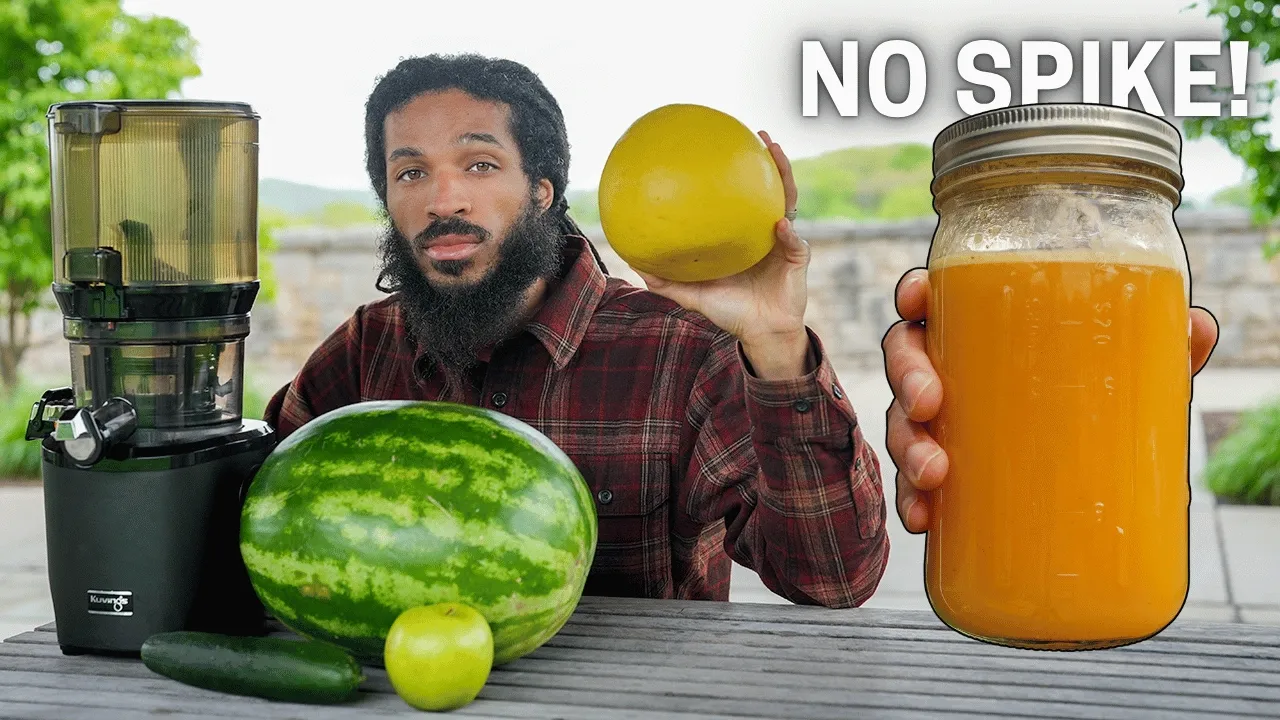
Brandon Ahmaud · @BrandonAhmaud
Where viewers went back to watch this video again, from YouTube's public Most replayed graph, lined up with what was said at that moment.
Most replayed moment #1
5:463.8x the video's typical replay level
been avoiding fruit because of a number on a chart, you may have been responding to an incomplete picture. The question to ask is never just how fast, it's how much and in what context. That's exactly what we're building for.
Said at 5:39
Most replayed moment #2
9:213.7x the video's typical replay level
of my personal favorites, dandelion greens, watercress, cucumber, fennel. Together, these are low sugar, high water content, and they bring the glycemic load of the entire juice down before you've added anything else. From
Said at 9:15
Most replayed moment #3
8:583.6x the video's typical replay level
small portion of fresh pressed pomegranate added to another juice, it brings antioxidant density that's hard to match. Use it strategically. A little goes a long way in flavor and function. Now let's talk about ways we can build
Said at 8:51
The graph counts replays. It does not show where viewers stopped watching.
Words
2,154
Runtime
12:48
Speaking pace
168wpm
Reading time
9min
168 words per minute, between the 160 25th percentile and the 181 median of 349 measured videos. That distribution comes from the 349-video hook study.
Opening (first 30 seconds)
You don't have to quit juice to protect your blood sugar. You just need to stop drinking it the way most people do because the issue was never juice. It was never fruit. It was never sugar. The issue is nobody taught you how to build it. Today I'm going to fix that and once you see this, please share it with whoever told you fruit sugar is bad. They need to see this too. Let me show you how this plays out. Someone
84 words, the words spoken in the first 30 seconds at 168 words per minute.
Free, no signup. See how the first 30 seconds hold attention, with rewrites.
Sentence shape
| Measure | This transcript |
|---|---|
| Sentences | 177 |
| Average words per sentence | 12.2 |
| Longest sentence | 38 words |
| Questions asked | 3 |
| Sentences containing a number | 3 |
Most used terms
Filler phrases
13 in total: like 6 · actually 4 · right? 1 · uh 1 · you know 1.
A literal whole-word count of the same phrase list the Prepublish browser extension uses, so a phrase inside another word is not counted and a phrase used in its ordinary sense still is. It is a count and not a judgement.
Run the check on the words above: where attention is likely to drop, with a rewrite for each weak line. The free check shows the scores and the one issue costing the most.
What this transcript is
Every word below is the caption track YouTube publishes for this video, pulled from the video itself and reproduced unchanged. It is not Prepublish's writing, not a summary, and not a re-transcription: it is the video's own published captions. English captions, generated automatically by YouTube, in the video’s original language. Source: the video on YouTube. A channel that would rather this page did not exist can ask for its removal through the contact page, and it is removed.
You don't have to quit juice to protect your blood sugar. You just need to stop drinking it the way most people do because the issue was never juice. It was never fruit. It was never sugar. The issue is nobody taught you how to build it. Today I'm going to fix that and once you see this, please share it with whoever told you fruit sugar is bad. They need to see this too. Let me show you how this plays out. Someone decides to get healthy.
They start doing research. They read that fruit has sugar and that sugar spikes insulin. They connect the dots and juice gets cut. It's no longer a healthy option and honestly that logic sounds clean, but here's what that logic skips over entirely. Not all sugar behaves the same inside your body. Fruit sugar and refined sugar are not the same molecule doing the same job. That's not an opinion. That's biochemistry. When you're drinking something built on added sugars, syrups, or processed sweeteners, your body gets a flood.
No structure, no support, just a hit with no infrastructure to handle it. But when you're working with whole fruit, your body recognizes what's coming because that sugar comes with minerals, hydration, natural compounds your cells have been processing for a thousands of years. That is a fundamentally different experience. So the issue was never juice. It was never building it with intention. Let me give you a real comparison.
Refined sugar is stripped. It's processed down to its most stimulating form. No nutrients, no cofactors, no balance, just a hit and your body has to actually raid its own reserves just to metabolize it. Now fruit, fruit comes packaged with support even when you juice it. Now I'm not going to tell you that juice is the same as eating whole fruit. That would be dishonest and you know, we don't do that here. When you juice, you remove most of the insoluble fiber and fiber does something critical.
It slows how sugar enters your bloodstream. It's essentially nature's pacing mechanism. So yes, without fiber juice can hit your blood sugar faster. That part is real, but keep in mind that juice, homemade juice, still has soluble fiber. And here's the distinction that most people completely miss. Faster does not mean dangerous. Unintentional does. When you understand what you're building, you can compensate. You can structure the juice in a way that changes how your body responds entirely.
That's exactly what we're doing here. I do want to give a shoutout to today's sponsor Kuvings USA because this part gets overlooked more than anything else. Your juicer matters. It matters because of what happens to the juice during extraction. Most standard centrifugal juicers, the ones most people start with because they're cheap. They work through high speed spinning. That spinning creates heat. That heat creates friction and heat and friction break down the very enzymes and compounds you're trying to get more of.
You're degrading the juice in the process of making it. Cold press juicers work differently. Slow mechanical pressure, less heat, less oxidation. What's naturally in the fruit stays intact in the juice and in your body. You're not forcing the fruit, you're drawing from it. And yeah, you feel the difference in how long the energy lasts. If you're serious about this, it's a worthy upgrade to consider. I personally use the Kuvings Auto 10.
The link for it will be in the description. So let's talk about what people are actually drinking when they think they're drinking juice. Store bought juice. Even the ones with the green labels, the ones that say cold pressed on the bottle. What most people don't realize is that most commercial juice is pasteurized. It's been heated sometimes multiple times to extend shelf life. And that heat doesn't just kill bacteria, it degrades enzymes, it alters the molecular structure.
It takes something living and turns it into something shelf stable. And y'all know my saying, you got to seek out things that preserve your life, not shelf life. And for the cheaper options, when you read labels, you'll find that most of the products still contain added sugars, natural flavors, concentrated juice from other fruits. Now it doesn't say sugar because at that point legally it doesn't have to. So now you're not drinking fruit, you're drinking a product designed to taste like fruit.
When you make your own juice, that gap closes completely. No additives, no preservatives, no secret inputs. You control every single ingredient that goes in. Okay, let me simplify something that causes unnecessary fear. People hear glycemic index and they treat it like a danger score. But glycemic index only tells you how fast something raises blood sugar. It doesn't tell you how much it raises it in the real world because that depends on how much you're consuming.
That's what glycemic load captures. Glycemic load is the full picture. It accounts for the serving size, the concentration, everything actually in the glass. Here's a practical example. Watermelon. Shoutouts to my brother Meger by the way, he got me this watermelon. It's orange and allegedly has seeds. First one of the season. I can't wait to get into it, but anyways, watermelon has a high glycemic index, but watermelon is mostly water.
The actual glycemic load of a reasonable serving is low. Your blood sugar doesn't behave the way the index alone would suggest. So if you've been avoiding fruit because of a number on a chart, you may have been responding to an incomplete picture. The question to ask is never just how fast, it's how much and in what context. That's exactly what we're building for. Before we get into building full juice blends, let me give you something even simpler because sometimes you don't want a recipe.
You just want the juice, one thing and know that it's actually working for you. These are my go-to fruit juices, single ingredient and every one of them is a solid choice when it comes to keeping your blood sugar in a range that makes sense. Let's start here because watermelon gets misread constantly. The glycemic index looks high on paper and people walk away from it, but remember what we talked about, glycemic load is the real number.
And watermelon is over 90% water. The actual sugar concentration per serving is low. What you get from watermelon juice is hydration, L-citrulline, which supports circulation and muscle recovery, and lycopene, one of the more powerful antioxidants available in fruit. Cucumber, technically a fruit, and cucumber juice is one of the cleanest things you can put in your body, near zero sugar, high silica content, which supports skin, joints, and connective tissue.
And it has a natural cooling effect especially in warmer months or after training. When it's own, it's light and clean. Combined with anything else, it stretches the juice and brings the glycemic load down immediately. Pear juice is underrated. It's gentle on blood sugar compared to most fruit juices because of its fructose to glucose ratio. Your body processes it more gradually. It also has natural sorbitol, which supports digestion.
The flavor is subtle, almost floral. It plays well on its own and it's one of the best bases to pair with herbal teas, which we'll get into in a minute. Green apple, the tartness is a signal. That tartness comes from malic acid and a lower sugar content compared to sweeter apple varieties. It has a cleaner glycemic profile and the flavor is sharp enough to hold on its own without needing to add anything else with it.
If you're new to juicing and you want something that tastes familiar, but won't overload you, start here. Pomelo, think of pomelo as grapefruit's quieter, more refined relative, which makes sense because grapefruit is a hybrid descended from it. There's a couple of varieties of pomelo out there, but the flavor is typically less aggressive and the sugar content is lower than grapefruit, which makes it a more forgiving choice if you're watching your glycemic load closely.
It still carries naringenin, the flavonoid associated with insulin sensitivity support. So the functional benefits are there. And unlike grapefruit, it doesn't have any medication interaction concerns, which means it works for a wider range of people. If you've never juiced pomelo, it does take some time to remove the outer layer of the skin and to separate the pulp, but it's worth trying at least once to see what you're missing.
The yield is high, the flavor is clean, and I feel it pairs well with cucumber or pear if you want to take it further. Pomegranate is what I'd call a finisher, not a base. It's higher in sugar than the ones on this list. So I'm not saying drink a full glass of it straight, but a small portion of fresh pressed pomegranate added to another juice, it brings antioxidant density that's hard to match. Use it strategically.
A little goes a long way in flavor and function. Now let's talk about ways we can build on top of these even for options that the glycemic index on and glycemic load look shaky. Start with your greens. Some of my personal favorites, dandelion greens, watercress, cucumber, fennel. Together, these are low sugar, high water content, and they bring the glycemic load of the entire juice down before you've added anything else.
From there, layer in your support ingredients. My go-to's are ginger and key lime. They add complexity, they settle digestion, and they sharpen everything. Now if you want fruit, add it as the enhancer, not the base. One apple or one pear is all you need to balance out the bitterness and honestly cucumber can even do that. But what you end up with is a juice that tastes intentional because it is. Your body gets sweetness, minerals, and compounds that support how it processes everything coming in.
And your blood sugar, it gets measured. A steady response, not a spike and a crash. Now, here's where I take this further than most people go. I don't always drink juice on its own. I combine it with herbal teas. I love apple juice, but depending on the variety, it can be too sweet on its own. So, instead of drinking it straight, I combine it with herbs. And what I get is something richer, more layered, and significantly easier on blood sugar.
A newer combination I've been playing with, bilberry and elderberry tea combined with Honeycrisp apple, is so good. Another great combination is hibiscus, or sorrel known in Jamaica, combined with the Honeycrisp apple juice. I like that mix with the Fuji apple juice with a little bit of ginger as well, so good. If you're looking for something that gives you that smooth, drinkable vibe, think of something like a Lipton tea moment, but a thousand times better.
Try soursop leaf tea combined with apple juice. Another solid combination we did recently on the channel was burdock root tea combined with pear juice. That's a combination I keep coming back to. The method is simple. You brew your tea, let it cool completely, then combine. I usually do 2/3 juice, 1/3 tea, or 3/4 juice, 1/4 tea. Play with the ratio and find what works for you. And I suggest working with loose herbs over tea bags.
You'll feel the difference there, too. So, why this works so well, the tea brings polyphenols and antioxidants that the juice alone doesn't have. It dilutes the sugar concentration without adding anything artificial. The flavor becomes complex, not flat sweet, but layered. And the way your body receives it changes. Less intensity, more evenness. The energy is steady instead of front-loaded. So, yeah, you don't need to fear fruit.
You don't need to cut out juice, but what you need to do is stop approaching what you consume without structure. Whatever it is you do, bring balance to the table because balance is what makes it sustainable. If this gave you something, please share it because I'm tired of seeing the same comments about how fruit is bad, how juice is bad, it's a sugar, but I'm tired of it. I'm tired of hearing it. There are plenty of testimonials out there, but I can only speak for myself.
Fruit and juice has been very beneficial within my life. Anybody that'll try to tell you juice is bad, I want you to ask them like, "What is it that you drink? Is it just water? Let me know." You observe people. The people saying this, they're at Starbucks on the regular. They're drinking They got Mountain Dew, Pepsi, or they had a bad experience drinking Minute Maid lemonade. Like, stop listening to these people, all right?
Uh till next time. Peace, God.
The words are the caption track's own and nothing is reworded or re-transcribed. Paragraph breaks are placed between sentences so the text reads as prose.
Free tools for your own script: paste a draft and see where it stands before you record it.
Paste your draft and see where viewers are likely to drop off, with a rewrite for each weak line.
Paste the first 30 seconds of your own draft for a hook score and rewrites.
Check your draft against YouTube's advertiser-friendly guidelines before you record it.
Read this channel's public videos and transcripts, and download a writing brief for it.