Getting the transcript
Reading the captions from YouTube. A video nobody has opened here before takes 10 to 30 seconds; this page fills in on its own.
Getting the transcript
Reading the captions from YouTube. A video nobody has opened here before takes 10 to 30 seconds; this page fills in on its own.
SMB Capital · @smbcapital
Where viewers went back to watch this video again, from YouTube's public Most replayed graph, lined up with what was said at that moment.
Most replayed moment #1
6:182.4x the video's typical replay level
So, mostly hunting in these two pockets of time. Okay, quick but important note before we dive into these examples, I usually find these on strong stocks pulling back to a short-term moving average on the daily chart, mainly the
Said at 6:11
Most replayed moment #2
3:362.1x the video's typical replay level
sure about it. The 9 EMA cross is the confirmation. It happens, you're in. And fifth, your stop and your target come off the measured move. Simple. You measure the distance from the low of the day up to the cross. That distance is
Said at 3:28
Most replayed moment #3
2:261.9x the video's typical replay level
things in order. First, the stock turns off the low of the day. It sells off, puts in a low, stops going down. That's the starting point. Second, momentum builds back towards VWAP. Quick definition, if you're newer, VWAP
Said at 2:19
The graph counts replays. It does not show where viewers stopped watching.
Words
2,063
Runtime
12:51
Speaking pace
161wpm
Reading time
9min
161 words per minute, between the 160 25th percentile and the 181 median of 349 measured videos. That distribution comes from the 349-video hook study.
Opening (first 30 seconds)
Everybody wants to nail the exact bottom. I get it. You buy the low, you feel like a genius. Problem is, it's probably the worst trade on the chart. You're buying while everyone else is still selling. You're betting on a turn that hasn't happened yet. And then you're surprised when you get stopped out right before the thing finally runs. I stopped trying to catch the bottom a long time ago. Now I show up late on purpose, which is
81 words, the words spoken in the first 30 seconds at 161 words per minute.
Free, no signup. See how the first 30 seconds hold attention, with rewrites.
Sentence shape
| Measure | This transcript |
|---|---|
| Sentences | 171 |
| Average words per sentence | 12.1 |
| Longest sentence | 46 words |
| Questions asked | 6 |
| Sentences containing a number | 32 |
Most used terms
Filler phrases
12 in total: like 6 · basically 3 · actually 2 · kind of 1.
A literal whole-word count of the same phrase list the Prepublish browser extension uses, so a phrase inside another word is not counted and a phrase used in its ordinary sense still is. It is a count and not a judgement.
Run the check on the words above: where attention is likely to drop, with a rewrite for each weak line. The free check shows the scores and the one issue costing the most.
What this transcript is
Every word below is the caption track YouTube publishes for this video, pulled from the video itself and reproduced unchanged. It is not Prepublish's writing, not a summary, and not a re-transcription: it is the video's own published captions. English captions, generated automatically by YouTube, in the video’s original language. Source: the video on YouTube. A channel that would rather this page did not exist can ask for its removal through the contact page, and it is removed.
Everybody wants to nail the exact bottom. I get it. You buy the low, you feel like a genius. Problem is, it's probably the worst trade on the chart. You're buying while everyone else is still selling. You're betting on a turn that hasn't happened yet. And then you're surprised when you get stopped out right before the thing finally runs. I stopped trying to catch the bottom a long time ago. Now I show up late on purpose, which is why I call this trade the fashionably late.
I let the stock turn. I let the momentum prove it's really there, and then I step in while it's still building. There's basically one moment where that happens, where a stock stops fighting you and starts pulling you along with it. And today, for this very specific trade, I'm going to show you exactly where that moment is, how I get in, where my stop goes, where I get out, so stick around. Real quick on me, my name is Justin Spero.
I've been with SMB since 2018. I trade momentum names every day, and this is one of the setups I look for almost every day. Couple ground rules before we get into the charts. This is a scalp. We're in and out. You're trading the move. You're not getting married to the stock. And the whole thing runs on two popular studies, the 9 EMA and VWAP. That's it. No 12 indicators stacked on top of each other, just two lines and one specific moment.
Let me show you how it works. So, why do we call this the fashionably late? Why not just try and buy the turn off the bottom, like everyone else is trying to do? It comes down to momentum, and momentum is really just energy building. The longer and steadier something moves in one direction, the more likely it keeps going. Down at the low of the day, all the energy is against the stock. Smart money is still selling, but then it turns.
And as it climbs back, that energy slowly starts to flip. Here's the thing though, I don't want to guess when that turn happens. Guessing the turn is exactly how you catch knives, churn and burn. I want the turn to prove itself to me first. I want to watch the stock pick itself up off the low and start working back up. Let it prove it, then buy. The actual setup. Now, I want you to notice it's all intraday, just five things in order.
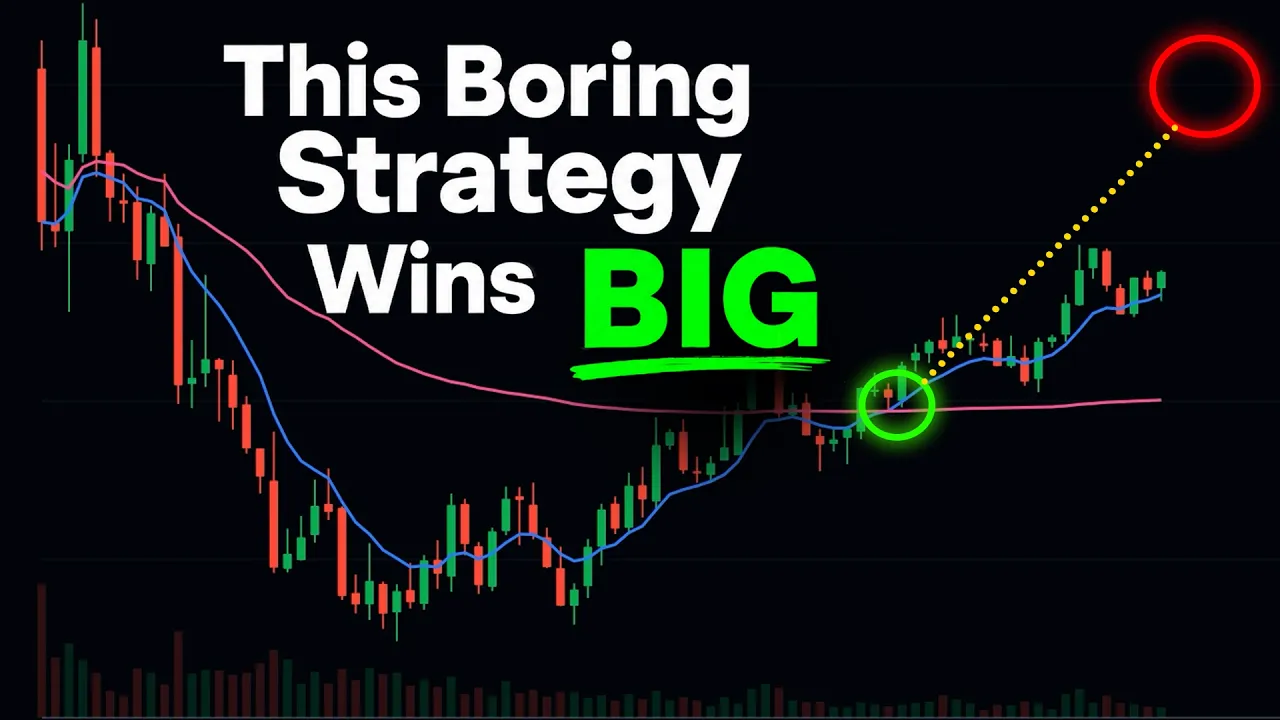
First, the stock turns off the low of the day. It sells off, puts in a low, stops going down. That's the starting point. Second, momentum builds back towards VWAP. Quick definition, if you're newer, VWAP is the volume weighted average price. Basically, the average price everybody's paid for the stock today, weighted by where the volume actually traded. Think of it as the day's center of gravity. So, after the low, I want to see price grind its way back up toward that line.
That move back is the momentum rebuilding in real time right in front of you. Third, and this is the trigger. The 9 EMA crosses VWAP. The 9 EMA is just a fast, short-term moving average. It tends to hug price. It reacts quick. So, when that line turns up and crosses through VWAP, that is the entry signal. That's the moment. Fourth, you enter right there at the cross. You don't wait for the candle to close. You don't wait for three more bars to close so you feel sure about it.
The 9 EMA cross is the confirmation. It happens, you're in. And fifth, your stop and your target come off the measured move. Simple. You measure the distance from the low of the day up to the cross. That distance is your unit. Your target is one full unit above the cross. Your stop is the third of the way back down toward the low. And that's why that math comes out clean. When you enter at the cross, you're entering right around VWAP.
So, the distance from the cross down to the low is basically the same as the distance from VWAP down to the low. You're risking a third of that going for a full one unit. That's where the roughly three to one comes from. You risk one, you're looking for three. Real quick, everything I just said works the same in reverse for shorts. Fast line crossing down through a flat to rising VWAP, you're short. Same trade, you just flip the chart.
Now, the cross gets you in, but not every cross is the same. So, here's what I'm looking at to decide how much to trust it. Biggest one is speed off the low, speed off the turn. Not violent speed, we're just looking for a steady, a clean committed push back towards VWAP. Steady is the word there. Steady tells me the buying is consistent and is probably going to keep going. Once price crosses back above VWAP, I want it to hold above.
If the action after the 9 EMA VWAP cross is choppy and slow, I'm out. Chop is noise. Lots of movement, no progress. After the reclaim, a stock chopping around without making ground is the market telling you it's probably not ready yet. And if price just sits there, pausing right at the entry, hangs around that cross for like 10 to 15 minutes instead of going, that hesitation tells me there's a lack of commitment. The clean ones just go, as you'll see in these examples coming right up.
If after the turn, but before I get my entry, that 9 EMA goes completely flat, I don't take it. It's a no. A flat nine exponential moving average means the momentum stalled out. Okay, one more piece. This setup lives in two windows, the morning, roughly 10:00 a.m. to 10:45, and midday, 10:46 to 1:30. That's when there's enough movement and enough participation for it to actually work. Same exact setup outside of these windows, you'll often get a bad result.
So, mostly hunting in these two pockets of time. Okay, quick but important note before we dive into these examples, I usually find these on strong stocks pulling back to a short-term moving average on the daily chart, mainly the five and 10 SMA. And we'll see these in just a second. Let me show you on some real charts so you can see everything come together. I pulled three examples that I personally traded. I'm going to walk you through the setup on real charts so you can see the read the same way it shows every single time, which is why I love this trade.
The first one's Rocket Lab, RKBL. Watch the bottom left. It sells off into the morning and puts in its low down around $115.50. Then it turns. You can see it grind up back toward VWAP. That's the momentum coming back. And right here, late morning, the nine EMA crosses up through VWAP around $120. That's the entry. All right, so do the math with me. Low to the cross is about four and a half points, so the target's one move above near 124.50, 125.
And the stop's a third of the way back down around 118, 118.50. We're risking about a buck 50 to make about four and a half dollars. And look what it does after. It doesn't stop at the target, it keeps running up towards $130 a share. That's the kind of move where if you're trailing your stop up a 3:1 can turn into a lot more. Second one, ALAB. Same exact trade. Low of day around 291. It turns, builds back, and right around 10:00 in the morning, so we're in that first window of time, the 9 EMA crosses VWAP near 303.
From there, it works up towards 322. Same exact setup. And the third, QBTS. Little bit of a cheaper, faster name, under 30 bucks. So, you see the low around 2570. It turns, it crosses VWAP late morning around 2660. We get that 9 EMA crossing through VWAP, which is our confirmation, and it pushes up towards 28. And notice this one fired in that midday pocket. See, cheap stock, expensive stock, mid-price stock, doesn't matter.
Let me be straight with you on the numbers, too. From what I've seen, this setup tends to make money around 60% of the time, and the winners tend to pay more than the losers cost you, again, right in that neighborhood of 3:1, or even better. So, you're still going to take some losers, and the edge is that payoff ratio holding up over many trades. So, let me put the whole thing back together start to finish. You find a stock that's turned off the low of the day.
You watch the momentum build back toward VWAP. You wait. You wait for that 9 EMA to cross VWAP, and that is your entry signal. You set your stop and target off the measured move. A third down for the stop, a full move up for the target. You check your tells. Is volume starting to come back? Do we have a steady push from the lows? Is price holding the 9 EMA? And if that EMA ever goes dead or flat, that's your red flag.
That's it. That's the fashion we late scalp. You're not predicting the bottom, you're not bottom picking, you're not the hero buying the exact low, you're letting momentum introduce itself, and then we're showing up a little bit late on purpose while that stock is building momentum. That's it. Like and sub for more detailed trade breakdowns, and I'll see you in the next one. >> So, you're an active trader, not doing as well as you want, not doing as well as you deserve, and you just can't figure out why you can't become profitable no matter how hard you try.
Well, let me show you why. This is your competition, the traders in this room. This room right here is full of elite traders, some of whom are making seven and even eight figures a year. In fact, our top guys have made nearly 20 million each in net trading profits in a single year. Let's head to my office so I can share more. So, you're probably used to seeing videos of lavish trader lifestyles, trading gurus trading off of a laptop for an hour a day, heck, maybe even 15 minutes a day, and then them relaxing on some secluded beach for the rest of the day.
Well, all I can tell you is that our traders train like pro athletes. They live and breathe the markets and are continually working on their trading skills because at our firm, that's what we found it really takes to make it in this game. I'm Mike Bellafiore, co-founder and managing partner of SMB Capital, one of the world's top proprietary trading firms located in Midtown Manhattan. And we're always looking for trading talent to hire and develop.
And not just to trade in-house on our desk, but also to trade from their own home, entirely using our firm's capital. And we have numerous traders doing just that, allowing them to make upwards of seven figures trading the firm's capital without risking their own money. But to even get a shot at something like that, you need to have the right training. >> That's why we're doing a new free online presentation in which we share how you can get an interview with SMB to become an in-house or remote trader, trading firm capital without risking yours, and getting access to all of our firm's coaching and resources.
And the best part? You don't have to be a profitable trader yet. In fact, we prefer to mold profitable traders with our methods and our techniques. That's why we have just three simple criteria that can earn anyone an interview. We're looking for highly ambitious and determined traders who fit our culture first and foremost. So, if you believe that could be you, sign up for the free 1-hour online presentation by clicking the link that's in your top right corner of your screen now.
The words are the caption track's own and nothing is reworded or re-transcribed. Paragraph breaks are placed between sentences so the text reads as prose.
Free tools for your own script: paste a draft and see where it stands before you record it.
Paste your draft and see where viewers are likely to drop off, with a rewrite for each weak line.
Paste the first 30 seconds of your own draft for a hook score and rewrites.
Check your draft against YouTube's advertiser-friendly guidelines before you record it.
Read this channel's public videos and transcripts, and download a writing brief for it.