Getting the transcript
Reading the captions from YouTube. A video nobody has opened here before takes 10 to 30 seconds; this page fills in on its own.
Getting the transcript
Reading the captions from YouTube. A video nobody has opened here before takes 10 to 30 seconds; this page fills in on its own.
Ambition Arc · @TheAmbition-Arc
Words
1,754
Runtime
10:31
Speaking pace
167wpm
Reading time
7min
167 words per minute, between the 160 25th percentile and the 181 median of 349 measured videos. That distribution comes from the 349-video hook study.
Opening (first 30 seconds)
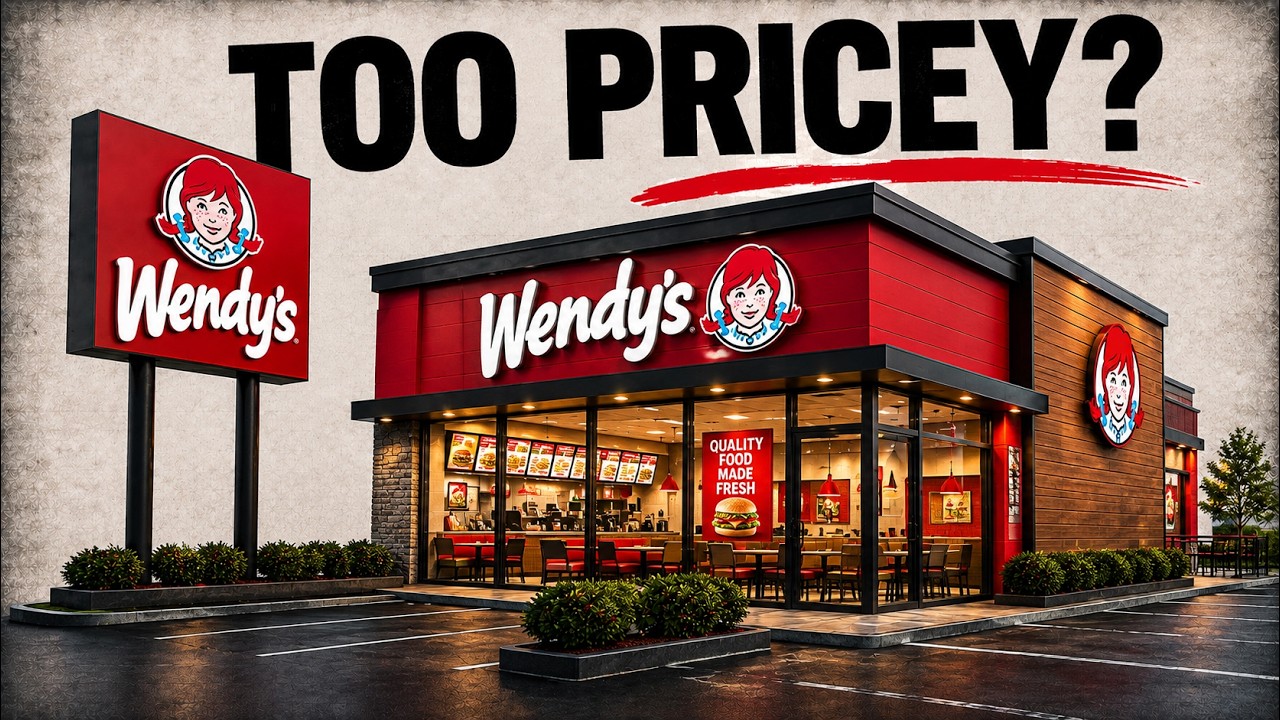
In a single quarter this year, one in eight Wendy's customers just [music] stopped showing up. Not sales, people. US traffic fell 12%. And here's what [music] makes it strange. Wendy's didn't lose to a scandal or an outbreak or a bad product. It lost to a number on a menu board. For 57 years, this brand sold one promise. Pay a little more, get something better. This is the story of the year America decided the little more wasn't little anymore. To understand
84 words, the words spoken in the first 30 seconds at 167 words per minute.
Free, no signup. See how the first 30 seconds hold attention, with rewrites.
Sentence shape
| Measure | This transcript |
|---|---|
| Sentences | 144 |
| Average words per sentence | 12.2 |
| Longest sentence | 46 words |
| Questions asked | 3 |
| Sentences containing a number | 33 |
Most used terms
Filler phrases
5 in total: like 4 · actually 1.
A literal whole-word count of the same phrase list the Prepublish browser extension uses, so a phrase inside another word is not counted and a phrase used in its ordinary sense still is. It is a count and not a judgement.
Free, no account. See where attention is likely to drop, with a rewrite for each weak line. The free check shows the scores and the one issue costing the most. Or run it on the words above first.
Free · No login · See a sample audit first if you prefer.
What this transcript is
Every word below is the caption track YouTube publishes for this video, pulled from the video itself and reproduced unchanged. It is not Prepublish's writing, not a summary, and not a re-transcription: it is the video's own published captions. English captions, generated automatically by YouTube, in the video’s original language. Source: the video on YouTube. A channel that would rather this page did not exist can ask for its removal through the contact page, and it is removed.
No Script X-ray for this video: YouTube shows a Most replayed graph only once a video has enough views.
In a single quarter this year, one in eight Wendy's customers just [music] stopped showing up. Not sales, people. US traffic fell 12%. And here's what [music] makes it strange. Wendy's didn't lose to a scandal or an outbreak or a bad product. It lost to a number on a menu board. For 57 years, this brand sold one promise. Pay a little more, get something better. This is the story of the year America decided the little more wasn't little anymore.
To understand the fall, you have to understand the promise it was built on. Because that promise is the story. In 1969, Dave Thomas opened the first Wendy's in Columbus, Ohio, on one stubborn idea. Fresh beef, never frozen, made to order. For decades, that [music] was the entire pitch. You paid a little more than the Golden Arches and you got something better. Not the cheapest burger, the better one at a price that still felt fair.
And [music] that trade works, but only as long as people believe the little more is actually little. The whole brand balances on that one word. The moment [music] a little more turns into too much, the entire reason to pick Wendy's over McDonald's [music] evaporates. Fresh beef doesn't matter if the total on the screen makes you flinch. And by 2026, [music] people were flinching. Survey after survey found Americans had started treating fast food itself as a luxury.
Nearly 8 in 10 saying the [music] drive-thru had gotten too expensive to be casual. Among households earning under $30,000 a year, roughly 7 in 10 said [music] they were eating less of it. That's Wendy's core customer, quietly walking out the door. And here's what turned a headwind into a crisis. When customers [music] went looking for someone to blame, Wendy's had painted a target on itself. Its prices had climbed among the fastest in [music] the entire category.
The chain that sold itself on quality got quietly reclassified as the chain that costs [music] too much. And then in one week, it said the quiet part out loud. February 2024, a brand new CEO, Kirk Tanner, 32 years at PepsiCo. barely a month into the job, gets on an earnings call [music] and describes the future. Wendy's, he says, will spend $20 million putting digital menu boards in its [music] restaurants. And beginning as early as 2025, we will begin testing more enhanced features like dynamic [music] pricing.
Two words, dynamic pricing. That's all it took. The internet didn't hear dynamic pricing. It heard surge pricing. Uber but [music] for a baconater. Pull up hungry at the lunch rush. Pay more because you're hungry [music] at the lunch rush. Within hours, boycott Wendy's was trending. The New York Post ran it on the front page [music] as inflation's next frontier. And a competitor smelled blood. Burger King [music] posted, "The only thing surging at BK is the flame." And started [music] handing out free Whoppers. 12 days later, Wendy surrendered.
It put out a statement saying the comments had been misconstrued, that the boards were for discounts and [music] featured items, and it would never raise prices just because customers showed up. And here's the honest [music] truth. That was probably accurate. Dynamic pricing can mean lower prices at slow times. Wendy's likely never [music] planned to surge charge anyone. It didn't matter because the damage [music] was never about what Wendy's meant to do.
It was that for one week, the company's deepest vulnerability, the creeping suspicion that Wendy's [music] was quietly reaching into your pocket got handed to the public with a bow on it. You can walk back [music] a policy. You can't walk back a perception. And the perception was now set in concrete. Wendy's is the one that costs too much. Now watch what happened when that perception met a competitor who went to war.
Through 2025 and into [music] 2026, the sales curve bent down and kept bending. US same restaurant sales falling 11.3% [music] in one quarter, then falling again and again. Six straight quarters [music] of decline. And Wendy's blamed traffic, weather, operating hours. But here's the detail that kills the excuse. [music] In the exact same stretch, McDonald's global sales rose [music] almost 4%, taking share in nearly every major market.
Burger King grew, too. The weather was the same for [music] everybody. The economy was the same for everybody. Only one major burger chain was falling like this. The reason isn't a mystery. It's the value war, and Wendy's [music] lost it. McDonald's went allin on price. items under $3, a $4 breakfast deal, value meals [music] built around the Big Mac. Wendy's answered with Biggie deals at 4, $6, and $8 and hoped quality would carry the rest, but it couldn't for a reason wired into the brand's DNA.
Beef inflation ran double digits, and a chain that sells fresh, never frozen beef can't hedge costs the way a frozen supply chain can. The very thing that made Wendy's special made it more expensive to run exactly when customers [music] had the least patience for it. And then Wendy's own executives said the thing [music] you can never say. They admitted the company was doing better with higher income customers than [music] with lower income ones.
Sit with that. For a value burger brand, a brand whose entire existence answers, "Where do we eat when money's tight?" Losing your lower [music] income customers isn't a bad quarter. It's an obituary for the whole idea. And that idea has a body count. [music] Wendy's is closing hundreds of stores, somewhere between two and 300 this year alone. Picture just one of them. A building on a corner [music] where somebody worked their first job.
A franchise owner who borrowed against their house [music] to buy in, now being told the closure is good for them, that fewer restaurants will [music] somehow mean healthier ones. Some believe it, most don't. The number on the balance sheet is a system optimization. [music] On the ground, it's a dark building and a family that bet wrong. So, you've got a shrinking brand, [music] a collapsing customer base, and a stock that's lost nearly half its value in a year.
In American markets, that smell attracts two very different crowds, and they showed up one after the other. First, the joke. On June [music] 24th, a post went up on Reddit's Wall Street Bets. Save Wendy's [music] before it's too late. Roughly a quarter of the company's tradable shares had been sold [music] short. Bets the stock would keep sinking and Reddit decided to squeeze them. [music] The stock rocketed as much as 42% in a single session, tripped [music] a trading halt, and closed up 25% on 200 million shares, about 15 times its normal volume.
A 57-year-old company [music] built on a promise about fresh beef had become a meme. an American institution rescued [music] for about 48 hours by strangers on the internet who mostly thought it was funny. The rally lasted 2 days and evaporated. Then came the serious [music] money. Melson Peltz has circled Wendy's for 20 years. First invested [music] in 2005, chaired the board for over 15. Through his fund Trion, he [music] still controls around 16% of the company.
In February 2026, with shares at a six-year low, Peltz told regulators the company was undervalued and floated taking Wendy's private, buying the whole thing and pulling it off the public market. Not because the burgers got better, because a broken company [music] is cheap. And cheap is when investors like him move. And this August, [music] he got close. assembled the consortium, an Abu Dhabi investment firm, one of Wendy's biggest [music] franchises, with reports a bid could land within weeks.
The stock jumped on the news and then on August 27th, he walked away. Trion sheld the bid. The stock sank [music] 13% in a day. The billionaire who' circled this company for 20 years finally [music] got close enough to look at the wreckage and decided it was somebody else's [music] problem. No rescue from Reddit. No rescue from Wall Street, just a shrinking company [music] and one man left holding it. That man is Bob Wright.
On May 21st, the board [music] brought him back, a former Wendy's operations chief who'd spent the intervening years turning around potbelly. He's the fourth [music] person to hold this job since January 2024. And standing in front of the worst quarter in years, he did what none of his predecessors would. He agreed with the critics. [music] Wendy's, he said, is clearly not performing at its potential. Then he acted like he meant it.
Cut the dividend in half to free up about 53 million a year, withdrew the entire 2026 forecast, and [music] laid out a turnaround built on value, marketing, and fixing the stores themselves. Wall Street answered with a shrug. Most analysts covering [music] the stock rated a hold. A market politely saying it has heard turnaround language from this company several times [music] now, and it will wait for receipts. So, is Wendy's finished?
No. And this is the honest part. It still makes money. [music] $120 million of free cash flow in 6 months. It still has more than $7,000 [music] restaurants and a logo almost every American can draw from memory. This isn't a company dying. It's a company shrinking because it stopped being the obvious answer to the simplest question there is. Where do we eat tonight when money's tight? Dave Thomas built this whole thing on a promise that paying a little more was worth it.
[music] And that promise didn't break in a boardroom or on an earnings call or in a Reddit thread. It broke one order at a [music] time at one drive-thru window at a time by people who looked at the total on the screen, thought about the burger down [music] the road that cost less, and quietly decided the little more wasn't worth it anymore. If Bob Wright wants them back, he doesn't need another slogan or another billionaire or another meme.
He needs them to pull up to that menu [music] board, look at the price, and believe in it again. He needs a little more to feel little again. If you want the rest of these, the brands that were winning right up until they weren't, that's the whole channel. Stick around.
The words are the caption track's own and nothing is reworded or re-transcribed. Paragraph breaks are placed between sentences so the text reads as prose.
Free tools for your own script: paste a draft and see where it stands before you record it.
Paste your draft and see where viewers are likely to drop off, with a rewrite for each weak line.
Paste the first 30 seconds of your own draft for a hook score and rewrites.
Check your draft against YouTube's advertiser-friendly guidelines before you record it.
Read this channel's public videos and transcripts, and download a writing brief for it.