Getting the transcript
Reading the captions from YouTube. A video nobody has opened here before takes 10 to 30 seconds; this page fills in on its own.
Getting the transcript
Reading the captions from YouTube. A video nobody has opened here before takes 10 to 30 seconds; this page fills in on its own.
The Andrew Faris Podcast · @andrewfarispodcast
Words
3,303
Runtime
13:51
Speaking pace
238wpm
Reading time
14min
238 words per minute, above the 201 75th percentile of 349 measured videos. That distribution comes from the 349-video hook study.
Opening (first 30 seconds)
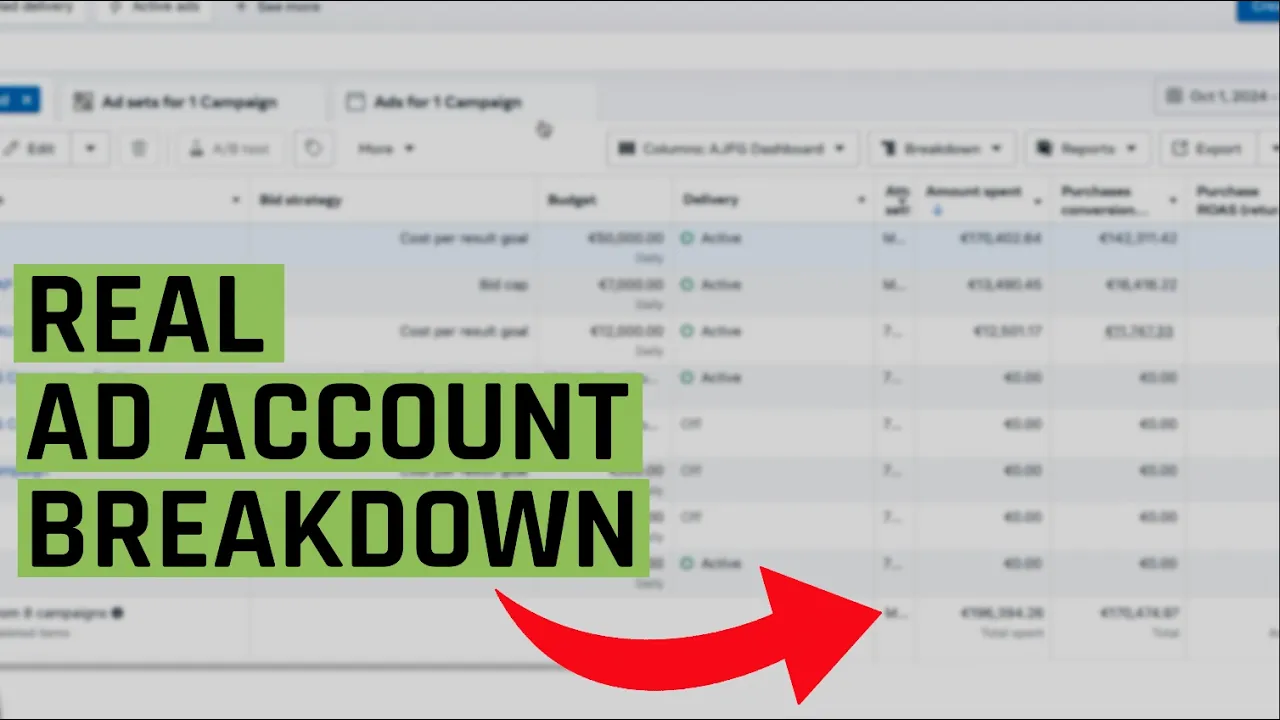
This ad account has spent €500,000 in the last 30 days. You can see it right here. Here's the total spent across the ad account. That is real spend. I really don't know anything about this brand because it's in French and I don't know anything about French. But this is 100% manual bids. Cost caps and tro a tiny bit of bid caps mixed in. I'm going to show you something in this account because the operator of this brand asked me to take a look. Said they would share it publicly, which is just incredibly cool, like incredibly gracious of them to do that. And and if really if you want to see what an account that's
119 words, the words spoken in the first 30 seconds at 238 words per minute.
Free, no signup. See how the first 30 seconds hold attention, with rewrites.
Sentence shape
| Measure | This transcript |
|---|---|
| Sentences | 239 |
| Average words per sentence | 13.8 |
| Longest sentence | 144 words |
| Questions asked | 13 |
| Sentences containing a number | 49 |
Most used terms
Filler phrases
137 in total: um 42 · like 34 · actually 18 · uh 16 · you know 8 · kind of 6 · right? 6 · sort of 5 · basically 2.
A literal whole-word count of the same phrase list the Prepublish browser extension uses, so a phrase inside another word is not counted and a phrase used in its ordinary sense still is. It is a count and not a judgement.
Free, no account. See where attention is likely to drop, with a rewrite for each weak line. The free check shows the scores and the one issue costing the most. Or run it on the words above first.
Free · No login · See a sample audit first if you prefer.
What this transcript is
Every word below is the caption track YouTube publishes for this video, pulled from the video itself and reproduced unchanged. It is not Prepublish's writing, not a summary, and not a re-transcription: it is the video's own published captions. English captions, generated automatically by YouTube, in the video’s original language. Source: the video on YouTube. A channel that would rather this page did not exist can ask for its removal through the contact page, and it is removed.
No Script X-ray for this video: YouTube shows a Most replayed graph only once a video has enough views.
This ad account has spent €500,000 in the last 30 days. You can see it right here. Here's the total spent across the ad account. That is real spend. I really don't know anything about this brand because it's in French and I don't know anything about French. But this is 100% manual bids. Cost caps and tro a tiny bit of bid caps mixed in. I'm going to show you something in this account because the operator of this brand asked me to take a look.
Said they would share it publicly, which is just incredibly cool, like incredibly gracious of them to do that. And and if really if you want to see what an account that's growing and spending entirely on manual bids is, this is a really good picture of that. There's a lot you could say about this, but what I like to start with is by go back to October because get out of the holiday months. Um, and you see this brand is spending uh 200,000 in October.
The CBO campaign is all cost capped. So you can see cost per result goal right here, the bid strategy. Um, and so that's the bulk of the spend. And then over time, slowly but surely, as they've added more creative and really not changed the target cost cap much over that entire time, you go from 196,000 in October in November, you go to 279. So, a lot of growth there, including a BFCM campaign. This campaign is going to stay with us as we kind of orient ourselves to the account because uh they're just going to use that for their promotional campaign going forward.
And they just don't change the name. December 273. Then you go to January, picks up a little bit more after that, right? 335. They had some ups and downs over that month, but ultimately getting there. Same setup. You see they've got some promotions still running here in that BFCM campaign. February, which of course only has 28 days, goes up again, 360,000, so three less days, but another 10% in spend increase, which is really great to see.
And what they've added here now is a rorowass campaign, which is really interesting. So they're running T- Roras right here. So a rorowass gold campaign. So that comes alongside of things. In March, the rorowass campaign um is still there. And now they've gone to 394. And then this month in April as I record this, they're all the way up to 508. And what you can see is the rorowass campaign has now been changed to an ASC campaign, but very similar kind of approach overall.
So um 58,000. So that's really cool to see. They're growing in spend, adding a bunch of creative. And certainly one of the things you will see here if you look at this is that um a bunch of stuff here is spending a lot of money. Okay, so if we go to amount spent um you go to 186 across this, but what you see is that like no, amount spent is not sorting correctly. By the way, this is like a weird bug right now, but you can see these top spending campaigns.
Nothing's spending more than 20 grand. Let's see. Are any of these spending more? Is there something that is sneaking in here? Yeah, there's 1,800. Yeah. So, you can see like um 20k euros is the most it's spending. So, they've got launched tons of creative across all these adets and and a lot of it is spending and they're just doing this this the sort of classic way that I would recommend basically anybody do this, which is they're just launching ads into the adsets.
They're leaving them for a long time. They have a low AOV and so they're getting a lot of purchases per category which means all like all of these are out of learning which is really awesome. You don't get until your lower spends where things are are still in learning. So that's really good and just a really really well-run account. Now it's interesting when you look at this whoops because there's a couple things going on.
The first thing is it's 100% cost caps and you'll see or not 100% but a lot of cost caps and you'll see a $49 cost control or excuse me 49 euro cost control here. Okay, you can you look at that and you go there's one problem right away. Right now, I'm going to get outside of the range of the last 7 days or so because of the way attribution works. And you'll see it's all 7-day clicks. Let's check the attribution setting.
Okay, 7-day click pretty much across the board. Actually, top spenders are also including view conversions, which I would clean that up. Get rid of those view conversions and get back to 7-day click only. But either way, what you see is like the actual CAC over that time um in platform uh is uh let's see, where is it? Oh, here we go. Sorry. cost per purchase. Holy cow, Andrew, get your brain together. You can see it's €71.
So, that looks like a problem, right? Because you're running this cost control of €49, but you're actually getting um 71. If you go to the last month instead, what you'll see is that's a little closer at 62. And so, this is one of people's big complaints about cost controls is like you don't get performance that is actually at the number that you are suggesting. Now, one of the things I want to say right away here is that that's not totally shocking to me.
When I run cost caps, which is extremely rare, I run almost no cost caps. You regularly see this because cost caps are actually allowed to bid above and below the target dynamically according to whatever uh the machine thinks is best. And so sort of built into the tool is the idea that it can actually go and find the ceiling of bids. And sometimes that means it doesn't actually hit your target. Now at the baseline level that's okay as long as you adjust your cost cap to get the actual target you're getting. in this case running on mostly 7-day click.
Okay, €62 is what the number is that they're actually getting. If that's an acceptable CAC for this brand, then their 49 P then their 49 um cost cap is perfectly fine. And what the thing I will always tell people is let's say you're actually getting let's say you wanted that 60 to be a to actually be 49. There's a simple solution to this, which is that you just lower the cost cap. Okay? Um, and so you lower it towards getting roughly what the actual outcome that you want is.
If you are an executive or an operator of an e-commerce business that's running seven, eight, or nine figures, and you like this video, I can just about guarantee you you will get benefit from joining Workspace 6. Workspace 6 is a closed private community for seven, eight, and nine figure executives and operators of e-commerce businesses. There are no software providers, no service providers like me allowed in the community.
So, let's say you were working with me and you thought I was doing a terrible job. You could tell other people in that community, "Don't work with Andrew Paris. He's terrible." Uh, multiple of my clients are in Workspace 6 and so I know it's a good community. I know it's valuable. It's also really affordable. $1 for your first month and $99 after that with no commitment. You can get real answers to your questions in real time from other operators like you are going to help you out.
I love the Workspace 6 guys. They've been super helpful to me. I've been reading their newsletter forever. Workspace 6.io. Go check it out. There's actually another solution that I like more in this case, and that solution is to run bid caps. um because bid caps cannot bid dynamically above the CAC target and they are much more likely to get you closer to your actual target um with less volatility. So if the volatility bothers you and you're running cost caps, switch to bid caps.
You tend to get more of a solution. The same dynamic is at play here on these to campaigns. Okay. Now, I've spoken to this person and they have said they're really happy with the overall structure with the overall outcome. So I assume that the number they're getting is a number they're actually fine with even if it's not exactly what they're what they're inputting. Right? So in this case, they're saying they want a 0.85 on 7-day click.
They're actually getting a 67 over this time period. Again, um eliminating the most recent week so that you sort of eliminate um the uh incomplete um attribution windows from that. Uh so they they seem to be fine with that. Not surprisingly, slightly higher AOV on their TRS targets. Um this looks pretty good to me. I would say like again like if they wanted this 067 to become a 0 75, raise that 085 to a 0.9 and keep moving.
There is no bid cap version of TRA targets. uh it there is only averages that can bid dynamically um no threshold like a bid cap is a threshold but a cost cap is an average um and there's no equivalent of that when you're bidding highest value which is what uh TRS campaigns do right TRS campaigns are going to bid for the highest value customer cost cap and bidcap campaigns are going to build bid for the lowest cost customer and that's a really important distinction um for a lot of reasons so but there is no um highest value equivalent of a bid cap which is going to have that threshold so um so you just kind of have to deal with that and I think one of the things you see in this account very clearly is that adding um TRS campaigns was definitely additive to the overall spend.
It's one of the reasons I tell everybody to do it is because you know you get a lot more spend when you do that. And this is what we do for our campaigns if the if they're for our clients if if performance is not quite exactly where we want it. If the performance is actually under the target that we want, we just raise the target and and until the performance comes through. Sometimes that stabilizes over more time and with more bidding and we've got more stuff out of learning, etc.
He's got it as a as a ASC and I think that's a perfectly fine way to do it as well. But what you can see, right, 394 before the TRS bidding back way back in January, like we saw, it was like closer to 330. There's no rorowass bidding in there, I don't think, yet. Oh yeah, it just started back then. So you got 22K and it really seemed to add meaningful amounts of spend at a total performance. In this case, you're at a 086 rorowass over that time.
Um, you know, maybe what we want to do is look at the attribution windows and say, let's look at the 28 day click version of this so we can sort of normalize things. 0.94 over that time. Um, you know, I think that probably came down some. It's been a very volatile time economically, so not real surprising. 081 there up to 360. Let's check again in March 086. So yeah, right back up while spend increased and then more recently in April.
And he mentioned this actually that April has been a little bit more challenging. They're down back down to 74. But you can see the range is not too wide and um and you can make some adjustments in the account to ask for more to try to get Meta to give you more volume, more efficiency as you see fit. That's the way I would run this account. One other thing I want to point out in this account that's really interesting, and this is something that also they had pointed out to me.
So, I'm back in that cost cap uh campaign. I went and found it and paused the video for a second so you didn't have to watch me go find it. And you can see there's this one adset that um really has performed poorly. So, 5,000 in spend, €750 um in return. Uh that's that's way way way below target. And so, one of the questions is what do you do about that? Do you do you let that run or not? You know, I'm a big proponent of generally never turning it off an ad.
Um, and my answer to this question is like I would probably let this run, but I understand if you don't and I think that's fine. Like if if you don't think this is going to be a mega smash hit ad and there's some risk that it's something is wrong here. It's just not working. This is not a big deal. I would I would uh I would be fine turning it off. Again, I think ultimately if you let it go for longer, that'd be fine.
Another thing you could try and do is like isolate it to its own campaign and drop the budget so you sort of force it to spend at a lower budget. That's sometimes something I've done as well. Um, so I can kind of go either way here. it. This is pretty far off the performance mark that you want. If you're asking for, you know, a CAC of €49 and you're getting €296, that's beyond small sample size noise. Something looks like it's like messed up there.
I don't mind the idea of spending it because that is such a big um the mind of I don't mind the idea of cutting that there. It's such a big thing. Overall, it's an extreme outlier in this ad in this ad account. And so, if you want to eliminate a little bit of risk by doing that, that's just fine. You do have a couple other um camp uh adsets here I noticed that are doing some similar things. If you go look by amount spent again, you'll see there's a couple that are like performing pretty meaningfully worse than others.
Like here's this one. Actually, if you if you look at by CPM, you'll see I just noticed this a second ago actually. Uh maybe it's even just the last seven days. Let's see. I just found this recently last seven days. You've got a couple of adsets that are doing something kind of weird where you've got like this one and let's see if I can find the other one. This one down here. Whoops. Move me out of the way. You can see it.
This is something I sometimes look for when something is being weird. You can see that not only is the performance way, way below target, the CPM is way different. So 31 euros and 42 euros versus an accountwide 10. I have seen that happen occasionally. In this case, it looks like it's delivering to somebody so completely different than your other the rest of your account that if you see that and the performance is poor, I don't mind the idea of shutting those off as well and saying like there's something weird going on here.
That's fine. Again, extreme outlier. Um, in my accounts, I've basically had to turn on turn off ads for that reason a couple times ever, but it does happen. And so, uh, I don't mind the idea of doing that. None of these systems are perfect, right? They're probabilistic machines. Um, and and some, you know, they're not they're they're not created by God, right? There's challenges at times. So, yeah, I don't have any problem with the idea of turning that off.
What I really want to avoid all the time is actually turning off individual ads that are really high spenders. If you're turning off lots and lots of ads in an ad account because you think, oh, high spender, not hitting my target, like that's where I think you get into trouble. If you're doing that constantly, then something is probably wrong. Um, overall, this account setup, I think, is really great. You've got a promotional campaign setup.
Um, you've got ASC and CBO as your main TROAS and cost cap campaigns. You're spending the bulk of the money there. You can see a little bit of the scale campaign. This is just where they're moving some winners into less adsets, getting them out of learning, trying to get some more consistent delivery. Then still this old bidcap campaign just kind of sitting along. I would probably move towards bidcap and to for all the reasons I've said before, but that's actually a huge job at this point.
And if you're getting a total volume and a total outcome you like, I really like it. You see the account is growing. You see a lot of things happening in the last 7 days. They've spent even above their previous pace right at 146 umk euros. Like that that's you know pushing towards a 600k euros per month pace. Um I think that's really strong and there's some volatility as they're trying to scale etc. One question that um the operator did ask me was how do you scale this account more?
And my answer to that question is yeah it's all the normal things and this is the beauty of a setup like this. You don't go scaling this account by trying to go and find um some new media buying thing that's going to do it. This is the media buying setup account with which you scale. You don't need to test audiences. You don't need to try some crazy stuff. You just keep adding creative into this account. And then you think about product launches, you think about funnels, offers, you think about promotions, those kinds of things.
All the hard work of being a brand. That's how you pursue scaling it. Tightening up your cogs, right? One way you could scale it is if you can spend more to acquire customers because your cost of delivery gets cheaper. Like that's all the stuff that you keep doing. Keep adding creative, etc. Um, and all that normal stuff. But the account now is not at a spot where I think it needs major overhauls. Leave this. Keep adding creative.
See what happens. And um, and see if you can get it to keep scaling. Really, really well-run account. I think um, you know, I don't have I'm not privy to all the details of exactly how much they can pay to acquire a customer and how all the math nets out. And that's not what I'm really interested in this case. What I'm interested instead is the combination of highest volume and highest value bids in in the form of cost caps and to targets and to ads.
You run them both side by side. You see how things go. Add a bunch of creative. Run it all in manual bids. It's a pretty simple setup and then you launch and see what you can make happen. Really, really good job. [Music]
The words are the caption track's own and nothing is reworded or re-transcribed. Paragraph breaks are placed between sentences so the text reads as prose.
Free tools for your own script: paste a draft and see where it stands before you record it.
Paste your draft and see where viewers are likely to drop off, with a rewrite for each weak line.
Paste the first 30 seconds of your own draft for a hook score and rewrites.
Check your draft against YouTube's advertiser-friendly guidelines before you record it.
Read this channel's public videos and transcripts, and download a writing brief for it.