Getting the transcript
Reading the captions from YouTube. A video nobody has opened here before takes 10 to 30 seconds; this page fills in on its own.
Getting the transcript
Reading the captions from YouTube. A video nobody has opened here before takes 10 to 30 seconds; this page fills in on its own.
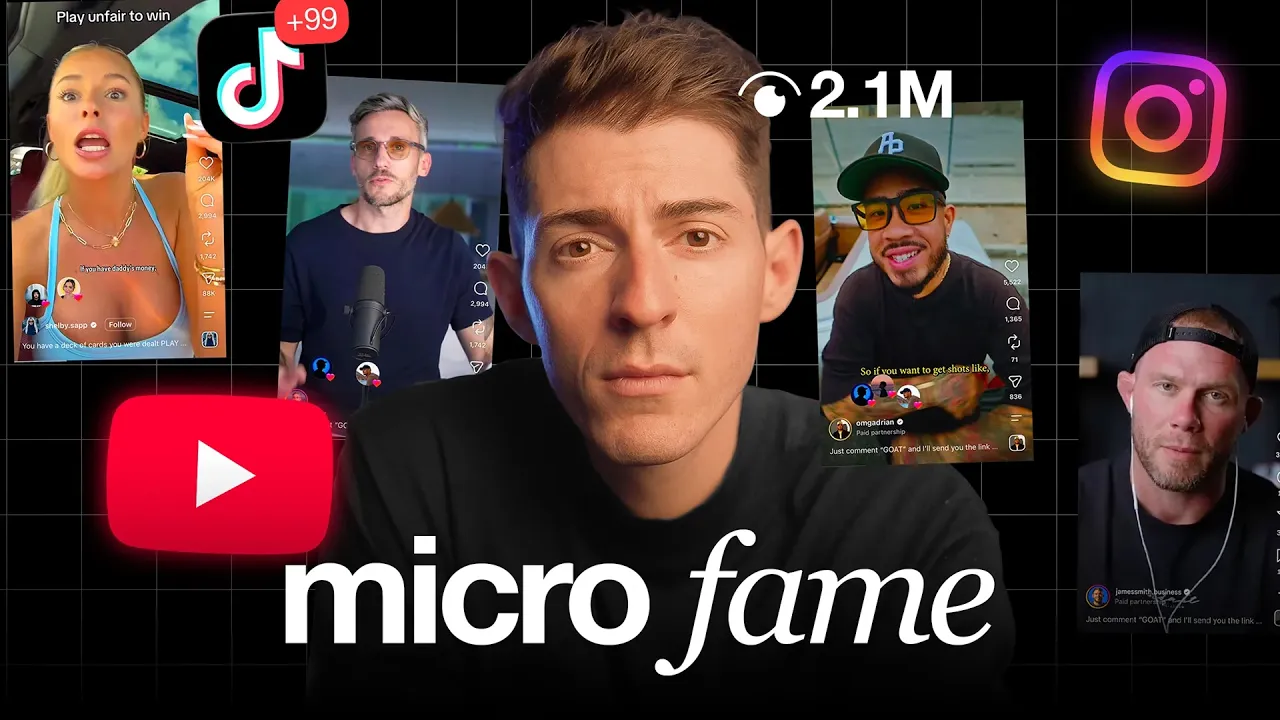
Kallaway · @kallawaymarketing
Where viewers went back to watch this video again, from YouTube's public Most replayed graph, lined up with what was said at that moment.
Most replayed moment #1
22:254.1x the video's typical replay level
points you know they have, outcomes you know they want, things that have come from client conversations, or topics you've seen covered that you know matter for your ideal viewer. And those two narrow buckets are not meant to go super viral. Instead, they're meant to go deeper and drive more conversion and trust
Said at 22:19
Most replayed moment #2
21:323.6x the video's typical replay level
strategies, and like I said, worked with dozens and dozens of business owners testing all this. I'm very confident the 3-2-1 is the best for most people. So, the 3-2-1 is very simple. You're going to come up with three different topic buckets that you make two videos each per week. So, that'll be six of your seven
Said at 21:25
Most replayed moment #3
10:023.5x the video's typical replay level
This would be like trying to buy beachfront property in Hawaii today. There are still deals to be had, but you have to really know what you're doing and spend time carving out your thesis. Now, when I say carve your lane, let's get very granular. There are seven different positioning attributes where you can find
Said at 9:54
The graph counts replays. It does not show where viewers stopped watching.
Words
6,935
Runtime
29:29
Speaking pace
235wpm
Reading time
29min
235 words per minute, above the 201 75th percentile of 349 measured videos. That distribution comes from the 349-video hook study.
Opening (first 30 seconds)
We are entering a completely new era in personal brand building. Today, if you want to build a lucrative personal brand that makes millions of dollars, you don't need to go mega viral. You don't need millions and millions of followers. You don't need to have made content for 10 years. All you need is to become micro famous in your niche. This is how all of these people have built seven-figure businesses in just a couple years online without ever touching mainstream fame. Now, the truth is building micro fame this quickly wasn't possible just five years ago. Most people on this list hadn't even started posting five years ago. But, the reason it's possible now and
118 words, the words spoken in the first 30 seconds at 235 words per minute.
Free, no signup. See how the first 30 seconds hold attention, with rewrites.
Sentence shape
| Measure | This transcript |
|---|---|
| Sentences | 388 |
| Average words per sentence | 17.9 |
| Longest sentence | 64 words |
| Questions asked | 20 |
| Sentences containing a number | 53 |
Most used terms
Filler phrases
79 in total: like 42 · actually 13 · kind of 6 · literally 6 · right? 5 · you know 4 · basically 3.
A literal whole-word count of the same phrase list the Prepublish browser extension uses, so a phrase inside another word is not counted and a phrase used in its ordinary sense still is. It is a count and not a judgement.
Free, no account. See where attention is likely to drop, with a rewrite for each weak line. The free check shows the scores and the one issue costing the most. Or run it on the words above first.
Free · No login · See a sample audit first if you prefer.
What this transcript is
Every word below is the caption track YouTube publishes for this video, pulled from the video itself and reproduced unchanged. It is not Prepublish's writing, not a summary, and not a re-transcription: it is the video's own published captions. English captions, generated automatically by YouTube, in the video’s original language. Source: the video on YouTube. A channel that would rather this page did not exist can ask for its removal through the contact page, and it is removed.
We are entering a completely new era in personal brand building. Today, if you want to build a lucrative personal brand that makes millions of dollars, you don't need to go mega viral. You don't need millions and millions of followers. You don't need to have made content for 10 years. All you need is to become micro famous in your niche. This is how all of these people have built seven-figure businesses in just a couple years online without ever touching mainstream fame.
Now, the truth is building micro fame this quickly wasn't possible just five years ago. Most people on this list hadn't even started posting five years ago. But, the reason it's possible now and why so many people are unlocking this micro fame is because the algorithms have changed. And that change makes right now the only time in history where you can get famous fast inside of a category. Now, in this video, I'm going to break down the playbook for how anyone watching this can become micro famous in their niche.
I'll explain why it's possible now, what makes it so attractive, and the exact steps that you can follow to make it happen for yourself. By the way, if you don't know me, my name is Chalene. I have a million followers. I've done billions of views, and content is all I do all day long. All right, before we get into the tactics, let's just define what being micro famous actually means. Cuz this will really help you understand the ultimate goal of your content strategy.
Being micro famous means that you are the authority figure in your category. Micro fame isn't about the number of followers you have. It's about your authority density per follower. And if there was one single metric that could compare audience value across channels, it would be this. Imagine there were two accounts. The first one has 2 million followers in the sports niche, but it's largely based on news reporting, trends, memes, and a couple of viral bangers based around cultural moments.
The second one only has 50,000 followers in the collectible space. But, every single one of those 50,000 people considers them the collectibles expert. They trust them. They follow their picks. And when they have a question on collectibles, their name and face is the first thing that pops in their head. Now, be honest, which of these two accounts would you say is more valuable? Most people honestly would say the first one.
Because even though it's more general, it has 40 times more followers and likely gets way higher average views. But, the truth is, in almost every scenario, the collectibles account, number two, will out-earn the first one. And this is the power of authority density. In personal branding, dollars come from authority, which comes from trust accrued over time. So, your goal, if you're trying to build a super lucrative personal brand, is to increase the density of authority across your audience.
And it actually doesn't take that big of an audience to be able to build a seven-figure business. This is exactly why buying followers or running follower ads to grow your following is a mistake. This is a metaphor I like to use. Imagine you had a glass full of red food coloring, and it was super concentrated, very, very deep red. Every follower you add that doesn't trust you would be like adding clear water to that glass.
Over time, the glass fills up, but the liquid dilutes, first turning light red, and then pink, and then eventually almost clear. This metaphor is a proxy for trust dilution over time, which is very common, but it is the number one killer for why personal brands stop being able to monetize. So, if there's one metric that tells you how valuable an audience actually is, it's not followers, it's authority density. And becoming micro famous is just the exercise of maximizing this authority density.
So, here's a really quick test you can run to just subtly gauge what your authority density looks like. Ask yourself this, if you polled all of your followers and you asked them independently, "Who is the number one person in this niche that you trust the most?" Would they say you? Cuz if the answer is mostly no, you don't have a follower problem, you have a density problem. And everything else I'm going to go through in this video will help you fix that.
And that will enable you to become micro famous. All right, the last thing I want to cover before I get into the tactics, and this is so, so important, is to understand why becoming micro famous is now so much easier today than it was five years ago. Something structurally has changed in the way social media works, and understanding this is very important in helping you to take advantage. There are three core shifts to the algorithms and social media design that make this fast fame possible in this era.
The first one is what I call zero ramp virality. Just 5 years ago, there was really no ability for you to go viral on day one of posting. [music] You had to first build up a following and get them to engage with your stuff over time even have a chance of something breaking out. Well, today that is completely flipped. If you make a new account on Monday and you post a banger on Tuesday, you could have a million views and 10,000 followers by Wednesday.
I call this zero ramp virality. There's zero ramp required to be able to go viral. And this is an insane thing to unlock if you know what you're doing. It just wasn't possible before. Now, the second condition that changed that makes this micro fame process easier is called automatic targeting. 5 years ago, social algorithms targeting ability was nowhere near as sophisticated as it is today. And this just means it took a lot longer for algorithms to understand who your ideal viewer was supposed to be.
Because of that, you just had to post organically for a long time to try to hone in this audience match. Well, today that is also completely flipped. Social targeting precision is insanely good. Almost right out of the box as soon as you start posting on a new account. Because of this, in just a couple videos, the algorithms can very accurately target the exact person you want to reach with almost zero spillover into a bad fit avatar.
So, you're getting both insane reach potential to the exact right people almost instantly. Now, the third condition that changed this, and this really is the biggest one, is the unlimited scale. Organic content can now scale infinitely. Before, you could post high volume like 5, 10 times a day, but you really risked follower fatigue because the only people that saw your stuff were followers. So, if you just hammered post, the same people would be seeing your stuff over and over.
Today, that is also changed. For You feeds basically allow you to post 10 times per day without fatiguing your followers because they'll just show it to a bunch of other non-followers that are similar to the people following you. If you add these three variables up, it means that if you make the right content, you can reach millions of the right people on day one and then continue reaching millions more like them whenever you want.
These are what I call Goldilocks conditions when it comes to marketing and it's why I've been basically screaming to every business owner I know and making these videos with my hands like this over the last 2 years because as soon as I recognized these conditions had changed, it becomes the greatest marketing bet you could possibly make to make organic video content. So, these three conditions multiplied together are why it's so much easier to become micro famous now than it was 5 years ago.
And if you don't believe me, take me as an example. Just 3 years ago, I had never posted a short-form video. No YouTube, no short-form, nothing. Fast forward just 3 years, I have 2 million followers, I've done billions of views, I have my own micro fame in literally two different categories. I'm famous in AI and I'm famous in marketing as well. In each of those categories, I've built seven-figure businesses, both of them.
All of that in 3 years from zero. That is only possible because the conditions have changed so that I can jump to the top of a niche without having to wait my turn in line. And I'm telling you, you can do the same thing, too, by becoming micro famous in your niche, which I'm going to break down right now with this tactical playbook. By the way, guys, if you like how I'm explaining this, I've also open-sourced my content system for free.
What I'm about to go through is the strategy around winning and becoming micro famous, but you're also going to need the system for how to make the videos. So, everything I do from ideas to hooks to script writing to monetization, it's all included in here for free. You can get it at shortformsystem.co or check out the link in the description. All right, now let's get into the tactical playbook. This will cover the strategic positioning and the content strategy for how you become micro famous in literally any niche.
A lot of people don't know this about me, but I actually spend a lot of my time helping business owners figure this out, how to become micro famous in their category. I've obviously done it for myself twice in two different niches, but I don't think you can really pressure test a system until you apply it to other people that aren't you. So, this is what I've been running for dozens and dozens of business owners behind the scenes.
A lot of people you see dominating categories have some version of this running or I've worked with them directly. A good example of this is Pat. I've been working with Pat for about a year. He went from zero, never making content ever, to having over 100,000 followers total across Instagram and TikTok, and basically owning the backpacking review niche. He's had many videos get over a million views. He's done brand deals with many of the top brands in the backpacking space.
He's launched his own backpacking brand, which did its first launch with a five-figure launch, and that was all in 1 year. Nobody really knows him outside the backpacking niche, but inside he is a top authority figure. He's micro famous. So, this is a perfect example of what it looks like to become micro famous in a niche. And like I said, 12 months, zero to that. So, here's the tactical playbook that I personally run on all of my channels, what Pat ran himself, and what I put the dozens of business owners that I work with directly through.
The first part, and this is super important, is to figure out a unique strategic position. And this is literally the exercise that I ran through when I started posting on my Callaway Marketing Instagram account just 90 days ago. So, I'm going to take you through the framework, and then I'm going to show you how I applied it to myself to grow way faster. For context, I've gone from zero to about 60,000 followers in just 90 days.
I'm growing about 1,000 followers a day following this playbook exactly. So, here's how you do it. First, you take the niche and the platform that you're playing on. So, for me in this case, it was social media growth on Instagram. Then you want to come up with a unique lane within that niche that isn't currently oversaturated. I call this a unique positioning angle, a UPA. And this is ideally where you identify white space that suits your expertise, personality, background, and unique abilities, or unique experience.
Now, if you're literally creating the niche, or you're one of the first ones in this niche, well, then this exercise is not that difficult. All you have to do is start making content across any of these attributes, and you'll be good. This would be like the settlers in the 1850s in the US. They didn't have to be real estate savants, they just went out there, everything was available, they picked their plot and they were good.
Now, on the flip side, if you're trying to compete in a very crowded niche, this exercise is a little bit harder and you should spend time trying to figure out what your unique lane is going to be. This would be like trying to buy beachfront property in Hawaii today. There are still deals to be had, but you have to really know what you're doing and spend time carving out your thesis. Now, when I say carve your lane, let's get very granular.
There are seven different positioning attributes where you can find white space to carve your own positioning. The goal is to stack up as many of these attributes together cuz they multiply to create this unique lane. Again, if you're in your own category, you're one of the first to make content, you might only need one of these. If you're in a crowded niche, you probably need a few stacked up together. So, these are the seven unique attributes when it comes to unique positioning.
The first one is topic selection. So, this would be you talking about topics in your niche that aren't widely covered already today. So, for example, in social media growth, this would be like if I identified hooks were really important as a topic, but nobody was covering them, I could just start talking about hooks and that would create white space that I would fill. The second attribute is substance depth. So, this would be where you're talking about common topics that are already covered, but the value or the tactics or the insights that you give on those topics is just way different than everyone else.
So again, in the social media space, it could be I've identified hooks are important, a lot of people already talk about it, so I don't get any topic differentiation, but the way I talk about it, what I say, the insights I share are just different at a higher value level and so that's how I separate. The third attribute would be unique stories or scenarios. This would be if you have unique experience or expertise in actually doing the thing so that you can share that that a lot of people don't have and couldn't copy you on without lying.
So, for example, in the social media space, if I grew five accounts to a million followers and not that many people had done that, well then I could share lessons learned and stories that are atypical from what people typically see and that would create white space that I would fill. The fourth attribute or way to separate in positioning would be avatar specificity. So, this would be like you're talking to a specific unique avatar slice that is underserved in the niche.
So, for example, in the social media growth space, if there are a lot of people there, but no one's talking to mortgage brokers about social media, that would be a unique lane or unique avatar specificity that you would fill. The fifth attribute would be delivery style. So, this is your tone, your rhythm, your speaking cadence, the way you come off on camera. For example, to continue this in the social media space, let's say I saw everybody was communicating in this like informal raw way.
Well, I could fill white space being more professional, buttoned up, rigid, wearing a suit, for example. The sixth attribute is storytelling format. So, this is pretty classic. You're delivering storytelling formats that aren't typically being used in your niche. So, in the social media space, let's say I saw everybody making these ranking and tier lists and listical type videos, but nobody was doing challenge videos where they actually challenge themselves to go zero to 100k in 30 days.
I saw white space there, and so I filled it. And then the seventh attribute would be visual format. So, this is that you're filming or editing laying videos out in a way that you typically don't see in the niche. So, to finish the example in social media, if everybody's shooting raw in their bedroom, you could come more cinematic or in a studio or just a completely different visual delivery. So, those are your seven options for how to find differentiation or white space to create your own lane in a niche.
Again, the more crowded the space is, the harder it is to carve one of those lanes, and you have to stack some of those together. The more open the space is, the less you have to do. You can just pick one, fill it, and you'll win. So, if we think about how I approached the social media growth space on Instagram 90 days ago, this is how I went through each of those seven categories and what I thought about with respect to if there was white space that I could fill.
And again, a lot of this is custom to me with my unique background and skills that I knew I had. For you, you don't have the same skills and background and proof as me, so you may have to approach this differently even if you're attacking the social media growth space. So, like I said, just to give context, zero to 60k followers in 90 days, growing about 1,000 followers a day, 5.5 million views or so total. So, that means over 1% of people that see a video follow me.
I've driven over 20,000 collected emails and over 100,000 in revenue during that 90-day period. I should have over 100,000 followers by the end of 2026. Just to give you a sense of like where I'm at and how fast it's working. Now, here's how I thought about my positioning across those seven buckets. The first one is topic selection. So, are there any topics not being covered in the social media growth space that I could fill?
Candidly, social media growth is very competitive. A lot of the topics have already been covered. One that I identified that was pretty open was AI content workflows. So, anytime I make a video about Claude and Sandcastles combined, it crushes. That's my top category, and there's a reason for that. Huge TAM, and it's kind of open relative to some of the other stuff. So, that was something that I wanted to try to differentiate on a little bit.
This alone was not going to be my only competitive positioning difference because I didn't want my whole account to be about AI. But, that was definitely something I was going to add to the stack. Second bucket is substance depth, right? So, this is how I approach topics people are already covering, but going deeper and more value. The current state of social media content, for the most part, is very surface-level. You see a lot of people being like, "Monday, Tuesday, Wednesday, Thursday." And they're just like listing the formats with no value at all.
Someone like Eva, Personal Brand Launch, is actually very good at deeper substance. She goes a level deeper than most people, which is why she grew so fast. She was really like the only social media growth content channel that did this at scale 2 years ago. That was her significant positioning. But, I knew I could approach it similar to her in a different way. I could also go deeper substance, but not copy what she was doing, and I knew there was white space there.
So, the substance is a core pillar where I knew I could separate from most people. And this kind of goes back to like my expertise background and how I articulate things. This is a strong suit of mine, so I knew this would be my anchor unique positioning differentiation. And by the way, when you hear me break this down, you can hear the precision that goes into this type of strategic exercise. I'm very strategic with how I do this.
I am the type of person you're competing against in a very competitive niche. So, just A, accept that there are people that think about it at this depth. And B, the reason why you want to work with someone like me is cuz I'll just tell you what the positioning should be so you can follow it, so you can avoid the wandering period where you don't know. If you're not going to work with me, there's only a handful of people in the world that can kind of cut through the BS and tell you how to think about it at this level.
I recommend you find one of those and just pay them so you can avoid the ignorance tax. All right, the third bucket is unique stories and scenarios. Now, I have some really great case studies like the one I went through with Pat that I really rarely talk about cuz I don't like to lead with the case study proof. It feels sleazy and salesy to me. I also don't like layering in those examples when you have a very small following.
Something feels incongruent about having 5,000 followers but being like, I helped this person grow to 100k. It's very misaligned. So, I like to wait to use the case studies and scenarios until I'm a little bit bigger. So, for that reason, I wasn't planning on using this as a differentiation point in the first growth phase. The fourth bucket was avatar specificity. Now, rather than talk broadly about social media growth to everyone, I was going to dial in for social media for business owners.
The thing is, there's still a lot of people that are positioning themselves that way, social media for business owners. So, although that was going to be part of how I wanted to come across, it wasn't going to be enough differentiation alone to separate. The fifth bucket is delivery style. Now, I have a pretty unique speaking cadence and rhythm when it comes to content. I'm very good at annunciating my words so that clarity is maxed out.
This is one of the reasons why I've been able to grow so fast on YouTube and it's kind of like my calling card, right? It's just a It's just a unique skill that I have. Also, on the delivery side, I dress in all black. I have this kind of like cinematic set that is atypical from what you typically see in social media. You don't see people articulating things like this at this level of depth in this visual package. So, for all of those reasons, delivery was also something I thought I could separate on by just executing in my normal style.
Now, the sixth attribute is storytelling formats. Now, when it comes to social media, almost all the formats have been tried and covered. The social media niche is really where formats get born typically. So, I knew there wasn't going to be much space to differentiate on this attribute. Because of that, I was just going to stick to what I'm good at, breakdowns, explainers, and listicles. Now, you can win by coming up with a unique format no one's ever seen before, but that quickly gets cloned and commoditized.
Just look at the Kumar thing. And so, it's not easy to rely on this to have consistent advantage. So, for that reason, I just wasn't counting on any lift here. And then lastly was visual format. Visually, I prefer the premium, high-polish, high-aesthetic, cinematic execution. That's just what my eye suits. It's what I do on YouTube. It's what I do on my tech videos. Lots of the gurus talk about how this doesn't work and raw is the only way to win.
It's nonsense. I don't believe that at all. Raw can work, the cinematic can work, it can all work. It's just about what are you contrasting against relative to the field. So, the good news is most people try to do the raw stuff on social media. I knew I could easily win with cinematic and polished, and so that's how I wanted to come across visually. So, if you add those up, I had significant differentiation on substance and delivery style.
I was going to come across differently visually, and I had a one-topic bucket that most people weren't covering. If you multiply those together, it makes me one of one in the niche. And so, that doesn't mean I'm guaranteed to win, but at least if I execute on the strategy correctly, there's open white space that I can run and fill into and then grow faster. Now, people can try to copy the visual execution, and they already have, right?
The style I have, people try to copy that. But the thing is, when you copy a visual style that most people think of one person for, most of the value accrues back to me. When they see that style, they think of me in this niche. So, if you copy it, you don't really get the lift. [music] Things like substance and delivery style are way less easy to copy, so there's a moat there as well. Now, I will say, if you're watching this, unless you're in the social media growth space, which I know a lot of people are who are watching this, if you're outside that, there's a good chance your niche is way less competitive than social media growth.
The two niches I play in, social media growth and AI, are two of the most competitive niches on the internet. I would say fitness and maybe like cooking or recipes or also super competitive, although those TAMs are massive. But most other niches, there are small pockets where they aren't that competitive. So, you have a ton of room to come up with your own UPA. You don't really need to go so crazy like I did. Now, the best way to come up with what the options are that you could use for each of those buckets is called transpositioning.
So, what I recommend is first you look at your niche and try to figure out what the baseline is that's working on your niche. And you could use sandcastles.ai for that. Just build a channel list and then you can kind of look at what's working. But then, if you can't find differentiation, what you want to do is go to similar or distant niches that are far from yours, look at what's working for them, and then bring some of that over to yours.
This is called transpositioning. Typically, you're not going to outrun somebody by cloning the person that's in your niche. If they're already better than you and they have a compounding advantage, you're typically not going to outrun by copying them. So, what you want to do is go somewhere else. If you're in social media growth, go to like the vintage hat niche, see what they're doing at the top of that niche, and if there's something different that you don't see in social media, bring that over.
That's really where the alpha and sauce is. And this is why it's actually really helpful to study people outside of your niche. Now, the best way to get exposed to those is you can look at collections on sandcastles. We've hand-curated 105 different collections across formats, [music] signature series, editing styles, and visual hooks. Inside of each collection are between five and 10 of the best-performing videos for that type across all niches.
So, there's probably 500 to 1,000 different videos that are hand-curated. These are top videos that you can watch and get exposed to different types of execution, different types of formats that are outside your niche. I find this to be one of the fastest ways to just get exposure to top-performing videos without having to reset your own social algorithms. So, if you want to check that out, I've linked a couple of the collections below so you can see how they work.
All right, so that is really the first piece around strategic positioning. And I find that to be really, really helpful, especially if you're playing in a competitive niche. If you do the work up front to define what that white space lane could be, Then, all you have to do is execute on the content strategy, and you will grow a lot faster. Now, the next piece is how you actually make the content. Like, what is your content mix across different topics that will help you execute on that positioning?
And I recommend every single person run what I call the 3-2-1 content strategy. Now, I've built a ton of different content strategies, and like I said, worked with dozens and dozens of business owners testing all this. I'm very confident the 3-2-1 is the best for most people. So, the 3-2-1 is very simple. You're going to come up with three different topic buckets that you make two videos each per week. So, that'll be six of your seven weekly videos if you're posting once a day.
The seventh video is going to be what I call the chaos agent. This can be a triple down on any of the three buckets, or just something random you saw in some other niche that you just want to try, right? It's meant to be controlled chaos to inflict random tests so you can experiment outside of the buckets. For the three main buckets, one of your buckets is going to be more broadly positioned. So, it's still going to be a topic that will accrue trust and authority to you in the niche, but it's meant to be a little bit broader so you can have a chance at virality to bring a ton more people into the zeitgeist.
The other two buckets are going to be more narrowly positioned. These will be specific buckets that are very valuable to your specific ideal viewer avatar and buyer. And so, these can come from pain points you know they have, outcomes you know they want, things that have come from client conversations, or topics you've seen covered that you know matter for your ideal viewer. And those two narrow buckets are not meant to go super viral.
Instead, they're meant to go deeper and drive more conversion and trust accrual per view. So, three buckets, two videos each, one chaos agent. 3-2-1. Now, to figure out what these three buckets are going to be, you can either randomly guess, so you take a piece of paper, you write down all the most important topics you think matter, you pick three, you randomly guess, you make videos across those three for a few weeks, let the data tell you, and then iterate.
That's the less data-backed way to do it, but like the quickest, just random guess. The other way to do it, which is what I recommend, is you research the top competitors in your niche between 25,000 and 250,000 followers. You do a deep analysis, which I'll walk through how to do in a second. You let that tell you which topic buckets are working best, and then you pick three from there. Now, the fastest way to do this, this exercise, which I recommend everyone do, you first go to Sandcastle's, and you need to build a channel list of your top competitors in your niche.
If you don't know who they are, just go to Sandcastle's, go to the channels tab, go to describe, and just type in the topics that you cover, or whatever you describe your niche as. Sandcastle's will suggest the top channels that fit that description. You can either add all of them into the channel list just by pressing add all or the plus, or you can pick one of them that you recognize, add that one in, and then press the arrows that say more like this, which will hone the search to be closer to that person.
If you don't want to do it this way, you can also scroll on your For You page, or look at your explore page until you see videos come up that you like. Take that person's channel profile, go to the channels tab, either search for them or add the URL in, and build your channel list that way. Either way, you want to build this channel list of competitors. Every single person that makes content has done this. This is the most valuable exercise you could do.
Your goal is about 20 to 25 competitor channels between 25 and 250,000 followers in that Sandcastle's watch list. Now, once you have that done, go to the videos tab, you will automatically see all of the videos from those channels listed in the videos tab. I want you to go up to sort, press outlier score. I want you to go to post date, and do last 3 months. And then for engagement rate, put the minimum bound at 2%, which filters out any of the paid brand deals.
Now, you've got the top performing videos organically from the last 3 months from all those competitors in one place. Now, you can easily open each of these in a new tab and watch them. If you just hover over, you can see how to do that. But, the much faster way is to deep analyze all these videos, and let Claude tell you what the best performing topics are. So, to analyze, you can hover over a video and click the analyze button one by one, or you can go to bulk analyze at the top, type in either 50 or 100, which will be 100 videos analyzed at once, and it will automatically deep analyze the top 100, or whatever number you put in.
Doing this will spend one credit per video, so 50 is a good number to start with. Now, let that run for 5 to 10 minutes and you will see the little green analyze badge on all the videos. It'll say done in the upper right. Once it's done, go to export and export that data into a CSV. You will now have all of the videos you deep analyzed, the transcript, the topic, the hook, the format, the storytelling structure, literally all the data you would need about those videos.
You're going to grab that, you're going to drag them to a new chat in Claude, you're going to use the Fable 5 model, and you're going to run this prompt. My goal is to build a high-value authority audience in insert niche, put your niche there. I want you to build a visual distribution that breaks down the top-performing topic buckets across all of the videos in the file I gave you. This is a deep analysis pull of the top X videos, however many you did, from the top channels in my niche.
Screen out any video that doesn't make sense for my niche, if it's about their personality or whatever, screen those out. My goal is to come up with one broader-reaching viral topic bucket and two more narrow topic buckets for the avatar that I'm trying to cover. You can add more information about your avatar to help clarify it, I recommend as much detail as possible, and then press run. This will run for 5 minutes and it will give you a visual distribution breaking down the topic performance for all of those videos.
This will tell you exactly what topics are working best, and you can pick three from there. Now, based on the three you pick, you're going to run the 3-2-1 strategy. You're going to do that for 2 weeks, and then you're going to come back and you're going to re-evaluate how it's working. If you notice some of the buckets are not performing at all across any of the four videos you made across those 2 weeks, you're going to kill that bucket, and you're going to promote a new bucket, either from the initial research list or something that your random controlled chaos agent surfaced, [music] you can bring that to a new bucket.
This is the fastest way to use data to make sure your allocation of time towards content is working the best. Now, once you have done these two strategic exercises, number one, you identified your unique strategic position, and number two, you mapped out the 3-2-1 strategy, you'll only have three questions left. Number one is how do I actually make the winning video? Like, I have the topics, but how do I write the hooks?
How do I write the substance? How do I edit it? Right? That's That's bucket one. Number two, if you're busy or a business owner, how do I build a team that can actually help me do these videos for me? And number three, how do I evaluate which videos are working and not? And specifically the ones that are working, how do I extract the learnings to apply to my future videos? Those are the three big questions you'll have once you solve these two strategic pieces.
Now, for those first two questions, how do I make the videos? How do I make a team? This is what I help people with in SFA. I work one-on-one with business owners to help you make winning videos, help you build a team. You come in, I review your videos, get you good, and then you graduate out. So, if you want to work with me for that, I've got a link below. Now, for the third question, how do I know what's working? This is where you want to use the Sandcastles dashboard.
If you click the dashboard tab, you will notice, once you verify your social channels, we are running a content strategy report for you every 7 days. If you scroll to the bottom of the page, you'll see the top-performing topics, hooks, formats, and scriptwriting techniques automatically run for your last batch of videos. You can click on any of those subcategories, and to the right side we will tell you specifically what is working and what's not working, what you should keep doing, and what you should not keep doing.
So, once you have your channels verified and you turn that on, it will be a machine that just surfaces you insights for what's working and not working automatically. You can see it in the dashboard whenever you want. We also send you an email every time we run that report. This has been hands-down the favorite feature we've ever launched. I look at this dashboard literally every day because it tells me what to make and what not to make.
If you want to learn more about how to get the dashboard set up and how I'm using it, like what I'm looking at in the metrics, I've got a tutorial linked below for you. All right, guys, that is all I've got for this video. As promised, I wanted to go deep down the rabbit hole on how to actually build your strategy around becoming micro famous in any category. First, we talked about what being micro famous is and the conditions that changed in the social media world that make it possible to do this faster now.
Then, as promised, we went through what I think are the two most valuable strategy exercises you could do. One, defining your unique strategic positioning, and two, defining what those buckets would be for the 321 content strategy. Obviously, there's a lot more to it from there in terms of how to actually make the videos and improve them over time. If you want to work directly with me on that, I've got links below. If you don't, I recommend you linking up with some coach that can help you cuz it will speed up your cycle of iteration.
If you're a business owner or a serious creator, you can probably tell this will be one of the most valuable channels you could watch in terms of how to learn content to grow your business. So, make sure to like, make sure to subscribe, and definitely drop a comment on what you're struggling with on the content front. I look at those comments to help guide the next video, so it's super helpful when you do. I've got a bunch of free stuff in the description to help you get started with a lot of these things, so make sure to check out all of that.
I'm trying my best to help people grow as fast as possible. All right, we will see you guys on the next one. Peace.
The words are the caption track's own and nothing is reworded or re-transcribed. Paragraph breaks are placed between sentences so the text reads as prose.
Free tools for your own script: paste a draft and see where it stands before you record it.
Paste your draft and see where viewers are likely to drop off, with a rewrite for each weak line.
Paste the first 30 seconds of your own draft for a hook score and rewrites.
Check your draft against YouTube's advertiser-friendly guidelines before you record it.
Read this channel's public videos and transcripts, and download a writing brief for it.