Getting the transcript
Reading the captions from YouTube. A video nobody has opened here before takes 10 to 30 seconds; this page fills in on its own.
Getting the transcript
Reading the captions from YouTube. A video nobody has opened here before takes 10 to 30 seconds; this page fills in on its own.
Theo - t3․gg · @t3dotgg
Where viewers went back to watch this video again, from YouTube's public Most replayed graph, lined up with what was said at that moment.
Most replayed moment #1
16:187.2x the video's typical replay level
And I empathize with this a lot because I had a similar experience at Twitch where I so desperately wanted to fix the mobile app. I did a hackathon project where I started from scratch and with 10 people was able to get a better app in 4 days. And my reward for that was a trophy and HR warning because the mobile team
Said at 16:11
Most replayed moment #2
2:556.7x the video's typical replay level
and hope for the best. It's so nice. Spend less time waiting and more time building at swedish.link/depot. I'm going to be honest, the main reason I'm making this video is because Justin's story pissed me off so much. The thought of somebody like him being fired shows that the environment at Google is not one where
Said at 2:47
Most replayed moment #3
14:455.0x the video's typical replay level
of how you would use AI for coding. And obviously now Claude code is the biggest existential threat that a company like Cursor has. Here's where the leak comes in. Codex was not a strategic plan that OpenAI had. It was also an internal hack project that one
Said at 14:38
The graph counts replays. It does not show where viewers stopped watching.
Words
3,980
Runtime
19:24
Speaking pace
205wpm
Reading time
17min
205 words per minute, above the 201 75th percentile of 349 measured videos. That distribution comes from the 349-video hook study.
Opening (first 30 seconds)
A bit of news, after nearly 9 years, I've decided to leave Google DeepMind and join Anthropic. After 14 years at Google, it's time for something new. Top AI researchers, Jonas Adler and Alexander Pritzel, are leaving Google for Anthropic. Oh boy. Seems like there's a lot of people leaving Google right now. That is four of the biggest names they've ever had, all leaving back-to-back-to-back, with three of them leaving for Anthropic specifically. On one hand, Google owns a decent bit of Anthropic stock, so they can benefit from that. But on the other, it absolutely seems like things are burning internally
103 words, the words spoken in the first 30 seconds at 205 words per minute.
Free, no signup. See how the first 30 seconds hold attention, with rewrites.
Sentence shape
| Measure | This transcript |
|---|---|
| Sentences | 241 |
| Average words per sentence | 16.5 |
| Longest sentence | 68 words |
| Questions asked | 8 |
| Sentences containing a number | 20 |
Most used terms
Filler phrases
52 in total: like 38 · actually 8 · kind of 4 · literally 2.
A literal whole-word count of the same phrase list the Prepublish browser extension uses, so a phrase inside another word is not counted and a phrase used in its ordinary sense still is. It is a count and not a judgement.
Free, no account. See where attention is likely to drop, with a rewrite for each weak line. The free check shows the scores and the one issue costing the most. Or run it on the words above first.
Free · No login · See a sample audit first if you prefer.
What this transcript is
Every word below is the caption track YouTube publishes for this video, pulled from the video itself and reproduced unchanged. It is not Prepublish's writing, not a summary, and not a re-transcription: it is the video's own published captions. English captions, generated automatically by YouTube, in the video’s original language. Source: the video on YouTube. A channel that would rather this page did not exist can ask for its removal through the contact page, and it is removed.
A bit of news, after nearly 9 years, I've decided to leave Google DeepMind and join Anthropic. After 14 years at Google, it's time for something new. Top AI researchers, Jonas Adler and Alexander Pritzel, are leaving Google for Anthropic. Oh boy. Seems like there's a lot of people leaving Google right now. That is four of the biggest names they've ever had, all leaving back-to-back-to-back, with three of them leaving for Anthropic specifically.
On one hand, Google owns a decent bit of Anthropic stock, so they can benefit from that. But on the other, it absolutely seems like things are burning internally at Google. As insane as these departures are, they're not actually what I want to talk about today. Rather, I want to focus on the circumstances and environment that has resulted in these types of departures happening. We'll never fully understand the culture and environment within Google externally, but all of the leaks that have been coming out have been very helpful in forming it.
But most importantly, I want to talk about Justin here, who is the creator of the Google Workspace CLI, which is one of the coolest things Google has ever made, and somehow it got him fired. There's a lot to dive into here, and in a world where Google has previously demonetized my YouTube videos for being too critical about Gemini and stuff going on on the DeepMind side, I'm a little bit scared to make this one. But I think it's important, and I'm going to take the risk.
So, I hope you can understand why I need to make a little bit of money outside of YouTube ads, like with today's sponsor. I'm going to be real with y'all. I haven't been using agents the correct safe way. It's just not that fun setting up Docker and trying to get it running. And even when you do get it running, it just takes so long to build your images that it barely feels worth it half the time. That's why I've been running my agents on my machines directly.
Well, I was until I started using today's sponsor more. You probably heard me talk about Depot before and how much faster they can make your CI. It's literally 10 times faster than GitHub Actions for a ton of real-world use cases. But what's way cooler is their 40 times faster Docker builds. Depot's way of doing Docker almost feels magical. The way they cache their layers on their CDN allows for insane performance. So, both your builds and CI as well as the machines that your devs are running and trying to spin Docker up on will all feel a massive performance win because they're pulling the reused work from the network instead of building it all from scratch locally.
They do this by running the whole build off of your machine and just giving you the results instead, which it turns out is just absurdly faster. And the result is that they can go deeper. They're not just caching your NPM installs, they're caching all of the different layers for your build process. Which means every language benefits massively, whether you're deep in a Basil config, you're using Go, Turbo Repo, or more.
It's just a massive win immediately. We're talking real-world wins as big as 16x for companies like PostHog on their giant repositories. And don't sleep on their programmatic CI. It's super cool to let your agents be able to run CI via API calls or a CLI instead of having to push up the changes and hope for the best. It's so nice. Spend less time waiting and more time building at swedish.link/depot. I'm going to be honest, the main reason I'm making this video is because Justin's story pissed me off so much.
The thought of somebody like him being fired shows that the environment at Google is not one where good things can happen. But they seem to know that too, and in order to understand, we need to go back to a leak from April. Google DeepMind formed a strike team to improve its coding models with Sergey Brin directly involved. It's surprising to me that Google has the world's largest internal codebase with over 2 billion lines of code, but it's lagging behind Anthropic and OpenAI in coding and agents.
This was the start of what seemed to be some awareness internally that Google is actually really far behind. For a while, it seemed like they just didn't get that. Like they actually thought internally that because they would top some certain benchmarks, it didn't matter that they're actually a frontier lab and they're actually a far ahead of Anthropic and OpenAI. And that is proven to just not be the case in the slightest.
And they're starting to be aware of this. I'm saying this with confidence because of my previous Google video and the response to it. I was surprised as hell to see how many people like Logan or Philip or many others, Jack Witherspoon from the Google Gemini and DeepMind teams, came in and had good things to say about this. They were like, "Yeah, these are actual good lessons that I hope we can learn from." Also, they did a great job of getting my previous video remonetized when all of that happened and I'm thankful for them for that.
I will still roast them forever for cuz it's very scary that my livelihood could be taken away by saying mean things about Google that are also entirely true. So, I do have those worries, but they've been good to me. I want to be good to them, but the environment they're in is the problem. And the fact that this video went around internally and I've heard from a lot of people at Google that this video started a number of meetings and was watched a lot internally.
They are realizing how chaotic the environment is, but they're not addressing it in the ways I want them to, at least not yet. It is absolutely possible that whatever they're doing now to make the model better could work, but at this moment it's not looking great. I saw this leak yesterday that alongside the 5/6 delay and the prep for the new voice model and Claude 3.5 and all that, this little bullet point in the middle was actually kind of the most interesting to me.
DeepMind is not satisfied with the current state of 3.5 Pro and it no longer is going to launch in June. This leak was corroborated by Business Insider who said Google's delayed the Gemini 3.5 Pro launch to July as it tweaks its new frontier AI. This reporting is kind of garbage. Just they call out that the Gemini 3 outperformed expectations last year, which is just [ __ ] [ __ ] They specifically call out that the new model is expected to be better at long horizon tasks and powering agents, which is the thing that Gemini models have historically been awful at.
To Google's credit, they've gotten really good at baking absurd amounts of knowledge into their models. They still top a lot of weird knowledge benches like my skate bench. They lead that by far. Very few labs even get into the 80% range with it, and Gemini 3 1 Pro can top 96% consistently on it, which is just crazy for what that bench is. But, they've done a good job of baking the knowledge in the spatial reasoning type stuff into Gemini 3 5 Pro or 3 1 Pro.
The models are smart. The problem isn't their intelligence, it's their behavior. It's how they work, not what they know. They often feel like the really smart coworker that knows everything about the whole code base that just doesn't respond or ignores your messages and doesn't show up in meetings. Like, they're not behaving properly, which is why these long-running tasks are something that is so bad. I can't tell you how many times I was working with a Gemini model and it gets stuck in a really dumb reasoning loop, or it keeps reading files that it shouldn't and just getting confused.
And the longer it goes, the less coherent it gets. Because, and this goes back to that first post I showed earlier, the size of Google's code base has nothing to do at all with the training data. And I really disagree with Yuchen thinking that would give them any success. That's been proven to not be the case. Having a lot of code does not make you good at making coding models. Having a lot of code histories is what does.
Having the history of changes being made, especially alongside agents. This is why a small new company like Cursor was able to catch up as quickly as they did with their training and post-training of models like Kimmy K25. They have the histories of us using the models to do real work. They have actual back and forth between a human and a really smart LLM in a real code base, as well as the before and after of that code base, so they can use for doing RL.
Google's whole pipeline was not built for any of this. First and foremost, it's important to understand that DeepMind is at its core a heavy research group. The science of baking the world's knowledge into these weights that can answer any question is really exciting to the team. It seems like getting slightly better at code is less exciting to that same team, which means they just haven't built the pipelines to artificially create all of this data to get the info they need to use in RL to make the model behave better.
They just don't have that set up because it hasn't been a priority for them. They also seem to think the data they need exists internally. Like they can train enough on their gigantic internal code base and somehow the model will be good at these long-running tasks. It just won't. More info from Google will not get what they need, and they kind of realize that with things like anti-gravity. Have you ever wondered why they were so generous with Opus 45 usage in anti-gravity?
It wasn't cuz they wanted to force you to use anti-gravity. I think even they know better than that. The reason is that they wanted to get data from people using anti-gravity and using Opus 45. Because if you use Opus 45 in their harness, they get a bunch of data on how it behaves that they can use to potentially train the model to behave more like that. But historically, they've just been focused on more knowledge in model, smarter model come out.
And now product is demanding different things. The teams building things like Jewels, Gemini CLI, rest in peace, anti-gravity and more want the models to be better at engineering and doing these long context horizon workloads. They're also the only lab putting out models that can still barely form coherent tool calls. The amount of work that Cursor had to do to shape the system prompt and set of tools so that the Google models would use them correctly is hilarious.
And you can still see the result in the reasoning traces when you use a Google model. Let's just try using Gemini in a random project. I'm not going to use anti-gravity cuz it's like the worst software I've ever used. I'll use Cursor, which is far from my favorite, but still far, far less bad. I'm going to ask it to figure out what this code base is. This is the Lakebed code base, my framework cloud thing that I've been working on for far too long.
Starting by running some checks, pulling with auto stash. Cool, Not bad so far. It's not showing us the reasoning traces though. I don't know if that's like a UI quirk here. Cuz that's what I want. That's broken. I can't open the explorer. I expected too much from our friends at Cursor here. To be fair, the Google APIs are the worst, so I understand why they wouldn't have the best experience here, but I'm going to do the same in a terminal.
I'm just going to use open code. Let's see how it goes. Cursor run is still going. It looks like it finished eventually. I guess none of these things are giving the reasoning traces anymore. Thought, exploring the code base. That's annoying. Previously, you would see it talk to itself like, here are all of my tools. Can I use this tool? No. What about this one? Hmm, maybe I can use that tool. What about the other tools?
It just Oh, it was not great. Okay, I turned on {slash} thinking. Okay, here now we can see some things. Okay, this is not as bad as it used to be. It was really bad before. That's actually progress. That gives me a little more hope. These reasoning traces are somewhat coherent. I've identified the Lakebed client offers standard hooks such that as use query use mutation alongside components like signing with Google. My next steps to review the cloud MDN skills for further directions.
That is kind of stupid cuz those files aren't really doing anything in this project. My understanding has solidified. I now grasp that this is Lakebed, an agent native platform for building full stack apps. Cool. And here we go for some nonsense. My current focus is on integrating core functionalities like routing, error handling, authentication, and custom hooks. This comprehensive system allows to streamline development by consolidating common patterns.
This is nonsense. This is not a thing that should have been thought about at all. It's just garbage. And when you read the reasoning traces at all from Gemini models, you will quickly see a lot of slop, especially when you ask it to start doing real work. It'll get stuck on something and keep running in a circle on that thing over and over again. It's really, really bad. The way I've described this before is it feels like Gemini models have a next generation level of intelligence and a last generation level of capability because they're so bad at like getting a task through to completion because they're so bad at knowing how to use the harness and the tools and everything and do a thing, wait, get a response, and then do the next thing.
All of that they're just bad at. But that doesn't mean Google has to lose. There's a lot of companies that realize they probably shouldn't be making models, they should be making infrastructure that the models will run on and take advantage of. Companies like Cloudflare have done great with this. If Cloudflare ever tries to make their own model, I'll be the first one to make fun of them for it because right now they're focused on making their tools work better with the models that already exist.
Google could be doing this. They could make it easier for us to integrate their tools with other models, with other agents, with other solutions. Like it would be great if I could manage my Google Cloud environments or more importantly my Google Workspace that I run my companies through with agents. Like if they had a CLI. Like the Google Workspace CLI, the thing that went super viral and did very well and got poor Justin fired for creating it.
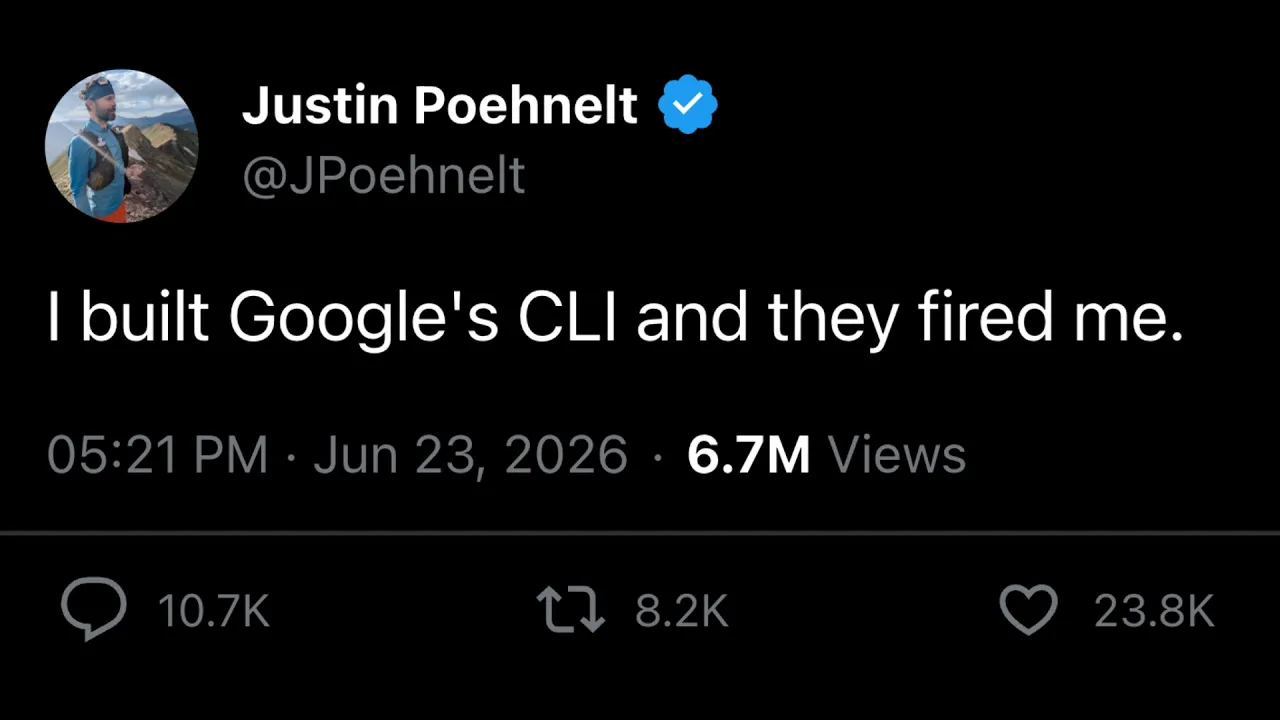
I'll read his post verbatim because I think it's worth knowing and understanding all of. Two months ago, I was fired by Google for creating the Google Workspace CLI. It went viral, hit number one on Hacker News, gained thousands of GitHub stars and many thousands of actual users in just a couple days. It was an incredible confusing journey from directors and leaders asking what they could learn from the tool to getting grilled by legal about why the Google logo and brand colors are on the Google Workspace GitHub code repositories.
I think the cause was that Workspace and certain leaders and projects were afraid of being disrupted. But the fear wasn't specific to his CLI, it was a broader fear in what agents mean for workspaces. Either way, the irony of his termination was that the announcement at Google Cloud Next two days before he was fired was that an official Workspace CLI was coming. I want this out there because it's easier for me to explain my story and it is an experience I want to fully own.
It's also part of my healing. Nearly 7 years at Google was an incredible opportunity for me and I was fortunate to have wonderful teammates and a manager that fully supported me throughout the last few months. He also shared all of the super positive feedback he went or he got when he released it from Ryan Carson saying, "Holy [ __ ] I love you. Swyx, I could kiss whoever it is that proposed doing this as a project." To which Adi Osmany came out and quoted and tagged Justin in saying he is the person who did this.
I literally just recorded a latent space with Felix where I enthused to him about how Claude co-workers AGI is it means I don't have to read Google API docs. Now even as money has left. I don't think Osmany left as part of this, but I think Osmany left because of the cultural shift that these things represent. Think I'm going to leak things that I shouldn't hear, but I don't really care. We all know the story of Claude code and how it started.
It was an experimental research project internally at Anthropic. They went as far as telling other companies they worked with like Cursor that they shouldn't worry too much about Claude code. It's just an experiment that they're trying out to get a better idea on the research side of how you would use AI for coding. And obviously now Claude code is the biggest existential threat that a company like Cursor has. Here's where the leak comes in.
Codex was not a strategic plan that OpenAI had. It was also an internal hack project that one random security engineer put together because he wanted to use the models inside of his terminal. He made it before Claude code was even announced. He just wanted his own way to pull in OpenAI's models at the time 03 mini into the CLI so that he could have it do things on his computer. And before anyone could say no, he had already gotten it far enough that people were using it internally.
At which point they said, "Fuck it, let's release it." And he convinced them to open source it because he loved open source. I think that was awesome. If he had done that same thing at Google, he would have been fired for it. Anthropic set up an environment where people could experiment and try those types of things, which would result in real product that became essential to their success. That's a huge part of why they did well.
OpenAI has the startup mentality internally where everybody is trying to think and act like a founder. So, if you can get far enough before somebody notices the resources you're wasting, people like the thing, they'll let you keep going on it for quite a while. Google says, "What the [ __ ] are you doing?" and fires you. That is scary. That is a fundamental failure deep at the core of the company that prevents the right people from having the incentives to actually progress the software and the technologies, and most importantly here, the models that we're using every day.
And I empathize with this a lot because I had a similar experience at Twitch where I so desperately wanted to fix the mobile app. I did a hackathon project where I started from scratch and with 10 people was able to get a better app in 4 days. And my reward for that was a trophy and HR warning because the mobile team was so mad. I could have apologized, sunk my head, and just moved on, but I was so pissed off by that that I left.
And I could see how if I stayed, that would have ultimately resulted in me getting fired because I never would have agreed to apologize to the mobile team. I know the position Justin was in when he made something objectively better, objectively more important, and objectively impactful. And his reward for that, for changing the direction of Google and making something that made Google way more exciting as a person who likes agents, was getting reprimanded to the point where he genuinely feels that he was fired for this.
And I think he is right. I think that is true. And those early investments that companies like OpenAI and Anthropic made in those coding agents resulted in them getting a lot of feedback, a lot of data, a lot of valuable stuff internally that lets them make the models smarter and stronger. Google has none of that. They have anti-gravity, which nobody wants to [ __ ] use, including official employees at the company. They have a giant code base that's a slop fest that's too big to be useful and doesn't have traces that are useful, either.
They don't have any of what they need to be successful right now other than a bunch of TPUs, which apparently isn't going so well cuz now they're even renting capacity from Elon. They had a compute lead, which doesn't seem to be going well for them. They had a data lead, which doesn't seem to matter anymore. They had a code base size lead, which doesn't seem to matter at all. They had a talent lead and a lead in terms of the capital they had available to them, which they have been blowing left and right with all of these people leaving to Anthropic as soon as the money made sense for them.
Google had everything they needed to win, but Google itself doesn't seem capable of doing anything but losing right now. That all said, if they understand this now and it does seem like they do from the convos I have had with people both in and out of Google, they understand now, finally, just how far behind they are and that the strategy that they have had so far is just not working at all. And hopefully, maybe, they're finally going to change it.
But until that happens, I will see posts like this and we will probably see many more departures not far from the ones we are seeing right now. It's just not looking great for Google at this point. Oh, I missed Noam leaving, as well. They spent $2.7 billion pulling him out of Character AI and now he's leaving for OpenAI. This is insane. It's over. It's over. And until they fundamentally flip internally, it's just going to keep getting worse.
They seem to have woken up to it. We'll see where that all goes, but for now, I honestly think Mistral has a better chance of success. We'll see how this all goes and I'm curious how y'all feel. Am I just crazy for thinking Google is so doomed, or was I crazy for thinking they'd be successful in the first place? Where do you think it's going? Do you use Gemini at all? I've pretty much given up myself. Let me know how y'all feel, and until next time, peace, nerds.
The words are the caption track's own and nothing is reworded or re-transcribed. Paragraph breaks are placed between sentences so the text reads as prose.
Free tools for your own script: paste a draft and see where it stands before you record it.
Paste your draft and see where viewers are likely to drop off, with a rewrite for each weak line.
Paste the first 30 seconds of your own draft for a hook score and rewrites.
Check your draft against YouTube's advertiser-friendly guidelines before you record it.
Read this channel's public videos and transcripts, and download a writing brief for it.