Getting the transcript
Reading the captions from YouTube. A video nobody has opened here before takes 10 to 30 seconds; this page fills in on its own.
Getting the transcript
Reading the captions from YouTube. A video nobody has opened here before takes 10 to 30 seconds; this page fills in on its own.
Sweat Equity · @SweatEquityPodcast
Where viewers went back to watch this video again, from YouTube's public Most replayed graph, lined up with what was said at that moment.
Most replayed moment #1
3:353.5x the video's typical replay level
out. It's the funnel. It's the partnership ad to the listicle to the offer to the retention, right? Like that is what allowed them to scale so aggressively. They probably had a very bad one-day click ROAS. However, Chad, the founder, has been on the record saying that they scaled at a 3x CAC to LTV. What does that
Said at 3:29
Most replayed moment #2
14:553.4x the video's typical replay level
with those exact same frameworks I just discussed. And like our other three brands, Create leans heavily into partnership ads, shot on iPhone TikToks, out content, geo if you want, adjacent benefits, steep intro offers, and a limited time discount messaging. They also emphasize the three-month supply while utilizing
Said at 14:48
Most replayed moment #3
1:192.7x the video's typical replay level
competitor funnels, analyze ads, and take inspiration is called Motion. It's literally the easiest way to identify winners, bookmark them, and analyze your own paid ads. I used it to scale Yuka Health, my last telehealth brand, to 20 million in revenue in just 6 months, so I could not recommend this thing more. We'll
Said at 1:12
The graph counts replays. It does not show where viewers stopped watching.
Words
4,428
Runtime
18:53
Speaking pace
234wpm
Reading time
18min
234 words per minute, above the 201 75th percentile of 349 measured videos. That distribution comes from the 349-video hook study.
Opening (first 30 seconds)
Most people think it takes a decade to get a brand to $100 million in annual revenue. Yet, these four brands have done it in under 3 years, all with the same playbook. The secret isn't a unicorn idea, a crazy product, or a celebrity founder. It's all in the funnel. And there are two new trends that have allowed this to happen. Number one, the health and wellness space is absolutely booming. People are more likely to try a supplement than ever before because biohacking, optimization, and the media surrounding the space has reached all-time highs. Consumer appetite for subscription has also strengthened. People have been conditioned to want routines and subscriptions reduce friction for their
117 words, the words spoken in the first 30 seconds at 234 words per minute.
Free, no signup. See how the first 30 seconds hold attention, with rewrites.
Sentence shape
| Measure | This transcript |
|---|---|
| Sentences | 315 |
| Average words per sentence | 14.1 |
| Longest sentence | 65 words |
| Questions asked | 24 |
| Sentences containing a number | 53 |
Most used terms
Filler phrases
120 in total: like 70 · right? 15 · you know 11 · I mean 5 · actually 5 · literally 4 · kind of 3 · uh 3 · basically 2 · sort of 2.
A literal whole-word count of the same phrase list the Prepublish browser extension uses, so a phrase inside another word is not counted and a phrase used in its ordinary sense still is. It is a count and not a judgement.
Free, no account. See where attention is likely to drop, with a rewrite for each weak line. The free check shows the scores and the one issue costing the most. Or run it on the words above first.
Free · No login · See a sample audit first if you prefer.
What this transcript is
Every word below is the caption track YouTube publishes for this video, pulled from the video itself and reproduced unchanged. It is not Prepublish's writing, not a summary, and not a re-transcription: it is the video's own published captions. English captions, generated automatically by YouTube, in the video’s original language. Source: the video on YouTube. A channel that would rather this page did not exist can ask for its removal through the contact page, and it is removed.
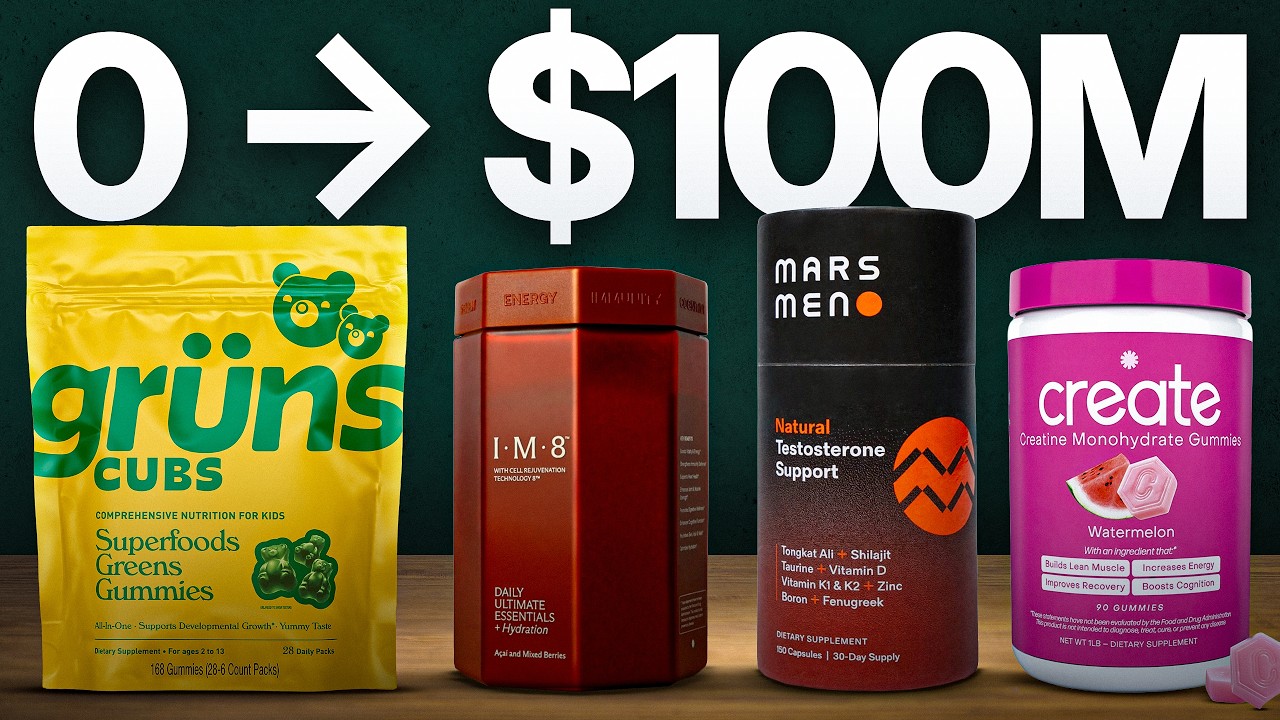
Most people think it takes a decade to get a brand to $100 million in annual revenue. Yet, these four brands have done it in under 3 years, all with the same playbook. The secret isn't a unicorn idea, a crazy product, or a celebrity founder. It's all in the funnel. And there are two new trends that have allowed this to happen. Number one, the health and wellness space is absolutely booming. People are more likely to try a supplement than ever before because biohacking, optimization, and the media surrounding the space has reached all-time highs.
Consumer appetite for subscription has also strengthened. People have been conditioned to want routines and subscriptions reduce friction for their favorite products. As a result, you've seen a demand boom for supplements with new market conditions to support the financial model. Brands can pay huge amounts to acquire a customer as long as they stay subscribed for a significant amount of time, which is exactly what these four brands we're going to dissect and done.
I'm going to outline this model for you because it's a clear playbook to get to $100 million in revenue in under 30 months. And it's shockingly simple once you break it down. Everything comes down to persona-based funnels, a gamified conversion process, and steep intro offers. Let's examine each brand's funnel so you know what I mean. And we're going to start with the hottest name in CPG and recently acquired for $1.2 billion, Grout's.
And by the way, before we get into it, the tool I used to study these competitor funnels, analyze ads, and take inspiration is called Motion. It's literally the easiest way to identify winners, bookmark them, and analyze your own paid ads. I used it to scale Yuka Health, my last telehealth brand, to 20 million in revenue in just 6 months, so I could not recommend this thing more. We'll be using it throughout the video, so you're probably going to see it a bunch, but if you're interested in checking out, we'll link it in the description for you.
All right, let's get into it. So, Grout's leads heavily into two components in their funnels. Number one is listicles, and two is partnership ads. It's because they know that fiber and gut health and all these benefits they promote are highly saturated. So, they hyper-personalize the angles. It starts with the ad creative. A creator will tell a story shot on iPhone selfie cam style talking about the impact Grout's has made specifically in their life.
In every script, they call out an identity. For the girls who can't poop, or for the GLP-1 patients needing nutrients. That identity is mirrored by the creator. Either they are the target audience or they're someone that the target audience would trust. Next, the ad sends the click to a landing page, almost never the GROWN S actual homepage. That landing page is either an advertorial or a listicle. A listicle is something like the seven benefits that GLP-1 users love about GROWN S {parentheses} besides the poop or six reasons everyone's obsessed with GROWN S and feeling their best.
On that landing page, GROWN S leverages strong benefit-driven copywriting with social proof like how many five-star reviews they've had, doctor recommendations, and the amount of units sold to drive home the conversion. But, what's most powerful is the intro offer. Language like limited-time sale and get 52% off plus free shipping lines the page like a flashing billboard. And the subscribe and save option is a full $14 cheaper than a one-time purchase despite being cancelable at any time.
This creates an irresistible offer for the consumer. Not only is this product going to directly solve a problem they experience, but it's a great opportunity to try and if they don't like it, they can cancel. GROWN S then dings the customer the full $79.99 price tag 30 days later and the product becomes such a part of their routine they never leave. This is the exact funnel that another comprehensive nutrition brand studied and brought to life.
Another thing GROWN S has done an amazing job of is making their product very habit-forming. It's a really nice routine to peel up in the gummies and eat them every morning. It's enjoyable experience and so that part of it is well coupled with all of these benefits means that you really don't want to break your routine just because it's 80 bucks a month. It makes you feel good. It makes you feel comfortable with what's going on.
All of these doctors are saying they're using it. All of these influencers saying this is the secret to them feeling good all the time. But, the biggest piece is these mechanisms. That's what I want to call out. It's the funnel. It's the partnership ad to the listicle to the offer to the retention, right? Like that is what allowed them to scale so aggressively. They probably had a very bad one-day click ROAS. However, Chad, the founder, has been on the record saying that they scaled at a 3x CAC to LTV.
What does that mean? That means they had $3 of profit for every dollar of CAC that they spent on a customer. He was able to take that those unit economics and scale into the moon. The guy just exited this company for $1.2 billion to Unilever in just 3 years. It's one of the most incredible success stories in supplements history, but more importantly, it shows like the underlying execution was there. This is a product that AG1 has been making for a decade, and they just turned it into a gummy.
Now, I'm not going to say that's all they did, but generally speaking, that's kind of what happened. They turned it into a gummy, and because they were so good at executing, which was the components that we just outlined in everything we just talked about, they were able to exit this company for $1.2 billion. They're doing around $300 million of annual revenue. They're the number one selling supplement across every single vertical because they speak directly to personas.
It wasn't just like, "Oh, if you're on a GLP-1, you need to cover your nutrients." It was, "This is the best thing for your gut health." It was, "This is how men are taking control of their health at 40." Like, the amount of personas they're running did not just stop at the two I listed above. There was probably like 30 to 40 concurrent personas they're running with the creator looking like the person that they're speaking to.
The landing page having extremely specific copy about that person, about the challenges that they're facing. And then, again, paired with this irresistible offer. How do we get you in, form the habit, and then you never want to leave? So, that's what GHOST did to scale this business so fast and reach an incredible outcome in 3 years. And here's the crazy part. This is the exact funnel that another comprehensive nutrition brand studied and brought to life just in a different color.
Let's talk about IM 8. So, Danny Young launched IM 8 in 2025, and in just 1 year has reached $100 million in revenue. There are a lot of similarities to GHOST, but one key difference. Their use of high performers and celebrities. IM 8 went with a more science-backed positioning. A formulation they tested, ran clinical trials on, and as a result, is trusted by people who would only put the best in their body. However, their funnel architecture is very much the same.
Partnership ads whitelisted through their thought leader creators into an advertorial that matches the benefits that are being pitched. Here's something super notable about their copy. It tells the consumer, "It's not your fault." It's It's your fault you feel off when you're traveling. You need a consistent component to your daily routine that you have at home. It's not your fault you feel bloated at 2:00 p.m. It's a little known cause that we can help solve for.
And because the IM-8 formula has both scientific backing and a broad set of nutrients, they can essentially market to any challenge. Brain fog, 3:00 p.m. energy crash, inconsistent gut health. They solve for all of it. And now it's not just their paid traffic that's excellent. IM-8 also introduces a steep discount to push subscription. But even more so, they offer free gifts. They price anchor these gifts as $80 of value.
It's a little fraud-y. They include a drink mixer, a water bottle, they have a little longevity pack, whatever it is. And they include these things and they price anchor them as $80 of free value. They articulate the cost of their product in dollars per day. This price anchoring makes you feel like you're actually getting a steal, even though the product might be a little expensive for a just a packet of powder. Another interesting hack they do is they show a monthly price despite needing to pay quarterly for their welcome offer.
It's a bit of smoke and mirrors, but ultimately it drives huge AOV boosts, which allows them to absorb higher acquisition costs. Once you have someone's routine for 3 months, it's very likely they never cancel. So, not only do they name your problem, build trust, and create urgency on the offer, but it's all engineered to boost retention and higher customer lifetime value. Notice how similar these two models are. Personalized funnel into an irresistible offer, and then they hack the retention.
But what's staggering about IM-8 is that they are running 1,200 ads at a given time. This is truly an insane amount of volume to be running ad creative towards. And it's only doable if you are able to scale on a very, very, very low ROAS. Again, that's why these brands are pushing high AOVs, steep intro offers, so they have a massive subscription bank to recover a lot of that revenue. Now, what IM-8 has done, which is a lot different than Grüns, is the use of celebrities.
They've got Giannis Antetokounmpo, they got Sabalenka the tennis player. Obviously, the David Beckham cosign is huge. And that's because they went with more of a scientific-based product. This is interesting because Grüns obviously had success as sort of like a, "Hey, we're just AG1 in a gummy." IM-8 wanted to go a completely new route in terms of the form factor. They wanted to say, "We developed most comprehensive, most scientifically backed formulation of a powder that we could." Now, why is that different?
It's because they saw the white space that happened when AG1 was bad-tasting greens powder. Gruns then took in the comprehensive nutrition and turned it into a gummy. But, what's really fascinating is how powerful it is to simply own a color. Hims is red, very very red. They own the color red. Gruns owns the color green. They literally took all of Gruns' benefits stack and then flipped it to be, instead of it was a playful bear, now it's a doctor recommendation.
Instead of a blurry playful font, now it's a very, you know, high-end serif, right? Like, they basically just twisted Gruns to be like very, very trustworthy, threw a bunch of athletes into it, and threw it in a powder, and they're running the exact same playbook. Why is that important? Because this is the playbook. This is what everyone is doing, right? Like, if you can just take your form factor, twist it, find a little bit of white space with some color, and find a unique positioning that the other brand didn't do, there's immense opportunity in running these type of funnels.
Partnership ads, the landing pages. This steep intro offer, the high subscription revenue. Like, this is the model. And you also obviously have to have around an 80 to 90% gross margin to support the initial loss leader on the acquisition and then recuperate through lifetime value. You'll see something very similar, but with a new twist, in our next brand, Mars Men. See, Mars still leans into the clear identity-based top of funnel creative.
Stuff like your grandpa had more testosterone at 60 than you do at 35. And they also portray a clear enemy, pointing the finger at cortisol as the thing making you gain stubborn belly fat. It's not your bad diet. Right. They send all their traffic to listicles, quiz funnels, and advertorials. And the copy is incredible. And they ask you questions like, "When you look in the mirror, who do you see?" One of the answers is your dad.
Think about how emotionally tying that is. A man at 35 doesn't want to look in the mirror and see his dad. He wants to see himself. He wants to have self-actualization. He wants to feel his best. He should be in his prime. He doesn't want to see a 60-year-old man or the similarities or the future path that he's going to reach as that 60-year-old man. He wants to feel like he's in his prime. And that's essentially what Mars is saying.
They're saying, "Look, you slept. Like, you're not in your prime anymore, but we're going to help you get there, right? Like, this is the path to help you get there." The quiz is shockingly long. Like, I think it's at least 30 questions. And every single question is directly tied to highly specific problems that most men face. Are you feeling irritable at 2:00 p.m. in the afternoon? Do you wake up to pee too much? It's all stuff that every single dude is probably going to experience, right?
And the copy really hits in that way. I also think what's fascinating about these guys is the tone. They are very casual. Like, they know that they're just talking to strictly men, particularly like probably a Barstool type like bro-y, like anywhere from 30 to 50-year-old like guy who what listens to podcast, right? And honestly, like they use cartoons, they use like animations, they use all these different very, very casual.
They use emojis in their stuff. Like, it is not a scientific I Am 8 style brand. It's very approachable. It's It's like your boy that's kind of funny. It's almost like the tone they're trying to strike. I think that's actually super effective because guys don't want to listen to doctors. Like, they don't want to listen to, you know, a lot of thought leaders. Like, the average bro, right? I'm not talking about the optimizer, the biohacker, but like the average guy who may feel like his test is slipping, may feel like, you know, he's making some mistakes with his diet and his nutrition, and he's getting some belly fat.
That guy probably wants to just have someone point him in the right direction, but not telling him he's an idiot, not being condescending. And so, that's what's so striking about Mars is they really nailed that tone with their copy and their kind of overall branding and positioning. And then the other thing that I think is fascinating is men are told to suck it up and never complain. So, when Mars comes to them as a friend, it it's not a doctor, it's a friend, it does feel like they're being seen for the first time.
That's why this quiz being so long is actually not that surprising. Even though it's counterintuitive to not rush someone through a funnel, once they complete it, the amount of intent is incredible, right? Like, if you go through that quiz, Mars probably converts you at anywhere from like a 70 to 80% clip. I would not be surprised. It's 30 questions. So, like, if you complete it, like, you're you're going to buy. Once they get to that checkout step, they do the same thing that we've seen before, I made style.
Here's free gifts, added value, it's $80 of value, and 50% off your first one to just go with it, right? Like, how many times do we have to see this before we understand like these are this is the tactic that allows brands to scale to $100 in just 18-24 months, right? The slashed-through pricing creates the illusion of a deal, and they even take it a step further with a sweepstakes style. This is your chance to win an Apple Watch.
The playbook is remarkably simple, right? Like, feature-and-benefit driven, highly specific, persona-based marketing, going to listicles, going to quiz funnels, going to advertorials. Where most brands massively falter, and I literally can't tell you guys how much I see this every single week, every single day. If I click an ad, and I click it for a certain reason, and you send me to a landing page that is not about what that ad did, what that ad said to me, what do you think that does to the customer experience?
Now, on the flip side, if you have an ad that is very curiosity-provoking, speaks directly to my identity and a problem that I'm experiencing, delivers some sort of trust, tells me that the promise of a, you know, I failed before, and now this is the unique mechanism that's going to solve my problem this time go around, well, I'm going to click it. And when I click it, you have an opportunity now to present this listicle, to take me through the quiz.
And that's a congruent experience. You see how much more powerful that is? Like, you have to keep it congruent. And then, they send you to the product page, right? It's like they don't just rush you through this thing. We're all so optimized these days to just grab the conversion. I saw it. I mean, when we were doing TikTok Shop, that's the whole point. It's like eliminate friction in the buying process. However, I actually think we're starting to reverse that.
And you're seeing all of these heavy subscription brands do so much of the upfront selling, so much of the buy-in before the conversion, that psychologically, they're boosting your long-term loyalty. You're going to stick with these people because you believe in what they said. You believe the reason you got sold this product, and so you're going to give it 6 months. You're going to lean in and actually listen to some of the marketing instructions that they're going to give you.
Now, this is not a commentary on if any of these products are effective. I have no opinion on that. I have only tried Groen's. I like it. I don't really know if it's working. I don't care. I'm just talking about the effectiveness and the ability to reach these levels of revenue very quickly. Before we move on to this final brand, I did just want to say again, the reason I'm able to find this information and dissect it so effectively is because I'm a power user of Motion.
Motion is by far my favorite creative analytics tool on the planet. I've used these guys for 5 years. So, when they reached out to partner about the podcast, I was over the moon. It's like I've never had more synergy with somebody because you have to understand hook rate. You have to understand what the average watch time is of a video. Basically, all these metrics that you'll spend hours creating custom in Meta, they just have built into the platform.
Not only that, you can do competitive research. Not only that, it's going to take a look at all of your different ads and tell you what worked, what didn't, opportunities to test, new hooks to test. Like it's it's literally having a built-in creative strategist who's like 120k a year just as a software. Their new AI agent, it rips. I can't say enough about these guys. It's the only reason I was able to run this analysis in a reasonable amount of time.
If I went through Meta Ads Library over and over again, I would have probably lost my mind. So, that's my shameless plug. I love Motion. They're fantastic. Again, going to be in the description. You should check them out. It's a fantastic tool. Uh also very reasonably priced. Like no-brainer if you're someone spending real money on Meta. All right, let's get into the last brand. So, the fourth brand I want to talk about, and remember the playbook is going to be remarkably simple here, is Create Wellness.
So, they are the fourth brand to reach $100 million in annual revenue with those exact same frameworks I just discussed. And like our other three brands, Create leans heavily into partnership ads, shot on iPhone TikToks, out content, geo if you want, adjacent benefits, steep intro offers, and a limited time discount messaging. They also emphasize the three-month supply while utilizing copy that pushes a customer to stick with it.
And they leverage their paid success and subscription revenue to land massive retail distribution and a huge funding round. Create has done this for years. They capitalized on the creatine trend well, but they also adjusted the form factor to mirror something super accessible. Strategy-wise, they've done pretty much the exact same style as all these other brands we've covered. They lean into thought leaders like coaches.
They lean into different doctors. They lean into all of this different science about creatine and they package it into a short-form ad, partnership ad with that creator, wallah, there you go. You get sent to a landing page or a listicle or an advertorial where the copy is going to match up with the benefits and the promise that you were given in that ad. This congruence is the point of this video. I want that to be the number one takeaway you have if you watch to this point or if you're listening on audio, shout out to our Spotify and Apple podcast listeners, please leave a leave a review.
Leave a review. Subscribe if you're not, please. Uh so I like witty podcast. We do this for free for y'all every week, so we just need that's our only gentleman's agreement. We just need a little bit of support on the reviews, comments, etc. Okay, anyways, congruency, funnel congruency. It should be the same message, the same identity, and the same offer throughout your entire funnel. If you can achieve that, if you can get a steep intro offer, if you can get them in, make a habit-forming product, right?
A lot of this is done in your email marketing. I That's another video entirely, but generally speaking, I mean, you're just going to ping them every now and then and be like, "Hey, don't forget to take your stuff. This is how to take it well. This is how to take it properly. If you're experiencing this, do this." Email marketing is, you know, a little less uh black magic, but the acquisition piece, congruent funnel, right?
You have identity-based, persona-based funnel. You have a landing page or a listicle that mirrors exactly what you said in the ad, but goes a little bit deeper. It has the social proof, trusted by doctors, trusted by celebrities. If this is apparel, you can still do this, right? Like, you know, True Classic Tees or whoever the hell like you could be like, "This is why, you know, dads across America are hiding their tummies with True Classic Tees." Like, it doesn't have to be a supplement, to be very clear.
Social proof is not something that is limited to doctors or thought leaders. That's influencers or anyone that you would listen to. It's more so like take these principles and throw them in your funnel. If it doesn't work, like comment and tell me I'm an idiot. I I like I would love to be proven wrong, but we have never seen this level of success from brands at this scale. I mean, seriously, we've never seen so many brands going to a hundred million dollars in revenue in such short amount of time.
And most of these are meta ads funnels. I mean, I'm not even going to talk about Mary Ruth's comfort neuro gum, like these brands that are also using TikTok shop virality to be able to juice their stuff. Like Groen's had a very viral moment on TikTok shop originally that obviously catapulted them and helped them quite a bit, you know, drove a tremendous amount of trial. The biggest thing that all these brands believe in is trial will lead to retention.
Everyone is so obsessed with one day click row ads and you know, being able to profitably acquire a customer in that singular moment. That's like obviously not the move. Like you have to have a customer payback period. You have to have a lifetime value. You have to know your numbers. You have to know your CAC to LTV ratio. And if you can achieve that, you can monitor the TikTok shop Amazon situation, you will become extremely appetizing to a retailer.
They know that you can drive traffic. They know that your product is sticky and that people will come back and come get more. So, if you can get that, you can get into retail, have predictable wholesale sales, all of a sudden, you're looking at a massive business. So, that might have sounded simple. I don't know if it's that simple. I'm about to try it myself. I'm launching a new product here soon. I'll tell you more about it on the next episode.
But, to me, there seems to be a clear playbook here. So, if this was valuable to you, please leave a comment, like, subscribe, support the podcast. The boys are trying to do as much value for you guys as possible. I know Alex is obviously doing his work on the creative side, the creative production side, the brand marketing side. But, this is a very deep dive episode on performance marketing, performance marketing funnels.
I think every single D2C brand should probably, you know, take some of these lessons from these huge outcomes that these brands are driving and apply it to yourself. All right, that's really the whole episode. We'll see you all next week. Peace.
The words are the caption track's own and nothing is reworded or re-transcribed. Paragraph breaks are placed between sentences so the text reads as prose.
Free tools for your own script: paste a draft and see where it stands before you record it.
Paste your draft and see where viewers are likely to drop off, with a rewrite for each weak line.
Paste the first 30 seconds of your own draft for a hook score and rewrites.
Check your draft against YouTube's advertiser-friendly guidelines before you record it.
Read this channel's public videos and transcripts, and download a writing brief for it.