Getting the transcript
Reading the captions from YouTube. A video nobody has opened here before takes 10 to 30 seconds; this page fills in on its own.
Getting the transcript
Reading the captions from YouTube. A video nobody has opened here before takes 10 to 30 seconds; this page fills in on its own.
Luuk Alleman · @LuukAlleman
Words
2,451
Runtime
11:48
Speaking pace
208wpm
Reading time
10min
208 words per minute, above the 201 75th percentile of 349 measured videos. That distribution comes from the 349-video hook study.
Opening (first 30 seconds)
My business finally started running itself and for the first time in history I think yours can too and in this video I will walk you through every single detail and at the end of this video you will know everything you need to know to build the exact same for your business as well. So this is my dashboard but first I've made some slides to make things a bit more clear. So my business actually runs itself and this is all done by code and because of Claude this is finally possible but this is something I've been working on for nine
104 words, the words spoken in the first 30 seconds at 208 words per minute.
Free, no signup. See how the first 30 seconds hold attention, with rewrites.
Sentence shape
| Measure | This transcript |
|---|---|
| Sentences | 200 |
| Average words per sentence | 12.3 |
| Longest sentence | 55 words |
| Questions asked | 5 |
| Sentences containing a number | 8 |
Most used terms
Filler phrases
33 in total: like 12 · actually 11 · basically 4 · I mean 3 · right? 3.
A literal whole-word count of the same phrase list the Prepublish browser extension uses, so a phrase inside another word is not counted and a phrase used in its ordinary sense still is. It is a count and not a judgement.
Free, no account. See where attention is likely to drop, with a rewrite for each weak line. The free check shows the scores and the one issue costing the most. Or run it on the words above first.
Free · No login · See a sample audit first if you prefer.
What this transcript is
Every word below is the caption track YouTube publishes for this video, pulled from the video itself and reproduced unchanged. It is not Prepublish's writing, not a summary, and not a re-transcription: it is the video's own published captions. English captions, generated automatically by YouTube, in the video’s original language. Source: the video on YouTube. A channel that would rather this page did not exist can ask for its removal through the contact page, and it is removed.
No Script X-ray for this video: YouTube shows a Most replayed graph only once a video has enough views.
My business finally started running itself and for the first time in history I think yours can too and in this video I will walk you through every single detail and at the end of this video you will know everything you need to know to build the exact same for your business as well. So this is my dashboard but first I've made some slides to make things a bit more clear. So my business actually runs itself and this is all done by code and because of Claude this is finally possible but this is something I've been working on for nine months already.
Also a little disclaimer this is not something you can create in just an afternoon. This takes a lot of time. So the whole thing is features rot but an infrastructure compounds. With AI becoming better and better and with the amount of features that Claude is shipping this all compounds with your infrastructure and what I mean with infrastructure is the following. I have this super base database and this contains a lot of different tables containing everything.
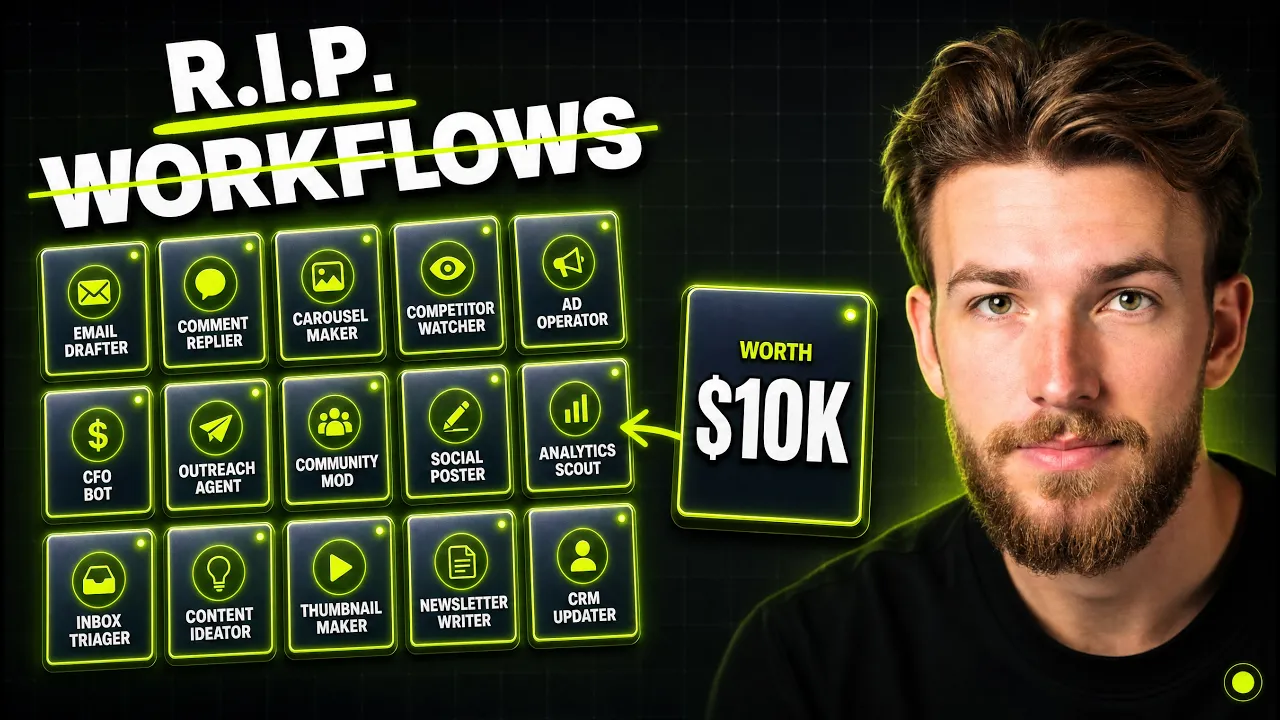
So it's a database it's edge functions it's Claude code routines which I will show in a moment and everything runs automated. So I don't do a lot of stuff manually. I am only the human in the loop and I just accept or reject something. Every workflow I had is now a row in my table in my super base right here. What I mean with that is I had a lot of emails coming in daily. I need to create a lot of content both new ideas and repurposing.
[music] I need to know what my competitors are doing so I have competitor watching. All my finances my income and my expenses are also in my super base. Then I run ads. So all my ads are also run by Claude. I have clients so I have a CRM for that so I can keep track on all the specific income that I get because of a client. Also I run stuff in Azure. That is basically a place where you host code and I needed better insights on everything that was happening inside of Azure.
Also I post on YouTube Instagram TikTok Twitter LinkedIn. That was also a lot of manual work so all of that is automated. Like I don't need to open the apps anymore. So this is basically the infrastructure that I'm talking about. So this is not really just a simple API call. This is not something on the surface. This is deeply rooted in the infrastructure. This is really like a colleague that clocks in. So there's a trigger.
So I want stuff done every five minutes every hour. I want something done once a week. We have the trigger it spins up a Claude code session because Claude code is very proactive. It is not limited to the code we just wrote. It can read everything. So [music] it uses specific Claude skills. It can access all the stuff in my super base right here and it uses the memory that it stores over time. Then it can act. So it has access to every single MCP tool [music] I need.
Think about my Gmail. Think about my calendar. Think about my super base. Think about Higgs field for thumbnail generation. And then it writes back to super base and Telegram. [music] So on my phone I just get pinged whenever something goes wrong. So here's the thing. We have edge functions in super base they got all the data. So it gets all my emails all my Revolut data all my YouTube analytics. Everything is pulled out of the external apps.
Then I have routines. So for example draft my emails come up with video ideas and build up context about me and my business over time. So for example this video the idea the context behind it was made with AI. Like this is still me I'm a real person and these slides are created with just one prompt because I created a skill that makes those slides on autopilot. So what happens? I have sources. So for example my Revolut all my expenses all my income it is fetched into my super base right here and then shown right here.
And for now I blurred my financial. Like that is the only thing that I'm blurring in this video. Right here I have my revenue. I have my audience on all the different platforms. I have my agenda. I have everything in my inbox coming from YouTube comments to my [music] email inbox to community posts where I need to react on. Then I have content. I have the monitor. I have to-do list. So I will now just show you everything in detail.
This is the main dashboard but I also have a very simple to-do. I have finance where I have the revenue this month the expenses of the month the averages and everything I need to understand but also my revenue in the last years. So now that I have this infrastructure I can actually just have a conversation with Claude and it can help me understand what is happening with my finances. So I have everything by purpose. So what I spend on travel what I spend on my team what I spend on SaaS what I spend on private on ads.
Everything is in here and I can also invite my team members to access this. Then I have content. So right here I have this content board storing all my content [music] and it compounds over time. Whenever I post a YouTube video it gets the YouTube video with the transcript and the AI actually starts to understand my type of content better. It has everything automated. So it has the [music] hook it has the promise it has the proof.
But what I can now do is for example I can get the URL right here. So I just copy the URL. I go to my Claude. I paste the URL and I just say the following. Please create three packaging options for those for this video with thumbnails. Like this is a short so that is not the best example but I can show you for example this one which actually has thumbnails that I can just use immediately. I have multiple packaging options right here but those are really good already.
So everything is just automated in my Claude code and it can access my infrastructure right here. So what happens is I have a table for example here called YouTube videos and I have everything right here. All my content with descriptions. I have the duration. I have the key topics. I have embeddings. So I can actually search through all my content and everything shows in here. So I have my Telegram which is just texting me stuff that I need to know about and this is my main thing.
And the nice thing about this is and I will show you that directly right here on my phone I actually have an iOS app. As you can see this is my logo. I can now click it and right here I have everything. [music] So it's the same. So what I can do is I can go to content and right here I can just edit whatever I want. So this is just a a side note. Like it's an iOS app as well and it just has everything I need. So for example the calendar but also my analytics right here.
How is everything growing? But also my meta spends. So I do promotion for Instagram for example. I can then see everything from here. What I can also do is the following. I want to promote something. I can click right here and I can just promote it. So I can do for example 10 euros for 7 days. I want engagement and I can now just promote it like this. It has been promoted. As you can see it is live. I can now click it and right here I have the actual post that is being promoted.
Then I have my inbox and honestly this is the one that is most important to me. I was getting a lot of emails for partnerships request client contact. Everything is now in here. So I have one unified inbox for everything. So for example this is called I reached to me about a video that I created and they want to give me a chair. Now I have this reply. Not a fit right now. I don't do sponsored chair integrations. Thank you for the note though.
I can now click on approve and send and it will actually send the email. But also for example right here on my video I got a comment. So it's someone saying if you're watching this this is how I answered your comment. But I've been programming for 50 years and the vibe coded programs I've made so far not follow this pattern. You just iterate slowly. Okay nice. That is crazy. 50 years is a long time. I can now approve and send and it will actually respond to the comment.
I also have infrastructure. So right here everything that I'm running for example for BuildLoop right here is right here shown so everything is clear to me. Also if you want to know more about how to make this make sure to check out the link in the description. At this point I'm helping three other entrepreneurs build this for themselves. Whether you're a solopreneur or someone with a very large business you can now start automating every single workflow that you want.
So that is amazing. Make sure to check out the link in the description. Also if you enjoyed this video make sure to like and subscribe. Okay let's go on. So I think by now you really want to understand how I created this right? So this is basically just a web app. But the web app is really simple to create right? It's just you show data. It comes from the super base. We have all these tables. It stores everything. But right now I want to show you what's behind it because we can now go to Claude right here and it shows routines.
If I click this right here you see 15 routines and this is exactly where the intelligence come from. How you should see a routine is every single row in here is basically an employee. So for example email drafts twice daily. That is exactly what is answering my emails right here. BuildLoop YouTube sync. So it checks for new comments and writes responses to that. But the whole thing is where we previously had a trigger we then had a large language model and we had some output we still trap the large language model into A then B then C.
It is not really an agent and that was exactly why these workflows were no employees yet. Right now when you use a routine what is actually happening is it is spinning up a Claude code session. So Claude code is super proactive. What I mean with that is if something goes wrong it won't just break down and say sorry I couldn't do that. What it would actually do then is hey I tried to access this URL. I found that it didn't work.
I will try another URL to eventually achieve the end goal. That is the big difference. So for example when I now go more in depth in the app I have the start morning review. Like the whole walk through this is the actual part that brings everything together even more. So what happens is I have a LinkedIn carousel completely automated for me. So look looks like this. Images are added. Nice looks good. So what I now want to do is I can click on post now.
I have the actual text right here. So this is really cool right? I don't even come with the ideas. So it uses all my content from my YouTube from my other social media accounts and from there gives me the ideas and already executes them. I can now just click a YouTube community post and Instagram story. So today I stopped blaming the model. Looks pretty good. What I can now do is I can click on post now. And as you can see, I can now go to the Instagram and right here you will see build loop.
When I check the story, here we have our story. So, this is all automated. But the main point about this is you have a business, probably. You have a lot of workflows that you could automate. Identifying what workflows you need, identifying what data is important to your business, storing that into one infrastructure, aka a Superbase database, is the best decision you can make for the coming 2 years. The single most important thing that makes the output of AI high quality is context.
We give it context by having our second brain, our digital twin, whatever you want to call it. Because we have everything in tables, we have everything structured right here in one main database, it can access everything forever. Every model that gets upgraded, the output gets better because the context is already there. Everything is done for me right here. And in the morning, I just open this and in 10 minutes, I've done [music] everything already.
And I am ready in 5 minutes what previously took more than 1 hour every single day. So, the core message of this video is make sure your data is in one place and you store everything there. Not in 10 different systems, but all in one. Then from there, you can do anything. You can automate anything with Cloud Routines. Just explain to Cloud Routines. I have more videos about this. Long story short, just explain your workflow, say that you want a scheduled run.
And if you need more guidance in actually making a system like this, whether it's for personal use or for your whole team, make sure to check out the link in the description. We can do a call to discuss this further, but this is really the best move that you can make right now. So, without any further ado, make sure to like and subscribe and then we'll see each other in my next video.
The words are the caption track's own and nothing is reworded or re-transcribed. Paragraph breaks are placed between sentences so the text reads as prose.
Free tools for your own script: paste a draft and see where it stands before you record it.
Paste your draft and see where viewers are likely to drop off, with a rewrite for each weak line.
Paste the first 30 seconds of your own draft for a hook score and rewrites.
Check your draft against YouTube's advertiser-friendly guidelines before you record it.
Read this channel's public videos and transcripts, and download a writing brief for it.