Getting the transcript
Reading the captions from YouTube. A video nobody has opened here before takes 10 to 30 seconds; this page fills in on its own.
Getting the transcript
Reading the captions from YouTube. A video nobody has opened here before takes 10 to 30 seconds; this page fills in on its own.
Sabri Suby · @SabriSubyOfficial
This video has no Most replayed graph yet: YouTube shows one only once a video has enough views. These are the moments viewers replayed most in Sabri Suby's most watched videos.
Most replayed moment at 5:51
3.1x that video's typical replay level
of different variations. And the way that I like to do this is I give it my winning ad and then I say, "Okay, I want you to read this ad and I want you to be the author. If we show the next ad, I'm going to ask you to write to 100 people. Not one in a 100red would be able to
Said at 5:44
Most replayed moment at 10:35
2.4x that video's typical replay level
keyword that people would be searching in order to find what it is that I am trying to sell? And I call this the coliseum keyword. There's always going to be one keyword that represents the most amount of traffic in your niche. And you want to type that in. You want
Said at 10:30
Most replayed moment at 4:44
4.2x that video's typical replay level
like, you know, the chick's not wearing any makeup and it's just a little bit more casual. That could also work depending on what it is that you're selling. But I'm going to go with this one. So, what we do is we go ahead and we download this puppy. So, we've got the static image. Now, we need to take this static
Said at 4:37
The graph counts replays. It does not show where viewers stopped watching.
Words
2,582
Runtime
13:39
Speaking pace
189wpm
Reading time
11min
189 words per minute, between the 181 median and the 201 75th percentile of 349 measured videos. That distribution comes from the 349-video hook study.
Opening (first 30 seconds)
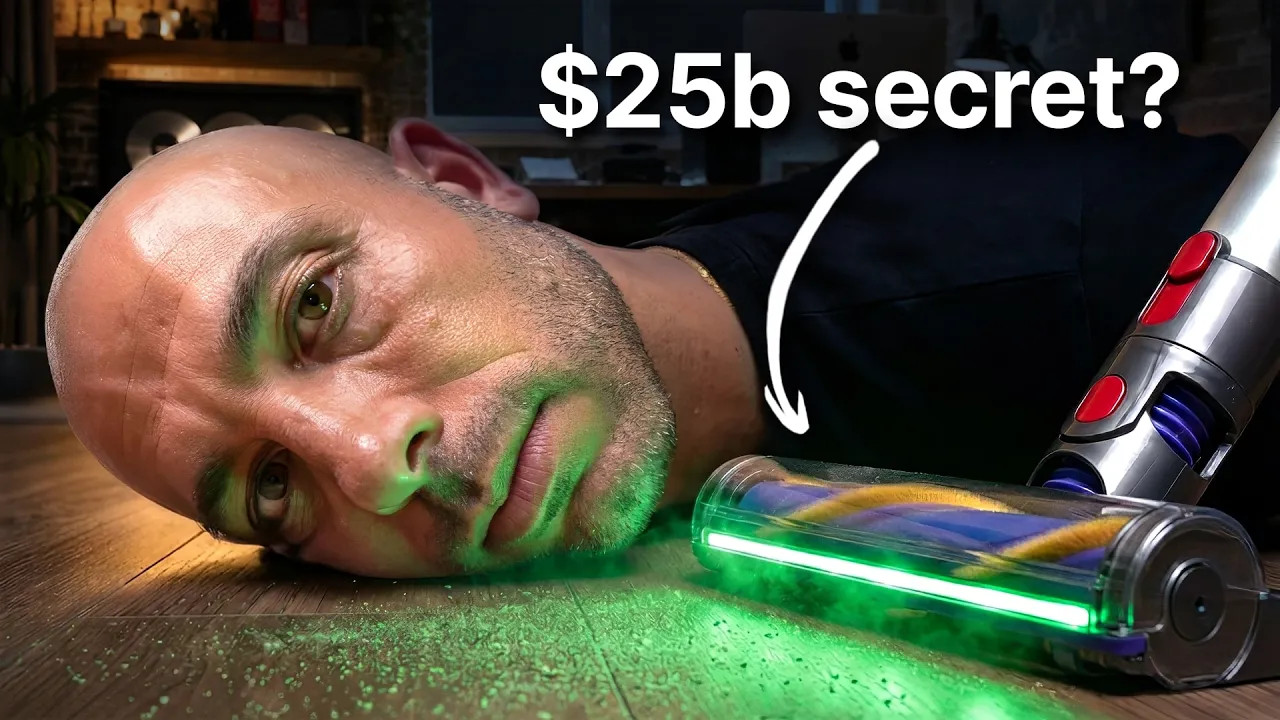
Check this out. Dyson ran this one ad throwing shade at their entire industry and literally killed their competition. >> When your vacuum cleaner loses suction, they all clog with dust. So, the Dyson works differently. >> Which made them the number one vacuum cleaner company in the entire world. And it doesn't matter whether or not you're selling vacuum cleaners, you can apply the same strategy to any business on Earth. Every business has a product, but very few have a mechanism. You see, Dyson isn't a vacuum cleaner company. They are a hero
95 words, the words spoken in the first 30 seconds at 189 words per minute.
Free, no signup. See how the first 30 seconds hold attention, with rewrites.
Sentence shape
| Measure | This transcript |
|---|---|
| Sentences | 151 |
| Average words per sentence | 17.1 |
| Longest sentence | 60 words |
| Questions asked | 9 |
| Sentences containing a number | 15 |
Most used terms
Filler phrases
39 in total: literally 12 · like 10 · basically 6 · you know 5 · actually 3 · right? 2 · I mean 1.
A literal whole-word count of the same phrase list the Prepublish browser extension uses, so a phrase inside another word is not counted and a phrase used in its ordinary sense still is. It is a count and not a judgement.
Free, no account. See where attention is likely to drop, with a rewrite for each weak line. The free check shows the scores and the one issue costing the most. Or run it on the words above first.
Free · No login · See a sample audit first if you prefer.
What this transcript is
Every word below is the caption track YouTube publishes for this video, pulled from the video itself and reproduced unchanged. It is not Prepublish's writing, not a summary, and not a re-transcription: it is the video's own published captions. English captions, generated automatically by YouTube, in the video’s original language. Source: the video on YouTube. A channel that would rather this page did not exist can ask for its removal through the contact page, and it is removed.
Check this out. Dyson ran this one ad throwing shade at their entire industry and literally killed their competition. >> When your vacuum cleaner loses suction, they all clog with dust. So, the Dyson works differently. >> Which made them the number one vacuum cleaner company in the entire world. And it doesn't matter whether or not you're selling vacuum cleaners, you can apply the same strategy to any business on Earth.
Every business has a product, but very few have a mechanism. You see, Dyson isn't a vacuum cleaner company. They are a hero mechanism factory. And once you see it, you'll then understand how they are able to charge five times the price for the same product. I entered the Dyson showroom and immediately a Dyson dealer approached me. So, then I asked, So, why do you think that I I should get this one? >> First of all, they have so many different models.
Everything has got some particular specific reason. >> Every single Dyson product use a uniquely named and branded mechanism. The root cyclone technology, air multiplier, acoustic dust sensing, laser slim fluffy. It is designing a unique component using engineering language that positions it as superior and unique to any of the other solutions that are present in the marketplace. They're not just saying that our vacuum cleaners suck harder.
They say they use proprietary air sucking technology to be the most effective vacuum cleaner on the market. So, here is exactly how you can apply this strategy to your own business and literally develop a hero mechanism. So, the first thing that you need to understand is what is the unique mechanism behind the problem. What is the pressing problem that the market is absolutely [music] starving for? For Dyson, it was that vacuums, they didn't have enough suction to them. >> It's clogged the bag, reducing airflow and suction. >> And that was a real pressing problem.
If you looked out and looked at all the research, you'd see that people that use vacuum cleaners were constantly complaining about this problem. And that's exactly what you want to do with your market. You want to look at all the existing solutions that claim to solve the problem that your market has. [music] And then you want to look at what are people complaining about? What would be a dream solution to solve [music] this problem?
And this is where we basically take that problem that exists and we take all the other solutions and we say these have all failed you. So what we have done is we have created a brand new patented technology that solves all of those problems in the name of our mechanism. And for Dyson, that was the cyclone technology. No bags, it never loses suction, and it just solves that problem of an effective vacuum cleaner better than anything.
But you can't simply go out there and say that. You have to name your mechanism. And then everything that you do, all of your sales angles, all of your touch points are all [music] centered around this hero mechanism. And the reason that this is so powerful in a world where everybody is constantly comparing to other products, it gives you something unique. It puts you in your own category, a one of one that people can't simply look at and go, "Oh, I want that cyclone technology." Because that is a hero mechanism, a patented piece of [music] technology that is owned by Dyson. >> Over 230 patents and patents pending protect Dyson technology.
[music] >> So stop selling features and start selling mechanisms. Name it in a unique way that is bold and is memorable. And that is tactic number one, the $25 billion hero mechanism factory. So a great mechanism, it gives you an engineering mode. However, once you've done that, you need to create an environment where people can actually experience that. And the way that Dyson did it is something that most businesses never get right.
Dyson opened up their first showroom in Paris in 2000. And since then, they have rapidly expanded to over 200 different locations. And from the moment that step inside those stores, they are psychological minefield. Man, look at this thing. You have the rep there that then hands you the vacuum cleaner. It has a rug on the bottom of the floor, and they simply say try it. Once you start using it and you start trying it and you see it for yourself, you're starting to automatically justify in your mind spending a thousand dollar plus on a vacuum cleaner. >> This is it, yeah? $1,329.
That's very affordable, right? >> And it is an entire immersive experience. You're looking at this giant screen with a 3D render of how their mechanism works. This is the way that they quickly escalate you up to justifying these crazy prices. So, whether it's your showroom, your website, your sales presentation, you need to think about how can you visually immerse somebody in that [music] entire experience where you don't have to rely on a salesperson to do the selling.
Your product, that experience, it [music] is an almost live demo where you are experiencing the thing first hand, and that should be doing all the heavy lifting for you. And that [music] is tactic number two. Let the demonstration do the selling. Most brands are faceless corporations. They hide behind logos, or they rent some beige vanilla spokesperson. >> Hello, this is Dwight Schrute from the Dunder Mifflin Paper Company. >> Dyson did the absolute opposite, [music] and they put their founder front and center to tell their origin story.
In 1978, James Dyson is renovating a Cotswold farmhouse and getting furious at his own vacuum cleaner losing suction. >> And so, when I had a a family and a home of my own, and I bought the most powerful vacuum cleaner you could buy, I was amazed to discover that most of the time it didn't pick up very well. >> Then he spends the next four years building 5,127 prototypes [music] in a shed behind his house. He then launches DC01 in 1993, the world's first bagless vacuum. >> The new Dyson has no bag, [music] so you get 100% of the power. >> Within 18 months, it's the number one selling [music] vacuum cleaner in the UK.
And from that moment, he never let anybody else become the face of Dyson, because who is going to do a better job at selling the product than the founder? [music] No one. And that number of 5,127 prototypes, it does the selling. It shows somebody that was maniacally obsessed with literally creating the best product that exists. He understands the problem more intimately than any of the other companies that are out there.
And I can tell you from experience that nothing, and I mean nothing, converts better on cold traffic than a founder story. I have created thousands and thousands of ads within my business, and still to this very day, a founder story about me making 150 cold calls and getting my first clients and desperately searching for clients until I created a selling system that goes out there and it brings in warm, hungry buyers, and it sifts, sorts, and siphons them.
Nothing has converted better than that. And the reason that this works so well, not only are you using yourself as the hero and creating the hero's journey, but you can't argue with stories. You can go out there and say this is the best vacuum cleaner, or you could tell people that you built 5,127 prototypes, and you went through the enormous amount of work to create the best solution, and use you as the person that your market can identify with and be like, "Yeah, that's exactly what I was struggling with." Because people don't buy from brands, they buy from people.
And that is tactic number three, the founder as living proof. So, most brands, they play it safe, right? They like to be defensive. They like to just talk about their product, the features, the benefits of what it does. And they want to basically pretend like they they don't have any competitors. [music] The worst thing that they could do in their mind is talk about a competitor, where Dyson literally did the opposite.
They went out and they basically put themselves [music] up against the biggest, most aggressive player in the marketplace and they used comparative advertising to literally deconstruct their competitor's selling argument. They came out with a campaign called say goodbye to the bag where they literally compared their product to Hoover's vacuum cleaner where they showed it literally choking up on the dust, the bag getting full and becoming incredibly ineffective.
And then they showed their cyclone bagless technology and how it was so much more powerful. It sucked up so much more dirt off the ground. When it comes to comparative advertising, your market it wants the comparison. It wants you to basically do all the heavy lifting for them and literally show them the product side by side and how they work. Don't be naive and think that when somebody is in the market for whatever it is that you sell, that they are not having to do those comparisons.
People have got multiple tabs open. They're comparing reviews. They're looking at all these different shopping sites. So, they are doing all of that anyway. If you can basically just drag that all out into the light and do the comparison for them, it's going to make your sales message so much more effective. And the way that you do this is you need to intimately understand [music] your competitors. You need to literally have your finger on the pulse and know what all of these people are doing.
You need to read their five-star reviews, [music] their one-star reviews. Find about what people love about them, what they hate about them. And then every single sales message that you put together, it literally deconstructs [music] them. And so you can compare and contrast. If you know what people hate about all of your competitors, then guess what? You take those things that they hate, you make sure that the product or service that you sell doesn't have them and then you shout it from the rooftop.
But there is a very important distinction [music] to make here. You have to be able to back up your claims. Your mechanism actually has [music] to work. And that's the reason this is so powerful for Dyson. If they came out and they tried to do this comparative advertising and their product wasn't better, they would have just killed their company. Instead, they built the 5,127 prototypes to make sure that this product was better than anything else in its category.
That's when they knew that they had put in the work that no other company was willing to do, that they could literally bring out every single competitor and break their legs one by one because they knew their product was better. So, once you create your hero mechanism, you need to make sure without a shadow of a doubt that it is indeed the superior product or service in the category and then you can go out and you can shout it to everybody and actually visually demonstrate [music] how it is so much more effective than all the other competitors.
And that is tactic number four, comparative advertising. But look, even once you've got all of this, you've got the mechanisms, you've got the founder story, you've got the demonstration of how it all works. This is only going to take you so far because if Dyson was just in the vacuum cleaning business, they wouldn't even be a tenth of the size as they are now. In business, most people think that their product or their single service is the business.
[music] This is the wrong mindset. You want to look at every single product or service that you sell as the entry point and that's exactly how Dyson looks at it. If you walk into any bathroom at any five-star hotel or gym, you will notice that they all have a Dyson hair dryer. And it's the same thing when you walk into a bathroom in the business lounge of an airport, you're going to see a Dyson hand dryer there. This works in two different ways.
First of all, it's the association with their brand to something [music] that is premium, but here is a sneaky thing that is far more effective. Not only do you have that brand association, but you also come into contact with that product and you get to experience that product >> [laughter] >> and you're like, "Wow, this is an amazing hair dryer." Then before you know it, it's on your Christmas wish list, and then you're getting a Dyson hair dryer.
Then once you get the hair dryer, you experience the product engineering, how beautiful the packaging is, and just how seamless it works. Then you're like, "Wow, if this product is so good, next time you're using your vacuum cleaner and it fills up with dust and it's broken, it looks like this ugly thing, like this monster that you hide in the cupboard, you're like, maybe I'll buy a Dyson." Then before you know it, you're buying the vacuum cleaner.
They're turning each of these sales into entry points. It is an entry ramp into the other products that they sell. And the reason that this is so powerful, it is not just normal retail, where you come in and you buy one product. It is a carefully crafted and engineered value ladder, where you know exactly the entry points, you know the other pain points that then they are then going to create, and it just creates a whole ladder that each customer will ascend up.
So, here's how you can apply this to your own business. You want to think of the one product or service that you sell that has the largest TAM, the largest total addressable market, so that you can basically create that as the hero product. Then what you want to do is intimately understand the problem that your market has better than anybody else in that market, and you want to make sure that your entry product is a category killer.
It literally goes out there and murders the competition. Then you go through, you go into the market, you buy up all the customers that exist because your product is the best, and you can demonstrate it with your hero mechanism. Then it creates a moment for each and every customer that comes into your business that goes, "Wow, I was blown away with this first product. I wonder what else that they sell." And that is tactic number five, the Trojan horse strategy.
Now, if you want to go even deeper, and you want to know the forensic detail of how to craft a hero mechanism for your business, I've put together this video. Go watch that now. Like, subscribe, and I'll see you in the next one. >> I need to dry my hair when I go to the shower. I just stick this thing on and just
The words are the caption track's own and nothing is reworded or re-transcribed. Paragraph breaks are placed between sentences so the text reads as prose.
Free tools for your own script: paste a draft and see where it stands before you record it.
Paste your draft and see where viewers are likely to drop off, with a rewrite for each weak line.
Paste the first 30 seconds of your own draft for a hook score and rewrites.
Check your draft against YouTube's advertiser-friendly guidelines before you record it.
Read this channel's public videos and transcripts, and download a writing brief for it.