Getting the transcript
Reading the captions from YouTube. A video nobody has opened here before takes 10 to 30 seconds; this page fills in on its own.
Getting the transcript
Reading the captions from YouTube. A video nobody has opened here before takes 10 to 30 seconds; this page fills in on its own.
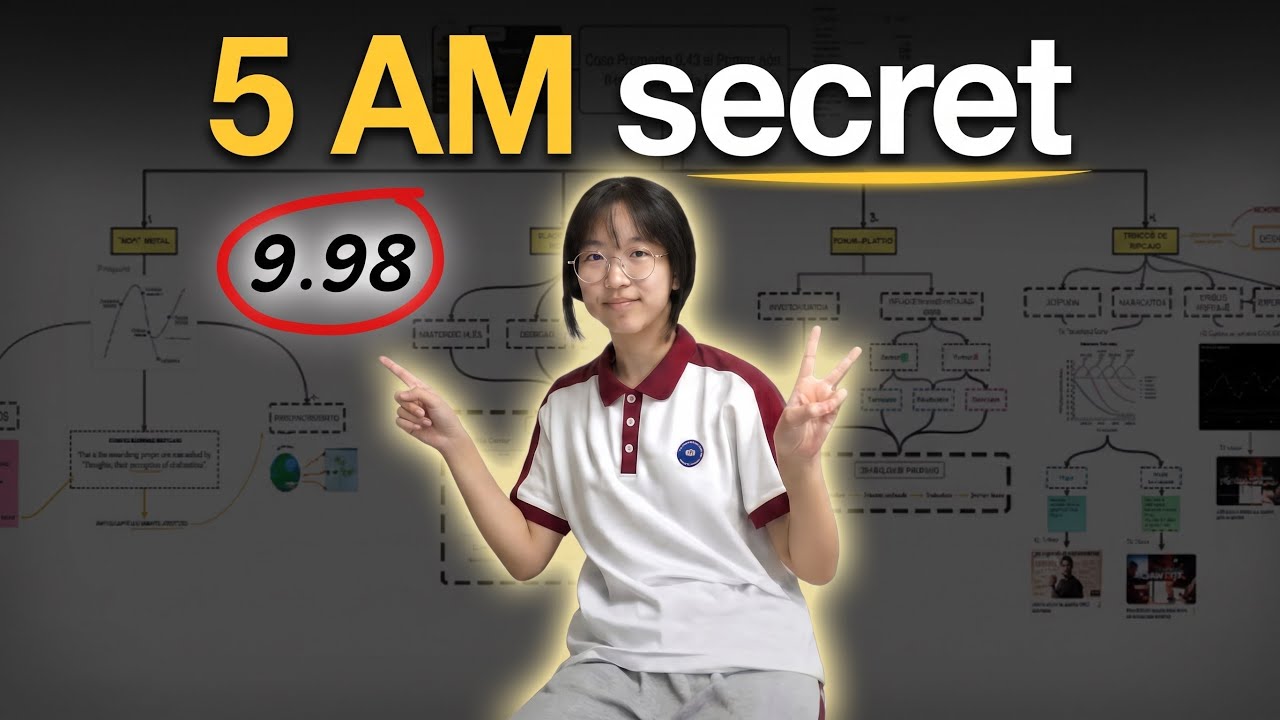
Luz Maialen · @luzstudy.17
Where viewers went back to watch this video again, from YouTube's public Most replayed graph, lined up with what was said at that moment.
Most replayed moment #1
11:373.5x the video's typical replay level
When you talk fast, your brain lies to you with total confidence. When you write, [music] it can't. Writing forces you to go so slow that every single knowledge gap gets exposed [music] in absolute silence right there on the
Said at 11:29
Most replayed moment #2
6:033.3x the video's typical replay level
The 3-2-1 method eliminates [music] that trap from the root because it straight up bans highlighting >> [music] >> during the reading phase. Let me stop for a second because I need
Said at 5:58
Most replayed moment #3
12:552.5x the video's typical replay level
Number one, active recall. Forcing your brain to remember without help builds way stronger memories than passive rereading. Number two, desirable difficulty. Just because an exercise feels hard,
Said at 12:48
The graph counts replays. It does not show where viewers stopped watching.
Words
2,295
Runtime
16:21
Speaking pace
140wpm
Reading time
10min
140 words per minute, below the 160 25th percentile of 349 measured videos. That distribution comes from the 349-video hook study.
Opening (first 30 seconds)
They study less than you. They sleep more than you. >> [music] >> And yet, they absolutely crush you on the exam. And today, you're going to understand exactly [music] why. The med student drowning in flashcards, not knowing which ones to prioritize. The student prepping for boards who's been locked in their room for 14 days straight, memorizing the same material over and over. The engineering major studying 10
70 words, the words spoken in the first 30 seconds at 140 words per minute.
Free, no signup. See how the first 30 seconds hold attention, with rewrites.
Sentence shape
| Measure | This transcript |
|---|---|
| Sentences | 184 |
| Average words per sentence | 12.5 |
| Longest sentence | 40 words |
| Questions asked | 6 |
| Sentences containing a number | 16 |
Most used terms
Filler phrases
20 in total: like 10 · actually 8 · you know 2.
A literal whole-word count of the same phrase list the Prepublish browser extension uses, so a phrase inside another word is not counted and a phrase used in its ordinary sense still is. It is a count and not a judgement.
Free, no account. See where attention is likely to drop, with a rewrite for each weak line. The free check shows the scores and the one issue costing the most. Or run it on the words above first.
Free · No login · See a sample audit first if you prefer.
What this transcript is
Every word below is the caption track YouTube publishes for this video, pulled from the video itself and reproduced unchanged. It is not Prepublish's writing, not a summary, and not a re-transcription: it is the video's own published captions. English captions, generated automatically by YouTube, in the video’s original language. Source: the video on YouTube. A channel that would rather this page did not exist can ask for its removal through the contact page, and it is removed.
They study less than you. They sleep more than you. >> [music] >> And yet, they absolutely crush you on the exam. And today, you're going to understand exactly [music] why. The med student drowning in flashcards, not knowing which ones to prioritize. The student prepping for boards who's been locked in their room for 14 days straight, memorizing the same material over and over. The engineering major studying 10 hours a day >> [music] >> and still failing midterms.
All three of them have one thing in common. None of them have an effort problem. They have a system problem. Every June, 13 million Chinese students sit down [music] for the most ruthless exam on the planet, the Gaokao. A test [music] that decides the rest of their lives in just 2 days. And the ones who make it to the top, to Tsinghua, to Peking University, aren't the ones who memorized things the fastest. They're the ones who mastered a study system that the West almost never teaches.
Today, [music] I'm giving you the whole thing. The three steps in order with nothing cut out. If [music] you're new here, I'm a biomedical engineering major and I've been obsessed with one single question for years. >> [music] >> Why do some people study half as much as everyone else and get double the grades? It's not luck. [music] It's not being naturally smart. It's applied neuroscience. And today, you're going to steal it.
Stick around until the end because step number three is the one absolutely nobody does. And it's what separates the elite from everybody else. Let's start by destroying the habit that's stealing the most of your time right now. Rereading and highlighting. It feels productive. >> [music] >> The yellow highlighter, the colorful pages, it gives you the feeling that you're actually learning. It's a lie. And there's a scientific name for that lie, the illusion of fluency.
Your brain recognizes the text the second time it reads it, and it confuses recognizing with knowing. When you reread, your brain takes the shortcut, recognition, fast, comfortable, and practically useless on test day. >> [music] >> When you force yourself to remember without looking, you trigger the long route, >> [music] >> active recall. That route is uncomfortable. It's slow, and it's the only one that actually leaves a mark on your long-term memory. >> [music] >> Elite students, the ones getting into Tsinghua, Seoul National, the top engineering programs in the world, don't read more.
They recall more. This is what the elite [music] student community in China calls, loosely translated, the total mastery cycle. I tweaked it and dubbed it the 3-2-1 method. [music] Three numbers, three phases, one single goal, that on test day, your brain doesn't hesitate or stutter. But I'm warning you right now, step three [music] is painful. It's the one almost everyone skips, and it's exactly what makes the difference between passing and getting an A. >> [music] >> We'll get to it in a few minutes.
Step one, you read it three times. But not just any read-through. Each one has a different goal, and if you mix them up, >> [music] >> you lose 80% of the benefit. The right mindset to start with is this. >> [music] >> Read like the exam is in 10 minutes. Not like you have 3 weeks left. >> [music] >> That artificial urgency completely changes how your brain prioritizes information. The first read is straight through.
No stopping, no highlighting absolutely anything. >> [music] >> Your only goal here is to catch the general structure. What the topic is about, how it's broken down, >> [music] >> what connects to what. It's a map, not a detailed exam. >> [music] >> If you stop to memorize a date on the first pass, you're breaking the entire purpose of the method. Think of it like a pilot checking the flight map before taking off. They need to see the whole route, not memorize every cloud along the way.
On the second and third read, that's when you dive deep. Now you're specifically looking for what slipped by. Proper nouns, [music] exact numbers, the connections between one idea and the next. This is where I usually bring up an example of a student I've been following for a while. Let's call her Wei from Chengdu prepping for the Gaokao. Wei didn't just read her chemistry notes once hoping they'd stick. She read them exactly three times with three different questions in her head each time.
What is this about? What detail am I missing? >> [music] >> How does this connect to the last topic? Three reads with three different questions >> [music] >> are worth way more than 10 reads with zero questions. And here comes the first mistake I am sure you're making right now. >> [music] >> Confusing highlighting with studying. Highlighting makes you feel like you're making progress. But it's a motor activity, not a cognitive one.
Your hand is moving. >> [music] >> Your memory isn't. If you finish a whole chapter painted yellow, congratulations. >> [music] >> You just manufactured the most expensive illusion of fluency of your semester. The 3-2-1 method eliminates [music] that trap from the root because it straight up bans highlighting >> [music] >> during the reading phase. Let me stop for a second because I need to be totally honest with [music] you.
What you're watching here isn't some generic study [music] tips content I copied from a blog. It's the result of months of researching how [music] elite students in Asia actually train, cross-referencing it with scientific evidence on memory and attention, [music] and adapting it so it works in your language, your curriculum, and your real life. And this is barely the tip of the iceberg. >> [music] >> There's a complete version of this system with the exact templates, the review calendar, >> [music] >> and how I apply it week by week that I haven't shown in any public video yet.
The people who are building something serious with me, the ones who want to stop winging it [music] and get into a real system, already know this. You don't come here to consume motivational content. >> [music] >> You come here to install a discipline that doesn't depend on your mood. Put a pin in that idea. We're going to come back to it at the end of the video because there's a way for you to be a part of that. All right, let's keep going because step two is where most people discover, in absolute embarrassment, that they actually didn't know anything they had already studied.
Step two. And this is the one that's the most [music] uncomfortable the first time you do it. You close the book. You close the notebook. You turn to an empty wall and [music] explain the topic out loud from scratch. Like you're teaching it to someone who knows [music] absolutely nothing. This technique has super deep roots in the Chinese academic tradition. >> [music] >> Bei Song, reciting out loud as a tool for total mastery. >> [music] >> It's not some cultural quirk.
It's pure brain mechanics. >> [music] >> Talking out loud forces your brain to organize information in real time [music] without the visual crutch of having the book right in front of you. And right then, in that exact moment, >> [music] >> something mind-blowing is going to happen. You're going to start talking smoothly, and at some point, you're going to stutter. >> [music] >> You're going to draw a blank. You're going to say, "This was and you won't know how to keep going." >> [music] >> That's called hitting the wall, and it's not a sign of failure. >> [music] >> It's the most valuable piece of intel in your entire study session. >> [music] >> That exact spot where you stuttered is exactly what your brain does not [music] know yet.
No matter how much you felt like you had it mastered after reading it three times. [music] Most students never find their blind spots until the exam. You're going to find them right now in the safety of your room >> [music] >> without anyone grading you. Think about the engineering major from the beginning of the video. The one studying 10 hours a day >> [music] >> and still failing. His mistake wasn't the amount of hours. >> [music] >> It was that he never self tested out loud.
He'd read the circuit diagram, nod his head thinking, "Yeah, [music] I get this." and close the book without ever actually checking. >> [music] >> The day he started explaining every diagram out loud to a blank wall, he realized there were at least three concepts he understood [music] while reading, but was completely incapable of explaining without help. Repeat this full process twice. The first explanation shows you your gaps. >> [music] >> The second confirms if you actually close them.
Second little mistake. >> [music] >> Thinking that talking smoothly means you know the topic. You can sound confident and be completely wrong. >> [music] >> Verbal fluency tricks even brilliant students because your brain is an expert at filling in gaps with vague words that sound like knowledge. >> [music] >> That's why the method doesn't end at step two. Because talking can still be faked. And now we get to the step I promised at the beginning.
The one almost nobody does. The one that truly separates the ones who pass from the ones [music] who master it. You grab a completely blank piece of paper. No book, no notes, no paused video on the side of the screen for a quick check. [music] And you write down absolutely everything you know about the topic from scratch. Why write and not just keep talking out loud? If you already did that in step two. Because talking is fast and speed [music] is exactly what lets your brain fill in the gaps with what neuroscience colloquially calls filler [music] words.
Empty connectors, vague statements, phrases that sound smart but don't [music] actually mean anything concrete. When you talk fast, your brain lies to you with total confidence. When you write, [music] it can't. Writing forces you to go so slow that every single knowledge gap gets exposed [music] in absolute silence right there on the paper. It's uncomfortable. It's slow. You're going to hate this step the first time you do it.
And that is exactly why it works. When you finish brain dumping everything onto the blank page, and only then, you open the book and compare it line [music] by line. Mark what you forgot in red. Mark what you got right in green. Don't erase anything. The whole page with its visible mistakes is your exact map for what to review tomorrow. This final comparison is what [music] seals the information into your long-term memory because you're giving your brain the most powerful ingredient for learning. >> [music] >> Immediate and specific feedback.
The entire 3-2-1 method rests on three pillars >> [music] >> that cognitive science has been confirming for decades. Number one, active recall. Forcing your brain to remember without help builds way stronger memories than passive rereading. Number two, desirable difficulty. Just because an exercise feels hard, like writing without notes, doesn't mean it isn't working. It's the sign that your brain is building a real connection.
Number [music] three, consolidation through comparison. Seeing exactly where you messed up right after the effort of remembering is what burns the information in almost permanently. Let's go back for a second to the three students from the beginning. The med student doesn't need to guess which flash cards to prioritize anymore. >> [music] >> The three reads gave her the map, and the final writing step showed her exactly which deck to review.
The student prepping for boards who was locked in his room for 14 days repeating the same stuff now repeats less, >> [music] >> but tests himself more. And because of that, he moves faster than he did in two whole weeks. And the engineering major studying 10 hours and failing realized the problem was never the effort. It was never having a blank page to tell him the truth. That is the entire point of the 3-2-1 method.
To stop feeling like you're studying and start proving that you actually learned. Being part of the academic elite isn't some talent you're born with. >> [music] >> It's not magic. It's not just having the brains for it. It's a system. One that you can learn, copy, and install into your routine this very week. The students making it to the top in the Gaokao [music] in Seoul at the best universities in the world weren't born knowing how to study like this. >> [music] >> Someone at some point showed them the system.
Today, that someone was me. [music] If you made it this far, you're not average anymore. >> [music] >> You now know what the other 99% still don't understand. Subscribe, because this is just the first building block of the complete system I'm putting together, and [music] you're not going to want to miss what's coming. And if you really want to join the group of students [music] who are done winging it and ready to build a real system with me?
Leave me [music] just one word in the comments, "unstoppable". I'm going to read it. >> [music] >> And very soon, you'll understand exactly what it was for. See you in the next video. >> [music] [music]
The words are the caption track's own and nothing is reworded or re-transcribed. Paragraph breaks are placed between sentences so the text reads as prose.
Free tools for your own script: paste a draft and see where it stands before you record it.
Paste your draft and see where viewers are likely to drop off, with a rewrite for each weak line.
Paste the first 30 seconds of your own draft for a hook score and rewrites.
Check your draft against YouTube's advertiser-friendly guidelines before you record it.
Read this channel's public videos and transcripts, and download a writing brief for it.