Getting the transcript
Reading the captions from YouTube. A video nobody has opened here before takes 10 to 30 seconds; this page fills in on its own.
Getting the transcript
Reading the captions from YouTube. A video nobody has opened here before takes 10 to 30 seconds; this page fills in on its own.
Ambition Arc · @TheAmbition-Arc
Words
1,746
Runtime
10:29
Speaking pace
167wpm
Reading time
7min
167 words per minute, between the 160 25th percentile and the 181 median of 349 measured videos. That distribution comes from the 349-video hook study.
Opening (first 30 seconds)
In early 2026, [music] Taco Bell was the single bestrun business in American fast food. Its parent company had just sold off Pizza Hut for 2.5 [music] billion to stop the bleeding. While Taco Bell carried the whole operation, the biggest engine of profit in the [music] portfolio, growing at 8% while the rest of the industry sat flat, 22 straight quarters of winning. Its own CEO stood in front of investors and said the formula was firing on all cylinders. And then [music]
84 words, the words spoken in the first 30 seconds at 167 words per minute.
Free, no signup. See how the first 30 seconds hold attention, with rewrites.
Sentence shape
| Measure | This transcript |
|---|---|
| Sentences | 146 |
| Average words per sentence | 12.0 |
| Longest sentence | 39 words |
| Questions asked | 1 |
| Sentences containing a number | 27 |
Most used terms
Filler phrases
6 in total: like 3 · actually 2 · kind of 1.
A literal whole-word count of the same phrase list the Prepublish browser extension uses, so a phrase inside another word is not counted and a phrase used in its ordinary sense still is. It is a count and not a judgement.
Free, no account. See where attention is likely to drop, with a rewrite for each weak line. The free check shows the scores and the one issue costing the most. Or run it on the words above first.
Free · No login · See a sample audit first if you prefer.
What this transcript is
Every word below is the caption track YouTube publishes for this video, pulled from the video itself and reproduced unchanged. It is not Prepublish's writing, not a summary, and not a re-transcription: it is the video's own published captions. English captions, generated automatically by YouTube, in the video’s original language. Source: the video on YouTube. A channel that would rather this page did not exist can ask for its removal through the contact page, and it is removed.
No Script X-ray for this video: YouTube shows a Most replayed graph only once a video has enough views.
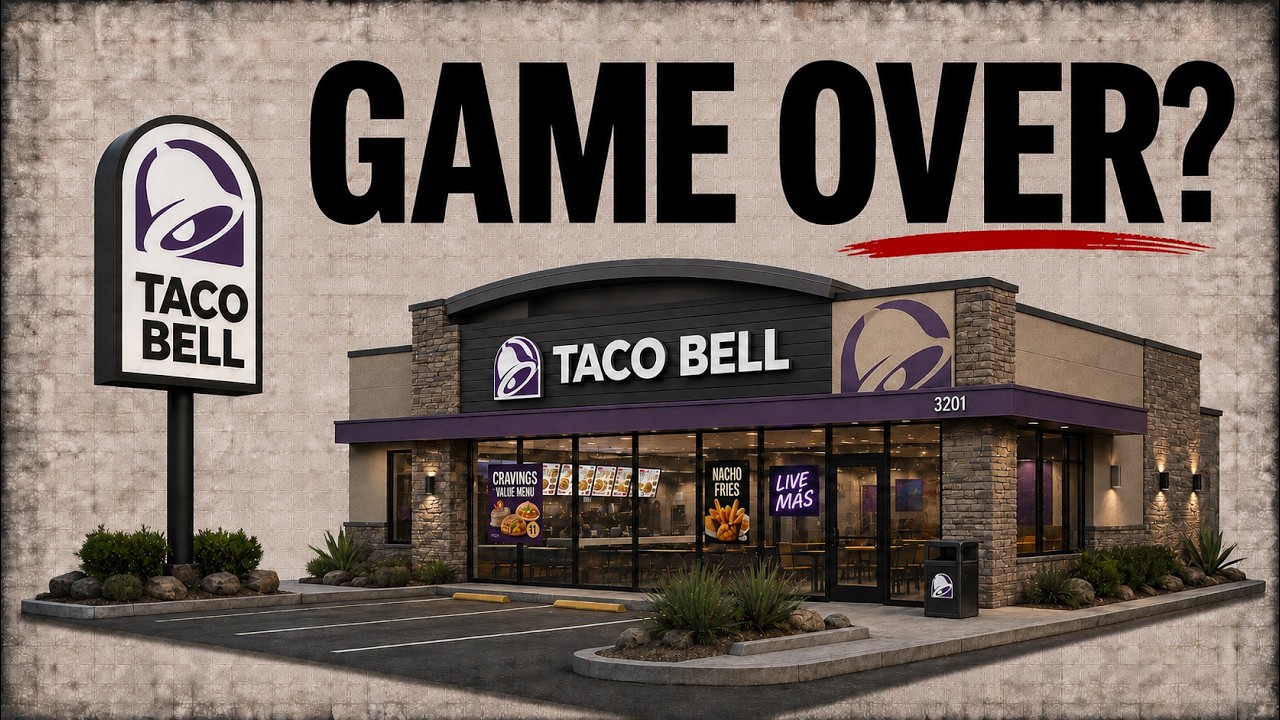
In early 2026, [music] Taco Bell was the single bestrun business in American fast food. Its parent company had just sold off Pizza Hut for 2.5 [music] billion to stop the bleeding. While Taco Bell carried the whole operation, the biggest engine of profit in the [music] portfolio, growing at 8% while the rest of the industry sat flat, 22 straight quarters of winning. Its own CEO stood in front of investors and said the formula was firing on all cylinders.
And then [music] over a single summer, nearly 2,000 people who ate there got sick. 98 [music] of them ended up in a hospital. The strongest brand in fast food taken down by something that never showed up on a single earning slide, a bag of lettuce. This is the story of the one thing Taco Bell couldn't put on a dashboard. To feel how strange this is, you first have to understand how far [music] ahead Taco Bell actually was.
This wasn't a company already wobbling. It was the strongest thing in the building by a wide margin. Look at the family it belongs to. Taco Bell's parent company [music] also owns KFC and it owned Pizza Hut until Pizza Hut got so weak that in 2026, the company simply sold it off for $2.5 billion to [music] stop the bleeding. Taco Bell was doing the opposite. It wasn't being carried. It was the single biggest engine of profit in the entire portfolio.
And the numbers hold up. 22 consecutive quarters [music] of positive same store growth. 5 1/2 years of never going backwards. 376 brand new restaurants in a single year. Same store sales up 8% while most of the industry [music] was flat or shrinking. When the CEO called it firing on all cylinders, the scoreboard agreed [music] with him. But what made Taco Bell special was never the food. It was the promise. Taco Bell didn't claim to be the best meal on the block.
It sold [music] something rarer and stickier. Cheap, fast, and dependable. The place you could feed a whole car for the change in [music] your cup holder and know exactly what you'd get. That promise is the entire machine. And that's the quiet danger in a business like this. The machine measures everything it's good at. Speed, price, sales, digital orders in real time down [music] to the decimal. But there's one number it can't see until it's too late.
Whether the person pulling up to that window still believes the food won't make them sick. That one doesn't trend. It doesn't flash yellow before it goes red. It sits at 100% quietly for years. Right up until the day it drops through the floor all at once. In the summer of 2026, it dropped through the floor. It began the way these things always do. invisibly weeks before anyone knew there was a story. The first illnesses started in May and nobody connected them because of what was making people sick.
This wasn't the usual food poisoning bug. It was a parasite, cycllospora. And cycllospora is uniquely good at hiding. For one thing, it's slow. Symptoms can take a week to even show up, and it can drag on for weeks after that, fading and then roaring back. So people don't always tie it to a specific meal. For another, most labs don't catch it. A standard test won't find cycllospora unless a doctor specifically asks the lab to look for it.
So case after case gets written off as a stomach bug that never gets counted. And the tracing is brutally slow. It can take health officials up to six weeks to link [music] one confirmed patient back to the plate that did it. So picture what those weeks [music] actually looked like. People getting sick across five different states recovering, some getting sick again, and no one, not the customers, not the labs, not the company, able to see that they were all [music] points on the same map.
By the time the pattern was visible at all, it was already enormous. Then the count started to climb, and it didn't stop. By mid July, the CDC had tied more than 1,600 infections [music] across five states directly to people who'd eaten at Taco Bell. Within weeks, it was nearly 2,000 across [music] nine states, 98 of them hospitalized. And investigators didn't have to guess at the source. In Michigan, health officials took 190 of the cases and pulled the meals apart, [music] ingredient by ingredient, looking for the one thing they all shared.
They found it. 90% of them had eaten iceberg lettuce. The federal trace [music] back narrowed to a single supplier, Taylor Farms de Mexico. And on July 17th, that lettuce was recalled. But here's where the story gets bigger than Taco Bell. That same recalled lettuce hadn't only gone to Taco Bell restaurants. It had gone to grocery stores, retail bags, on shelves, in people's [music] fridges. So, the outbreak the CDC was tracking wasn't just a restaurant problem.
Counting everyone tied to that Taylor Farms lettuce across restaurants and retail, the wider outbreak grew into [music] the thousands of cases across dozens of states, one of the largest of its kind the country had seen in years. Taco Bell [music] was the most visible face of it. It was never the whole of it. And this wasn't one rough night for the people in those numbers. Cycllospora is cramping, nausea, exhaustion.
The kind of sick that fades and then comes back, dragging on for weeks. Most people recovered, but that wider outbreak tied to the same lettuce, has now been [music] linked to two deaths in Michigan, both in people with serious underlying conditions. Deaths from this parasite are genuinely rare. That's worth saying plainly. That two happened at all is a measure [music] of how much of this lettuce got out before anyone knew it was dangerous.
And there's [music] one detail that trips up almost everyone telling this story. Early on, a lab [music] sample taken at the border came back positive for the parasite, then got flagged as a false positive [music] and withdrawn. That sounds like it should unravel the whole case. It didn't. The FDA said it directly. The false positive changed nothing. The trace back and the epidemiology still pointed at the same lettuce from the [music] same supplier.
One bad result got pulled. The evidence underneath [music] it never moved. So, how does the bestr run brand in fast food handle the worst week it's had in years. Quietly, Taco Bell [music] pulled the ingredient, put out a short statement, and then largely went silent. And when the numbers started to soften, it reached for the oldest lever in the business. It ran a sale. Discounts steady the receipts. They do nothing for the reason [music] people got scared.
To see how strange that choice is, look at what this same company did the last time this happened to it. 2006, an E.coli outbreak tears through Taco Bell in the Northeast. 71 people sick, most hospitalized, eight with kidney failure. And Taco Bell went loud. It pulled the suspect ingredient from all 5,800 restaurants [music] nationwide. It ran newspaper ads across the country. It put its own president in front of every camera that would have him and set up a customer hotline.
Whatever the outcome, the posture was unmistakable. They walked into the middle of the room and owned it. And here's the detail almost every version of this story misses. In 2006, Taco Bell blamed green onions and pulled them nationwide. But when the investigation finished, the onions were [music] innocent. The real source was something else. Lettuce. 20 years apart. Same company, same vegetable. In 2006, they got the cause wrong, but faced the public loudly.
In 2026, [music] they got the cause right and barely said a word. The company that once ran to the front of the room [music] now had the facts on its side, every reason to speak, and chose to stay quiet and discount instead. So, is Taco [music] Bell finished? No. Anyone telling you this brand is collapsing is selling you a [music] headline. So, let's put the real damage on the table straight from the company's own earnings call.
In the weeks after [music] the outbreak, same store sales dipped about 2%. A real hit, but a dip, not a freef [music] fall. The bigger cost showed up somewhere quieter, the margins. Taco Bell [music] guided its restaurant profitability down from about 26% to as low as 19 for the following quarter. And that number [music] tells you exactly what winning customers back costs. Every dollar off [music] deal, every promotion designed to coax people back through the door comes straight out of that margin.
The sales barely moved, but the profit on each [music] sale got squeezed hard. That's the real price of the outbreak, not a collapse. A bill for rebuilding trust paid a few points of margin at a time. And the recovery [music] had already started. The CEO told investors that within days, sales were climbing back toward [music] normal. This brand isn't going anywhere. But not fatal isn't [music] the same as no damage. For a company whose whole identity was cheap, fast, and fine, the outbreak hit the one word it couldn't [music] afford to lose.
Cheap survived. Fast survived, but fine. The quiet promise that the food is safe took the hit. And for the rest of this year, every competitor gets to run ads [music] about fresh ingredients you can trust, while Taco Bell, for now, can't. Taco Bell built something genuinely [music] impressive at everything it chose to count. Speed, price, 22 quarters of beating an entire industry at its own game. It measured all of it and it won. and none of it could see a parasite in a box of lettuce.
You can shave a second off a drive-through lane. You can engineer [music] a menu to the penny. You can measure everything that fits on a screen. But whether the person in that car comes back was never going [music] to fit in a spreadsheet. It was the one number that was never on the dashboard. If you want the rest of these, the brands that were winning right up until they weren't, that's the whole channel. Stick around.
The words are the caption track's own and nothing is reworded or re-transcribed. Paragraph breaks are placed between sentences so the text reads as prose.
Free tools for your own script: paste a draft and see where it stands before you record it.
Paste your draft and see where viewers are likely to drop off, with a rewrite for each weak line.
Paste the first 30 seconds of your own draft for a hook score and rewrites.
Check your draft against YouTube's advertiser-friendly guidelines before you record it.
Read this channel's public videos and transcripts, and download a writing brief for it.