Getting the transcript
Reading the captions from YouTube. A video nobody has opened here before takes 10 to 30 seconds; this page fills in on its own.
Getting the transcript
Reading the captions from YouTube. A video nobody has opened here before takes 10 to 30 seconds; this page fills in on its own.
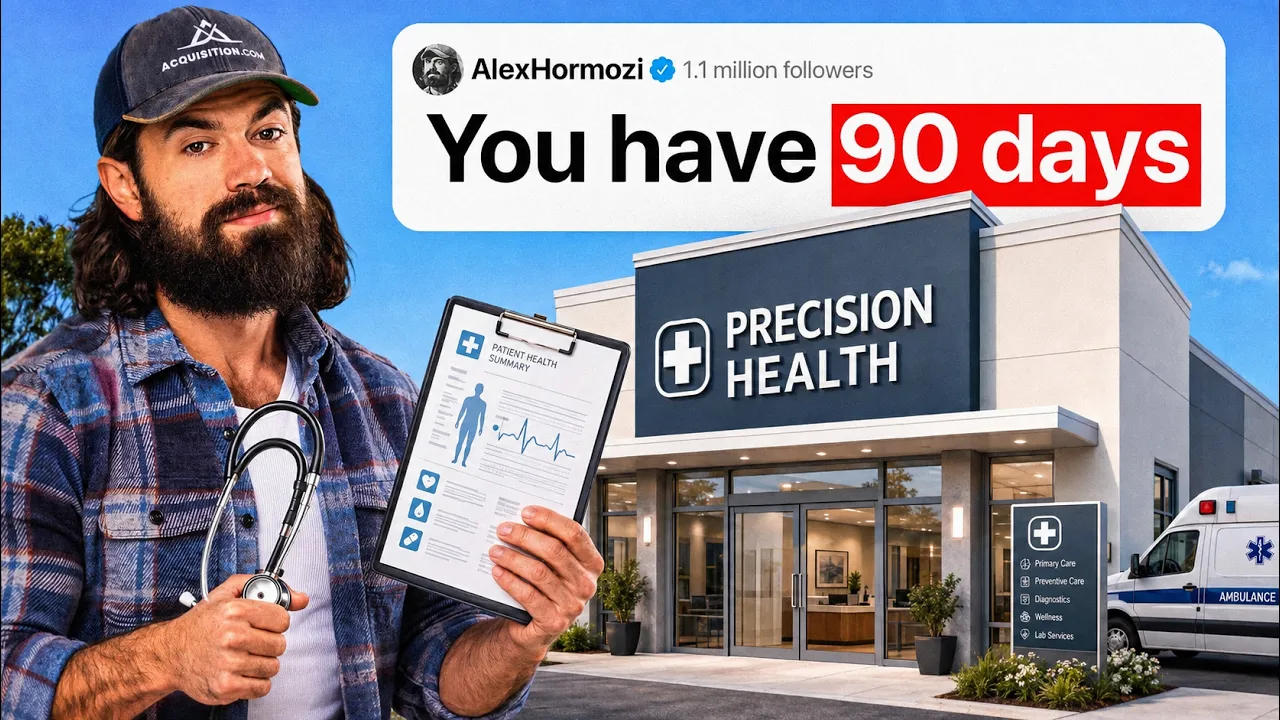
Alex Hormozi · @AlexHormozi
Where viewers went back to watch this video again, from YouTube's public Most replayed graph, lined up with what was said at that moment.
Most replayed moment #1
31:226.1x the video's typical replay level
physicians deliver this level of health care all over the country. So, I think it's all been a big win and and we'll move forward and be successful.
Said at 31:14
Most replayed moment #2
8:054.5x the video's typical replay level
offer. >> We have our 90-day. And for me, I would want this to be a bam fam process. meeting. Every one of these kind of meetings, we we set the next one and then we say, "Who do you want to bring with you?" And so, it's almost like assume that you're going to bring someone with you every time because
Said at 7:57
Most replayed moment #3
14:144.3x the video's typical replay level
and made like 400 instead of whatever you made 70, right? So in that world it's like how can we do one a week? >> Yeah. >> No, I guess that's that's really my question is like is there anything that prevents you from doing one of these per week because there's for sure events.
Said at 14:07
The graph counts replays. It does not show where viewers stopped watching.
Words
6,858
Runtime
31:30
Speaking pace
218wpm
Reading time
29min
218 words per minute, above the 201 75th percentile of 349 measured videos. That distribution comes from the 349-video hook study.
Opening (first 30 seconds)
All right. Tell me about the business. >> I'm Dr. Zad Oasi, MD. I own Precision Health Concierge Medicine. The business was in business for 18 years before I purchased. I've owned it for the past um 18 months. >> Okay. >> So, when we purchased, um revenue was around 1.8 million. Um we've grown it to 3 million in the last 12 months. Profit of 600K excluding my comp. >> What comp do you take? Last year it was about 300 and uh this year it'll be a little bit more than that and then three-year revenue goal of $15 million. >> Cool. How do you get customers
109 words, the words spoken in the first 30 seconds at 218 words per minute.
Free, no signup. See how the first 30 seconds hold attention, with rewrites.
Sentence shape
| Measure | This transcript |
|---|---|
| Sentences | 530 |
| Average words per sentence | 12.9 |
| Longest sentence | 160 words |
| Questions asked | 59 |
| Sentences containing a number | 71 |
Most used terms
Filler phrases
359 in total: like 131 · um 88 · uh 59 · right? 23 · kind of 19 · you know 17 · actually 10 · basically 7 · I mean 4 · literally 1.
A literal whole-word count of the same phrase list the Prepublish browser extension uses, so a phrase inside another word is not counted and a phrase used in its ordinary sense still is. It is a count and not a judgement.
Free, no account. See where attention is likely to drop, with a rewrite for each weak line. The free check shows the scores and the one issue costing the most. Or run it on the words above first.
Free · No login · See a sample audit first if you prefer.
What this transcript is
Every word below is the caption track YouTube publishes for this video, pulled from the video itself and reproduced unchanged. It is not Prepublish's writing, not a summary, and not a re-transcription: it is the video's own published captions. English captions, generated automatically by YouTube, in the video’s original language. Source: the video on YouTube. A channel that would rather this page did not exist can ask for its removal through the contact page, and it is removed.
All right. Tell me about the business. >> I'm Dr. Zad Oasi, MD. I own Precision Health Concierge Medicine. The business was in business for 18 years before I purchased. I've owned it for the past um 18 months. >> Okay. >> So, when we purchased, um revenue was around 1.8 million. Um we've grown it to 3 million in the last 12 months. Profit of 600K excluding my comp. >> What comp do you take? Last year it was about 300 and uh this year it'll be a little bit more than that and then three-year revenue goal of $15 million. >> Cool.
How do you get customers right now? >> Right now most of it well it used to be mostly word of mouth and uh over the past 4 months or so it's switched to SEO. >> Yeah. So originally um we had a rough first year uh issues with the seller and then issues with marketing. So, we knew that marketing was uh our big bottleneck. And so, we went out and uh interviewed five and we hired one and uh $50,000 later and no progress.
We ended up firing them. Um and I went on the website, I did all this myself. Um SEO turns out on the back end was trash. So, when we finally found somebody to fix it, um they started actually doing their job and the SEO converted really well. >> So, what's stopping right now from scaling? >> Uh it's mainly the the marketing piece. um we're just not that good at it. >> It is interesting um the $55,000 on the bad agency and and what you were saying earlier about like this [ __ ] Um it's funny cuz I see that and I just think it's cost of doing business, you know, like it's I wouldn't even >> That was the lesson learned. >> Yeah.
But like and it also doesn't mean agencies suck. Like the next one you worked with it worked fine. It's just like it's just part of the game. You're it's just you have margin so that you can try out a couple until one works. What do you think is going to get in the way of scaling for you? The landscape is changing pretty quickly and if we are not doing it correctly, it can fall apart pretty quickly. The technology aspect just from when we started the technology has improved so rapidly.
If we don't do it properly, every practice that we go into that we don't do well could cost us months to, you know, a year or whatever that is when we're small and the competitors are going to eat us up. >> Okay. >> Do you not agree? I I'm all for having a lot of urgency. I think people are going to keep getting sick for a long time. >> Yeah, of course. >> Yeah. And I like if I were to bet on industries, I think healthcare is fine.
Like which ones are going to get disrupted? People going to have more time to themselves. Uh and I think there's also a a high-end component to this which is like you're servicing people who have money. And you know I I think generic healthcare will change a lot with AI, your GPS, your general practitioners, etc. >> People will always be willing to pay more. There always will be a slice. >> All right. Well, let's let's sit down and figure out how to scale this thing. >> The real reason I wanted to get into this competition wasn't necessarily for the money.
Uh what I really wanted to do was get the input from Alex because I did do one of the scaling workshops and within six months of identifying my weaknesses, we have already accomplished a lot of those things and now imagine with what I know now with Alex's input how far how much further that could take me. That would be really awesome. [music] >> Okay. So [sighs and gasps] I I really think there's call it three real things to cover. >> Mhm.
And that's kind of it. All right. So, the first is how can we speed up the referral machine, right? And so, the question is right now, what are you doing? Obviously, you're getting word of mouth, but what are you doing in order to lubricate or facilitate it? Uh, so we need to do more open houses. We did two. Um, the one open house we offered members a $500 credit for both the member and the new signup. And then we did some raffles, gave some people some free stuff, so we introduced them to some of the aesthetics.
I love the giveaway. Um, if you want to have like way more people participate, just give a year of the service away. Just a full year of your optimized health, that would be my grand prize. The second place prize, um, and the way I'm thinking about this is like we want you want every referral to have a great reason to tell a friend. For the customers that you have, $500 probably makes no difference, right? They're probably going to refer you anyways.
So, and you just asking is what facilitated it, but to like make it so that it's social capital positive rather than neutral. Um, I' it'd be better to do either your friend gets some real treatment, some actual thing that's like a body optimization, whatever, or the six-month supplement thing or that, or uh you both get it as like if you if you refer a friend, you get this treatment. The the shtick is that it's a $1,000, $2,000 type, I would say, type ticket.
Um but your cost on g way less than that obviously. Um but the key is that if we can it's it's just a way better reason to come in. >> Yeah. >> Right. And the it's only for referrals. So it's not like we're running that as ads so you just have like you know Tom Dick and Sally coming off the street who are like oh I heard I got a coupon for like that's not what you're looking for. >> But it's like anybody who's an existing like it could even be a perk to me kind of like a like at kind of like at a gym.
Um you have uh like you can bring a plus one that idea but like if you are call it our you know you have our 5K membership. Um you you get five times our $2,000 one-off treatment or $1,000 one-off treatment that you can give to your friends uh and have them come in with you to do it. >> To me that's like a much more compelling offer. Yeah. >> And then what this does is that it allows you that every touch point we can ask them about it.
So it's like we have you have the immediate close, right? So this is kind of point number one that you can make it. So you you just closed them. You're like, "Hey, by the way, um a lot of people like to do some of these treatments together because it's a lot of fun." And so because you're now one of these members, you're going to be able to bring a friend with you at each of these four instances. >> And so whenever they book it, ask what friend they want to bring. >> You like that? >> Yeah.
It'd be a it'd be a great way because our aesthetics business is pretty much completely untapped and so that would be a great way. >> It's easy to do and like >> and people who are investing in that typically there's strong crossover. >> Um >> the second is when is there what wow what moment are people like whoa like you know what is that wow moment in the patient journey? >> Uh it's a little bit different for everybody.
Um, so like you know the average 50-year-old guy who thinks he's perfectly healthy and he comes back in in four or five months and he's like, "Dude, I haven't felt this good in years." And I'm like, "Yeah, it's cuz you didn't know you were feeling like crap." Now that we've actually fixed all these things or like >> you know the 80-year-old patient who um, you know, lost a bunch of muscle mass and could barely walk and now that we've used whatever treatments we have and they're like, "Wow, you know, I actually got my independence back." Do you do love that do you do what cadence of of touch points do you have with patients?
The older demographic usually starts out at a at a much higher cadence at like 60 days and then 90 days and then we as we optimize we kick it out and then um younger people so uh like if you signed up right you'd come in for your labs you'd do your V2 max testing uh you'd do your nutritional analysis and then 30 days later you show up you'd come in for your 1 hour appointment with me >> candy good on my nutrition analysis >> 100% perfect for you I love that for you >> so and that's the thing it's personalized medicine right so you do what you want um I just give you the information. >> Yep. >> What I'm trying to identify by asking the question is if there is a universally they're going to feel much better at day 90 >> and then get the referral, >> right?
So it's like maybe 90 because it's it's >> 90 days is a good spot. We have actually already kind of solidified on that 90 days that we're going to start implementing. >> So we have one at our close. This is our offer. >> We have our 90-day. And for me, I would want this to be a bam fam process. meeting. Every one of these kind of meetings, we we set the next one and then we say, "Who do you want to bring with you?" And so, it's almost like assume that you're going to bring someone with you every time because that's how we do it.
And we've also and I'm sure there's tons of research you could back it up that people who do healthy things together are five times more successful. Blah blah blah blah, right? And so this is like this is evidence backed, which it is. Uh when you do things together, you will get way better benefits. So like let's like I'm doing this as a practitioner. This makes sense. >> Um >> a lot of times that's how we get family members.
So wife signs up, we get husband. Husband signs up, we get wife. >> Yeah. So the third is you have a newsletter, correct? >> Yes. >> Okay. So what's the CTA inside of your newsletter? >> So we are uh we're very low pressure, right? So we don't have calls to action. I'm realizing now uh as as we're further in it that I truly do now feel that our product is so good that more people should know about it. And so we're we're not afraid to ask people.
So, I have not thought of putting a call to action in the newsletter yet. >> This is what I want you to do. [snorts] >> PS, >> perfect. >> Very simple. It's very just it's it's just it's not in your face. It's just like PS. Um this quarter we're running a uh uh you win a year of our premium VIP service um from any of your friends and family. And so if you want to enter and anybody who enters automatically gets that no matter what.
To me, that's like pretty compelling uh because they're doing their friend a favor because they're getting this no matter what, but then the friend is really excited and uh for this big giveaway. And the nice thing with giveaways specifically is that you can tell everybody what the price is. So, there's no sticker shock because when they come in and then we offer like they come in, one person wins the 20, but then everybody else you're like, "Great, you can do the 5K or the 10K or whatever else." And I think you doing the drawing at if you do that raffle thing that you do like once a quarter you do one of these to the list that'll probably in and of itself generate a lot of business. >> Yeah. >> Okay.
Does that feel okay? >> Good. Okay. >> So this is kind of like the referral referral engines. We needed a referral offer which I think this feels feels okay. This bam fam approach of like you're going to get five of these call it coupons. Not coupon. We wouldn't use that word, but like uh every one of these five treatments, you're going to have the option of bringing somebody else with you because of all the evidence reasons I just said.
So, who do you want to bring with you next time? Because now we're not asking for referrals. We're just saying who do you want to bring? It's just it's just much easier. >> Yeah. Okay. So, the second element of this beyond the referrals, um walk me through the sales process. Now, since we have the sales uh the um marketing person in house, uh she handles all of the calls >> and so she does her um script about what our office is and then um she finds a 15-minute time on one of the physician schedules. >> So, there's a phone call first. >> Mhm. >> All right.
And this is the marketing girl takes this. >> Yep. >> All right. So, this is set. All right. And then they come in person or they go Zoom. >> Uh for the most part, it's Zoom. I would say about 10% come in person. >> Interesting. Okay. And then the Zoom is with the doc. >> Uh well the Zoom is is with Hie. Uh the >> marketing again. >> Yep. Marketing. >> So this is doc plus her. >> Okay. Got it. Now what? >> Uh they either sign up or they don't.
And so >> on the call. >> Yep. And so if they want to come in to do a little bit more discovery, >> they'll do they'll do a walk around with Harley and then they'll decide whether they want to sign up or not. >> Got it. Um, so I get I call in, hey, this I need my health to be not sucky. Uh, she says, "Great. Let me see if I can find a 15-minute slot on Dr. Zad's calendar." And then she You see a 15-minute slot on your calendar.
She takes She hops on the Zoom. She says, "Okay, let me go get him." She gets you, you hop on, you say, "Hey, I think you should buy some [ __ ] from us." Uh, I'm kidding. Uh, and then the person says, "Yeah, that could be interesting." And then you're like, hi will take care of the rest of the the the business. And then you hop off and then Harley closes the sale. >> Yeah. Effectively the what not effectively that effectively why they want to speak with the physician is because they want to know what we're going to do, right?
Because what we're doing is is a little bit different than most other physicians. And so they want to take the time to understand if we actually do what we say we do. And so it's kind of building confidence for the patient like, hey, we're going to do all these things and we know what we're doing. >> Okay, great. So after that they then come in person. >> Yeah. >> Okay. So they get onboarded in person and then at this visit that's all onboarding.
Do they get any treatment? >> So uh what we do is we have instructions for fasting labs. Um based on that first call we've analyzed uh what type of labs we want to run with them. >> So we do labs here. >> Mhm. Okay. Got it. And then >> then they have a in-person meeting with the physician 30 days later. >> Got it. So, to me, this looks like a warm process, not a cold process. Uh, cuz someone just getting on the phone, having a phone call, and then 15 minutes to 10K a year, they've got to know something about you most likely in order to make that purchase here.
Um, this will work for the style that you are doing right now. The close rates are fine. like if you were running meta ads um or search ads, it would be it would be unlikely that that we'd need to put more friction in the process. Yeah. In order for this to work, >> but I'm not necessarily sure that that would be my immediate recommendation. And so if we're looking at the demand side of the business >> further this way, um I think basically you should probably have an event-based marketing strategy. >> Mhm. rather than adsp space.
Not to be clear, not that adspace doesn't work. It does. I'll give you I'll give you two adjacent strategies that you can do in sequence rather than a true like I like rather than what I would consider to be a traditional like call funnel, which I don't think is the strategy here. >> So number one is you did one event, right? And it was honestly lackluster in your ability to do the main thing that would have mattered for the event, right?
And so like I think there's a world where you could have spent $10,000 and made like 400 instead of whatever you made 70, right? So in that world it's like how can we do one a week? >> Yeah. >> No, I guess that's that's really my question is like is there anything that prevents you from doing one of these per week because there's for sure events. You're in a big enough city. You're in um Sarasota. >> There's probably a health or wealth or business related event. >> Yes. every week for sure and probably more.
And so I would take that as my primary kind of like paid strategy is you bring the big machine that you got and you do the expensive scan which is normally $500. I know what is it normally? >> So uh realistically we could do like 150 bucks. >> Okay. >> There actually uh there is another machine that we're going to buy that people are literally driving across the state and people do pay $500 to $1,000 to use that machine.
Is it something that people would get more than once? >> Oh, yeah. You do it every six months, especially once we put you on treatment to analyze. >> Okay. So, then I would say I would still do a giveaway at the event, which is a year >> of scans, right? And I'm trying to think like maybe call it like a year of digital health cuz normally it's a year of scans, right? So, it's like a year of integrated health. Same big idea of giveaway.
And I just wouldn't be afraid of like >> this is marketing. We have to be willing to give things away. Um, and know our math. the first time you do it, you're afraid of that you're going to give one client away, but you got 475 patients. It's not going to make a difference to the business. And so, it's like I would be wanting to give away the 20K thing because what's that going to do? I get to talk about it to everybody, but it's like it's not a it's not a it's not a pressury sale.
I'm like, this is what we do for our VIP. Enter here. In the meantime, go get a scan right now. You're going to have a line. That's what I want. I think what I would do is I would have my scan is I would have people watch a VSSL and set an appointment for later that day for a close. You just have you need some separation. So if there's any is there any part of this process where there's some kind of baked in 5 to 7 minute wait at some point. >> Uh the scan itself will take 20 minutes. >> Okay.
Can they watch something while they're getting scanned? >> That's true. Yes. >> Okay. Great. So we do scan plus VSSL at the same time so that they understand what's going on but the whole time they're being sold. And then right afterwards you can have those close meetings. You'll know immediately if it feels too fast. If it does feel too fast I would just set the next appointment and add a VSSL in between. That would be it.
So like V1 test is scan plus VSSL straight to close. The V2 of the test if for some like you'll get a vibe if you're like people feel like this is too fast. Then V2 is um scan plus VSSL and then we do appointment as our next meeting and then before they have the appointment you the VSSL and then you close. It's still two appointments. I'm just saying you may schedule it here. >> Yeah. >> Okay. So I would just say like can we do one of these per week and from a scaling this perspective every practice that you have you can there's going to be events that going to have high net worth individuals that are older that are going to be attending and it doesn't really matter like you could go to a cigar but maybe they [laughter] might have I mean hey there's people who like cigars who also still want to be healthy. >> We could 100% we could bring in a um >> like a breathing.
Yeah. Yeah. Exactly. Um, so I think this would be my this would be my strategy. Big giveaway. Everybody gets a scan. While they're watching the scan, uh, we then set them up for a close. If not, we schedule and then and then meet up the next day or we can do Zoom afterwards. Either way, but this is going to be monster lead genen at the events. The second, which is the even more scalable version of this, which honestly you could probably do this and get to your 15 million.
Um, which I like hesitate to even bring up more, but we're doing it for the people at home. Um, I would like you said you have a partner that's in wealth financial advisor stuff. So, one of the most common for like a high trust sale in-person events and workshops work better than just about anything. >> Yeah. >> And so, you could do a one-day full health thing that includes this scan um and maybe one other thing that's baked into the ticket.
Um, and then you just talk about your stuff and it could be a half day. It doesn't really matter. It's kind of like the diabetic dinners. You might have heard of that that kind of world. Um, it's the same idea. And then I would probably meet with them in person to close. >> Yeah. >> Because you have uh and so your lead genen is basically ads. So this is where this is where like meta this is where a meta ad campaign would be like more valuable, but you're going to have to sift through the the crap, but you also have the ocean to go after.
So that's a bit of the trade. Um, but I'll just walk through this, but this is for sure what I would start with on the demand side. So we run meta ads. It goes to the uh one day uh workshop. Name it whatever you want. One day workshop uh with the you know you know $500 in scans, whatever. Um you can charge money for it. You can have it be free. It's probably better to charge something for it. Make it $99 just so you get a little bit of riff ref.
You also have a card on file which makes the clothes easier. Um, and then from there then I would just book all the inersons and then at the in person and then Hie does the close and between here they watch a VSSL before they come in. So it's basically ads uh pitch one schedule pitch two with VSSL in between. So if we're looking at big picture what this hits overall the big meta thing is the attraction offer that you're going to use as a giveaway.
That's going to be to get referrals and then the BAM fam book a meeting from meeting every time that they have their treatment we should ask them who they want to bring and that's one of the big benefits and then we peel them off and we run the sales process because they're going to be warm anyways the existing process will work newsletter add we add our PS and then we uh add our our 90-day you know checkpoint as well but I still think this is going to do the majority of the work which is every single time they have a meeting ask who they're bringing with them and that's one of the main benefits of working with us now you can't bring the same person twice >> but you You can bring anyone you want cuz the marginal cost is nothing and if you can convert [ __ ] a third like who cares, right?
Um sales process I'm not going to mess with. This is what I think is going to be the big thing on the demand gen side. Um and you already know how to do this. Uh and so it's really just how many events can we do? And so I would just challenge you to be like can we do one a week? You'll close a year's worth of income every every event. >> I mean that would be incredible. >> Yeah. I mean, if you have a 300 person event, you could probably with that kind of offer get scans on a third of the people there, get a 100 scans.
If you convert 25% of people who get scans, 25 sales. >> Yeah, it'd be nuts, >> right? It's two and a half million event in LTV. >> Yeah, it'd be nuts. >> Who cares? And to be fair, what I'm seeing, because I look at a lot of businesses, the people who are running this model are printing right now. And so, the numbers are insane. >> Yeah. >> And you have unsophisticated business owners, which healthare professionals tend to be, um, even the entrepreneurial ones.
And it's just cuz like most of them, the reason I laugh at the $55,000 thing is it's like there's a curse of being a physician and I know this having three physicians in my family um is that because you started in business trading your time in the beginning. There's a tendency to like think in small numbers. And there's a reason that like not many physicians actually scale their practices. Like by number of physicians versus scaled practices, it's a crazy ratio compared to almost any other business.
Um, and so there's this trap of making a lot of money but not so much money that's like enough money to be comfortable like golden handcuffs. And so they tend to be very riskaverse because also the type person who gets into medicine tends to tends to not always but is very riskaverse. >> Um, there's also the world of defensive medicine and all that I want to get into. Um, but all that to say it's like that 55 grand, who gives a [ __ ] right?
And then betting on this uh, you know, $10,000 it's like they want $50,000 for this event. It's like yeah, but if we do a million bucks, who gives a [ __ ] And we might do one and it might not work, but it's like this is the game and all we got to do is find one event and then after we have that one event, we just know from every year here going forward, you're now in our permanent event calendar. And so the goal is we just get we try out event try event and then it's like every other every third becomes a a humdinger and you're like great this is permanently in the calendar and every year we reach back out say hey let's be a platinum sponsor whatever and then that becomes the marketing cadence and then you're going to hit capacity really fast. >> Yeah, >> that would be the game that I would play. >> I agree. feel good. >> Great. >> Any questions about that? >> No, it's uh I like I like this idea because um it's it's kind of the way we were going, but um this is a better way to do it, >> right? >> So, yeah, that's what I would do to scale this thing. >> Thank you, >> J.
Appreciate it. >> Yeah. Easy. [music] >> All right. Let's look at the scaling road map. Let's see. Let's see where the the practice is at right now. You're doing 3 million, right? How many people work at the practice right now? >> 16. >> 16. Okay. So, you're you're going to be in this phase into this phase. So, the productized to optimize phase. So, 10 to 19. You're in like kind of the director. I don't know what your your title is, but it's probably medical director or something like that. >> Or is it CEO? >> I'm the CEO.
That's right. Chief Zed, >> Lord, Lord of Lords. >> Lord AI. I kind of don't have um a true title right now. Basically, the other founding partner, he is he's the medical director. Um, so I'm kind of in this weird phase where I'm almost still part of the business, but I'm not. And so I'm trying to figure out what that, you know, role actually is. But essentially, my goal is to try to help grow the business. >> Cool. So if we're looking at this, this is where you're at to graduate into the next level.
So I'll just walk through this really quickly. Um, but right now you're in the process of having this kind of supplementation and the aesthetics angle. And so like that's what you're building into increase LTP right now, right? That's thing one from the um spending more niche down messaging with new offer. So for us, the new offer is going to be that giveaway. >> Mhm. >> Right. Um and that's that's basically the play here.
Now the sales ads material, you're in process for the VSSL, >> right? And basically building out this sales motion. Sorry, the sales motion um that we just went over. That's kind of like what we need to go what we need to do to graduate from here. And then the the the CS playbook, the onboarding is this bam bam referral process where it's like, okay, bring a friend every single time. And that's the that's the game that we're going to do to increase LTV on the back end.
Now, from like what are the problems that are about to hit, right? Um quality is going to start becoming an issue as you get more and more patients, especially as you get this this machine turned on and then you're going to have new new docs in that aren't as experienced, don't know you as well, etc. And so it's like how do we have incremental product improvements? um for the customer roadmap that we're on. The uh you probably won't need to worry about the ad assembly because we're going to be doing um basically event- based marketing for now.
So, it's really just reachouts is all we have to do there. But sales training is going to become a bigger issue at these events. And so, it's like we're going to have to get better and better and more systemized at the sales training. Also means that like you're going to have to like coach Hi, might have to coach other people to do it because there might be a world where you're doing two events a week or three events a week, right?
Um, and then, uh, I'm going to bet because you're at, you know, almost 500 customers. When you're at 1500, you're going to see that there's some clear cohort cohorts. Yeah. >> Um, and we covered some of this activation with that 30 and 90. Um, but there's probably going to be a customer in there that's willing to pay 50 or 100,000 a year. >> Yeah. >> And we want to give them the opportunity to do that, right? And so, we don't need to worry about that now, but that's like what's coming around the corner.
And so, that's where you're at in the scaling road map. And for anyone who's at home, welcome to download this for free. Just type in information. I'll tell you where you're at. There's 90 90-minute video that tells you what to do. Okay. So, I'm going to simplify this cuz we talked about a lot, but I want to like every person who comes in, we need to ask them who they're bringing with them for their each treatment to your list.
We're doing giveaway once a quarter, which in this 90-day period that we're talking about, this has to happen. >> Yep. And you need to get really violent with how many how many events are coming up that you can attend and run this play. Let's say, do you have kids? >> No. >> Okay. Do you have a wife? >> Yes. >> Okay. Let's say your wife gets napped. Unless you do a certain amount of events. How many events do you think you can do between now and 90 days from now?
I'm being dead serious. >> I would do 90. >> You do 90 >> if if if that were the >> How about Well, then can you do 12? >> Realistically, what we were planning was one per month. >> Okay. I would just like to say let's do one a week >> and yolo it. >> We will try. >> Your wife's gonna get napped. >> We will do it. >> Okay, great. [laughter] >> We will do it. >> Okay. Well, I just want to see a world where we do 200, 300, 400k from 10 events over the next quarter. >> That'd be fantastic. >> And you do 4 million and then you're already pacing your I mean plus your three, right?
You're you're you're already pacing your at least, you know, 10 million plus by the end of the year minimum. >> That would be nuts. or awesome >> or awesome. Cool. Let's do it. [music] >> So, overall, I I'm a little bit biased because I I was raised in in healthcare. Ironically, I don't talk about it much, but I was raised in healthcare uh with both parents as physicians. Um I really like healthcare in an AI world. I also really like healthcare because the there's so much lowhanging opportunity that exists in the marketplace right now and I don't think the demand's going anywhere and from a macro marketplace perspective all the people who have money are getting old and there's way few we're not making as many people um and the people who have it don't want to die and so and they got the money to try and prevent it and so this part is booming so there's a huge supply constraint issue number one number two the people you're competing against are either massive or tiny and there's not a lot in the middle and that's very exciting three traditional call it um marketing and sales motions and done classy not shittily um unlock like not just like 20% or 30% incremental improvements but can be like 10x 20x improvements in the business like very short periods of time.
I think that you will be able to do this and I think that from a revenue perspective of the businesses that I looked at today, this will probably be the one that I think can generate the most money in the shortest period of time and also has a model that uh can be replicated. So like this event-based motion guys a white lab coat you run the scan it's like very straightforward and the LTV on this because no one is really doing it.
It's still crazy. um maybe in the next 20 years it'll start coming down and all that stuff will happen. But we're so far away from that. Um that this excites me. And so uh on the on the that's on the scale side. On the fail side um the things that worry me is is uh it I don't I don't feel a huge amount of marketing chops. Obviously there's but like I don't know how. Um and great Yeah. >> [laughter] >> um and to grow the business.
I'm I'm a big believer and one of the hardest parts for physicians is that they typically make enough, like I said earlier, that they don't want to invest more in their education cuz they were like, I did enough education, but it's still like a totally different game. Um and they usually don't want to they're afraid of marketing, they're afraid of selling, they're afraid of seeming a certain way. Um a bunch of mental blocks around pricing because then they have this whole like I'm I'm trying to do good, but then I don't want to.
It it becomes this whole mess. And so that's usually where where docs fail. They also tend to hold on to things too close and say no one can do it like I can do it. There's also usually a lot of ego. I'm mixed on you. I'm not sure uh on that side. Um but that is usually a huge issue when I'm dealing specifically with physicians. Surgeons are even worse. Um I come with both parents being surgeons. Uh [laughter] anyways um all that to say uh I think this plan will succeed and then if we're looking at the next 90 days of scale or fail, we are scaling.
So, I'll see you back in 90. Will you do 10? >> Yeah, for sure. >> Just do this, dude. If you just do this. >> Yeah. Thank you. >> All right. Rock and roll. >> The conversation really helped me to solidify our plan. And it's it's really cool when somebody um gives you advice and you're on that track. And so, I really want to try to um open up the different opportunities that can come from what we talked about. So, we had eight business owners out and they are all competing for $100,000 and working with me for a year. to scale their businesses.
And so that was scale or fail. We'll see you next time. >> All right, guys. Dr. Z here, Precision Health Concier in Sarasota. Little update uh since we filmed. So, I'm way off schedule. Never going to achieve what Alex gave me to do. And I'll tell you why. Sarasota is very seasonal. We shut down from May to September. Half the population leaves. And so, I quickly realized I was going to struggle to find the right events.
Alex had said, "Don't make your own events because that's two steps ahead." Well, it's exactly what I did. And now we have an entire lecture series set up with a couple of venues that um are where our ideal clients live. And so this is actually a great thing for us because people after seeing me on the um as one of the contestants on Scale or Fail are now actually reaching out to me and which is exactly what I've wanted because I want to help physicians deliver this level of health care all over the country.
So, I think it's all been a big win and and we'll move forward and be successful.
The words are the caption track's own and nothing is reworded or re-transcribed. Paragraph breaks are placed between sentences so the text reads as prose.
Free tools for your own script: paste a draft and see where it stands before you record it.
Paste your draft and see where viewers are likely to drop off, with a rewrite for each weak line.
Paste the first 30 seconds of your own draft for a hook score and rewrites.
Check your draft against YouTube's advertiser-friendly guidelines before you record it.
Read this channel's public videos and transcripts, and download a writing brief for it.