Getting the transcript
Reading the captions from YouTube. A video nobody has opened here before takes 10 to 30 seconds; this page fills in on its own.
Getting the transcript
Reading the captions from YouTube. A video nobody has opened here before takes 10 to 30 seconds; this page fills in on its own.
The Andrew Faris Podcast · @andrewfarispodcast
Words
1,371
Runtime
6:05
Speaking pace
225wpm
Reading time
6min
225 words per minute, above the 201 75th percentile of 349 measured videos. That distribution comes from the 349-video hook study.
Opening (first 30 seconds)
all right let's talk about how bidc caps actually work for a second so let's think about this business with 42 points of margin 50% oneyear LTV and a 14% delayed purchase multiplier between 7day click and 28 day click what that means is if I because I have to bid on one day click or 7-Day click let's take a business that's bidding for 7-Day click I have to assume that there's some increase in the value of the clicks that I buy from day 7 to day 28 when meta shows you the full um value of your of your your purchases okay because there's always a gap between what you
113 words, the words spoken in the first 30 seconds at 225 words per minute.
Free, no signup. See how the first 30 seconds hold attention, with rewrites.
Sentence shape
| Measure | This transcript |
|---|---|
| Sentences | 1 |
| Average words per sentence | 1371.0 |
| Longest sentence | 1,371 words |
| Questions asked | 0 |
| Sentences containing a number | 1 |
Most used terms
Filler phrases
35 in total: um 17 · actually 7 · uh 7 · like 2 · basically 1 · you know 1.
A literal whole-word count of the same phrase list the Prepublish browser extension uses, so a phrase inside another word is not counted and a phrase used in its ordinary sense still is. It is a count and not a judgement.
Free, no account. See where attention is likely to drop, with a rewrite for each weak line. The free check shows the scores and the one issue costing the most. Or run it on the words above first.
Free · No login · See a sample audit first if you prefer.
What this transcript is
Every word below is the caption track YouTube publishes for this video, pulled from the video itself and reproduced unchanged. It is not Prepublish's writing, not a summary, and not a re-transcription: it is the video's own published captions. English captions, generated automatically by YouTube, in the video’s original language. Source: the video on YouTube. A channel that would rather this page did not exist can ask for its removal through the contact page, and it is removed.
No Script X-ray for this video: YouTube shows a Most replayed graph only once a video has enough views.
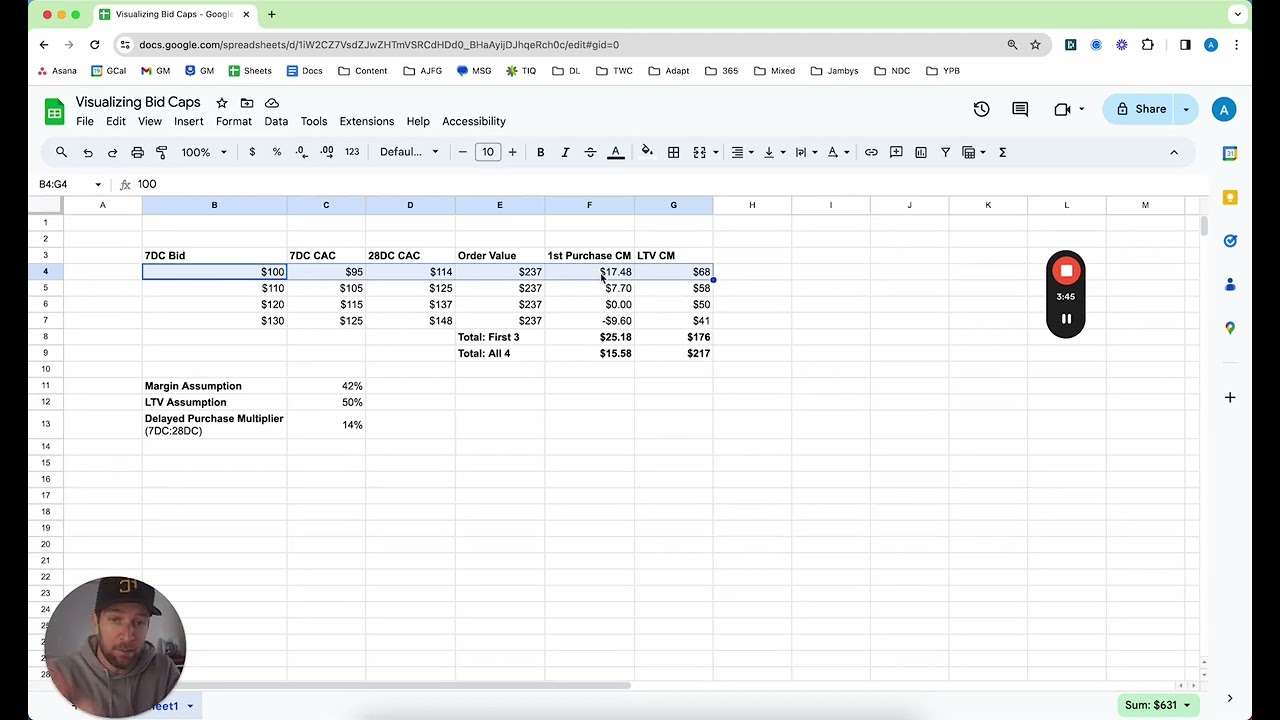
all right let's talk about how bidc caps actually work for a second so let's think about this business with 42 points of margin 50% oneyear LTV and a 14% delayed purchase multiplier between 7day click and 28 day click what that means is if I because I have to bid on one day click or 7-Day click let's take a business that's bidding for 7-Day click I have to assume that there's some increase in the value of the clicks that I buy from day 7 to day 28 when meta shows you the full um value of your of your your purchases okay because there's always a gap between what you get on day one or day seven and day 28 okay I call it the delayed purchase multiplier the idea is I click today and buy in three weeks that's going to show up as a click that I pay for in my 7-Day click attribution but it's not going to show up as a purchase in my 7-Day attribution but it will in my 28 day attribution I'm going to assume there's a 14% growth in customers from 7 days to 28 days so if um if I get $100 from customers within the first seven days after a click measured within my 7-Day click B bid and CAC I'm going to get I'm going to get another $14 worth of customer value um over the course of the next 21 days after that from 7 Day to 28 ta that's the idea okay um so bids work like this right I am going to bid um however much I want for a purchase and say this is the Threshold at which I am no longer willing to pay Above This threshold I'm no longer willing to pay for a customer based off of meta probabilistic forecasting about the value of a customer and the value of a click in my business okay uh really the cost of a customer not the of customer cost of a customer and the value of the click in my business and so uh and so if I bet 100 bucks I'm saying do not spend more than $100 to acquire a customer now meta auction is a second price sealed auction which means you actually pay the second highest bid for your conversion so let's just say there's two advertisers bidding on the same impression okay I'm Advertiser one I'm willing to pay 100 bucks Advertiser two is willing to pay $95 for that conversion okay I win the bid at $100 this is a simplified version of this but this is basically what's called happening I win the bid at $100 but I only pay 95 because I have to pay the second highest bid okay if that's the second highest bid that's what I pay which means when you run bid caps the average C you actually pay will always be under the cap as long as the forecasting model is working about right and then in the aggregate it pretty much does okay how what that Delta is between my bid and my actual average uh is um is it varies right but $5 is reasonable I've seen this somewhere in this range quite a bit of times right I pay 100 I get I I bid 100 I actually get 95 and by the way one of the differences here the key difference between bid caps and cost caps is that if I'm running a cost cap if I bid $100 um if that's my my cost cap is I'm going to get an actual average of $100 and that's because meta is going to be willing to B pay actually above my average for some conversions so I'm going to buy some conversions at higher than the number that I've set here and some lower but the average will work out as best as met is able to 100 okay so that's the idea so because I'm bidding at or under this bid threshold told every time I raise my bid on the same set of ads what I'm willing to do is take more incremental conversions that I was previously saying no to right so the way I visualized this is Imagine in this business there are um imagine this business there are um four potential conversions to get okay uh four potential bids to place okay and we'll just we'll just make it so these are the only four conversions I'm going to get just to make it easy okay for all of them the order value is $237 this is the margin assumption I've made again I've got this delayed purchase m multiplier assumption all in here and this is my bid 100 110 120 130 those are the four potential bids I could place and with each increase of $10 in bid I get one more conversion okay that's the idea so I'm go if I only bid $100 I get one conversion I get a first purchase cm of $748 I get an LTV cm of $68 So within the first year I'm getting $68 worth of contribution margin on this customer okay um if I bet 110 I'm getting an incremental conversion that also produces 7 .7 right away and then another $58 over the course of the Year okay over the course of the LTV if I bid 120 now I've added another conversion that's dead break even so it gives me nothing on first purchase but it gives me $50 over the course of the Year versus LTV and now if I been to 130 my cat comes in at 125 on a 7-Day click basis um you know again it gets multiplied up for the delayed purchase multiplier and now on that 28 day first purchase I actually lose some CM I lose $9.60 today but I gain another incremental 41 so if I only take the first three where I'm not bidding into a first order loss I get $25 worth of CM on that first order okay on these bids and I get 176 over the course of the year if I bet on all four now I lower my first purchase CM but raise my LTV cm and crucially um all of that LTV cm is truly incremental to my business so all so all of this is actually additional to what I'm getting now so if I'm saying no to the $130 tier what I'm saying no to is the additional $41 in C I'm saying no thanks now there might be a reason to do that for plenty of businesses right you might not have the cash to front a Year's worth depends on how quickly you get that money over the course of a year um you might just you might not be that aggressive and you might think like look I'm I'm willing to just take more profitability on first order um because I just would rather do that I'd rather be a little less aggressive but you are saying no to more profit over the course of a year or to more contribution margin anyway over the course of a year you are that is the decision you're making in that case and that's the idea that the bid helps you do so when you make decisions about where to set your bid you really making a strategic decision about how to think about the p&l in general and about the strategy in general um you got to set it relative to uh what you think is best for your business what you think is best for um your short and long-term cash position uh and all those questions come into play every time you make a decision about this and so yeah that's the way to think about your bids it's really a financial decision um and and again remember that idea of incrementality that is you are going to take extra purchases there and and how you think about uh the value of those extra purchases as you raise your bid is really the crucial question
The words are the caption track's own and nothing is reworded or re-transcribed. Paragraph breaks are placed between sentences so the text reads as prose.
Free tools for your own script: paste a draft and see where it stands before you record it.
Paste your draft and see where viewers are likely to drop off, with a rewrite for each weak line.
Paste the first 30 seconds of your own draft for a hook score and rewrites.
Check your draft against YouTube's advertiser-friendly guidelines before you record it.
Read this channel's public videos and transcripts, and download a writing brief for it.