Getting the transcript
Reading the captions from YouTube. A video nobody has opened here before takes 10 to 30 seconds; this page fills in on its own.
Getting the transcript
Reading the captions from YouTube. A video nobody has opened here before takes 10 to 30 seconds; this page fills in on its own.
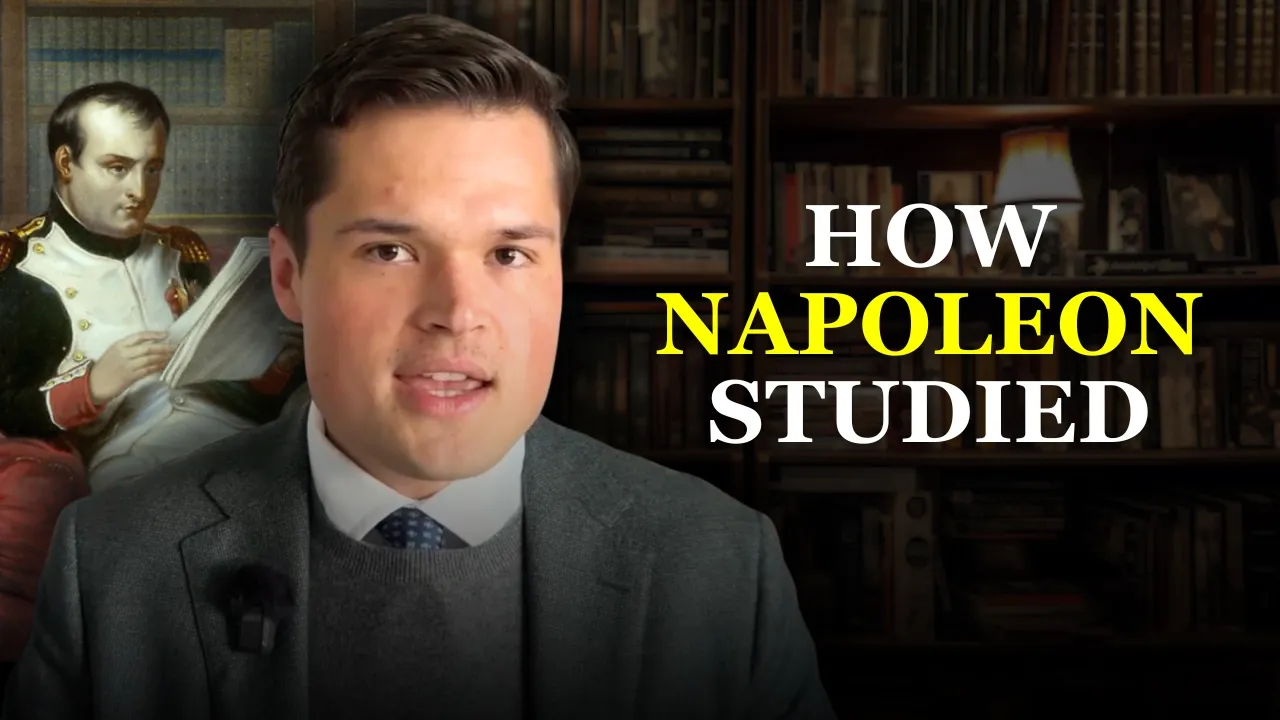
Five Minutes Late with Jesse Grant · @fiveminuteslatepod
Where viewers went back to watch this video again, from YouTube's public Most replayed graph, lined up with what was said at that moment.
Most replayed moment #1
7:3315.7x the video's typical replay level
another person." And so it's much more about the real world application on top of the theory. With that said, moving on to lesson number three from Napoleon, which is to revisit core books all the time. Now, Napoleon wouldn't just read a
Said at 7:25
Most replayed moment #2
1:064.9x the video's typical replay level
so, without further ado, let's get into his first tip for self-learning, which is to take notes in the book. He was a huge writer in all of the books that he'd read. He wouldn't just write notes
Said at 1:00
Most replayed moment #3
3:474.0x the video's typical replay level
said, let's move on to tip number two from Napoleon for becoming a self-educator and that is to read books under stress and plan to put it into immediate action. And like I said earlier in the video, Napoleon would read books while in the middle of
Said at 3:40
The graph counts replays. It does not show where viewers stopped watching.
Words
2,304
Runtime
12:11
Speaking pace
189wpm
Reading time
10min
189 words per minute, between the 181 median and the 201 75th percentile of 349 measured videos. That distribution comes from the 349-video hook study.
Opening (first 30 seconds)
Napoleon Bonaparte is a well-known self-educator and is often cited as being a huge bookworm. And even before becoming emperor, he wrote a manuscript for a novella which ended up never being published in his lifetime. And while there are so many videos and books and articles about the highly talked about controversial figure of the past, I hardly see any videos go into depth around his strategies for learning and how he was able to retain so much of the information that he'd studied from books. Because even on war campaigns, he would study
95 words, the words spoken in the first 30 seconds at 189 words per minute.
Free, no signup. See how the first 30 seconds hold attention, with rewrites.
Sentence shape
| Measure | This transcript |
|---|---|
| Sentences | 91 |
| Average words per sentence | 25.3 |
| Longest sentence | 73 words |
| Questions asked | 1 |
| Sentences containing a number | 4 |
Most used terms
Filler phrases
18 in total: actually 7 · like 4 · you know 4 · kind of 2 · sort of 1.
A literal whole-word count of the same phrase list the Prepublish browser extension uses, so a phrase inside another word is not counted and a phrase used in its ordinary sense still is. It is a count and not a judgement.
Free, no account. See where attention is likely to drop, with a rewrite for each weak line. The free check shows the scores and the one issue costing the most. Or run it on the words above first.
Free · No login · See a sample audit first if you prefer.
What this transcript is
Every word below is the caption track YouTube publishes for this video, pulled from the video itself and reproduced unchanged. It is not Prepublish's writing, not a summary, and not a re-transcription: it is the video's own published captions. English captions, generated automatically by YouTube, in the video’s original language. Source: the video on YouTube. A channel that would rather this page did not exist can ask for its removal through the contact page, and it is removed.
Napoleon Bonaparte is a well-known self-educator and is often cited as being a huge bookworm. And even before becoming emperor, he wrote a manuscript for a novella which ended up never being published in his lifetime. And while there are so many videos and books and articles about the highly talked about controversial figure of the past, I hardly see any videos go into depth around his strategies for learning and how he was able to retain so much of the information that he'd studied from books.
Because even on war campaigns, he would study books on war history, he would read fiction novels, he would read Plato, Socrates. He was a huge bookworm and even while in the midst of travel, in the midst of warfare, right in the thick of it, he would still continue to study and take notes. And so, I thought it'd be a good idea to look at his three major strategies for self-education and what we can learn from it and how we can apply it in our own day-to-day life.
And so, without further ado, let's get into his first tip for self-learning, which is to take notes in the book. He was a huge writer in all of the books that he'd read. He wouldn't just write notes on other pieces of paper, but he would write notes in the margins of each page of the book that he was reading. And the reported reason for why he did this is so he can actually have a dialogue with the person who wrote the book.
When he'd read something that perhaps he disagreed with, he would argue with it in the margins. If he read something that he did agree with, then he would underline it and write why he agreed with it. This allowed him to be in a constant flow and dialogue with the book, which allows you to retain more information once you're done reading it. And there have been countless studies which have proven this to be very true.
But also, another reason for why he would do that is because when he'd come back and read the book, potentially 6 months later or a year later, he would be able to see where his head was at at the time of reading the book and know if he's changed his opinion or if potentially what he was arguing against he now believes to be true because he's had more life experience. It allows you to actually see the growth of your own education and go back to books and remember what you were thinking about the first time you read it.
That allows you to continue your educational growth and also not forget get lessons that you'd learned in the past. Because I think we can all relate to this where we remember more information from debates and arguments that we've had with other people than we do from most of the books that we read. And so by actually arguing with the book and being alive in the book and treating the book as something that's living right now and not just something to read, but something to actively engage with, will allow you to retain so much more information and go deeper into the words that are being written.
As it's one thing to write notes on another piece of paper or to contemplate the page or the chapter you just read after reading it, but it's another to actually engage with it like it's its own living thing. And honestly, I have tried this and I really really enjoy it. I'm a huge note taker, but I don't just take notes in other books now. I now take notes in the books that I'm reading and write on the side of the page.
However, I will say it does ruin the option of being able to pass the book over to someone else as potentially you wrote some very private information that you want to keep to yourself and you have to buy another copy if you plan on sharing books or giving away books that you like as a gift. But with that said, let's move on to tip number two from Napoleon for becoming a self-educator and that is to read books under stress and plan to put it into immediate action.
And like I said earlier in the video, Napoleon would read books while in the middle of warfare. And the reason he did this is that he believed that if you are under stress and you had to read with a purpose and retain information and read for a strategic advantage in whatever you're campaigning against or whatever you're looking to do in life, then you will have to put it into immediate application. And if you're putting it into immediate application, you want to extract the best knowledge and the best tips and the best strategic advice that you can from these books and put it into your life straight away.
So, you're going to remember more, but you're also going to be able to see if those lessons work. Now, of course, most of us are not going to be in the middle of a military war campaign. We're not going to have that level of stress. But the thing you can take from this is whatever you get from a book, if you find it valuable, try and find some way to apply it immediately and see if it actually works for you. See if you're comfortable with it.
See if it's able to work in reality, if it's not just an abstract idea. And when you're also reading to put something into application straight away, you're going to be a lot more focused on what you read. And once again, it puts you in an engagement with the book. It puts you in a dialogue with the book where you're actively seeking any sort of juice or informational lessons from the book that you can apply straight away.
And now, this doesn't work for every book that you read because of course you're going to read some books and want to read it for leisure and keep it fun. But this is in regards to self-education. And I think the best way to learn is to constantly push yourself to put it into practice because I know, and I'm sure you know, we can all go down rabbit holes where we think we're learning a lot because we're watching a lot of videos or reading a lot of books, but we're never putting anything into practice.
We're never putting anything into action. And when you don't do that, then you're not really learning anything. Because learning is not just about having the information and knowing what to do, but it's also knowing how you can do it. For example, we can all look at videos of the perfect golf swing, but if we go out to play golf, just because we know what the perfect swing is, doesn't mean we're actually going to be able to do it.
I think that's a really great example as to how important application and actually doing it is as opposed to just reading it. And so putting yourself in an environment where maybe you're setting a deadline for a paper or an essay or something you can write in private, where you can actively put into application what you're learning and try and get some real world feedback or see how comfortable it is for you to apply it or see where you're struggling to apply the information that you're learning.
And so it's really just about putting pressure on yourself to not get stuck in that loop of constantly consuming and thinking that that is helping you learn and thinking that because you can recite things or know things that that means you're a learned person and an educated person. When in reality, the learned person also know needs to know how it applies in life as well. Very similar to that Goodwill Hunting scene where Robin Williams says to Matt Damon, "Yes, you can tell me what's in the Sistine Chapel.
You can tell me about specific wars in Spain hundreds of years ago, but you can't tell me how it felt. You can't tell me how the Sistine Chapel smelt, what the feeling was in your soul. You can't tell me what it was like to love another person." And so it's much more about the real world application on top of the theory. With that said, moving on to lesson number three from Napoleon, which is to revisit core books all the time.
Now, Napoleon wouldn't just read a book once, twice, three times, or four times. He would go back time and time again. He really loved to go back and reread Plato and reread different philosophers and different historical biographies on wars because you never know what you've missed. And also, you can never walk through the same river twice because once you've walked through a river, once you've had an experience, once you've read a book, you're therefore a changed person.
And when you read it again, when you walk through that river again, so to speak, it's going to be a different experience. You're going to get something else from that book. And what makes the great books so great is the fact that they are way too deep and way too complicated to fully grasp everything on the first go. And it requires you to live some life on top of just reading, and then you can come back to it and take something more from it or see where you've grown or understand different concepts or just see it in a new way, and that is very, very important.
And so, Napoleon was a huge advocate for going back to a certain set of core books, not every book. Not every book deserves to be reread over and over again, but certain books that are the most important ones, the ones that you hold dear to yourself, the ones that you think laid the foundation for your self-education, go back and read those time and time again as you're always going to get something else from it. If you're reading David Hume, if you're reading Nietzsche, if you're reading Plato, if you're reading Aristotle, there are so many great books out there that you can't just read five times or just 10 times.
You've got to read them at least 20, 30 times over your lifetime in order to have the full experience of what those books can do for you in your self-education. And I think that was a really important one because I think in today's world where we have so many books that are coming out, it can be very easy to never go back and reread a great book. And when you know that you should, when you know that that's the right thing to do, it means that you're going to be very focused on not reading every book that ever gets published, on not going down every rabbit hole.
You're going to be very focused on what you read. You want to read with a purpose. You want to choose your books wisely because you want to keep enough mental room, enough time in your life to go back and reread those great books. It's why I'm honestly, I'm someone who barely reads books that are published in the 21st century because I think there are so many great books in the last 2,000 years that how can I possibly squeeze much more in there?
Now, there are some great books that have been published recently and I do try and get to them, but I I I try my best to be as disciplined in not reading every shiny new object. Just cuz it has a good cover, just cuz it might have a nice plot, read the important books, the ones that you learn a lot from, go back and reread them time and time again. And Napoleon has the same advice there. And that wraps up today's video on Napoleon's three tips for self-education.
And I think this is an important one to talk about because I think a lot of people today are self-educated. When you look at the internet, when you look at the boom of educational content on the internet, when you look at the boom of philosophy online, that's all people who are looking to be self-educated. And I do want to say it's important to get a real education. You know, there's a lot of talk out there that university degrees are pointless today.
I don't think that's the case. I do think they have lost some kind of value. They don't potentially hold the same amount of value as they used to have, but they are definitely important. But with the rise of self-education, you need to know how to educate. You at least need to know how you're going to go about your learning and not just read anything and go in any direction. You need some kind of structure. And so, I hope this video helped you in some way.
There are lots of lessons that I've taken from Napoleon in regards to how he educated himself, not really how he lived his life. Some differences there, but in regards to self-education, I've learned a lot from him and I think you guys can, too. And hopefully, there was some information in this video that you did learn from. But, with that said, hope you guys enjoyed the video and until next time, take care.
The words are the caption track's own and nothing is reworded or re-transcribed. Paragraph breaks are placed between sentences so the text reads as prose.
Free tools for your own script: paste a draft and see where it stands before you record it.
Paste your draft and see where viewers are likely to drop off, with a rewrite for each weak line.
Paste the first 30 seconds of your own draft for a hook score and rewrites.
Check your draft against YouTube's advertiser-friendly guidelines before you record it.
Read this channel's public videos and transcripts, and download a writing brief for it.