Getting the transcript
Reading the captions from YouTube. A video nobody has opened here before takes 10 to 30 seconds; this page fills in on its own.
Getting the transcript
Reading the captions from YouTube. A video nobody has opened here before takes 10 to 30 seconds; this page fills in on its own.
HealthyGamerGG · @HealthyGamerGG
Where viewers went back to watch this video again, from YouTube's public Most replayed graph, lined up with what was said at that moment.
Most replayed moment #1
8:372.0x the video's typical replay level
then really ask yourself, am I ready to pay the price to make this change? People who focus on that are more likely to succeed. Second thing that is really, really, really important is a belief in self-efficacy. So, once again, it's not
Said at 8:30
Most replayed moment #2
6:571.8x the video's typical replay level
people that really succeed. So, don't give up, and even if you screw up once, twice, three times, four times, five times, six times, seven times, eight times, nine times, 10 times, stick with it. That's the point of sharing this bit of data. So, now we come to the meatiest part of the research, which is what is
Said at 6:52
Most replayed moment #3
9:271.7x the video's typical replay level
framework, arguably evidence-based, but it's not super evidence-based, but I find it to be really helpful. So, a smart goal should be specific, it should be measurable, it should be attainable, it should be relevant, and it should be time-bound. So, let's go through this and show y'all examples of what works
Said at 9:20
The graph counts replays. It does not show where viewers stopped watching.
Words
2,999
Runtime
16:34
Speaking pace
181wpm
Reading time
13min
181 words per minute, the same as the 181 median of 349 measured videos. That distribution comes from the 349-video hook study.
Opening (first 30 seconds)
All righty, chat. It's that time of year, where maybe you've failed at your New Year's resolution. So, when the new year rolls around, everyone makes resolutions. And if you look at the science of behavioral change, we run into something really, really scary, which is that the way that we make New Year's resolutions actually runs contrary to what the science shows us works for sustained behavioral change. It's almost like New Year's resolutions tend to shoot us in the foot. So, to begin with, let's start a couple of
91 words, the words spoken in the first 30 seconds at 181 words per minute.
Free, no signup. See how the first 30 seconds hold attention, with rewrites.
Sentence shape
| Measure | This transcript |
|---|---|
| Sentences | 204 |
| Average words per sentence | 14.7 |
| Longest sentence | 47 words |
| Questions asked | 37 |
| Sentences containing a number | 32 |
Most used terms
Filler phrases
65 in total: actually 21 · like 15 · right? 12 · sort of 6 · kind of 5 · basically 4 · literally 1 · you know 1.
A literal whole-word count of the same phrase list the Prepublish browser extension uses, so a phrase inside another word is not counted and a phrase used in its ordinary sense still is. It is a count and not a judgement.
Free, no account. See where attention is likely to drop, with a rewrite for each weak line. The free check shows the scores and the one issue costing the most. Or run it on the words above first.
Free · No login · See a sample audit first if you prefer.
What this transcript is
Every word below is the caption track YouTube publishes for this video, pulled from the video itself and reproduced unchanged. It is not Prepublish's writing, not a summary, and not a re-transcription: it is the video's own published captions. English captions, generated automatically by YouTube, in the video’s original language. Source: the video on YouTube. A channel that would rather this page did not exist can ask for its removal through the contact page, and it is removed.
All righty, chat. It's that time of year, where maybe you've failed at your New Year's resolution. So, when the new year rolls around, everyone makes resolutions. And if you look at the science of behavioral change, we run into something really, really scary, which is that the way that we make New Year's resolutions actually runs contrary to what the science shows us works for sustained behavioral change. It's almost like New Year's resolutions tend to shoot us in the foot.
So, to begin with, let's start a couple of basic statistics. 77% of people stick with a New Year's resolution for about 1 week, okay? So, 23% of people don't even last a week. About 50% of people fail at the 1-month mark, and only about 20% of people make it after 1 year or about 2 years. Which means that 80% of people ultimately fail in their New Year's resolution. What do we know about the people who succeed? way that we make New Year's resolutions may actually sabotage us from succeeding in the first place.
So, here's the first big mistake that people make. They decide to do it with a friend. So, this is the way that this kind of thinking goes. Hey, I have trouble sticking with things. You know what would be great is if I rope in one of my friends and we decide to do it together. I'm going to find an accountability partner. So, here's the subtle psychology that makes that really hard. Why do you find an accountability partner?
Because you can't do it yourself. And if I'm finding an accountability partner to keep me accountable, mentally, where is my responsibility for my own accountability? I'm outsourcing my accountability to a friend. And what we actually see in New Year's resolutions, it's kind of like this, this is the analogy that I sort of like. Imagine I have two bales of hay that are leaning against each other, right? So, if I take two pieces of wood or two bales of hay and I lean them against each other, they both stand as long as they're both standing.
The problem is that if a single one falls, then the other one falls, too. And what we see very practically, and I see this all the time in addiction psychiatry with sobriety pacts, is like me and my girlfriend, we both use opiates and we're both going to get sober together. That sounds great, and sometimes it works, right? Maybe 19% of the time with New Year's resolutions. But, the real problem is that if one person fails, the other person fails with them.
Not only are you outsourcing your accountability, you are opening yourself up to be dragged down by your accountability partner. So, the research actually shows that working with someone, having a partner, doesn't show any benefit until after 6 months. And this is sort of an interesting kind of statistic that we can kind of tunnel down more into. The way that I understand it is that if the two of you don't screw up for 6 months, then the two of you can support each other after that.
But, the first 6 months is actually where we see the largest drop-off in sticking with New Year's resolutions to begin with. Just because having an accountability partner doesn't work, doesn't mean that support isn't useful. Here's a really interesting study that compared three groups of people. One group that has no support, one group that has limited support, and one group that has extensive support. The really crazy thing is that the group with no support and the group with a ton of support actually have the same failure rates.
The best group is the one with moderate support. Now, why does this happen? I think it once again comes down to the psychology of accountability. When you have someone who's working with you, supporting you for 12 months, you start to become dependent on that person, and it ends up the the the benefit of that extended support essentially washes out, right? So, at what point do you go from getting supported to becoming dependent?
There's another really great study that sort of tunnels down into this point, because I think the point of support is a little bit complicated. There's another study that really tunnels down into the best way to provide support, okay? So, when you have people who are non-resolvers, these are people who have failed to follow their New Year's resolution. It turns out that periodic telephone calls may facilitate people from progressing from thinking about doing something to actually doing something about it.
And here's what's really fascinating. This study found that 54% of their initial pool of non-resolvers moved from contemplation to action within 4 weeks, right? So, within 1 month, 54% of people who are not resolved to do anything move to actually doing something within 4 weeks with simply three telephone calls. When I designed our coaching program, it was precisely along these guidelines. It was looking at the research and understanding that people don't need help for 12 months.
In fact, helping you for 12 months, making you dependent on your coach, isn't actually helpful. It can become harmful. Instead, a time-limited weekly intervention that supports your forward momentum, but doesn't make you dependent, is what actually leads to the highest amount of behavioral change. Second big thing that people with New Year's resolutions miss. Failure is on the path to success. So, one study found that for people who stuck with something for 2 years, they failed an average of 14 times.
So, one of the biggest mistakes that we see in people who make New Year's resolutions is not that they screw up, it's that they throw in the towel when they screw up. So, if you were trying to make a behavioral change, give yourself 14 chances before giving up. That's what the data actually shows. Now, there's a subtle bit of psychology there where if you sort of tell yourself, "Oh my god, like if I have patients who are addicted to heroin and they're like, 'Oh, Dr.
K, are you telling me that I can relapse 14 times? Like, oh, I've got 14 misses. Okay, well, then I've got 14 options. Let me go on a bender this weekend. I'll get my together next week.' And then, 'Oh, I've got 13 left. Let me go on a bender again this week, right?' Oh, and 'Oh, Dr. K, by the way, you said I can screw up 14 times, right? So, if I'm going on a bender for 1 weekend, what's the difference between 1 weekend and 1 week, right?
It still counts as one. So, you have to be a little bit careful about the way that your mind will take this information and sort of say, "Okay, that means I get to screw up." That's not what I'm intending to tell you. What the data actually shows is that the process of behavioral change is fraught with missteps. That it's the people who stick with it over time, those are the people that really succeed. So, don't give up, and even if you screw up once, twice, three times, four times, five times, six times, seven times, eight times, nine times, 10 times, stick with it.
That's the point of sharing this bit of data. So, now we come to the meatiest part of the research, which is what is the difference between the 19% of people who stick with it and the 81% of people who don't stick with it. So, the first is that people who stick with it prepare to make a change. They don't spontaneously make a change. So, it's [clears throat] not like you wake up on December 31st and you're like, "Oh, Tomorrow is New Year's, time to make a resolution." The people who make a change think about it ahead of time.
And this is the key thing, they are ready to make a change. So, there's another bit of data here, which is really interesting. The desire to make a change has no bearing on your success to make a change. So, wanting something, this is insane, I know, but wanting a New Year's resolution really bad or wanting to do something, "I really, really want to get in shape." actually does not affect your chances of success. The question is, are you ready to get into shape?
So, the way that this looks in addiction psychiatry is we'll oftentimes designate a quit date. We're not quitting today. Some people will go turkey. Addiction science gets a little bit more complicated because there's different stuff going on in the brain, but generally speaking, setting up a time ahead of time, designating a quit date, correlates with success with sobriety. So, what you really need to do is think about it ahead of time, and then really ask yourself, am I ready to pay the price to make this change?
People who focus on that are more likely to succeed. Second thing that is really, really, really important is a belief in self-efficacy. So, once again, it's not how much you want something, it is your belief in whether you are capable of achieving it. This is critical for success in behavioral change. So, this is where things get a little bit tricky, because oftentimes in New Year's resolutions, we want to make changes that we want a lot, but we actually don't have a faith in ourselves to achieve.
So, I want to get a six-pack by the summer. Turns out that this is actually sabotaging you. So, take a step back from what you want. Now, the way that we want to do this successfully is by using something called a smart goal. This is a really, really simple framework, arguably evidence-based, but it's not super evidence-based, but I find it to be really helpful. So, a smart goal should be specific, it should be measurable, it should be attainable, it should be relevant, and it should be time-bound.
So, let's go through this and show y'all examples of what works and what doesn't work. I want to get in shape. That is neither specific nor measurable, right? Instead, what we want to do is focus on things that we can actually measure. I want to go to the gym three times a week for 1 month. I want to go to the gym three times a week for 2 months. I want to stop eating after 10:00 p.m. Right? So, these are things that are specific that you can actually measure.
It becomes very clear whether you are achieving it or not achieving it. And then we get to attainable, which leans into self-efficacy. So, in order for you to access self-efficacy, it has to be something that you believe you can do. So, does three times a week sound like you can really do that? Instead, what can be far more successful is for you to scale back your goal to let me go to the gym once a week, right? Focus on things that you can actually succeed in.
And the reason for that is that this is where we get to some more interesting psychology. When we look at people who fail at their goals, oftentimes they fall short, they experience a lot of negative emotions. They start to be overly self-reflective. So, this is what's really interesting is that there's a certain amount of self-reflection that you need, but if you get too stuck in your head to try to solve the problem instead of actually just doing the thing, that correlates with a greater level of failure.
So, we want things that are attainable. Next thing is we want things to be relevant. So, it has to be like relevant to you here and now. There should be some The way that I sort of think about it is when I'm working with a a coaching client, one question that I'll ask is I'll ask them, "Okay, what's your goal for today's session?" And they'll say, "My goal is to figure out what I'm going to do in my relationship." And then I say, "Okay, fine." And the next question that I ask, which is really, really important, is why is this goal relevant for you to solve today?
Something about asking that question, making it relevant to you here and now, shapes your motivational circuitry in a positive way. Because goals that we have that are not relevant to us here and now, these goals like, "Oh, I want to like write a book one day." And the problem is when that goal is very far away, if I have a goal that takes 5 years to do, what's the harm in delaying a week? There's 274 weeks left to finish, like I can absolutely delay.
So, make it relevant to the here and now. And the last thing is make it time-bound. So, this is where we get to another principle of behavioral change, which is not focusing on how much you want something, but focusing on implementation. So, when, where, and how? Those are the questions that you need to ask yourself for a New Year's resolution. So, it's not just I want to go to the gym once a week. On what day are you going to go?
Are you going to go in the morning? Are you going to go when you're coming back from work? When, where, and how are you going to accomplish the thing? The last point is that the goal that you're choosing may actually sabotage you. So, we know that there are two kinds of goals. There are approach-oriented goals and there are avoidance goals. So, this is a little bit different from once again addiction psychiatry because in addiction psychiatry sometimes the goal is more avoidant.
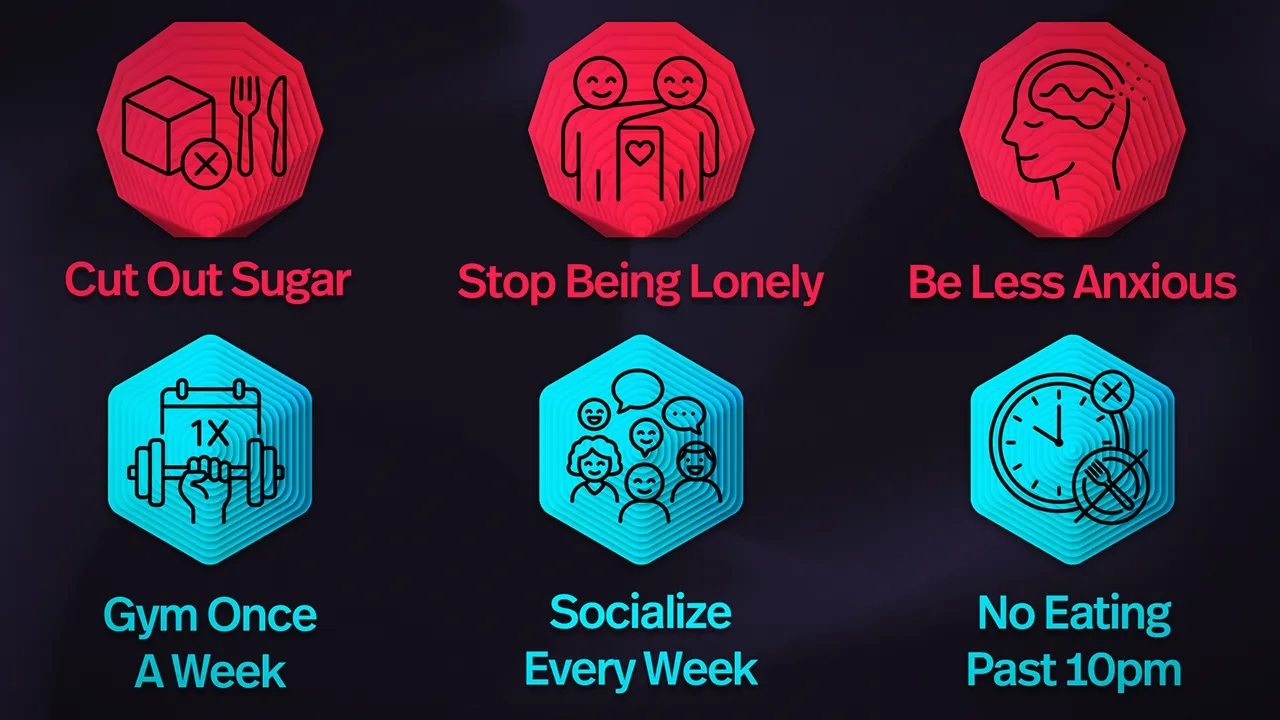
But what we know from the science of behavioral change is that we basically want to choose approach goals. And a lot of times in New Year's resolutions, we pick avoidance goals. So, what's the difference? It's basically are you moving towards something or are you moving away from something? So, here's an example of an avoidance goal. I want to stop eating fried food. I want to cut out sugar. I want to stop doing this, avoid doing this.
I want to stop feeling a particular way. I'm not going to feel anxious anymore. I'm going to stop being lonely. I'm going to stop being a shut-in. So, these are avoidance goals where you're basically moving away from something. An approach goal is when you are moving towards something. So, an approach goal is I want to go to the gym once a week. I want to make a point to socialize for lunch once a week. So, one goal that I had when I was a freshman in college and I didn't know anyone is I had a goal where I was not going to have lunch with the same person more than once a week.
So, this ensured that I was meeting lots of different people, distributing my time, not putting all my eggs in one basket. So, an approach goal is moving towards something. Now, why is this important? The psychology behind this is fascinating. We're not 100% sure about this, but this is what I've seen just working with people for the last 11 years, okay? An avoidance goal is stimulated by a negative emotion. So, if I say, "Okay, I'm not going to be lonely.
I'm not going to be a shut-in. I'm going to leave the house." It may sound like it's a approach goal, but it's actually an avoidance goal. So, here's the problem. That goal is motivated by a negative emotion, which means as the loneliness rises, it crosses a certain threshold and then I act. Then what happens is once I leave the house, then my loneliness decreases. And then my motivation disappears. And if my motivation disappears, I slide back towards the house, okay?
This is the problem with avoidance goals is that they basically trigger action only when you're failing at the goal. And when you succeed, now the driver that motivates you is gone and then you don't do it anymore, right? So, oh thank god I left the house. Now, I'm no longer lonely and so you kind of slide back towards being at the house. Approach goals are the opposite. When you succeed in an approach goal, it's not moving from negative 100 to zero, which is what a lot of avoidance goals are, right?
So, I'm trying to get rid of something bad. And once I get rid of something bad, then I'm just sitting at neutral. Approach goals are different because I'm moving from zero to 100. I am actively doing something. I'm going to the gym. I chose to go to the gym. It's not about losing weight, it's about becoming stronger, okay? It's about exercising more, improving my health. Because when I achieve that thing, that is rewarding.
Now I'm trying to do something that gives me a reward. And when I get a reward, that will reinforce the behavior. And literally what we see is that people who select approach goals, this is all about the selection of what you're doing, are more successful at sticking with it than avoidance goals. We all want to make changes in our life and you should understand the science behind behavioral change to optimize your chances for success.
And one of the best things that you can do, if you can't manage it on your own or if you want to increase your chances of success, is work with someone else and that's exactly what our coaching program is for.
The words are the caption track's own and nothing is reworded or re-transcribed. Paragraph breaks are placed between sentences so the text reads as prose.
Free tools for your own script: paste a draft and see where it stands before you record it.
Paste your draft and see where viewers are likely to drop off, with a rewrite for each weak line.
Paste the first 30 seconds of your own draft for a hook score and rewrites.
Check your draft against YouTube's advertiser-friendly guidelines before you record it.
Read this channel's public videos and transcripts, and download a writing brief for it.