Getting the transcript
Reading the captions from YouTube. A video nobody has opened here before takes 10 to 30 seconds; this page fills in on its own.
Getting the transcript
Reading the captions from YouTube. A video nobody has opened here before takes 10 to 30 seconds; this page fills in on its own.
Stephen Petro · @stephenpetro411
Words
2,295
Runtime
14:15
Speaking pace
161wpm
Reading time
10min
161 words per minute, between the 160 25th percentile and the 181 median of 349 measured videos. That distribution comes from the 349-video hook study.
Opening (first 30 seconds)
School tells you what kind of thinking to use to ace a test. But real life simply gives you a mess and expects you to figure it out. And one university has built its entire curriculum around closing this learning gap. Manurva University. In the book, Building the Intentional University, Manurva founder Ben Nelson and Harvard cognitive psychologist and founding dean Steven Klin explain how they designed an education system that forces students to transfer critical thinking skills into their everyday
81 words, the words spoken in the first 30 seconds at 161 words per minute.
Free, no signup. See how the first 30 seconds hold attention, with rewrites.
Sentence shape
| Measure | This transcript |
|---|---|
| Sentences | 141 |
| Average words per sentence | 16.3 |
| Longest sentence | 39 words |
| Questions asked | 11 |
| Sentences containing a number | 11 |
Most used terms
Filler phrases
17 in total: actually 10 · like 3 · I mean 2 · kind of 2.
A literal whole-word count of the same phrase list the Prepublish browser extension uses, so a phrase inside another word is not counted and a phrase used in its ordinary sense still is. It is a count and not a judgement.
Free, no account. See where attention is likely to drop, with a rewrite for each weak line. The free check shows the scores and the one issue costing the most. Or run it on the words above first.
Free · No login · See a sample audit first if you prefer.
What this transcript is
Every word below is the caption track YouTube publishes for this video, pulled from the video itself and reproduced unchanged. It is not Prepublish's writing, not a summary, and not a re-transcription: it is the video's own published captions. English captions, generated automatically by YouTube, in the video’s original language. Source: the video on YouTube. A channel that would rather this page did not exist can ask for its removal through the contact page, and it is removed.
No Script X-ray for this video: YouTube shows a Most replayed graph only once a video has enough views.
School tells you what kind of thinking to use to ace a test. But real life simply gives you a mess and expects you to figure it out. And one university has built its entire curriculum around closing this learning gap. Manurva University. In the book, Building the Intentional University, Manurva founder Ben Nelson and Harvard cognitive psychologist and founding dean Steven Klin explain how they designed an education system that forces students to transfer critical thinking skills into their everyday lives.
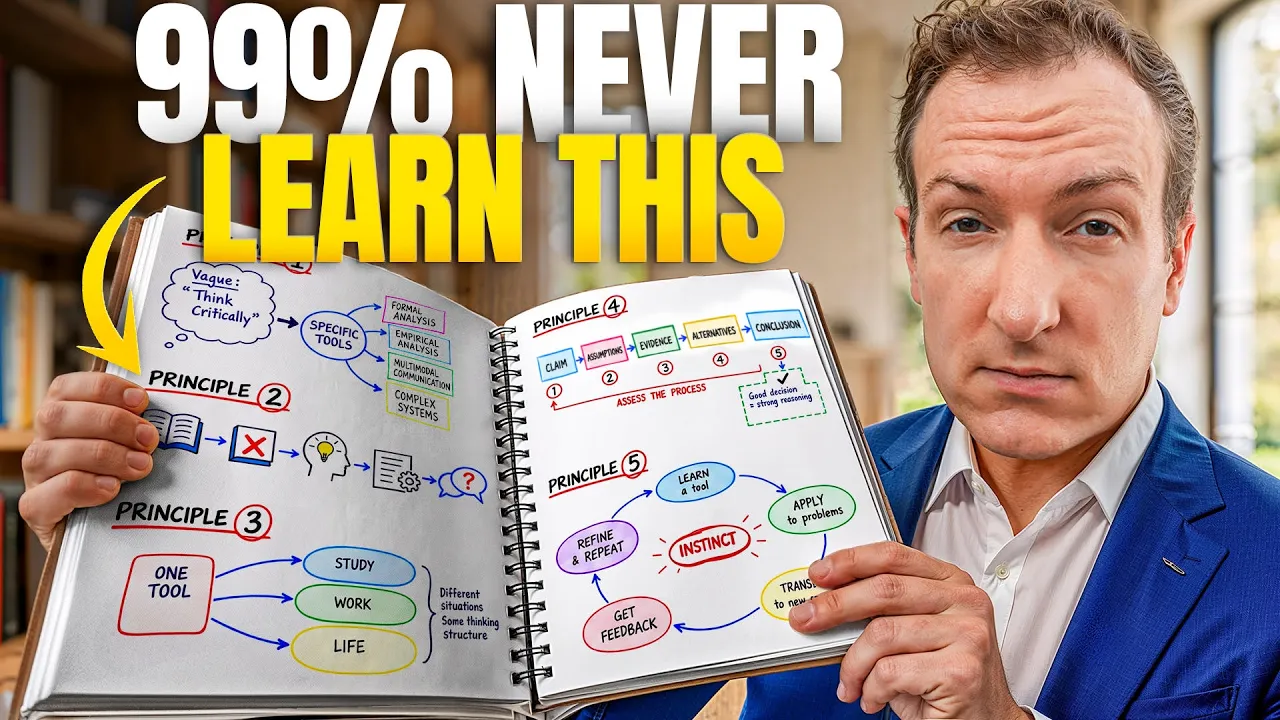
And so in this video, I want to break down the five mechanisms Manurva uses to develop this and show you how to build them into your own self-education curriculum. Starting with principle number one, be explicit about the tools and steps. You see, most educational institutions claim that they teach critical thinking. But simply telling someone to think critically is about as useful as telling them to be athletic. I mean, what exactly are they supposed to do?
Run faster, lift more weight, improve their balance? I mean, unless you actually decompose the larger ability into explicit specific actions, you can't deliberately practice it, diagnose why it failed, or even determine whether it's actually improving. And so, Manurva breaks this vague idea of sophisticated thinking into what it calls habits of mind and foundational concepts or HC's. A habit of mind is a cognitive action that through practice should eventually be triggered automatically.
For instance, when you encounter a sweeping claim, you might immediately search for a counter example or inspect the inferences that follow from it. A foundational concept, by contrast, is a broadly useful idea. Something like distinguishing correlation from causation or conducting a costbenefit analysis that can ultimately help you adapt across many different situations. And students encounter roughly 100 of these tools through four firstear cornerstone courses. formal analyses, empirical analyses, multimodal communications, and complex systems.
But don't let those academic labels obscure just how practical this can be. Imagine, for instance, that you are deciding whether to leave your current job for a new offer. Formal analysis asks, "What conclusion am I reaching and which assumptions would have to be true for that conclusion to follow?" Empirical analysis asks, "What actual evidence do I have about the company? and am I generalizing from a few unusually positive or negative experiences?
Multimodal communication asks which conversations do I need to have and how should my message change when speaking to my current employer, my spouse or the new company? And complex systems analysis asks, how could this decision alter my finances, relationships, future opportunities, and behavior over time? You see, the point here is that the otherwise generic prescription to make a good decision has now been decomposed into explicit operations that can be practiced and whose improvement can be measured.
And so, here's an exercise you can practice based on this principle. Choose one decision or problem that genuinely matters to you and divide a page into four boxes corresponding to the four cornerstones. In the formal box, list the assumptions and logic underneath your current conclusion. In the empirical box, list the evidence you possess and the evidence you still need. In the communication box, identify the relevant audiences and how their perspectives differ.
And in the systems box, map the second and third order consequences that could unfold. And from here, congratulations. You have now taken something that otherwise would have stayed vague and converted it into an actual executable system of practice. But knowing the thinking tool does not mean you can actually use it. And that brings us to principle number two. Turn every lesson into a performance. You see, Manurva operates through what it describes as an extreme flipped classroom.
Students obtain the initial information before class through readings and structured preparation. The live class is then devoted to active use. Analyzing a problem, defending a conclusion, responding to a counterargument, interpreting the evidence, or revising an answer when new information appears. And this is much harder than it sounds. You see, when you're listening to an articulate professor explain an idea, you can actually fall prey in that moment to feeling like you totally understand it.
After all, every sentence you hear might actually feel like it makes sense as it enters your mind. You recognize the terminology, follow the examples, and perhaps even predict the next point. But this perception in the moment is often not learning at all. In fact, it's often what psychologists term the illusion of competence. And so, Manurva's virtual classroom platform was designed to address this very problem. Instructors can see who's participating, use polls and smaller group activities, and deliberately call upon students rather than allowing the same confident minority to dominate every discussion.
Classes can also be recorded so that particular applications of thinking skills can be evaluated and followed by feedback. In other words, within the Manurva system, there's very little room to just disappear into the back of the lecture hall. And this general principle has substantial research behind it. In the 2014 metaanalysis, active learning increases student performance in science, engineering, and mathematics, Scott Freeman and his colleagues analyzed 225 studies.
Students in active learning classes performed better on examinations, while students taught through traditional lectures were approximately 1 and a half times as likely to fail. Now, this doesn't mean that lectures have no value. I've conducted many myself with great results. But the problem arises when students confuse their exposure to the explanation as understanding or even as mastery of the subject. And so after studying anything important, perform what I call a closed book defense.
Close the source and do four things. Explain the idea without reproducing the author's exact vocabulary. In other words, as I constantly tell my own students, say it in your own words. What's more, push yourself to do the following. One, produce an example the author never even used. Two, apply the idea to a real problem. And three, formulate the strongest objection you can against your own application. Because you see, if you can't do those four things, you may have recited or memorized the information, but you've not actually made it usable.
And by the way, if you want a deeper dive into these and other critical thinking methods, then be sure to check out my free master class at the link in the pinned comment below. Which brings us to principle number three. Change the surface while preserving the structure. This is the heart of Manurva's curriculum because it addresses one of the deepest problems in education. Transfer. Transfer occurs when something learned in one context changes how you reason in a different context.
And you might have noticed that I've harped on this issue again and again in several videos because yes, it is that important. Throughout my own teaching, I've encountered highly intelligent people who can solve a formal logic puzzle almost immediately. For instance, but who accept invalid reasoning when they are emotionally invested in an everyday disagreement. I've also encountered students who know perfectly well that correlation does not prove causation, but seem to forget this the moment the claim appears inside a news story, a workplace report, or something else they're emotionally invested in.
And so, what's going on here? Well, you see, in school, you're presented with a specific question in a specific form, requiring a specific tool and having often only one right answer. For instance, if a question they need to answer appears under the heading correlation and causation, well, the student knows what mistake to look for. In life, however, the same problem is presented to you disguised as sales increased after our rebrand, "My health improved after taking the supplement or my friend became distant after that conversation." And you have to independently be able to spot the structure of the problem or statement, know which thinking tool to use and apply it effectively.
And this is precisely why Manurva gives its thinking tools specific names and then requires students to apply them across different courses and increasingly specialized problems. In other words, the service content and context changes, but the student is supposed to recognize the same structure underneath it. And classic research in what is called analogical reasoning helps explain why this is necessary. In their classic 1983 study, schema induction and analogical transfer, psychologists Mary Gick and Keith Holio gave participants stories that shared a deeper solution pattern with a later problem.
Merely encountering a relevant example often didn't produce spontaneous transfer. However, comparing analogous cases and identifying their shared structure made transfer more likely. And so the lesson here is that experience alone does not necessarily teach the general principle hidden inside the experience. Instead, you must deliberately and explicitly extract that structure and practice recognizing it in a wide variety of contexts.
And in fact, it's this very point that brings us to principle number four. Grade the reasoning, not merely the answer. You see, a correct answer can be produced by terrible reasoning. Conversely, you can use an intelligent method, overlook one crucial piece of evidence and reach the wrong conclusion. And so, if we evaluate only the final answer, we lose the information needed to improve the underlying process. And this is why Manurva therefore attaches a fivepoint mastery rubric to each habit of mind or foundational concept.
A student can receive feedback on how well a particular tool was applied during an assignment, project, or a contribution in class. More radically, assessment of these HC's continues after the first year. Cornerstone courses in the model Manurva has described later demonstrations of mastery can update the evidence used to evaluate the students foundational learning. Interestingly, these have been described as timetraveling grades.
In other words, the idea here is that your performance years later reveals whether the skill introduced in your first year actually improved and became transferable. And actually, I think this might just be the most brutal part of the system. In most traditional curricula, you can cram, perform well once, receive the grade, and then just allow the knowledge to disappear. But imagine being told that the real examination will occur 2 years later inside another discipline without anyone announcing which firstear concept you're expected to remember.
Well, in effect, this actually makes it much harder for you to just learn something, get a grade in it, and then forget all about it because, well, you already got the grade, didn't you? Which is unfortunately how a lot of students operate. Which brings us to principle number five. Recycle the tool until it becomes instinctive. You see, a traditional curriculum is largely organized around completion. You finish algebra, move to geometry, complete the course, and receive credit.
But as we just discussed, once you complete a course and get a grade, do you actually remember what you learned 5 years later? How about 10 years later? Yeah, I thought so. And the reason for this is that a skill that is not retrieved, varied, and used will become less accessible regardless of what your transcript says you mastered at a certain point in time. And so Manurva's curriculum therefore spirals. The HC's are introduced during the first year cornerstones, applied inside a student's major, deepened inside more specialized concentration courses used in real world projects, and ultimately brought together through advanced work.
And the capstone, the aim is not simply that students remember the definition of a thinking tool. It's that the appropriate tool begins activating when the structure of a new problem demands it. And so to round all this out, here is how I would build a 12-week version of this curriculum. In week one, choose one genuine problem with stakes attached to it. A business decision, a research question, a professional transition you're trying to make, a community problem, or an intellectual project.
Then select four tools or mental models, one corresponding broadly to each cornerstone. You might choose identifying assumptions for formal analyses, evaluating causal evidence for empirical analyses, adapting a message to an audience for multimodal communications, and mapping feedback loops for complex systems. During weeks 2 through 9, devote two weeks to each tool. Before each session, read enough to understand the tool and examine at least two worked examples.
Then, close the material and perform your closed book defense. Apply the tool to your central problem. Transfer it to two unrelated situations and grade the application with your rubric. At the end of each twoe block, ask another person to challenge your reasoning. If nobody can examine the work directly, then write the strongest adversarial critique yourself. During weeks 10 and 11, stop practicing the tools separately.
Analyze two new problems using all four without labeling in advance which tool belongs where. And this is key because real life will not present you with four neat boxes. Instead, you're going to have to diagnose the problem before selecting the method. Finally, in week 12, produce a capstone, an essay. It could be a presentation. It could be a business proposal, a research analysis, a decision memorandum in which all four tools visibly improve the final product.
Then preserve that work and reassess it one month later using the same rubric. If your skills remain available and easily able to be called upon after the original learning context has disappeared, you're beginning to achieve genuine transfer. And it's this kind of transfer that ultimately leads to mastery. If you want to keep leveling up your critical thinking to make a massive impact not only on your own life, but also on the lives of countless others, then be sure to watch this next
The words are the caption track's own and nothing is reworded or re-transcribed. Paragraph breaks are placed between sentences so the text reads as prose.
Free tools for your own script: paste a draft and see where it stands before you record it.
Paste your draft and see where viewers are likely to drop off, with a rewrite for each weak line.
Paste the first 30 seconds of your own draft for a hook score and rewrites.
Check your draft against YouTube's advertiser-friendly guidelines before you record it.
Read this channel's public videos and transcripts, and download a writing brief for it.