Getting the transcript
Reading the captions from YouTube. A video nobody has opened here before takes 10 to 30 seconds; this page fills in on its own.
Getting the transcript
Reading the captions from YouTube. A video nobody has opened here before takes 10 to 30 seconds; this page fills in on its own.
Stefan James · @stefanjames.brandbuilding
Words
915
Runtime
4:24
Speaking pace
208wpm
Reading time
4min
208 words per minute, above the 201 75th percentile of 349 measured videos. That distribution comes from the 349-video hook study.
Opening (first 30 seconds)
Prime builders, listen up. If you're building a premium or luxury brand, understand that brand consistency, brand restraint, brand reputation, they're very bloody important. Here's what I've learned from over a decade of working with brands, top London agencies, building my own premium and luxury brands, studying brands for over a decade, and just in the trenches doing this stuff every day. Brand psychology is powerful. It's what I teach in this channel. We go through creative direction, brand positioning, and brand psychology. If you really don't [clears throat] understand what brand psychology is, or you've heard of it and can't quite put your
104 words, the words spoken in the first 30 seconds at 208 words per minute.
Free, no signup. See how the first 30 seconds hold attention, with rewrites.
Sentence shape
| Measure | This transcript |
|---|---|
| Sentences | 67 |
| Average words per sentence | 13.7 |
| Longest sentence | 45 words |
| Questions asked | 5 |
| Sentences containing a number | 3 |
Most used terms
Filler phrases
16 in total: like 4 · you know 4 · right? 2 · um 2 · I mean 1 · actually 1 · kind of 1 · sort of 1.
A literal whole-word count of the same phrase list the Prepublish browser extension uses, so a phrase inside another word is not counted and a phrase used in its ordinary sense still is. It is a count and not a judgement.
Free, no account. See where attention is likely to drop, with a rewrite for each weak line. The free check shows the scores and the one issue costing the most. Or run it on the words above first.
Free · No login · See a sample audit first if you prefer.
What this transcript is
Every word below is the caption track YouTube publishes for this video, pulled from the video itself and reproduced unchanged. It is not Prepublish's writing, not a summary, and not a re-transcription: it is the video's own published captions. English captions, generated automatically by YouTube, in the video’s original language. Source: the video on YouTube. A channel that would rather this page did not exist can ask for its removal through the contact page, and it is removed.
No Script X-ray for this video: YouTube shows a Most replayed graph only once a video has enough views.
Prime builders, listen up. If you're building a premium or luxury brand, understand that brand consistency, brand restraint, brand reputation, they're very bloody important. Here's what I've learned from over a decade of working with brands, top London agencies, building my own premium and luxury brands, studying brands for over a decade, and just in the trenches doing this stuff every day. Brand psychology is powerful.
It's what I teach in this channel. We go through creative direction, brand positioning, and brand psychology. If you really don't [clears throat] understand what brand psychology is, or you've heard of it and can't quite put your finger on it, let me break it down. It's simply understanding why people buy what they buy, what makes someone choose that brand over an identical option, and how you can use that to build something people trust, remember, pay more for, build that cult-like following that everyone wants.
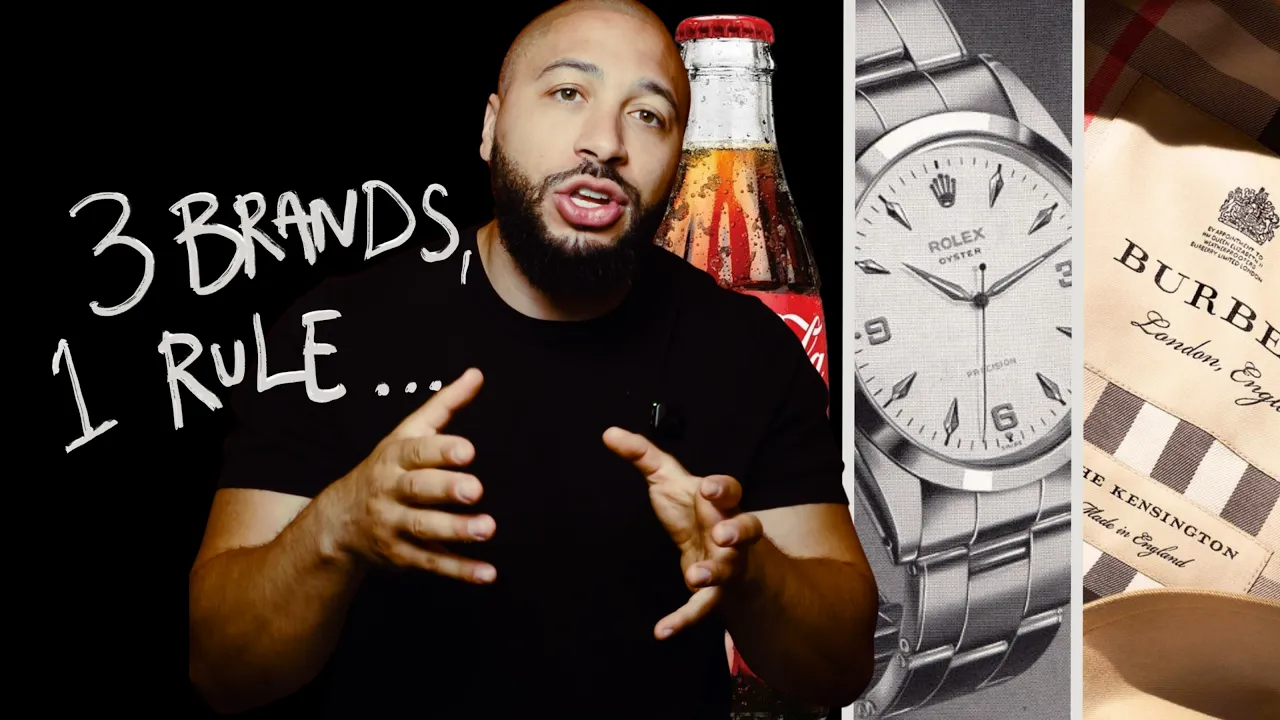
So, I've got three quick tips for you in this short video. Number one, the look doesn't need to change to stay powerful. What do I mean by that? Stop reinventing the wheel, okay? People can't tie an association to you, tie a a visual to you. They can't really associate you with anything if you keep changing it. I learned this hard way with one of my own brands. A brand like Burberry has used almost the same camel, black, red, and white check since the 1920s.
It's never been reinvented into something clever. It's just been consistent for over 100 years, and that consistency does most of the heavy lifting when it comes to branding, association, brand positioning. Number two, saying no to money on purpose builds more trust than saying yes to everything. Let's take a brand like Rolex. They've never once put a watch on sale. No discounts, no clearance rail on any model ever. They refuse to negotiate, and that's exactly why the brand feels so elevated, why it feels something worth waiting for, why the secondary market, the resale market, is booming.
Because they have taken a stance on their pricing, which is a core brand signal. So, I teach a lot of premium brand signals, which is a core premium signal, showing people that, "Hey, this is who we are. This is what we do. This is what we won't do, and this is what we stand for." Timeless elegance, loads of different associations with the brand. I won't go through them. You know what Rolex is about. Number three, a good reputation is slow, boring, and it compounds.
Key word here, compounds. All right? If you do this stuff repeatedly, it compounds over time. Branding is not an overnight thing. We see a lot of brands popping up all the time. A lot of them won't be around in the future. And a lot of the brands that you see doing really well been doing this stuff in the background for the last decade. Coca-Cola, brand everyone knows. Coca-Cola's Christmas trucks have toured the UK and the US every year for decades.
You know, when you hear that jingle, "The holidays are coming. The holidays are coming." But one appearance a year, the same red trucks, the same lights, that same magical Christmas feeling, and that patient repetition has built a kind of festive reputation, a festive myth around what is essentially a cancerous sugary drink. Sorry to lower the tone. But look, it's done more heavy lifting for the brand than any one single campaign has done.
And it's because it's repeated exposure over time. It's called the mere exposure effect. It's a really powerful behavioral bias that I cover on this channel. I'm going to do a deep dive on this. So, subscribe and um I'll show you how to actually use the mere exposure effect to your advantage if you're building a premium or luxury brand. But here's a quick win for you. You should keep your visual identity consistent for longer than it feels comfortable.
So, we always get the urge as creative people, creative brand builders, to constantly tweak things, re-engineer things, and change things. And often you're changing it before it's gained traction or even had the ability or the possibility of sitting in someone's mind. I know I did this so many times over um cuz I've always got a new great idea. All right? Try not do that. Stay consistent for a longer than it feels comfortable.
Say no to easy revenue and discounting. You know, you could easily launch a sale and sell out stock, but that damages your brand. It damages your trust, and it damages your reputation. And then lastly, let your reputation build slowly and what you're known for slowly, and use that exposure effect of repeated exposure for one single thing, okay? One thing that you're trying to communicate, repeat that over and over and over again instead of chasing a quick campaign win or a quick influencer campaign or, you know, the next shiny campaign that you can think of that might be a million-dollar idea.
If you like the sound of this sort of stuff, I teach brand psychology, creative direction, brand positioning all on this channel. No no fluff, deep dives based on working with big brands, small brands, founders, CEOs, a stint at Google, and also building my own brands. I've been in the trenches doing this for the last 10 years. Hope it's of some help.
The words are the caption track's own and nothing is reworded or re-transcribed. Paragraph breaks are placed between sentences so the text reads as prose.
Free tools for your own script: paste a draft and see where it stands before you record it.
Paste your draft and see where viewers are likely to drop off, with a rewrite for each weak line.
Paste the first 30 seconds of your own draft for a hook score and rewrites.
Check your draft against YouTube's advertiser-friendly guidelines before you record it.
Read this channel's public videos and transcripts, and download a writing brief for it.