Getting the transcript
Reading the captions from YouTube. A video nobody has opened here before takes 10 to 30 seconds; this page fills in on its own.
Getting the transcript
Reading the captions from YouTube. A video nobody has opened here before takes 10 to 30 seconds; this page fills in on its own.
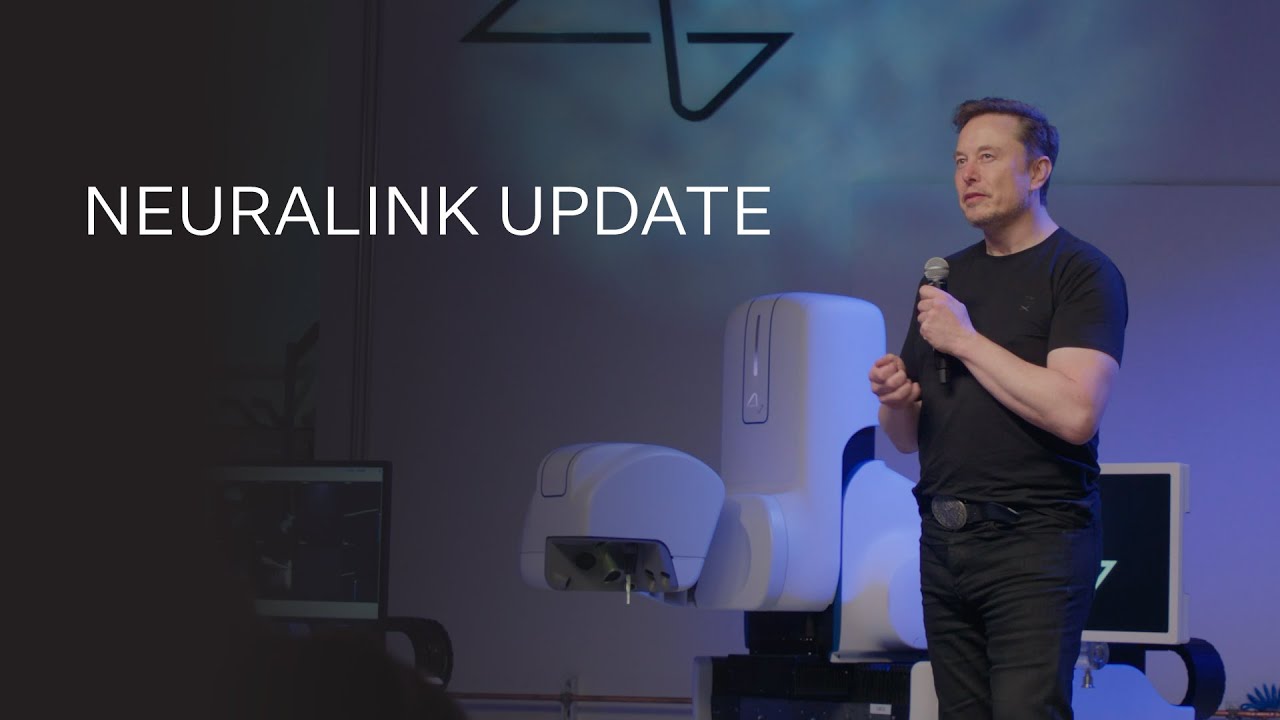
Neuralink · @neuralink
Where viewers went back to watch this video again, from YouTube's public Most replayed graph, lined up with what was said at that moment.
Most replayed moment #1
56:597.3x the video's typical replay level
we think that sensing more and more neurons will also completely redefine how we interact with computers and reality at large. I want to leave you with one final thought. When I was a child, I used a 56 kilobit modem to access the internet.
Said at 56:53
Most replayed moment #2
25:484.4x the video's typical replay level
And I'm about to show you the clip, on day one, Noland breaking the BCI world record. You just beat the world record. Oh, s***
Said at 25:44
Most replayed moment #3
12:003.8x the video's typical replay level
And what this presentation is mostly about is, attracting smart humans to come and work with us on this problem. So this is not a presentation to raise
Said at 11:53
The graph counts replays. It does not show where viewers stopped watching.
Words
8,562
Runtime
59:59
Speaking pace
143wpm
Reading time
36min
143 words per minute, below the 160 25th percentile of 349 measured videos. That distribution comes from the 349-video hook study.
Opening (first 30 seconds)
Hello everybody. My name is Alex Conley. I'm the second participant in the Neuralink study and I'm here to count us down to the demo. In five, four, three, two, one. Hi everyone. Welcome to the Neuralink presentation. This is an update for, the progress of the Neuralink team. It's been an incredible amount of progress. We're going to start off high level, generally describing what Neuralink's doing, and then we're going
72 words, the words spoken in the first 30 seconds at 143 words per minute.
Free, no signup. See how the first 30 seconds hold attention, with rewrites.
Sentence shape
| Measure | This transcript |
|---|---|
| Sentences | 536 |
| Average words per sentence | 16.0 |
| Longest sentence | 73 words |
| Questions asked | 24 |
| Sentences containing a number | 41 |
Most used terms
Filler phrases
104 in total: actually 39 · like 36 · basically 7 · you know 7 · kind of 6 · sort of 4 · I mean 2 · literally 2 · right? 1.
A literal whole-word count of the same phrase list the Prepublish browser extension uses, so a phrase inside another word is not counted and a phrase used in its ordinary sense still is. It is a count and not a judgement.
Free, no account. See where attention is likely to drop, with a rewrite for each weak line. The free check shows the scores and the one issue costing the most. Or run it on the words above first.
Free · No login · See a sample audit first if you prefer.
What this transcript is
Every word below is the caption track YouTube publishes for this video, pulled from the video itself and reproduced unchanged. It is not Prepublish's writing, not a summary, and not a re-transcription: it is the video's own published captions. English captions, published by the channel, in the video’s original language. Source: the video on YouTube. A channel that would rather this page did not exist can ask for its removal through the contact page, and it is removed.
Hello everybody. My name is Alex Conley. I'm the second participant in the Neuralink study and I'm here to count us down to the demo. In five, four, three, two, one. Hi everyone. Welcome to the Neuralink presentation. This is an update for, the progress of the Neuralink team. It's been an incredible amount of progress. We're going to start off high level, generally describing what Neuralink's doing, and then we're going to have a very deep technical dive.
So you can actually get an understanding of what exactly we're doing at a granular level, and what we can do to enhance human capabilities and ultimately build a great future for humanity. So those are neurons firing. It's funny to think that me talking right now is a bunch of neurons firing that then result in speech that you hear and cause neurons fire in your brain. Part of this presentation is about demystifying the brain.
It is a remarkable organ. I mean, we are the brain. basically. When you say you, that really is, you're the brain. Like you can, you can get a heart transplant, you can get a kidney transplant, but I don't know anyone who's gotten a brain transplant. So, you are your brain. And your experiences are these neurons firing, with trillions of synapses that somehow lead to conscious comprehension of the world. This is something that we have only begun to understand.
We're really just barely at the beginning of understanding what is the nature of consciousness. And I've thought a lot about what is consciousness? What is it? Where does consciousness arise? Because if you start at the beginning of the universe, assuming physics is true, the standard model of physics is true, then you have this, big bang, the matter condensing into stars, those stars exploding. A lot of the atoms that are in your body right now were once at the center of stars.
Those stars exploded, recondensed, fast forward 13.8 billion years, and here we are. At somewhere along that very long journey, to us at least, consciousness arose. Or the, the molecules started talking to each other. And it begs the question of what is consciousness? Is everything conscious? Maybe? It's hard to say where along that line. There's no sort of discrete point where consciousness didn't exist, and then suddenly it does exist.
It seems to be, maybe you have a condensation of matter that has a a density of- we don't know what- the real answer is we don't know what consciousness is. But with Neuralink and the progress of the company's making, we'll begin to understand a lot more about consciousness and what does it mean to be. Along the way, we're going to solve a lot of brain issues, where the brains get injured or damaged in some way or didn't develop in quite the right way.
There's a lot of brain and spine injuries that we'll solve along the way. And I do want to emphasize that this is all going to happen quite slowly. Meaning you'll see it coming. Sometimes people think that suddenly there will be vast numbers of Neuralinks all over the place. This is not going to be sudden. You'll be able to watch it happen, you know, over the course of several years. And we go through exhaustive regulatory approvals.
So this is not something that we're just doing by ourselves without government oversight. We work closely with the regulators, every step of the way. We're very cautious with Neuralinks in humans. That's the reason we're not moving faster than we are, it's because we're taking great care with each individual to make sure we never miss. And so far, we haven't. And I hope that continues into the future. Every single one of our implants in humans is working and working quite well.
And you'll get to hear from some of the people that have received the implants and hear it in their words. So what we're creating here with a Neuralink device is a generalized input/output technology for the brain. So, it's how do you get information into or out of the brain and do so in a way that does not damage the brain or cause any negative side effects. So it's a very hard problem. And, generally the the reactions I've seen to this range from it's impossible to it's already been done before.
Those people should meet actually. The reality is that there actually have been limited brain to computer interfaces for several decades on a very basic basis. What we're doing with Neuralink is dramatically increasing the bandwidth by many orders of magnitude. So, a human bandwidth output is less than one bit per second over the course of a day. So there's 86,400 seconds in a day. It's very rare for a person to do more than 86,400 bits of output per day.
You'd have to really be talking a lot or typing all day, and you might exceed that. So what we're talking about here is going from maybe one bit per second to ultimately megabits and then gigabits per second. And the ability to do conceptual, consensual, telepathy. Now the input to the brain is much higher especially because of vision. Depending upon how you count, it might be on the order of, a megabit or in the megabit range for input, primarily due to sight.
But even for input, we think that can be dramatically increased to the gigabit plus level. And a lot of the thinking that we do is we take a concept in our mind and we compress that into a small number of symbols. So when you're trying to communicate with somebody else, you're actually trying to model their mind state, and then take perhaps a quite a complex idea that you have maybe even a complex image or scene or kind of mental video and try to compress that into a few words or a few keystrokes, and it's necessarily going to be very lossy.
Your ability to communicate is very limited by how fast you can talk and how fast you can type. And what we're talking about is unlocking that potential to enable you to communicate, like I said, thousands, perhaps millions of times faster than is currently possible. This is an incredibly profound breakthrough. This would be a fundamental change to what it means to be a human. So we're we're starting off with reducing human suffering.
We're addressing issues that people have. Say if they've been in an accident or they have some neural disease that's degenerative so they're losing capability to move their body or, some, some kind of injury, essentially. Our first product is called Telepathy, and that enables someone who has, lost the ability to command their body to be able to communicate with a computer and move the mouse and actually operate a computer, with roughly the same dexterity, ultimately much more dexterity, than a human with working hands.
Then our next product is Blindsight, which will enable those who have total loss of vision, including if they have lost their eyes or the optic nerve, or maybe have never seen or even blind from birth to be able to see again. Initially low resolution, but ultimately very high resolution and, and then in multiple wavelengths. So you could be like Geordi La Forge in Star Trek. And you can see in radar, you can see in infrared, ultraviolet, superhuman capabilities, cybernetic enhancement, essentially.
And then along the way, this should help us understand a lot more about consciousness. What does it mean to be a conscious creature? We'll understand vastly more about the nature of consciousness as a result of this. And then ultimately, I think this helps mitigate the civilizational risk of artificial intelligence. We already sort of have three layers of thinking, there's the limbic system, which is your instincts, your cortical system, which is your higher level planning and thinking, and then the tertiary layer, which is the computers and machines that you interact with, like your phone, all the applications you use.
So people actually are already a cyborg. And you can maybe have an intuitive sense for this by how much you miss your phone if you leave it behind. Leaving a phone behind, it's almost like missing limb syndrome. Your phone is somewhat of an extension of your self, as is your computer. So you, already have this digital tertiary layer, but the bandwidth between your cortex and your digital tertiary layer is limited by speech and by and by how fast you can move your fingers and how fast you can consume information visually.
But I think it's actually very important for us to address that input/output bandwidth constraint in order for the collective will of humanity to match the will of artificial intelligence. That's my intuition, at least. So, let's see. And what this presentation is mostly about is, attracting smart humans to come and work with us on this problem. So this is not a presentation to raise money or anything like that. We're actually, you know, very well funded.
We have a lot of, great investors. Some of the smartest people in the world are invested in Neuralink. But we need smart humans to come here and help solve this problem. So with that, let's proceed. Hey everyone. My name is DJ. I'm a co-founder and president of Neuralink. And as Elon mentioned, well, actually, we're standing in the middle of our robot space. We have a stage set up, but, you know, this is actually where some of the next generation, most advanced surgical robots are being built.
So, welcome to our space. It's important to highlight that this technology is not being built in the dark. This is not a secret lab where we're not sharing any of the progress. In fact, we're actually sharing, you know, the progress very openly, as well as also telling you exactly what we're going to be doing. And we're hoping to progress on that as diligently and as safely and as carefully as possible. So, to start off, two years ago, when we did our previous fundraising round, we outlined this path and timeline to first human.
And we currently have a clinical trials in the US for a product that we call Telepathy, which allows users to control phone or computer purely with their thoughts. And you're going to see how we do this and what the impact that this has had. And not only have we launched this clinical trial, but as of today, we have not just one but seven participants, and we have an approval. And we also have an approval to launch the trial in Canada, UK, and the UAE.
So before we dive into what this technology is and what we built, but I wanted to quickly share a video with you guys of when our first five participants met each other for the first time. So here you go. All right. We have everyone together. What's up guys. Thanks everybody for joining. Definitely want to introduce all of you. Yeah I'm Noland aka P1. My name is Alex I am the second participant in the Neuralink study.
I am Brad Smith, the ALS Cyborg, P3. My name is Mike P4. I have ALS like Brad does. Yeah, I'm RJ, I'm P5, and I'm kinda the newest one to the team here so, Yeah. Appreciate it, Noland. Trailblazer. You know somebody's got to go first man and that was you, appreciate that. What's been your favorite thing you've been able to do with the Neuralink so far? I've just had a good time being able to use it as I travel flying and and draw a little mustache on a cat.
I had a lot of fun doing that. I mean, I've just had a good time playing around with it. Oh, you know what? I do know what my favorite BCI feature is. Probably not a feature. But I just I love Webgrid more than I love anything in my life. Probably. I think I could play that game nonstop, forever. Has to be Fusion 360. Being able to design parts. Designed the hat logo with the BCI. That's what's up. Pretty sweet. That's sweet.
Yeah, yeah. I have a little, Arduino that takes input from my QuadStick, converts it into a, PPM signal to go to a RC truck. Cool. Little rock crawler. Well, with the BCI, I wrote code. Can you to drive the plane with the QuadStick. That's awesome. The best thing I like about Neuralaink is being able to continue to provide for my family and continue working. I think my favorite thing's probably been able to turn on my TV.
Yeah, like the first time in two and a half years I was able to do that. So that was a pretty sweet move. I like shooting zombies. That's kinda nice. Excited to see what BCI has got going on. I got a question. What's your shirt say? It says I do a thing called whatever I want. Now, one of the major figure merits that we have is to keep track of monthly hours of independent BCI use. Effectively, are they using the BCI?
And not at the clinic but at their home. And what we have noticed, and this is a plot of all of the different participants, first five participants and their usage per month, over the course of the last year and a half, and we're averaging around 50 hours a week of usage and in some cases, peak usage of more than 100 hours a week, which is pretty much every waking moment. So I think it's been incredible to see all of our participants demonstrating greater independence through their use of BCI.
Not only that, we've also accelerated our implantation cadence as we've amassed evidence of both clinical safety as well as value to our participants. So to date, we have four spinal cord injury participants, as well as three ALS participants, with the last two surgeries happening within one week of each other. And we're just beginning. This is just the tip of the iceberg. Our end goal is to really build a whole brain interface.
And what do we mean by whole brain interface? We mean being able to listen to neurons everywhere, be able to write information to neurons anywhere, be able to have that fast data, wireless transfer, to enable that high bandwidth connection from our biological brain to the external machines, and be able to do all of this with fully automated surgery, as well as, enable 24 hours of usage. And towards that goal, we're really working on three major product types.
Elon mentioned earlier that our goal is to build a generalized input/output platform and technology to the brain. So for the output portion of it, which is extremely slow through our meat sticks, as Elon calls them, Meat hands that are holding the mics. We're starting out with helping people with movement disorders- where they lost the mind body connection either through a spinal cord injury, ALS, or stroke- be able to regain some of that digital as well as physical independence through a product that we're building called Telepathy.
And this is our opportunity to build a high channel read and output device. On the input side of things, there's opportunities for us to help people that have lost the ability to see, be able to regain that sight again through a product that we're calling Blindsight. And this is our opportunity to build high channel write capabilities. And last but not least, be able to also help people that are suffering from neurological, debilitating dysregulation, or psychiatric conditions, or neuropathic pain, by inserting our electrodes in reaching any brain regions to be able to insert them not just on the cortical layer, but into the sulci, as well as deeper parts of the brain, the so-called limbic system, to, really enable better opportunities to just regain some of that independence.
Our north star metrics is one, increasing the number of neurons that we can interface with. And second, to expand to many, diverse areas-any parts of the brain. Starting with microfabrication or lithography, to change the way in which we can actually increase the number of neurons that we can see from a single channel, and also doing mixed signal chip design to actually increase the physical channel count, to increase more neurons that we can interface to, to sort of allow more information from the brain to the outside world.
And then everything we built from day one of the company has always been read and write capable and with Telepathy, our first product, the focus has been on the read capabilities or the output, and we want to hone in on our write capability and also show that through accessing deeper regions within the visual cortex, that we can actually achieve functional vision. So now just to step you through what the product evolution is going to look like in the next three years.
Today what we have is 1000 electrodes in the motor cortex, the small part of the brain that you see in this animation called the hand knob area, that allows participants control computer cursors as well as gaming consoles. Next quarter, we're planning to implant in the speech cortex to directly decode attempted words from brain signals to speech. And in 2026, not only are we going to triple the number of electrodes from 1000 to 3000 for more capabilities, we're planning to have our first Blindsight participant to enable navigation.
And in 2027, we're going to continue increasing channel count, probably on other triple so 10,000 channels. And also enable for the first time multiple implants. So not just one in motor cortex, speech cortex, or visual cortex, but all of the above. And finally, in 2028, our goal is to get to more than 25,000 channels per implant, have multiple of these, have ability to access any part of the brain for psychiatric conditions, pain, dysregulation, and also start to demonstrate what it would be like to actually integrate with AI.
And all this is to say that we're really building towards a set of fundamental, foundational technologies that would allow us to have hundreds of thousands, if not millions of channels with multiple implants for whole brain interfaces that could actually solve not just these devastating neurological conditions, but be able to go beyond the limits of our biology. And this vertical integration and the talent and team that we have at Neuralink has been and will continue to be the key recipe for rapid progress that we will be making.
Just to recap real quick, Neuralink is implanted with precision surgical robot. It's physically invisible. And one week later, users are able to see their thoughts transform into actions and to share more about what that experience is like. I'd like to welcome Sehej to the stage. What's up guys? My name is Sehej. I'm from the brain computer interface team here at Neuralink, and I'm going to be talking about two things today.
The first thing is what exactly is the Neuralink device capable of doing right now? And the second one is how does that actually impact the day to day lives of our users? Very simply put, what the Neuralink device does right now is it allows you to control devices simply just by thinking. Now, to put that a bit more concretely, I'm about to play a video of our first user. His name is Noland, and if you remember from DJ's section and what Noland is doing is he's looking at a normal off the shelf MacBook Pro and with his Neuralink device, as you're going to see, he's going to be able to control the cursor simply with his mind.
No eye tracking, no other sensors. And what's special about this particular moment is this is the first time someone is using a Neuralink device to fully control their cursor. This is not your ordinary brain controlled cursor. This is actually a record breaking control literally on day one, beating decades of brain computer research. And I'm about to show you the clip, on day one, Noland breaking the BCI world record.
You just beat the world record. Oh, s*** Sorry Oh. Well done man. Wait, what'd I miss? He's a new world record holder. Oh no way. On the first day. I thought it was higher. I thought I would have to get to five or something. Oh, my gosh, that's crazy. It's pretty cool. Another really fun thing you could do with the Neuralink device outside of controlling a computer cursor is you can actually plug it in through USB through a lot of different devices.
And here we actually have Noland playing Mario Kart. Now, what's special about this particular clip is Noland is not the only cyborg playing Mario Kart in this clip. We actually have a whole community of users, as mentioned earlier, and this is literally five of our first users of Neuralink playing Mario Kart together over call. Mario Kart is cool. You know, you're using one joystick and then you're clicking like a couple of buttons to throw items.
What would be even cooler is what if you could control two joysticks at once simultaneously with your mind? What I'm about to show you. And I think this is, for the first time, someone playing a first person shooter game with a brain-computer interface. This is Alex and RJ playing Call of Duty, controlling one joystick to move and then the other joystick to, like, think, point your gun, and then shooting people as a button.
Here's Alex shooting another participant. Oh, dear God. Oh that was good. RJ, Alex got you. I know he shot me in the face. Now that we have a bit of a sense of what the BCI can do, a very important question to answer is how does this impact the day to day lives of the people that use it every day? So I'm about to show you a clip, going back to Noland for a second, where he talks. We simply just asked him randomly during a day, how he enjoys using the BCI a couple months ago.
And this is his candid reaction. I work basically all day from when I wake up. I'm trying to wake up at like 6 or 7 a.m. and I'll do work until session, I'll do session and then I'll work until 11 to 12 p.m. or 12 a.m. I'm doing like I'm learning my languages. I'm learning my math. I'm like, relearning all of my math. I am, writing. I am doing that, class, that I signed up for, and I just, I wanted to point out that this is not something I would be able to do. without the Neuralink.
Next, I want to talk a bit about Brad. You guys may already know him as the ALS Cyborg, and Brad also has ALS. And what separates him from our other users is he's actually nonverbal, so he can't speak. Why this is pretty relevant is he relies, at least before the Neuralink, on an eye gaze machine to communicate. And a lot of eye gaze machines you can't use outdoors. You really need, like, a dark room. So what this means is, for the last six years since Brad's been diagnosed with ALS, he's really unable to leave his house.
Now, with the Neuralink device, we're going to show you a clip of him with his kids at the park, shot by Ashlee Vance and the team. I am absolutely doing more with Neuralink than I was doing with eye gaze. I have been a batman for a long time, but I go outside now. Going outside has been a huge blessing for me. And I can control the computer with Telepathy. Dad's watching. Look, he's watching on the camera. The last user I want to talk about is Alex.
You've seen some clips of him earlier. What's special about Alex to me is he's a fellow left handed guy who writes in cursive all the time. And what he mentioned is, since a spinal cord injury from, like, 3 or 4 years ago, he's been unable to draw or write. And he always brags about how good his handwriting was. So he actually got to put it to the test. We gave him a robotic arm. And I think this is the first time he tried using the robotic arm to write anything.
And this is a sped up version of writing out the CONVOY trial and drawing something. Controlling a robotic arm is cool. But this one has a clamp. And what would be cooler is if you could decode the actual fingers, the actual wrist, all the muscles of the hand in real time. Just in the past couple of weeks, we were able to do that with Alex. And you're about to see him and his uncle, playing a game. Rock, paper, scissors, shoot.
Rock, paper, scissors, shoot. Rock paper, scissors, shoot. Rock, paper, scissors, shoot. That was scissors. B*** s*** Thumb war? That's pretty dope. Controlling a robotic hand on screen is obviously not super helpful for most people. Fortunately, we have connections with Tesla, who have the Optimus hand, and we're actually actively working on giving Alex an Optimus hand so that he can actually control it in his real life.
And here's an actual replay of the end of that video using Alex's neural signals on an Optimus hand. Shawn, if you want to play that. Actually, let me maybe add a few things to that. As we advance the Neuralink devices, you should be able to actually have, full body control and sensors from an Optimus robot. So you could basically inhabit an Optimus robot. It's not just the hand. The whole thing. So you could basically mentally remote into an Optimus robot.
It'd be kind of cool. The future's going to be weird. But pretty cool. And then, another thing that could be done also is, for people that have say, lost a limb, lost an arm or leg, or something like that. Then, we think in the future we'll be able to attach an Optimus arm or legs. It'd be kind of like, I don't know if you remember that scene from Star Wars where Luke Skywalker gets his hand chopped off with a lightsaber, and he gets a robot hand.
And, I think that's the kind of thing that, we'll be able to do in the future, working with Neuralink and Tesla. So it goes far beyond just operating a robot hand, but replacing limbs and having kind of a whole body robot experience. And then I think another thing that, will be possible, I think is very likely in the future, is to be able to bridge where the damaged neurons are. So you can take the signal from the brain and transmit that signal past where the neurons are damaged or strained, to the rest of the body.
So you could reanimate the body. So that if you have a Neuralink implant in the brain and then one in the spinal cord, then you can actually bridge the signals and you could walk again and have full body functionality. Obviously, that's what people would prefer. To be clear, we realize that would be the preferred outcome. So that even if you have a broken neck, I'm actually at this point I'd say fairly confident, that at some point in the future, we'll be able to restore full body functionality.
Hello everyone. My name is Nir and I'm leading the BCI application group. And I think the videos that Sehej just showed with you, I probably watch them maybe thousands of times, but still I get goosebumps every time I watch them. And I think this is one of the cool perks here at Neuralink, when you get the job, is that you might get goosebumps every week or maybe every few days in good weeks. And this is really fun. As an engineer, it's really cool because you can build a new feature, you can build a new machine learning model, a new software feature and test it on the same day with a participant and get feedback.
And you already saw with our first device, Telepathy, that we can address very diverse needs of the different users that we have from moving a cursor to playing games, to moving a robotic arm with multiple fingers. And we could not have done it without the Neuralink device. The Neuralink device gives us something that no other device can give us, which is single neuron recording from thousands of channels simultaneously.
The Telepathy product is basically recording the neural activity from the small area in the motor cortex that is involved in execution of hand and arm movements. But if we go only about 2 or 3 inches below, there's another brain area that's involved in execution of speech. And with the same device, with the same machine learning model architecture, the same software pipeline, the same surgical robot, we can have a new application and we can do it very quickly.
It's really interesting that if we can decode someone's intention to speak silently and on vocal communication, we can use that to revolutionize the way we interact with computers, with technology and with information. Instead of typing with your finger or like moving the mouse or talking to your phone, you'll be able to interact with computer with the speed of thought. It will make this interaction much more, much faster and much more intuitive.
And the computers will understand what you want to do. And we can also expand that to AI. We can now build an interface with AI that you will be able to retrieve information, will be able to store our thoughts anywhere, anytime, privately, and silently again, because we built a fundamental technology platform and we do everything in house, we own the entire stack from neurons to pixels on the user's computer. Now I'll pass it to Rooz to talk about.
UI for BCI. Thank you, Nir. Each spike that our implant detects goes on a fairly remarkable journey to ultimately form a pixel on a participant's display. And that experience starts with, of course, unboxing. The very first time that a participant pairs to and meets their implant, this invisible part of their body, and sees their own spikes materialize across the display. From there, they'll go into body mapping and actually imagine moving their arm again and get a feel for what feels natural to them and what doesn't, and they'll take that into calibration using one of those motions to actually move a cursor again.
Iteratively refining their control as they go throughout this process, until finally they're teleported back to their desktop and can experience the magic of neural control for the very first time. And our control interface is where the OS integration that we do really shines, letting us adapt both control and feedback for every interaction. So for familiar interactions like scrolling, we can surface an indicator over the scrollable parts of the display.
Add a touch of gravity to automatically pop a participant's cursor onto that indicator as they approach, show the actual velocities that we decode inside of it, and add a bit of momentum to those velocities to carry them forward as they glide across the page. There are also unique interactions that we need to solve for in this space. For example, when a participant is watching a movie or just talking to somebody next to them, the brain is very active still, and that activity can actually induce motion in the cursor, distracting them from that moment.
So when a participant wants to just get their cursor out of the way, they can push it into the edge of the display to park it there. And of course, we add gravity to sort of hold it still, but they can push it out, with either just a firm push or in this case, a gesture. And of course, it goes without saying that all of these control interfaces are designed hand in hand with our participants. So huge shout out to both Noland and Brad for helping us design these two.
And those control interfaces, of course, extend to typing. We have a great software keyboard that does everything you'd expect it to, popping up when a participant clicks on a text field, giving them feedback about the click on the surface of the key, and supporting both dictation and swipe. Hi everyone. I'm Harrison, an ML engineer here at Neuralink. And I must say, being an ML engineer at Neuralink is a bit like being a kid in a candy store.
When you think of the inputs to most ML systems out there you might think of pixels or tokens or of a user's Netflix watch history. The input to our systems is a little different. It is pure, raw brainpower. And when we think about the ML systems we can build here at Neuralink, really we're limited by our imagination and our creativity. There's no reason our ML systems can't do anything that the human brain can do, such as controlling a phone, typing, or even gaming.
Right here to my left is actual footage of Alex, one of our participants, playing a first person shooter against RJ, another one of our participants. Now, for those unfamiliar with first person shooters, this is not a trivial feat. It requires two fully independent joysticks or four continuous degrees of control, as well as multiple reliable buttons. Now, contrary to popular belief, the Neuralink does not simply read people's minds, it's simply reading neuronal activations corresponding to motor intent.
So one of the fun challenges with this project was figuring out which motions were going to be mapped to the joystick. We started with the typical left thumb and right thumb, but quickly found that the dominant hand overshadowed the non-dominant hand. My personal favorite is we had one of our participants imagine walking for the left joystick and aiming for the right joystick. So in game they were simply doing naturalistic motions like you might do in virtual reality in Ready Player One.
And that was really cool to watch. What we ended up on was the thumb for the left joystick and the wrist for the right joystick, and I challenged the audience to try to replicate their motions. I'm really in awe of them being able to pull this off. I want to talk a bit about the progress to our cursor calibration experience. To my left here, you can see RJ completing his first ever cursor calibration with a redesigned open loop flow, where you first gather information about his intent and how to map the neural activity, to the first time he controls the cursor, to the final product, where he has smooth and fluid control of his computer.
And most remarkably, this experience took only 15 minutes from start to finish. 15 minutes from no control to fluid computer use. Contrast that to a year and a half ago with P1, where that was multiple hours to get to the same level of control, and several engineers standing around a table pulling their hair out, there was virtually no need for Neuralink engineers to even be at the session. This was basically an out of the box experience for our participant.
And even more remarkably, we're continuing to smash day one records with RJ being able to achieve seven BPS on his very first day with the Neuralink. Now, such an effective and efficient calibration process is only made possible by high fidelity estimations of a user intention or labels. And to briefly illustrate just how challenging of a problem that is. This is an animation of myself trying to draw circles on my desktop with the mouse.
Now the task was simple: draw a uniform circles at a constant speed repeatedly. And as you can see by that animation, I am horrible at that, even though my intent was pretty obvious unambiguous. The execution was really poor. There is a ton of variation in both speed and the shape itself. To visualize this a little differently, each row here is one of those circles unwound in time, well synchronized starts, and you can just see how much variation there is in the timing of each circle, as well as what I'm doing at any given point in time.
Orthogonal to the labeling problem is neural non-stationarity, or the tendency of neural signals to drift over time. And I think that's honestly a beautiful thing, right? If you if your neural signals didn't drift, you couldn't grow. When you wake up the next day, you're not the same person you were the day before. You've learned, you've grown, you've changed, and so too must your neural data change. This animation here is a simple illustration of the learned representation by the decoder and how it drifts the further away we get from the day it was trained on.
This is one of the key challenges we need to solve here at Neuralink, to unlock fluid and a product level experience for our users. Hey everyone. My name is Joey. Blindsight is our project to build a visual prosthesis to help the blind see again. Users would wear a pair of glasses with an embedded camera and receive an implant in their visual cortex. Scenes from the environment are recorded by the camera and processed in the patterns of stimulation delivered to the brain, causing visual perception and restoring functionality.
Now, Blindsight will be enabled by placing our implant into visual cortex. This is a new brain area for us and this brings new opportunities and challenges. So the surface of the brain for visual cortex represents just a few degrees of angle. In the center of the visual field. Larger fields of view are represented deep within the cortical folds of the calcarine fissure. Our threads are able to access these deeper structures, providing the possibility of restoring vision over a functionally useful visual field.
So the N1 Implant has had experimental stimulation capabilities for quite some time, but our new S2 chip is designed from the ground up for stimulation. It provides over 1600 channels of electrical stimulation, high dynamic range recording capabilities and a wide range of micro stimulation currents and voltages. We can achieve these capabilities because we are vertically integrated, and we designed this custom ASIC in-house.
Similarly, we design and fabricate our electrode threads in-house. And here you can see one of our standard threads, designed for recording in an electron micrograph for Blindsight our requirements are a little different, and our vertical integration allows us to rapidly iterate on the design and manufacturing of these threads for this new purpose. So here I'm using red arrows to highlight the electrode contacts, which are optimized for stimulation.
And as you can see, they're a little bit larger, which results in a lower electrical impedance for safe and effective charge delivery, which is important for Blindsight. Now, how can we calibrate our implant for Blindsight? So here's one way. We stimulate on the array picking, say, three different channels. The user perceives something, say three spots of light somewhere in their visual field and points at them. We track their arm and eye movements and repeat this process for each of the channels on the array.
And here's what a simulated example of a Blindsight vision could look like after calibration. Now I showed you how for Blindsight, we need to insert threads deeper into the brain than we have previously, and doing this requires state of the art medical imaging. So we worked with Siemens to get some of the best scanners on Earth. We built out our imaging core from scratch in the past year. Actually, it was faster than that.
It was about four months from dirt to done. Since bringing the scanners online, we scanned over 50 internal participants, building out a database of human structural and functional anatomy. What can we do with the imaging information from these scanners? So medical imaging can be used for surgical placement. It lets us parcellate brain regions by their function, and we use our imaging capabilities to refine the placement for Telepathy.
It also gives us the capability to target new brain regions for future products, such as Blindsight or speech prosthesis. And we're working towards more capabilities. So one click automated planning of surgery from functional images to robot insertion targets. Here you can see a screen capture from one of our in-house tooling to do end to end surgical planning, you can see a region of motor cortex known as hand knob, and the thread trajectory plans that'll be sent directly to the robot.
This is a really incredible degree of automation that's only possible because we're controlling the system from one end to the other. My name's John, and I lead the robot mechanical team. This is our current R1 Robot. It was used to implant the first seven participants. This robot works really well, but it has a few flaws. One of which is the cycle time is rather slow. So to insert each thread it takes, in a best case scenario, 17 seconds and in many cases, external disturbances cause us to have to retry to grasp that thread and then reinsert it.
To scale our number of neurons accessed through higher channel count, increased numbers of threads, we need to have much faster cycle time. So let me introduce our next generation robot, which is right here. Through rethinking the way that we hold the implant in front of the robot by holding it directly on the robot head, we're able to achieve an 11 times cycle time improvement. So each thread takes 1.5 seconds. We also scale up a lot of surgery, workflow process improvements through deleting the separate operator, station and implant stand.
Now, the outside of the robot looks pretty similar between the two, but what's inside that really counts. Each system has been redesigned from the ground up with a focus on reliability, manufacturability, serviceability. And using a lot of our vertical integration techniques, it's enabled us to have a lot more control of the system end to end. Now that fast cycle time doesn't mean much if it's not compatible with a significant portion of the human population.
Prior to each surgery, we scan participants' anatomy and ensure that they will be compatible with the robot and vice versa. Unfortunately, the robot isn't compatible with everyone, so we had to extend the reach of the needle in the next generation robot, and now we're compatible with more than 99% of the human population. We've also increased the depth that the needle can insert threads. Now, we can reach more than 50mm from the surface of the brain, accessing and enabling new indications.
We have to produce a ton of custom sterile components for each surgery. We actually supply more than 20 of these parts. Many of these parts are made through traditional CNC manufacturing capabilities, which we do just on the other side of this wall, actually. And some custom developed processes like this femtosecond laser milling used to manufacture the tip of the needle. Now these processes take quite a bit of time, effort, and cost.
So let's take a look at how we're going to reduce costs and time for one of the components. So the current needle cartridge has a total cycle time of about 24 hours. And the machine components cost about $350. The final assembly is performed by a set of highly skilled technicians. They have to glue a 150 micron diameter cannula onto this wire. EDM machined stainless steel baseplate. They have the electropolish a 40 micron wire into a sharp taper, and then they have to thread that 40 micron wire into a 60 micron hole in the cannula.
This is done manually. And then they finally have to laser weld all the components together. Next generation needle cartridge takes only 30 minutes of cycle time and $15 in component. We are able to delete the wire EDM machined baseplate and the cannula gluing step by switching to an insert molded component. So we get a box of these baseplates with the cannulas already installed for like a thousand of them for like five, ten dollars a piece.
We also deleted the electropolishing setup with a revised needle tip geometry, which is also compatible with inserting the threads through the dura. We have a few revised manufacturing techniques to delete the manual threading through a basically a funnel. Rather simple, but it has been a big impact. And then we're able to delete the laser welding through using crimping. Hi I'm Julian, I'm one of the leads on the implant team.
So the way humans communicate today, if they want to output information is by using their hands and their voice, as I'm doing right now. And if you want to receive information, you use your ears and your eyes. And of course, that's how you're receiving this very talk. But we've built this implant, and this implant is very special, because it is the first time that we're able to add a completely new mode of data transfer into and out of the brain.
If you look at this device, in a nutshell, it's really just sampling voltages in the brain and sending them over radio. But if you zoom out and look at the system from end to end, what you actually see is that we're connecting your brain or biological neural net to a machine learning model or a silicon neural net on the right hand side. And I actually think this is really elegant, because the machine learning model on the right hand side is, in fact, inspired by neurons on the left hand side.
And so in some sense, we're really extending the fundamental substrate of the brain for the first time. We're able to do this in a mass market product. That's a very, very special piece of hardware. So these are some of the first implants that we ever built. There are electrodes that were made with our in-house lithography tools. We have custom ASICs that we also designed in-house. And this was really a platform for us to develop the technology that allows us to sense micro level volts in the brain across thousands of channels simultaneously.
We learn a lot from this, but as you'll notice, in the right two images, there are USB-C connectors on these devices. These are not really the most implantable implants. This next set of images are the wireless implants, and it was a complete evolution that we went through to add the battery, the antenna, the radio, and to make it actually fully implantable. Once it's implanted, it's completely invisible. It's very compact, it's modular, and it's a general platform that you can use in many places in the brain.
Going from that top row to the bottom row is very challenging. The implant you see on the bottom right here is, in fact, the device that we have working in seven participants today. And it's augmenting their brain every day and restoring their autonomy. But getting to that point involved a huge number of formidable engineering challenges. We first had to make a hermetic enclosure, passing a thousand separate conductors through the enclosure of the device.
We had to figure out how to make charging seamless and work with very tight thermal constraints in a very, very small area. And then we also had to scale up our testing infrastructure so that we could support large scale manufacturing and very safe devices, and have confidence in our iteration cycle. So what's next? We're going to be increasing our manufacturing so that we don't just produce a small number of implants per year, but thousands and then eventually millions of implants per year.
We're also going to be increasing channel count. More channels means more neurons are sensed, which means more capabilities. In some sense, we often think a lot about the Moore's law of neurons that we're interacting with. And in the same way that Moore's Law propelled forward many subsequent revolutions in computing, we think that sensing more and more neurons will also completely redefine how we interact with computers and reality at large.
I want to leave you with one final thought. When I was a child, I used a 56 kilobit modem to access the internet. If you remember what it's like, you would go to a website. 56? You're lucky. You lucky bastard. When I was a child, we had acoustic couplers. They'd just beep at each other. The first modem was the acoustic coupler. Incredible device, honestly. But then I guess if you're my age, you started with 56 kilobit modem.
You would go to a website and there would be an image and it would scroll slowly. It was loading pixel by pixel on the screen. So that's what it's like to be bandwidth limited. Now imagine using the current internet with that same modem. It's like it's inconceivable. It would be impossible to do. So, what broadband internet did to the 56 kilobit modem is what this hardware is going to do to the brain. We are trying to drastically expand the amount of bandwidth that you have access to, to have a much richer experience and superhuman capabilities.
Just to close out and to recap. Today, Neuralink is working reliably and has already changed the lives of seven participants and making a real impact. And our next milestone is to go to market and enable scaling of this technology to thousands of people, as well as expand functionality beyond just movement to enable sophisticated robotic arm control, speech, vision, give sight back, and even getting to the speed of thought.
I hope you got a good sample of our technology stack and the challenges that we have, and I'd like to hand over the mic to Elon for any closing remarks. We’re trying to give you a sense of the depth of talent at Neuralink. There's a lot of really smart people working on a lot of important problems. This is, one of the most difficult things to actually succeed in creating and, have it work and work at scale and be reliable and available for millions of people at an affordable price.
So, super hard problem. And, we'd like to have you come join and help us solve it. Thank you.
The words are the caption track's own and nothing is reworded or re-transcribed. Paragraph breaks are placed between sentences so the text reads as prose.
Free tools for your own script: paste a draft and see where it stands before you record it.
Paste your draft and see where viewers are likely to drop off, with a rewrite for each weak line.
Paste the first 30 seconds of your own draft for a hook score and rewrites.
Check your draft against YouTube's advertiser-friendly guidelines before you record it.
Read this channel's public videos and transcripts, and download a writing brief for it.