Getting the transcript
Reading the captions from YouTube. A video nobody has opened here before takes 10 to 30 seconds; this page fills in on its own.
Getting the transcript
Reading the captions from YouTube. A video nobody has opened here before takes 10 to 30 seconds; this page fills in on its own.
Nic Munoz · @nic-munoz
Where viewers went back to watch this video again, from YouTube's public Most replayed graph, lined up with what was said at that moment.
Most replayed moment #1
5:093.5x the video's typical replay level
How often do you see that in every genius biography? Albert Einstein, Thomas Edison, Elon Musk, all of them spent countless hours alone just reading. And that knowledge added up exponentially throughout their life. And it it just goes back to that Warren Buffet quote. Read 500 pages like this every day. That's how
Said at 5:02
Most replayed moment #2
12:452.7x the video's typical replay level
was to take up later in his life. You see this habit a lot in history with Ben Franklin who would read an essay, put it aside for a couple days before trying to recreate that same essay from memory or Alexander Hamilton who would rewrite essays completely from memory or literally countless other people like
Said at 12:38
Most replayed moment #3
14:432.6x the video's typical replay level
real world and also let you find gaps in your line of thinking. At the end of the day, I think this is what really built Lincoln into the great speaker that he was. And here's the key takeaway. Always find a medium to teach what you learn on, whether it's a Substack or an X account or even just a journal. Teach what
Said at 14:35
The graph counts replays. It does not show where viewers stopped watching.
Words
5,035
Runtime
24:30
Speaking pace
206wpm
Reading time
21min
206 words per minute, above the 201 75th percentile of 349 measured videos. That distribution comes from the 349-video hook study.
Opening (first 30 seconds)
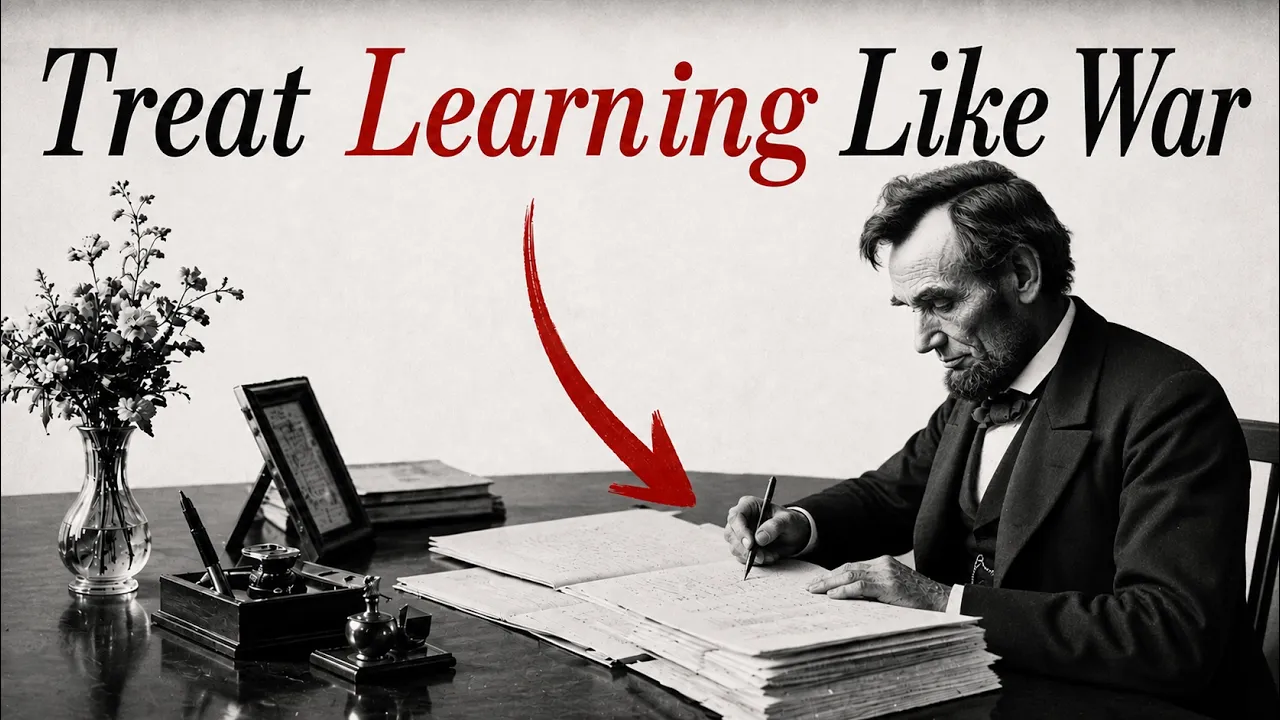
Abraham Lincoln didn't go to college. He didn't have any formal teachers. He grew up in a cabin with eight people. And yet, he was able to become a great autodidact, a speaker capable of uniting a nation and one of the leaders that would go down in history. But how exactly was he able to do this? I just finished reading this biography on Abraham Lincoln and I am just completely amazed at how great of a speaker and a leader that he was. But what I was most amazed of by Lincoln is that he is one of the best examples
103 words, the words spoken in the first 30 seconds at 206 words per minute.
Free, no signup. See how the first 30 seconds hold attention, with rewrites.
Sentence shape
| Measure | This transcript |
|---|---|
| Sentences | 310 |
| Average words per sentence | 16.2 |
| Longest sentence | 55 words |
| Questions asked | 2 |
| Sentences containing a number | 12 |
Most used terms
Filler phrases
53 in total: like 27 · actually 11 · I mean 6 · literally 5 · kind of 2 · sort of 2.
A literal whole-word count of the same phrase list the Prepublish browser extension uses, so a phrase inside another word is not counted and a phrase used in its ordinary sense still is. It is a count and not a judgement.
Free, no account. See where attention is likely to drop, with a rewrite for each weak line. The free check shows the scores and the one issue costing the most. Or run it on the words above first.
Free · No login · See a sample audit first if you prefer.
What this transcript is
Every word below is the caption track YouTube publishes for this video, pulled from the video itself and reproduced unchanged. It is not Prepublish's writing, not a summary, and not a re-transcription: it is the video's own published captions. English captions, generated automatically by YouTube, in the video’s original language. Source: the video on YouTube. A channel that would rather this page did not exist can ask for its removal through the contact page, and it is removed.
Abraham Lincoln didn't go to college. He didn't have any formal teachers. He grew up in a cabin with eight people. And yet, he was able to become a great autodidact, a speaker capable of uniting a nation and one of the leaders that would go down in history. But how exactly was he able to do this? I just finished reading this biography on Abraham Lincoln and I am just completely amazed at how great of a speaker and a leader that he was.
But what I was most amazed of by Lincoln is that he is one of the best examples for someone who is a true self-arner. He developed these principles that allowed him to recite Shakespeare from memory and to completely dismantle people in debates. So what I did after reading this book is I extracted seven of the principles and learning habits that made Abraham Lincoln into a self-taught genius. So let me take you through Abraham Lincoln's best learning habits starting with the first one.
So before you can understand how Lincoln really learned, you have to understand a little bit about the time that he grew up with. In the book, it says, "Lincoln was born in a national culture in which language was the most widely available key to individual growth and achievement. It dominated public discourse. No TVs, DVDs, computers, movie screens, radios, or electricity, and no sound bites. Language mattered because it was useful for practical communication and for learning because it could shape and direct people's feelings and thoughts in a culture in which spoken or written words had no rival." This is the main thing that you have to understand about the time that Lincoln grew up with that there was no smartphone.
There was no scrolling. There was no constant dopamine hits. And so the main form of entertainment was speaking and debating and learning and reading. Because Lincoln grew up in this culture, learning how to speak and how to write was extremely important. The book continues, "In Lincoln's case, it also mattered immensely because it was the tool by which he explored and defined himself. The tool, the toolmaker, and the tool user became inseparably one.
He became what his language made him. From an early age, he began his journey into self-willed illiteracy, then into skill, and eventually into genius as an artist with words. And I especially love this line said at the beginning, the tool, the tool maker, and the tool user became inseparably one. What you will find as this video progresses and as you see more of his habits is that at the very core, at the very fundamental of Lincoln's learning philosophy was his ability to write.
And writing was a sort of tool. And as the book says, the tool and the tool user became one. This transformation actually started for Lincoln as a child. And the book says, "A six-year-old Abraham Lincoln began to learn to read. His household text was the Bible. His parents were fundamentalist believers and regular worshippers, both literate and illiterate American Christians often memorized along stretches of the Bible.
And although Lincoln was never really religious, a lot of his audience was very religious. And so it was very helpful for him to memorize and to understand all these verses because it allowed him to speak to the heart of his audience. While none of the Jesus-entered theology of his childhood world remained central to his adult life, the power of poetic language, some of it secular, some religious, stayed with him. At this point in time, this was just extremely common in an American household.
But the beauty of Lincoln is that Lincoln was able to take these principles from the Bible and the style of the writing of the Bible and apply it to all these different areas of his life. The main thing I'm trying to get at here with all of these quotes, though, is to give you a little bit of an understanding of the time that Lincoln grew up with. a time where people were very religious, where it was incredibly important to know how to speak and to write and to be able to speak and to write fluently.
This is all going to help you when we get into the habits of Lincoln's learning, which is coming up in this next one. Most people know that the great geniuses of history were all incredibly relentless readers. They read a ton. But it's hard to know just what a ton means, like just how much they read, because it really was way more than the average person. Ever since Lincoln was a child, he read every single thing that he could get his hands on.
And in the book, it says, "The 11-year-old boy had an alert interest in the world, an attraction to verbal performance and jokes, an inquiring interest in the complexities of adult life. He asked questions, sometimes persistently. He read and reread as much as time and his few books aloud. Except for a sister, in an occasional playmate, he was very often alone." And so, in this quote, you see the pattern that you see with almost every other great genius in history. people like Einstein, people like Tesla, they read everything they can get their hands on.
They spend a lot of time alone just ruminating and thinking and they ask so many questions. And the craziest part is that all of this just came completely natural to them. Pouring over his first lessons, he could have had little awareness of why he was reading. Pleasure in language and pride in literacy probably compelled his engagement. But later, when he read for opportunity, he certainly had purpose. I mean, there were just accounts after accounts after accounts of people talking about Lincoln and talking about how obsessed he was with reading.
One of his halfsisters said he read whenever and wherever he could. Abe was not energetic except in one thing. He was active and persistent in learning. Read everything he could. He devoured all the books he could get or lay his hands on. He was a constant and voracious reader. How often do you see that in every genius biography? Albert Einstein, Thomas Edison, Elon Musk, all of them spent countless hours alone just reading.
And that knowledge added up exponentially throughout their life. And it it just goes back to that Warren Buffet quote. Read 500 pages like this every day. That's how knowledge works. It builds up like compound interest. All of you can do it, but I guarantee not many of you will do it. This is exactly what happened to Lincoln. And a lot of the stuff he read as a child actually shows up in his speeches as an adult. So, you can very clearly see the compounding effects.
It's actually even crazier when you put this into perspective of history because throughout most of history, books were extremely expensive and most people couldn't even afford them. Most people couldn't even go to the library to rent them out. But again, when you study the geniuses, they were all just obsessed, devoted to reading. Nicola Tesla's dad literally banned him from reading and took away his candles so he couldn't read at night.
And Tesla's response was to make his own candles. Ben Franklin once read through his brother's entire library and needed more materials to read. So he would literally steal books from the library and then return them in the morning before anyone caught him. Lincoln's might be even crazier. He grew up in a cabin with eight people and the book says with eight people crowded in the one room cabin, it had to be a challenge to find space and light as well as time for reading.
More difficult in the short winter days than in the summer. He would go out in the woods and gather hickory bark, bring it home and keep a light by it and read by it. When no lamp was to be had, grease lamp handle to it which stuck in the crack of the wall. Guys, it's the exact same story over and over again. Lincoln was addicted to reading. He had to read and he read everything that he could get his hands on. This habit is one that would stay with Lincoln for his entire life.
And the following description is actually one that I think you could apply to most of the great geniuses in history. An old leather office couch became Lincoln's favorite place to read. His feet extending far out, propped on chairs above a floor that seemed always dirty. Stretched down on the couch, he spent many work days reading newspapers and books, handling legal paper, walking to the courthouse or the legislature, scheming about politics.
Apparently neither happy nor unhappy. A difficult man to read, who loved jokes and stories, usually to make a point, but who otherwise was so self-contained that he seemed secretive. And even after he got home from work, he would continue to read. Stretched out in his office or at home in the evenings, he found that reading his favorite authors provided pleasure that little else did. It allowed for withdrawal and immersion.
Simultaneously, Shakespeare, Burns, and Byron continued to dominate his literary attention. Once again, I will repeat that he was addicted addicted to reading. At one point in his life, he was studying to become a surveyor and he learned the entire field simply by reading. The county surveyor, who had more work than he could handle, suggested that Lincoln studying surveying and become his assistant. With a borrowed textbook and a small field manual, he mastered the subject.
A gift for mathematics and a spatial imagination served him well. By the end of the year, he was tracking the countryside, mapping sites, creating serviceable plats, and making more money than he had ever made before. I cannot stress this enough. Reading continues to be one of the most important skills in this day and will only continue to get more important as technology progresses. It all goes back to that Warren Buffett quote.
Read 500 pages like this every day. That's how knowledge works. It builds up like compound interest. All of you can do it, but I guarantee not many of you will do it. And speaking of reading 500 pages a day, when you study the great geniuses of history, one thing that you'll find is that the best way to approach learning is to first learn a broad foundation of knowledge. This is why one thing that you commonly find in genius biographies is that a lot of them read dictionaries as children and why I'm so excited to talk about this book.
It's a book that goes over how to rebuild civilization from scratch. This book is literally 400 pages describing the most impressive inventions in history. It's exactly the type of foundational knowledge that makes The Great. And on top of this, this is one of the most unique books that I've ever read because it's really more than a book, but it's more like an art piece. The book includes 200 unique handdrawn illustrations and includes all of these Easter eggs relating to all of these different events throughout history that truly make it a journey rather than just a read.
I mean, just look at this section about forging. I mean, you guys know how much I love to talk about forging and hardship and how it builds character. And using that analogy, these are just my favorite types of products. The products at the intersection of art and science, as Steve Jobs or Edward Land would say. And when you open up this book, you can definitely tell the care and the attention that was put into it. So definitely check out this book using the link in the description.
And if you use the code word promo, you will get 10% off your first purchase. Now, on to the next principle. [music] Lincoln once said, "My mind is like a piece of steel, very hard to scratch anything on it and almost impossible after you get it there to rub it out." Lincoln had an incredible memory. And once again, this is something that started in his childhood. As young boys like Abraham became literate, they developed their ability to remember.
From an early age, Lincoln had a tenacious memory. By modern standards, few books were available to him. Those that were, he could recite almost by heart. This tenacious memory gets brought up like a million times during the book. And it's obviously something that made him very successful. One time he even memorized an entire Henry Clay speech. And the book says he also memorized some of Henry Clay's speeches. And often for amusement for his play fellows, neighbors and friends made quite good stump speeches where between the ages of 15 and 20, Henry Clay became Lincoln's hero.
And although you might think that he was just naturally gifted, which a lot of it is that like he was genetically and just naturally gifted to be able to recite things, he also worked at this a lot in his life. One thing that he would do is constant repetition. He would repeat certain things over and over and over again to himself until it was fully ingrained in his mind. The repetition that Lincoln believed facilitated comprehension also promoted memorization.
Abe could easily learn and long remember. And when he did learn anything, he learned it well and thoroughly. His stepmother recalled, "What he thus learned, he stowed away in his memory, repeated over and over again and again till it was fixed firmly and permanently. He developed an anthology of the mind independent of whether he had the actual book in hand. This is the exact same thing Winston Churchill would do when he was getting ready for a speech.
He would recite that speech over and over again until it was completely embedded in his mind. There's actually this great quote in the Lincoln biography that says, "So deeply absorbed was he as a reader of Shakespeare that quotations from the plays came as naturally to him as breathing." That is just the perfect way to describe what it means to truly learn something. You really should be repeating information to yourself as much as you can, until it's ingrained in you, until whatever you're repeating to yourself is almost like breathing.
If you're studying literature, be able to recite Shakespeare. If you're studying economics, be able to recite Adam Smith. If you're studying physics, be able to recite Maxwell's equations. Recite it over and over and over again until it is like breathing. The Fineman technique is something I'm always pushing because it is simply the best way to learn something. I mean, if you could only keep one principle in this video, it would have to be this one.
It's a four-step process that allows you to learn literally any subject in depth. And it goes like this. First, you learn, then you teach, then while you teach, you will find gaps in your knowledge, and then you go back and you fill the gaps. The idea is that you can't really teach something that you don't fully understand. And so, when you're teaching, you expose to yourself the gaps in your knowledge that were previously missing.
So, you go in and fill the gaps and understand the subject in depth. Lincoln was a master at the Fineman technique. And the book says, "Stimulated by his reading, he had begun to write brief essays on topics that interested him. With his changing moods, his tone was sometimes serious, sometimes comic. He wrote an essay on the evils of intemperance, a topic he was to take up later in his life. You see this habit a lot in history with Ben Franklin who would read an essay, put it aside for a couple days before trying to recreate that same essay from memory or Alexander Hamilton who would rewrite essays completely from memory or literally countless other people like Nicola Tesla, Winston Churchill, and Marcus Aurelius.
If you really look at history, it's actually kind of weird how many of the greats were actually content creators. Napoleon wrote the bulletins. Caesar wrote the GA campaigns. Hamilton wrote the hurricane paper. And I think this is because writing allows them to synthesize information. And when you synthesize information, it allows you to remember it better. Like many of these people, Lincoln also carried around a notebook in his pocket where he could immediately write down thoughts as soon as they came to him.
Like other autodidacts and young authors, he began to keep a notebook at first writing rude verses of his own in his copy books, also working out mathematical problems. And all of these habits of synthesizing information allowed him to truly understand the subjects that he was trying to learn. He was compressing information so that he could then recite it. The book says he could imitate various styles of speech from didactic sermons to overheated political oratory.
He had read great speeches from the classical world and the British Parliament. He had a good feel and natural propensity for the colloquial voice and the plainness of American diction. And most of all he admired clarity of presentation, the application of reason and logic to the challenge of persuasion. All the elements for a distinctive style were coming into place. And again, this is because all of the information that he was learning, he was synthesizing it for others.
He was making content out of it. The book continues to go on about how he was able to take all of these different writings and actually make connections to the real world, to what he was working on. Quotations from his favorite writers, especially the Bible, Asop, and Shakespeare were always at hand. Useful in the interplay between what he learned about human nature from his reading and what he learned from observation and direct experience.
This is what the Fineman technique will allow you to do. It will let you build connections to the real world and also let you find gaps in your line of thinking. At the end of the day, I think this is what really built Lincoln into the great speaker that he was. And here's the key takeaway. Always find a medium to teach what you learn on, whether it's a Substack or an X account or even just a journal. Teach what you learn, and it will help you so much with your memory. >> [music] >> So, this one kind of goes with the Fineman technique, but I really wanted to stress this point, and that's that Lincoln was always, always, always writing.
His literacy distinguished him noticeably. Being able to write was a skill of use when illiterate friends and neighbors needed letters written or documents copied. And it wasn't just that Lincoln liked to write, but it was an obsession, an addiction with writing, just like the addiction with reading. I mean, the amount of studying that he did on the art of writing was just insane. He studied composition, continuing his analysis of model essays and speeches from the ancients to the moderns that his first anthologies had provided.
Washington's sensible succinctness and Jefferson's eloquent simplicity were recent additions to the canon. And because of this studying and analyzing, Lincoln was actually able to develop his own unique distinctive style that would sway the masses. The most effective writing and speech, Lincoln concluded, issued preaching for calm persuasion, a demonstration not of superior or rhetorical powers, but of succinct expression in the service of truth.
It had an element in it of talk, of one person speaking to one another with no distinction of class, and he could admire and learn from the best models whether or not he was friendly to their ideology or their careers. A lot of his writings felt like you were just talking to him. And this is a very important lesson, especially in the age of AI. I don't know how many of you have noticed, but it is genuinely hard to sound like a human anymore, to sound authentic.
And so, if you can really master just writing like a human, which I know sounds weird, but if you can just master sounding like a human, you will already be able to stand out. Writing is a habit that Lincoln kept through his entire life. And the book continues to say, "If under the pressure of intense campaigning between 1856 and 1858, Lincoln had little time for the creation of much more than variations of his foundation speech and depended heavily on what he had already written.
He still engaged occasionally with pen and paper in an attempt to work out his ideas and find even better ways to express them. Away from home, he wrote and read at odd hours, often late at night in ins frequented by his legal and political colleagues. This is another really good lesson. But once again, when it comes to the greats, it's not that they had more money. It's not that they had more time or more resources.
They got busy just like everyone else. But it's simply that when they hit a roadblock, they would smash through it. Lincoln didn't have to write during this time. He could have taken a break in the same way that Edison could have taken a break from the lab or Kobe could have taken a break from practice. But they just didn't do that. Lincoln continued to write even at odd times, even if he missed some hours of sleep. The simple fact is that he kept this habit alive for his entire life.
[music] If you watch this channel then you will know that the greats of history study the greats of history and Lincoln was no different. He was the exact same and the biography actually talks extensively about Lincoln's love for biographies. Now in the early 1820s reading biography for the first time he became fascinated by Benjamin Franklin's autobiography and Mason Lim's life of Washington. Narrative biography was the dominant source of American history on the frontier and the 12-year-old boy occasionally read Life of Washington to the family, having borrowed it from his schoolmate's father.
And it continues, "Franklin and Washington became his heroes. Both helped mold him into the advocate of upward mobility he was in the process of becoming. Franklin's Horatio Alger story gave value to his own ambition. The printer, inventor, writer, and diplomat was the most capable and articulate representative of an America that embraced commerce and social improvement. Like Franklin, he too could rise in the world.
Ambition and hard work would win out. Now, I know that you might be thinking that this really has nothing to do with learning. But it was this love for biographies that inspired his love of learning. He wanted to learn more because he wanted to be great. You see this pattern in history. Reading the lives of famous men, he decided that he wanted to make his mark in some grand way, including the path of service. He said that he would be the president of the United States.
Said it jokingly, yet with a smack of deep earnestness in his eye and tone, Elizabeth Crawford recalled, "He evidently had an idea, a feeling in 1828 that he was bound to be a great man. No doubt that in his boyish days, he dreamed it would be so. Abe was ambitious, sought to outstrip and override others. This is the exact same moment that John D. Rockefeller had as a child when he said he would be the richest man in the world or Andrew Carnegie talking about how the firm Carnegie Brothers Co. would be a great one.
One of Lincoln's friends, Joshua Speeds, in his younger years even recalls Lincoln being depressed because he hadn't done anything great yet. Speed recalled that Lincoln expressed despair because he had done nothing to make any human being remembered that he had lived. perhaps a displaced expression of unhappiness about his failure to live up to his high standards of character and if more than that a measure of how huge was his political ambition since he had by most standards already achieved considerable success given his age.
I mean how much does this remind you of Caesar or Napoleon looking at Alexander and weeping because they had not accomplished as much as him yet. It's the exact same story. Isaac Newton said, "I stand on the shoulders of giants." And he is talking about the greats. And Lincoln has a very similar quote. Lincoln said, "Every man is said to have his peculiar ambition. Whether it be true or not, I can say for one that I have no other so great as that of being fully truly esteemed of my fellow men by rendering myself worthy of their esteem.
How far shall I succeed in gratifying this ambition is yet to be developed. I am young and unknown to many of you. I was born and have ever remained in the most humble walks of life. I have no wealthy or popular relations to recommend me. And so this is very important. If you want to be a genius that is remembered in history, you have to seek out some sort of greatness on some level. Edison was motivated by beating his fellows rather than inventing something new.
Einstein spent his entire life trying to figure out a unified field theory even after he had already changed physics forever. The Wright brothers were looking to be the first humans ever to fly. On some level, there was always a want, a desire to be great. I love those words, to be great. Lincoln had this desire. I cannot stress this enough. He grew up reading Emerson. And Emerson said, "There are men who by their sympathetic attractions carried nations with them and lead the activity of the human race.
And if there be such a tie that wherever the mind of man goes, nature will accompany him, perhaps there are men whose magnetisms are of that force to draw material and elemental powers, and where they appear, immense instrumentalities organized around them. Immense instrumentalities organize around that. Lincoln had that embedded in his heart. And because of that, he was able to become one of the greatest geniuses and speakers and leaders who has ever lived. >> [music] >> And this is the final step to Lincoln's learning process.
It's the story. Lincoln is a master at controlling the narrative and telling a story. And although you might not think this is a learning principle, it is. And it's actually the most important learning principle because humans don't learn through logic or information, but they learn through story. What you'll notice a lot of the times is that when you read a history book, it's very hard to remember because a history book tends to be events and dates and a lot of information.
But when you read a biography, it's much easier to remember because it's in the form of a story. And Lincoln knew this. What he also knew is that the person telling the story has full control over the narrative. And that was his aim for speeches. Lincoln had learned from his literary masters that language was the instrumental weapon in the struggle. The victory, even if temporary, went to the best creator and teller of tales.
This was his approach to a lot of his speeches during the Civil War as well. The book says early on he recognized that the persuasiveness of claims about natural law and universal truth resided in the ability of words and narrative to generate widespread coherence. If there was indeed a predisposition to believe what he believed, he needed to find the language that expressed what the majority preferred as operative feelings and beliefs.
He could not create that majority, but he could find it. He could search it out. He and his contemporaries could find coherence in the widely shared conviction that Americans prefer justice to injustice. That they are generous in their extension of benefici can be discovered in the assertion that all men are created equal. And that greed, folly, aggression, and lust for domination can be subordinated to better impulses and more constructive narratives.
This was all orchestrated. It was orchestrated by Lincoln and it was used to craft an idea in the minds of the masses. You could even say that Lincoln's biggest accomplishment is keeping the United States together after the Civil War. And this was because he controlled the narrative. During the war, he always told the line, "A house divided cannot stand." And because he repeated this over and over and over again, it became ingrained in the minds of everyone.
And this all culminated in his house divided speech, which will go down in history as one of the greatest speeches ever made. In this House divided speech, you can see all of Lincoln's learning principles played out. The repetition of the idea over and over and over again, the eloquence and strategy he used while addressing the nation, and his constant polling from different sources of historical text. In the end, this is what made Lincoln.
Thank you so much for watching. I just started writing a newsletter where I give my notes over the great geniuses, the great conquerors of history. It's the Substack link below. So, definitely check it out. And if you like this video, you might like this video on Nicola Tesla where I go over the genius principles that made him a genius. That's it.
The words are the caption track's own and nothing is reworded or re-transcribed. Paragraph breaks are placed between sentences so the text reads as prose.
Free tools for your own script: paste a draft and see where it stands before you record it.
Paste your draft and see where viewers are likely to drop off, with a rewrite for each weak line.
Paste the first 30 seconds of your own draft for a hook score and rewrites.
Check your draft against YouTube's advertiser-friendly guidelines before you record it.
Read this channel's public videos and transcripts, and download a writing brief for it.